
SLIDE 1
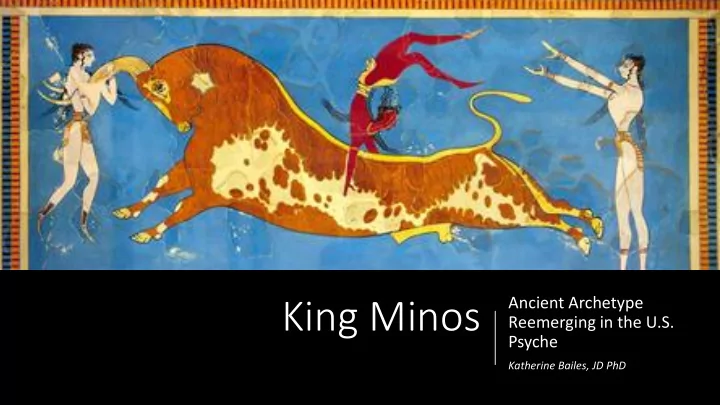
King Minos
Ancient Archetype Reemerging in the U.S. Psyche
Katherine Bailes, JD PhD
King Minos Reemerging in the U.S. Psyche Katherine Bailes, JD PhD - - PowerPoint PPT Presentation
Ancient Archetype King Minos Reemerging in the U.S. Psyche Katherine Bailes, JD PhD Review the mythic character of King Minos Identify the results of his refusal of the call to adventure in Campbells monomyth, including
Ancient Archetype Reemerging in the U.S. Psyche
Katherine Bailes, JD PhD
monomyth, including substitution in the rituals of sacrifice and regicide
the Island of Crete, was one of art and beauty.
palace-centered communities.
religion valuing such characteristics as floral decoration, music, dance and cyclic rituals.
culture, in later stories from the Greeks that lent a more masculine element, including battles, heroes, monster- slaying and vast merchant navies.
referred to Minos as a King of Crete and he was later portrayed as such in classical art, theater and poetry.
Agenor.
and brought across the sea to the island of Crete. Ovid’s
Metamorphoses Book 2, 846-875.
white bull, beautiful enough to seduce a young woman, and the fragile beauty of the princess succumbing.
including Minos, who were raised by their step-father, Asterion (the name later given to the minotaur).
was fated to be king in the myths.
(Odyssey 19, 178-179) and Hesiod called him the most kingly
held his scepter from Zeus.
in a proud and cruel manner (Plutarch’s Lives, Theseus) whereas
was a difficult journey because he imagined a sibling rivalry.
to rule, and boasted that he could prove it by praying for whatever he wanted and the gods would make it so.
he prayed that a bull would appear from the depths of the sea. Minos vowed that he would sacrifice the bull to Poseidon
snow white bull from the sea. Minos' claim for power was validated for no
let alone the mighty Poseidon who ruled
banished his brothers from Crete.
promised, Minos substituted the best of the fine bulls from his own herd and kept the bull from the sea.
merchants across the seas, the majestic bull became his downfall.
the substituted sacrifice) into personal gain.
Minos’ elevation from being a mere private person and his selfless submission to the functions of the role of king.
character and clothed him in the mantle of his vocation.
egocentric aggrandizement, directing him instead to the role of the tyrant.
converting the grand adventure of kingship to a negative, a wasteland, a battle against one’s self. (Joseph Campbell, The
Hero with a Thousand Faces)
plotted to punish him for his arrogance and hubris.
punishes Minos by instilling a passion within the king's wife, Pasiphae, for the bull that came from the sea (much like Europa’s passion).
it is Venus (Aphrodite) who curses Pasiphae, because the Queen had not shown proper piety to the goddess for some time. The goddess punished her by sending a salacious passion for the majestic bull from the sea (an attempt to redirect the blame to the succumbing queen).
Minos, went to Aphrodite for her help in the matter and she cursed Pasiphae as a favor to Poseidon (merging archetypal divinities).
aided by science (with no regard for moral outcomes)
desires, sought the help of the engineer, Daedalus and his son, Icarus.
a real cow hide and placed it upon wheels. He put the Queen inside the structure and wheeled her into the meadow where her beloved bull was grazing.
union the Minotaur (half bull, half human) was
King Minos' stepfather), which the Cretan people knew to be the Minotaur's true name.
discovered his wife's bestial affair and as punishment, Minos enslaved Daedalus and Icarus for their parts in the affair, leaving Pasiphae untouched. (was Minos hashing
nourish him while he was a bull calf. After the monster started eating people, King Minos commanded Daedalus and Icarus to build a grand Labyrinth to imprison and hide away the monster.
member of a royal house from Athens. There his nephew, Perdix, assisted him in his workshop.
to invent the saw and later invented the compass.
but Perdix was saved by Athena and turned into a
to his craft at all moral costs.
discovered that his only human son (with Pasiphae), Androgeos, had been killed.
his skill in the Panathenic Games.
and for the destruction of his family line. He sailed against the Athenians and harassed them until they agreed to pay the price for his son's death.
and seven youths from the best families every nine years or suffer a long and devastating war. King Aegeus of Athens agreed to the tribute.
with his own life) would insure a hieratic state wherein every person enacts his role.
Athen’s sacrifice of their own children, creating instead a merchant state where everyone is out for himself.
prison of the labyrinth to subdue the monster within.
interests in favor of the role, resulted in Minos preferring what he thought to be his own economic advantage to that of submission (death of the old).
and sources of support.
for the greedy rights of “my and mine.”
blight to the lives of those he touches even in friendship and assistance. [Even Daedalus sought to escape with his son, Icarus but Icarus fell to his death and the partridge (Perdix) hovered over Daedalus as a reminder of his crime. Daedalus made it to Sicily.]
every hand to meet and battle back the anticipated aggressions of his environment, which are primarily the reflections of his own uncontrollable impulses to acquire.
disoriented psyche while the Minotaur suffers a similar fate.
the third tribute of youths from Athens to be sacrificed.
and Phaedra, fell in love with Theseus. Ariadne went to Daedalus to learn how one could escape from his Labyrinth. She then raced to tell Theseus before he entered the Labyrinth.
self-achieved independence [compared to the hero’s voluntary submission] became the world’s messenger of
boiled alive by the daughters of King Cocalus of Sicily with the help of their harbored exile, Daedalus.
immigrants (self-hatred)
to the servant role (insecure, selfish)
sacrifice (boastful, misplaced values)
administration’s culture of service
the labyrinth (pentagon)
human imagination?
Campbell: The Hero with a Thousand Faces
“We have not even to risk the adventure alone; for the heroes
the labyrinth is thoroughly known; we have only to follow the thread of the hero-path. And where we had thought to find an abomination, we shall find a god; where we had thought to slay another, we shall slay ourselves; where we had thought to travel outward, we shall come to the center of
had thought to be alone, we shall be with all the world.”