MINOS Neutrino Oscillation Results and the new NO A experiment Alec - - PowerPoint PPT Presentation

minos neutrino oscillation results and the new no a
SMART_READER_LITE
LIVE PREVIEW

MINOS Neutrino Oscillation Results and the new NO A experiment Alec - - PowerPoint PPT Presentation

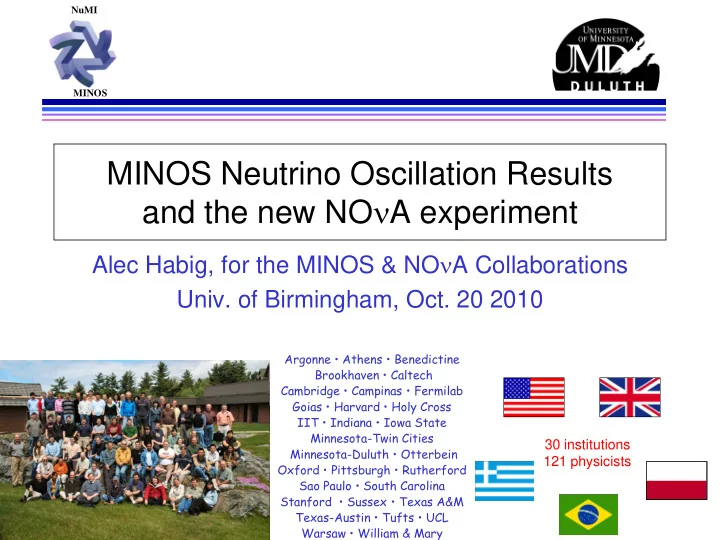
NuMI MINOS MINOS Neutrino Oscillation Results and the new NO A experiment Alec Habig, for the MINOS & NO A Collaborations Univ. of Birmingham, Oct. 20 2010 Argonne Athens Benedictine Brookhaven Caltech Cambridge


slide-1
SLIDE 1

NuMI MINOS

MINOS Neutrino Oscillation Results and the new NOνA experiment

Alec Habig, for the MINOS & NOνA Collaborations

  • Univ. of Birmingham, Oct. 20 2010

30 institutions 121 physicists

Argonne • Athens • Benedictine Brookhaven • Caltech Cambridge • Campinas • Fermilab Goias • Harvard • Holy Cross IIT • Indiana • Iowa State Minnesota-Twin Cities Minnesota-Duluth • Otterbein Oxford • Pittsburgh • Rutherford Sao Paulo • South Carolina Stanford • Sussex • Texas A&M Texas-Austin • Tufts • UCL Warsaw • William & Mary

slide-2
SLIDE 2

NuMI MINOS

Useful Approximations:

νµ Disappearance (2 flavors): P(νµ→ νx) = sin22θ23 sin2(1.27∆m2

32L/E)

νe Appearance: P(νµ→ νe) ≈ sin2θ23 sin22θ13 sin2(1.27∆m2

31L/E)

Where L, E are experimentally optimized and θ23, θ13, ∆m2

32 are to be determined

ν flavor mixing

  • ν are leptons, interact only weakly

– interact as flavor eigenstates {νe, νµ, ντ} – but propagate as mass eigenstates {ν1,ν2,ν3}

  • Different m’s make mass states

slide in and out of phase as they travel

– So a ν created as one flavor might be detected as another later

(m1)2 (m2)2 (m3)2 νe νµ ντ ∆m2

atm

∆m2

solar

(“normal” hierarchy)

1 2 3 1 1 2 3 2 1 2 3 3 e e e e

U U U U U U U U U

µ µ µ µ τ τ τ τ

ν ν ν ν ν ν           =               

3 13

sin

i e

U e

δ

θ

( )

( )

2 2 2 23 3 3

sin 2 4 1 U U

µ µ

θ ≡ −

slide-3
SLIDE 3

NuMI MINOS

MINOS

Main Injector Neutrino Oscillation Search

  • Investigate atmospheric sector

νµ oscillations using intense, well-understood NuMI beam

  • Two similar magnetized iron-

scintillator calorimeters

– Near Detector

  • 980 tons, 1 km from target, 100 m deep

– Far Detector

  • 5400 tons, 735 km away, 700 m deep

735 km

slide-4
SLIDE 4

NuMI MINOS

This Talk

MINOS Physics Goals

  • Precise (~10%) measurement of ∆m2

23

– The “Charged Current” (CC) analysis – Precisely measure νµ↔ντ flavor oscillation parameters, provide high statistics discrimination against alternatives such as decoherence, ν decay, etc

  • Directly compare ν vs ν oscillations (a test of CPT and odd stuff)

– MINOS is first large underground detector with a magnetic field for µ+/µ- tagging

  • Investigate the flavor-independent ν flux

– The “Neutral Current” (NC) analysis, checking for sterile ν

  • Search for subdominant νµ↔νe oscillations

– The “νe” analysis, a shot at measuring θ13

  • Study ν interactions and cross sections using the very high

statistics Near Detector data set

  • Cosmic Ray Physics with both detectors
slide-5
SLIDE 5

NuMI MINOS

νµ Disappearance Methodology

  • Measure νµ flux at Near Det, see what’s left at Far Det
  • Simulated results plotted as F/N ratio

– Position of dip gives ∆m2 – Depth of dip gives sin22θ

  • Spectral ratio shapes would differ in alternative models

Unoscillated Oscillated

νµ spectrum

Monte Carlo Monte Carlo

( )

ν ν   → = −     2

2 2 2

1 s n i si n L P E m

θ Δ

μ μ

Spectrum ratio

slide-6
SLIDE 6

NuMI MINOS

Far Detector

M16 PMT 16 mm

A module of 20 strips …on a plane 8 fibers on a pixel

  • 486 planes, 5400 tons total

– Each is (1” steel + 1 cm plastic scintillator) thick – 8 m diameter with torodial ~1.5 T B-field – 31 m long total, in two 15 m sections – 192 scintillator strips across

  • Alternating planes orthogonal for

stereo readout

– Scint. CR veto shield on top/sides

  • Light extracted from scint.

strips by wavelength shifting

  • ptical fiber

– Both strip ends read out with Hamamatsu M16 PMTs – 8x multiplexed

slide-7
SLIDE 7

NuMI MINOS

3D Reconstruction

  • Take all the “U” view

lit-up strips

– Cross with all the “V” view lit-up strips – X marks the spot(s)

See live events at http://www.soudan.umn.edu

slide-8
SLIDE 8

NuMI MINOS

3D Reconstruction

  • This is a real νµ

interaction from the beam

– µ− appears inside detector, – cruises along through many planes, – curving in the magnetic field,

  • Curvature tells us

momentum…

– stops.

  • …so does range

See live events at http://www.soudan.umn.edu

slide-9
SLIDE 9

NuMI MINOS

Near Detector

  • 282 planes, 980 tons total

– Same 1” steel,1 cm plastic scintillator planar construction, B-field – 3.8x4.5 m, some planes partially instrumented, some fully, some steel only – 16.6 m long total

  • Light extracted from scint. strips by wavelength shifting optical fiber

– One strip ended read out with Hamamatsu M64 PMTs, fast QIE electronics – No multiplexing upstream, 4x multiplexed in spectrometer region 3.8 m 4.8 m

ν

slide-10
SLIDE 10

NuMI MINOS

NuMI Beam

  • H2O cooled graphite target

– 2 interaction lengths absorb ~ 90% of primary protons

  • Flexible configuration of 2 parabolic horns

– H2O cooled, pulsed with a 2.6 ms half-sine wave pulse of 200 kA

  • Target, horns movable in beam direction

– Allows tuning of focused pion energy

  • 675 m long decay pipe

– radius of 1 m, evacuated to 1 Torr (filled with He for Run III)

  • 1 hadron monitor and 3 muon monitor stations
slide-11
SLIDE 11

NuMI MINOS

Beam Data Analyzed

HE beam: 0.15x10²⁰ POT Far Det >98% live! Exposures Analyzed (protons on target):

  • This talk (7.2x10²⁰ ν + 1.75x10²⁰ ν)
  • Previous analyses (>3x10²⁰)

1.07x10²¹ POT total through summer 2010 Anti-nu beam: 1.75x10²⁰ POT

slide-12
SLIDE 12

NuMI MINOS

Near Detector Data

  • How do data look in the Near Detector, where we

have ~unlimited statistics? (107 ν per 1020 pot)

  • If we understand things there, we can then look at the

Far Detector data where the oscillation physics is happening, so:

– Examine ND closely – Compare ND data/MC – “Blind” analysis done

?

?

?

slide-13
SLIDE 13

NuMI MINOS

Lots of ν in the Near Detector

  • A mean of 3 ν interactions per spill (in 8 or 10

µs), up to 10

  • Typical 250kW beam makes 104 ν/day in ND
  • Near Detector Electronics gates for 19 µs

during the entire spill

– Digitizes continuously every 19 ns, no dead time

  • Separate events using timing and topology
  • Below: ~35 x 106 events for 1.27 x 10²⁰ POT

image the ND’s internal structure with ν! A typical 6-event spill, colored by time

slide-14
SLIDE 14

NuMI MINOS

ν ν γ γ Z π0 N (+X) νµ µ W N X νe e W N X

What sort of ν Interaction?

νµ CC Event

NC Event

νe CC Event

Long µ track + hadronic activity at vertex

3.5m

Short event, often diffuse

1.8m

Monte Carlo

Eν = Eshower+ Eµ

40.4%/√E + 8.6% + 257MeV/E 5.1%/√E + 6.9% range (hadronic) 22%/√E (leptonic)

Eν = Eshower

2.3m

Short, with typical EM shower profile

slide-15
SLIDE 15

NuMI MINOS

Reconstructed Beam Spectrum

LE-10 pME pHE Weights applied as a function of hadronic xF and pT. MIPP data on MINOS target will be used to refine this in the future, NA49 and Harp results also used Discrepancies between data and Fluka08 Beam MC vary with beam setting: so source is due to beam modeling uncertainties rather than cross-section uncertainties MC tuned by fitting to hadronic xF and pT over 9 beam configurations (3 shown here, from older Fluka05-based work)

slide-16
SLIDE 16

NuMI MINOS

Do we understand things?

  • Data/MC agreement between low-level quantities

tells us the modeling and reconstruction are OK

  • Data/MC agreement between high-level quantities

(Energy, kinematics, PID) is:

– within the expected systematic uncertainties from:

  • cross-section modeling
  • beam modeling
  • calibration uncertainties

– improved after applying beam reweighting on the xF and pT

  • f parent hadrons in the Monte Carlo
slide-17
SLIDE 17

NuMI MINOS

What is Expected in Soudan?

  • Measure Near Detector Eν spectrum
  • To first order the beam spectra at Soudan is the

same as at Fermilab, but:

– Small but systematic differences between Near and Far – Use Monte Carlo to correct for energy smearing and acceptance – Use our knowledge of pion decay kinematics and the geometry of our beamline to predict the FD energy spectrum from the measured ND spectrum θf

to far Detector

Decay Pipe

π+ π+

(soft) (stiff)

θn

target ND

2 2 2 2 1

1 1         + ∝ θ γ L Flux

2 2

1 43 . θ γ

π ν

+ = E E

slide-18
SLIDE 18

NuMI MINOS

On to the Far Detector…

  • “Blind” analysis

– Only after understanding the Near Detector, reconstruction, selected non-

  • scillation Far Detector parameters, and

early pHE (ie, non-oscillating) beam data did we “open the box” – Data “re-blinded” when developing new analyses, analysis improvements, and adding new data

Two of zillions of such plots…

slide-19
SLIDE 19

NuMI MINOS

Spectrum

Expect 2451 without oscillations

includes ~1 CR µ, 8.1 rock µ, 41 NC, ~3 ντ BG

See only 1986 in the FD.

slide-20
SLIDE 20

NuMI MINOS

Spectrum

Expect 2451 without oscillations

includes ~1 CR µ, 8.1 rock µ, 41 NC, ~3 ντ BG

See only 1986 in the FD. Split up sample into five bins by energy resolution, to let the best resolved events carry more weight (plus a sixth bin of wrong-sign events) Fit everything simultaneously…

slide-21
SLIDE 21

NuMI MINOS

Spectrum

expected

  • bserved

= =

i i

e

  • Measurement errors are 1σ, 1 DOF

2 2 2 2 1 1

( ,sin 2 , ,...) 2( ) 2 ln( / ) /

j

nsyst nbins j i i i i i j i j

m e

  • e

α

χ θ α α σ 2

= =

∆ = − + + ∆

∑ ∑

Fit for oscillation parameters: χ2/ndf = 2119.51/2298

(100 bins x 4 spectra x 5 resolutions,

+ 100 bins x 3 spectra for PQ, – 2)

Expect 2451 without oscillations

includes ~1 CR µ, 8.1 rock µ, 41 NC, ~3 ντ BG

See only 1986 in the FD.

2 0.11 3 2 32 0.08 2 23 0.05

2.35 10 eV sin 2 1.00 m

+ − − −

∆ = × Θ =

slide-22
SLIDE 22

NuMI MINOS

Allowed Region

  • Fit includes

systematic penalty terms

  • Fit is constrained to

physical region: sin2(2θ23)≤1

– Best physical fit: |∆m|2 = 2.35 x 10⁻³ eV2 sin2(2θ)=1.00 – Unconstrained: |∆m|2 = 2.34 x 10⁻³ eV2 sin2(2θ)=1.007

Earlier results are in: Phys.Rev. Lett. 101:131802, 2010

slide-23
SLIDE 23

NuMI MINOS

Alternative νµ Disappearance Models

νµ↔ντ Oscillations:

2 0.11 3 2 32 0.08 2 23 0.05

2.35 10 eV sin 2 1.00 m

+ − − −

∆ = × Θ =

2 2 2 23 32

sin 2 sin (1.27 / ) P m L E

µ

θ

τ =

slide-24
SLIDE 24

NuMI MINOS

Alternative νµ Disappearance Models

Decay:

  • V. Barger et al., PRL82:2640(1999)

χ2/ndof = 2165.81/2298 ∆χ2 = 46.3 disfavored at 6.8σ c

Decoherence:

G.L. Fogli et al., PRD67:093006 (2003)

χ2/ndof = 2197.59/2298 ∆χ2 = 78.1 disfavored at 8.8σ

( )

2 2 2

sin cos exp( / ) P L E

µµ

θ θ α = + − P

µµ =1− sin2 2θ

2 1− exp −µ2L 2Eν            

slide-25
SLIDE 25

NuMI MINOS

νµ

  • MINOS is the first oscillation experiment able to tell νµ

from νµ on an event by event basis

– Due to µ charge-sign separation from the detectors’ magnetic fields

  • Do νµ oscillate the same way as νµ?

P ν

µ →ν µ

( )=1− sin2 2θ

23

( )sin2 1.27∆m

23 2 L

E      

A typical (ie, the most recent one when I made this slide) higher energy νµ CC interaction. Curvature is obvious, even with this fairly stiff muon – lower energy events in the oscillation region are even easier.

slide-26
SLIDE 26

NuMI MINOS

Neutrino Mode

120 GeV protons 2 m 675 m 15 m 30 m

νµ = 91.7% ν

µ = 7.0%

νe +ν

e =1.3%

Target Neutrino mode Horns focus π+, K+ Decay Pipe

π- π+ νμ νμ

Monte Carlo

Focusing Horns

slide-27
SLIDE 27

NuMI MINOS

Anti-neutrino Mode

120 GeV protons Focusing Horns 2 m 675 m 15 m 30 m

νµ = 91.7% ν

µ = 7.0%

νe +ν

e =1.3%

Target Neutrino mode Horns focus π+, K+ Decay Pipe

π+ π- νμ νμ

Monte Carlo

Antineutrino mode Horns focus π-, K-

Monte Carlo

ν

µ = 39.9%

νµ = 58.1% νe +ν

e = 2.0%

slide-28
SLIDE 28

NuMI MINOS

νµ Analysis

  • Same analysis done as νµ disappearance

– At low energies where oscillations occur (<6 GeV), curvature is obvious: antinu sample is 93.5% efficient and 98% pure (BG is 51% NC, 49% νµ) – Lower anti-hadron production and anti-nu interaction cross sections make for much lower statistics, about 2.5x less events per-pot

  • Same great MC, data

agreement (albeit with lower statistics)

slide-29
SLIDE 29

NuMI MINOS

νµ Results

  • 97 events seen, 155 expected (no osc)
  • No- oscillations scenario disfavored at 6.3σ
  • Same sort of
  • scillation fit yields:
  • Completely dominated

by low statistics

– Includes additional 30% uncertainty on the νµ background

  • Plan to double anti-nu

statistics after initial Minerva run

2 0.45 3 2 0.40 2

3.36 ( ) 0.06( ) 10 eV sin (2 ) 0.86 0.11( ) 0.01( ) m stat syst stat syst θ

+ − −

∆ = ± × = ± ±

slide-30
SLIDE 30

NuMI MINOS

νµ Results

  • Interestingly, oscillation parameters differ from the νµ

results at a not terribly significant level, ~2σ

Global fit from Gonzalez-Garcia & Maltoni,

  • Phys. Rept. 460 (2008), SK data dominates

MC Sensitivity studies show doubling the data should better resolve any differences:

slide-31
SLIDE 31

NuMI MINOS

So what are the νµ disappearing to?

  • For ν oscillations in this “atmospheric” sector,

we like to blame νµ oscillating to ντ,

– Most ν below τ production threshold – Few τ that aren’t produce very messy decays which get rejected by our analysis

  • Some very well might be going to νe as well,

depending on the currently unknown θ13 (known to be less than 0.21 from Chooz)

  • A fourth, sterile neutrino could also be the

culprit

– By definition, νs interact with nothing save gravity

slide-32
SLIDE 32

NuMI MINOS

NC Spectrum

  • NC events can be used to search for sterile neutrino

component in FD

– via disappearance of NC events at FD – If oscillation is confined to active neutrinos instead, NC spectrum will be unchanged ND NC Data 89% Efficient, 61% Pure

Peak of CC background

slide-33
SLIDE 33

NuMI MINOS

NC Analysis Results – 3-flavor Rate

  • FD NC energy spectrum for

Data and oscillated MC predictions

  • Form ratio R, data are

consistent with no νµ disappearing to νs

  • Simultaneous fit to CC

and NC energy spectra yields the fraction of νµ that could be oscillating to νs:

Earlier results are in: Phys.Rev.D81:052004, 2010

Data CC NC

N B R S − ≡

R ± stat ± syst θ13=0 1.09 ± 0.055 ± 0.053 θ13=11.5° 1.01 ± 0.055 ± 0.058

µ µ µ

ν ν ν ν → = − → ( ) 1 ( )

s s

P f P

< ν 0.22 (0.40 )@(90% C.L.)

s e

f

slide-34
SLIDE 34

NuMI MINOS

νe Appearance

  • Are some of the disappearing νµ re-appearing as νe?

– P(νµ→ νe) ≈ sin2θ23 sin22θ13 sin2(1.27∆m2

31L/E)

  • Plus CP-violating δ and matter effects, included in fits
  • Need to select events with compact shower

– MINOS optimized for muon tracking, limited EM shower resolution

  • Steel thickness 2.5 cm = 1.4 X0
  • Strip width 4.1cm ~ Molière radius (3.7cm)

– At CHOOZ limit, expect a ~2% effect

  • Do blind analysis – establish all cuts, backgrounds, errors first
  • Crosscheck in three sidebands
  • Only then look at the data to see what pops out
slide-35
SLIDE 35

NuMI MINOS νe Appearance Results

  • FD background prediction:

– 49.1±7(stat)±2.7(sys)

slide-36
SLIDE 36

NuMI MINOS νe Appearance Results

  • FD background prediction:

– 49.1±7(stat)±2.7(sys)

  • Observed:

– 54

slide-37
SLIDE 37

NuMI MINOS νe Appearance Results

  • FD background prediction:

– 49.1±7(stat)±2.7(sys)

  • Observed:

– 54 (0.7σ excess)

slide-38
SLIDE 38

NuMI MINOS νe Appearance Results

  • No significant excess

seen, find allowed upper limits using F-C approach

– For both Normal and Inverted mass hierarchies – Normal hierarchy (δCP=0):

  • sin2(2θ13) < 0.12 (90% C.L.)

– Inverted hierarchy (δCP=0):

  • sin2(2θ13) < 0.29 (90% C.L.)

A paper about this: arXiv:1006.0996 [hep-ex]

slide-39
SLIDE 39

NuMI MINOS

νe disappearance

  • The next frontier for neutrino experiments:

– Try to find θ13, since we know the other two θ

  • Reactor experiments tackle this problem by

getting a “beam” of anti-νe and seeing if any go missing

– Detect the positron from the same reaction as Reines and Cowan used to discover the ν – Slightly dependent on atmospheric parameters over the current narrow MINOS bounds

  • The Chooz experiment saw

nothing, has the current best limit of sin22θ13 < 0.17

slide-40
SLIDE 40

NuMI MINOS

νe disappearance

  • Three experiments are racing to improve on

this in the next few years:

– Double Chooz, Daya Bay, RENO – Will be up to an order of magnitude more sensitive with enough time

  • But this disappearance is

insensitive to CP-violating δ and the neutrino mass hierarchy

slide-41
SLIDE 41

NuMI MINOS

νe appearance

  • How about starting off with no νe and seeing if any

pop up after some L/E?

– This isn’t simply the converse of the reactor case

  • Back to the oscillation

approximations we use for νµ disappearance:

– Note that while experimentally θ23 is close to π/4, if it’s not exactly π/4 we can’t tell if it’s > or < – And that “≈” wipes away a lot more terms which result from multiplying out the mixing matrix properly

Useful Approximations:

νµ Disappearance (2 flavors): P(νµ→ νx) = sin22θ23 sin2(1.27∆m2

32L/E)

νe Appearance: P(νµ→ νe) ≈ sin2θ23 sin22θ13 sin2(1.27∆m2

31L/E)

Where L, E are experimentally optimized and θ23, θ13, ∆m2

32 are to be determined

slide-42
SLIDE 42

NuMI MINOS

νe appearance

  • Note there are θ23 terms that are not squared,

introducing sensitivity to θ23 >π/4 or <π/4

  • CP-violating δ is present
  • Matter effects are in there (30% for NOνA!), differ in

sign for ν and anti-ν, so a comparison could allow sorting out the mass hierarchy

  • But if θ13 is near zero, we learn nothing (all terms→0)

Thanks to Greg Pawloski for typesetting this beast!

slide-43
SLIDE 43

NuMI MINOS

So What Might We Learn?

  • Does the ν3 mass state have a νe component?

– Is θ13≠0? (without which nothing else works)

  • Is there CP violation in the lepton sector?

– Is δCP ≠0?

  • Is the ν3 mass state more massive than ν1 and ν2

(normal hierarchy) or less massive (inverted hierarchy)?

– Absolute mass values need β and ββ decay experiments to nail down

  • Does the ν3 mass state have a larger νµ or ντ

component?

– Is θ23 ≠π/4? In my biased opinion, that’s 2.5 of the fundamental 4 things we don’t yet know about the standard model, the Higgs mass being the 4th.

slide-44
SLIDE 44

NuMI MINOS

T2K

  • The first dedicated νe long-baseline experiment

– Uses an off-axis, narrow-band beam

  • 2.5o off-axis, 600 MeV peak, goal of 750 kW

– Far Detector is the existing Super-K detector, with its very large mass and good particle ID – Operating now at 50 kW, first ν seen in SK in Feb. 2010!

  • 0.75MW x 5x107sec (=3.75MWx107sec)

– Sensitive to appearance sin22θ13down to 0.018 (3σ), 0.008 (90%CL)

Takashi Kobayashi, Neutrino 2010, Athens, June 2010

slide-45
SLIDE 45

NuMI MINOS

Off-Axis?

  • What is this, and how does it help get a

narrow-band beam?

  • Let’s start with how to make a beam of νµ,

using the NuMI beam which will supply NOνA:

slide-46
SLIDE 46

NuMI MINOS

The pions decay

  • Pions decay into like-charge muons and muon

neutrinos (here, π+→µ+ + νµ)

– The 675m long, 2m wide, Helium filled decay pipe is a decay length for a 10 GeV pion – Viewed from off-axis, pion energy is a function of angle, from π decay kinematics

Off-axis angle

slide-47
SLIDE 47

NuMI MINOS

The NOνA Experiment

The NuMI Off-axis νe Appearance collaboration is 180 Scientists and Engineers from 27 Institutions:

Argonne • Athens • Caltech • UCLA • Fermilab • Harvard Iowa State • Indiana • Lebedev • Michigan State Minnesota, Duluth • Minnesota, Minneapolis • INR, Moscow TU München • SUNY Stony Brook • Northwestern South Carolina • SMU • Stanford Tennessee • Texas A&M Texas, Austin • Texas, Dallas • Tufts • Virginia William and Mary • Wichita State

slide-48
SLIDE 48

NuMI MINOS

A narrow-band, long- baseline νµ beam

  • 810 km away, 14 mrad off-axis, the beam spectra is

narrow and at a good L/E for oscillation physics

  • Current NuMI beam operates routinely at up to 400 kW

– NOνA upgrades will put it to 700 kW in 2012 (NOνA plots), up to 2.3 MW eventually (“Project X”) – Plans are to run in both neutrino and anti-neutrino modes

Oscillation Probability

slide-49
SLIDE 49

NuMI MINOS

Narrow? So What?

  • This off-axis trick sacrifices intensity for a narrow

range in energy. How does this help?

  • νe charged current interactions from here produce

electron showers of about this same energy

  • Other interactions (eg,

neutral currents, hadronic debris from νµ interactions) up here produce lower energy showers which can be confused with the νe signal

  • So, a narrow band beam cuts

background

Oscillation Probability

slide-50
SLIDE 50

NuMI MINOS

But Why?

  • Between the reactor experiments and T2K,

won’t we know θ13 already by the time this fancy beam powers up at 700kW in 2012/13?

– Perhaps, especially if it’s at a large (and interesting!) value, rather than a painfully small

  • ne
  • So why bother with Yet Another θ13

Experiment?

slide-51
SLIDE 51

NuMI MINOS

Matter Effects!

  • The longer baseline crosses underground

length than the T2K beam, as well as more dense rock due to its depth

– This enhances any CP-violating delta’s effects

  • Comparing T2K and NOνA results with their

different beams would allow even further disentangling of the various effects

810 km Ash River

11 km On surface!

slide-52
SLIDE 52

NuMI MINOS

Projected Sensitivity

  • Measuring θ13 and δCP:

– Sensitivities to θ13 comparable to T2K, an order of magnitude better than current experiments – Comparing the ν and anti-ν data can close the contours

slide-53
SLIDE 53

NuMI MINOS

The Detectors

  • All this assumes we can reduce systematics

by comparing similar Near and Far detectors, like MINOS does

  • Plus, going off-axis greatly reduces the total

flux, so we need to make up for this intensity by providing as large a target mass as possible

– And there’s no handy mine 810km off-axis, so this large detector must be on the surface

  • How do we accomplish this?
slide-54
SLIDE 54

NuMI MINOS

Ash River

  • The NuMI beam’s direction is set – so look for

the longest baseline available at the appropriate off-axis angle

  • A greenfield site on the last road in the US,

just across from Voyageurs Natl. Park

14 mrad

slide-55
SLIDE 55

NuMI MINOS

Building

slide-56
SLIDE 56

NuMI MINOS

Far Detector

  • That’s big!

14 kt of detector, “totally active” (ok, except for the PVC cell walls).

– If things don’t go overbudget, we could spend contingency to make it 15kt (67m long)

slide-57
SLIDE 57

NuMI MINOS

Fun Scales

NOνA in Soldier Field, Chicago (61,500 seat home of the NFL Bears)

slide-58
SLIDE 58

NuMI MINOS

Near Detector

  • The Near Detector will

watch the NuMI beam at Fermilab from 100m underground, off-axis near the MINOS Near Detector.

– Being built now on surface as a prototype and beam test through 2011 – Later moved underground. – 225 tons (130t totally active, 24t fid.) – Blocks are 2 modules wide by 3 modules tall (Ash River is 12x12)

slide-59
SLIDE 59

NuMI MINOS

Cells

  • NOνA composed of highly reflective (15%

TiO2) extruded PVC cells filled with liquid scintillator.

– Alternating horizontal and vertical layers provide stereo views.

slide-60
SLIDE 60

NuMI MINOS

Getting the Light Out

  • A loop of wavelength shifting fiber in each cell

pipes the scintillation light out to the readout.

slide-61
SLIDE 61

NuMI MINOS

Rate and Triggering

  • Cosmic Ray data rate for this large surface

detector is ~700 MB/s

– Would need LHC-level data handling

  • So to first order, throw away everything that’s

not within a beam spill window

– 10 µs every 1.3 seconds – Use GPS timestamps, as does MINOS – Cosmics, Supernovae, etc use other trigger schemes

slide-62
SLIDE 62

NuMI MINOS

Status and Schedule

  • Near Detector On the

Surface (“NDOS”) coming together now

  • Far Detector

– building done spring 2011 – assembly underway – First 2.5kT operational in winter 2011/12 – NuMU upgrades 2011-13 – Complete for full physics in 2013

  • Run 3 years each in nu,

anti-nu modes

NOνA NDOS MINOS shaft 5of 6 blocks completed in new building, filling now! (4 of 6 filled)

slide-63
SLIDE 63

NuMI MINOS

It works!

  • As of this Monday, first cosmic ray event seen

during commissioning!

– Really raw, but hot off the presses

slide-64
SLIDE 64

NuMI MINOS

  • The first 7×10²⁰ POT of NuMI beam data have been analyzed:

– νµ disappearance oscillations are consistent with standard neutrino

  • scillations with the following parameters:

– Alternative νµ disappearance models are disfavored:

  • Neutrino decay: 6.8σ

Decoherence: 8.8σ

– Direct νµ CC measurement shows they oscillate too, perhaps ~2σ differently than νµ – The Neutral Current data spectrum places limits on sterile neutrino participation, fs < 0.22 (90% c.l.) – Negligible 0.7σ excess seen in νe appearance channel, improves on the CHOOZ limit

  • sin2(2θ13) < 0.12 (90% C.L.) (for normal mass hierarchy, δCP=0)

MINOS Summary

This work was supported by the U.S. Department of Energy, the U..K. Science and Technology Facilities Council, and the State and University of Minnesota. We gratefully acknowledge the Minnesota Department of Natural Resources for allowing us to use the facilities of the Soudan Underground Mine State Park. This researcher was directly supported by NSF RUI grant # 0970111. 2 0.11 3 2 32 0.08 2 23 0.05

2.35 10 eV sin 2 1.00 m

+ − − −

∆ = × Θ =

slide-65
SLIDE 65

NuMI MINOS

NOνA Summary

  • NOνA will probe θ13 parameter space to an
  • rder of magnitude more precision than

current knowledge

– Later that other experiments, but with more sensitivity to δCP and the sign of θ23 – Off-axis, long, deep beam enhances matter effects – Totally Active Near and Far detectors

  • Construction underway

– Civil at Far site – Prototyping/beam test at Near site

  • Physics in 2013!

This research is supported by NSF RUI grant #0970111. NOνA is funded by the U.S. Department of Energy and National Science Foundation, and the State and University of Minnesota.

http://www-nova.fnal.gov