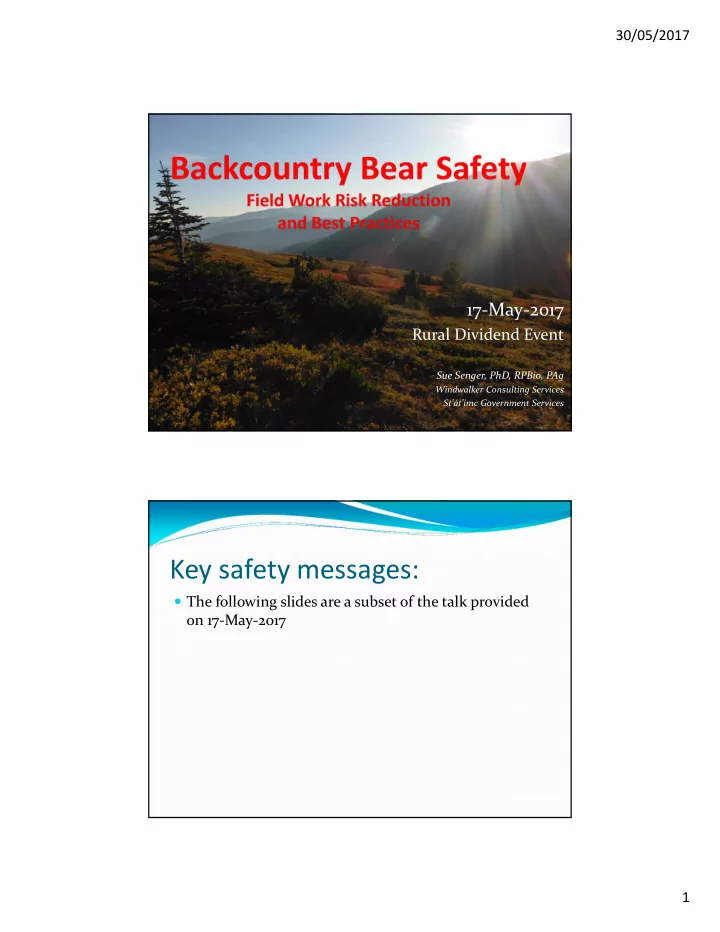
Key safety messages: The following slides are a subset of the talk - - PDF document

key safety messages
SMART_READER_LITE
LIVE PREVIEW

Key safety messages: The following slides are a subset of the talk - - PDF document

30/05/2017 17 May 2017 Rural Dividend Event Sue Senger, PhD, RPBio, PAg Windwalker Consulting Services St't'imc Government Services Key safety messages: The following slides are a subset of the talk provided on 17 May 2017 1


slide-1
SLIDE 1

30/05/2017 1

17‐May‐2017

Rural Dividend Event

Sue Senger, PhD, RPBio, PAg

Windwalker Consulting Services St'át'imc Government Services

Key safety messages:

 The following slides are a subset of the talk provided

  • n 17‐May‐2017
slide-2
SLIDE 2

30/05/2017 2

Outline

 What Kind of Bear is IT?  What is the BEAR doing?  What are YOU doing?

 Simple Steps to Remain Safe  Bear Safety Video

 Review of Safety Gear and

Best Practices

Mum & cub playing

International Union for the Conservation of Nature

 Dec 2016: declared Stein‐Nahatlatch Grizzly bears to

be “Critically Endangered” = 1 step away from being extinct in nature

IUCN Red List

slide-3
SLIDE 3

30/05/2017 3

Have you seen a Grizzly bear?

What is the bear doing?

slide-4
SLIDE 4

30/05/2017 4

Bear Behaviors ‐ Curiosity

Signs of Curiosity

 Standing up to see or

hear better

 Ears forward  Sniffing, head wagging  Might approach you

Bear Behaviors ‐ Stress

Signs of Stress

 Yawning  Chomping at the grass  Vocalizing  Ears back  Paw swatting  Stomping  May run back a short

distance or climb a tree

slide-5
SLIDE 5

30/05/2017 5

 A Defensive bear tries to remove you as a threat  You Could Trigger a CHARGE!  MOST charges stop short of contact

DO NOT Approach a BEAR First Contact with a Bear

 You have NO WAY of knowing the history of a bear

you encounter

 We tend to assume:  encounters in the wild are with wild bears  encounters in communities are with habituated

bears

 This is a false & dangerous assumption!!

slide-6
SLIDE 6

30/05/2017 6

Steps to staying safe

 What Kind of Bear is IT?  What is the BEAR doing?

What are YOU doing?

Avoiding Bear Encounters

Be Vigilant & Noisy When:

 the WIND is in your face  there is AMBIENT NOISE  you are VISUALLY SCREENED  you are NEAR BEAR FOOD  there is FRESH SIGN

slide-7
SLIDE 7

30/05/2017 7

When you see a bear:

 Stop what you are doing  Remain calm  Assess the situation:

 Does the bear see you?  Is it moving away or towards?  What is it’s behavior?  Work together to stay safe

Distances: How close is too close?

 Bears can easily run 30 ft/sec (9 m/sec)  Your Best Response Time = 3 sec

1 sec = to recognize the danger 1 sec = to draw your pepper spray 1 sec = to aim and fire Your minimum distance = 90FT (25‐30m)

slide-8
SLIDE 8

30/05/2017 8

What’s Wrong Here?

From the Inter‐agency Grizzly Bear Committee (IGBC), 2012

In the case of a serious incident Call the Conservation Officers ‐ They will determine the level of response required