= kC A C B . dt dt Elementary reaction is one place where - - PowerPoint PPT Presentation

kc a c b dt dt
SMART_READER_LITE
LIVE PREVIEW

= kC A C B . dt dt Elementary reaction is one place where - - PowerPoint PPT Presentation

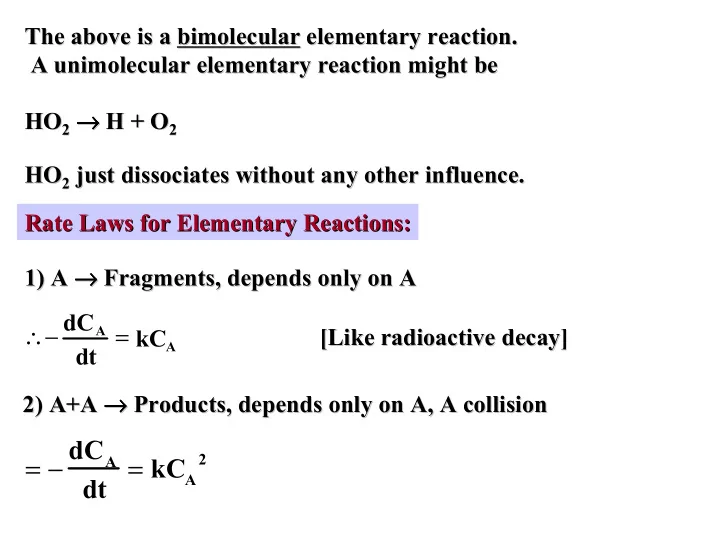
The above is a bimolecular bimolecular elementary reaction. elementary reaction. The above is a A unimolecular unimolecular elementary reaction might be elementary reaction might be A H + O 2 HO 2 H + O 2


slide-1
SLIDE 1

The above is a The above is a bimolecular bimolecular elementary reaction. elementary reaction. A A unimolecular unimolecular elementary reaction might be elementary reaction might be HO HO2

2 →

→ → → → → → → H + O H + O2

2

HO HO2

2 just dissociates without any other influence.

just dissociates without any other influence. Rate Laws for Elementary Reactions: Rate Laws for Elementary Reactions: 1) A 1) A → → → → → → → → Fragments, depends only on A Fragments, depends only on A ∴− dCA dt = kCA [Like radioactive decay] [Like radioactive decay] 2) A+A 2) A+A → → → → → → → → Products, depends only on A, A collision Products, depends only on A, A collision

= − dCA dt = kCA

2

slide-2
SLIDE 2

Elementary reaction is one place where Elementary reaction is one place where stoichiometry stoichiometry and and rate rate are are related. However never know when you have an

  • related. However never know when you have an

elementary reaction. Must guess and then verify with experime elementary reaction. Must guess and then verify with experiment. nt. Elementary reactions are hypothetical constructs! Elementary reactions are hypothetical constructs! A + B A + B → → → → → → → → Products. Products.

−dCA dt = −dCB dt = kCACB.

slide-3
SLIDE 3

Unimolecular Unimolecular Decompositions Decompositions

An example of An example of Mechanisms Mechanisms, , Steady Steady State State Approximation Approximation, , and and Elementary Elementary Reactions Reactions A A → → → → → → → → Fragments Fragments pyrazine pyrazine Observed Experimentally to Observed Experimentally to be first order in be first order in pyrazine pyrazine. .

slide-4
SLIDE 4

Lindemann Lindemann [Lord [Lord Cherwell Cherwell] suggested the following mechanism: ] suggested the following mechanism: Assume, however, that after A* is produced by a collision it han Assume, however, that after A* is produced by a collision it hangs gs around for some time before decomposing. This time lag between around for some time before decomposing. This time lag between activation and reaction may be thought of as the time necessary activation and reaction may be thought of as the time necessary to to transfer energy among the internal ( transfer energy among the internal (vibrational vibrational) coordinates. ) coordinates.

− dA dt = k[A] or C

  • r C -
  • B

B → → → → → → → → C + B with C + B with

− d[C− B] dt = k[C− B]

Collisions in general produce molecules with higher than average Collisions in general produce molecules with higher than average

  • energy. Consider a box full of A and let those molecules which
  • energy. Consider a box full of A and let those molecules which

have an energy E* greater than or equal to that necessary for have an energy E* greater than or equal to that necessary for decomposition be A*. decomposition be A*.

slide-5
SLIDE 5

If A If A*

* exists for a reasonable time it could suffer a collision and dr

exists for a reasonable time it could suffer a collision and drop

  • p

down to a lower energy where it cannot decompose. down to a lower energy where it cannot decompose. E E1

1 , E

, E2

2 , E

, E3

3 <

< E Emin

min;

; E E*≥ *≥ E Emin

min = energy necessary for decomposition

= energy necessary for decomposition A*(E*) + A(E4) A(E5) + A(E6)        k2     ↓ ↓ ↓ ↓ Products

k −1

 →  

Again E Again E4

4 , E

, E5

5 , E

, E6

6 <

< E Emin

min

A(E A(E1

1) + A(E

) + A(E2

2)

) A*(E*) A*(E*) + A(E + A(E3

3)

) k k1

1

Collision between Collision between A(E A(E1

1) and A(E

) and A(E2

2)

) creates “activated” creates “activated” A*(E*) A*(E*) Competition between Competition between reaction of reaction of A*(E*) A*(E*) to to form products and form products and collisional collisional cooling of cooling of A*(E*) A*(E*) to to produce produce unreactive unreactive A(E A(E5

5) and A(E

) and A(E6

6)

) Reaction step Collional cooling step Collision (k (k1

1, k

, k-

  • 1

1, and k

, and k2

2 are kinetic rate constants)

are kinetic rate constants)

slide-6
SLIDE 6

Mechanism Elementary Steps: Mechanism Elementary Steps: k k2

2 is decomposition step assumed irreversible.

is decomposition step assumed irreversible.

A + A

k1

 →   A

∗ + A

A

∗ + A k −1

 →   A + A

A

∗ k 2

 →   P

dP dt = k2[A

∗]

d[A∗] dt = k1[A]2 − k −1[A

∗][A] − k2[A ∗]

Don Don’ ’t know what [A t know what [A*

*] is, however the number of [A

] is, however the number of [A*

*] must be small

] must be small

  • r the reaction would go to completion very quickly. A* is a
  • r the reaction would go to completion very quickly. A* is a

“ “bottleneck bottleneck” ” for the reaction since product is only formed via A*. for the reaction since product is only formed via A*. Step 1 Step 1 Step 2 Step 2 Step 3 Step 3 Step 1 Step 1 Step 2 Step 2 Step 3 Step 3

slide-7
SLIDE 7

d[A d[A*

*]/

]/dt dt = 0 = k = 0 = k1

1[A]

[A]2

2-

  • k

k-

  • 1

1[A

[A*

*][A]

][A]-

  • k

k2

2[A

[A*

*]

] [A [A*

*] = k

] = k1

1[A]

[A]2

2 / ( k

/ ( k2

2+k

+k-

  • 1

1[A] ) } Key Point:

[A] ) } Key Point: Steady state approach allows us to solve for concentration Steady state approach allows us to solve for concentration

  • f
  • f unknown

unknown species [A species [A*

*] in terms of

] in terms of known known [A] concentration. [A] concentration. Therefore we assume a Therefore we assume a steady state steady state for [A for [A*

*]

] → → → → → → → → This is a This is a most most important important “ “trick trick” ” or approximation:

  • r approximation:

Rate = dP dt = k2[A

∗] = k 2k1[A]2

k2 + k−1[A]

Solve for [A*] →

→ → → → → → →

The The Steady State Steady State Approximation Approximation (Assumes are making and destroying A (Assumes are making and destroying A*

* at the same rate.)

at the same rate.) Fundamental result of Fundamental result of Lindemann Lindemann “ “Unimolecular Unimolecular Reaction Mechanism” Reaction Mechanism” Note, multistep mechanism leads to complex rate expression!

slide-8
SLIDE 8

At this point, it looks like At this point, it looks like Mr Mr. . Lindemann Lindemann will have to hand will have to hand in his Theorists in his Theorists’ ’ Club ID card since his scheme seems to Club ID card since his scheme seems to predict a second order kinetic dependence on [A] predict a second order kinetic dependence on [A]2

2!

! This says the rate of decomposition of A This says the rate of decomposition of A*

* is much

is much faster faster than the rate of deactivation. than the rate of deactivation. Using k Using k2

2>>k

>>k-

  • 1

1[A] and the expression for

[A] and the expression for dP dP/ /dt dt: : Thus, Thus, dP dP/ /dt dt ≅ ≅ ≅ ≅ ≅ ≅ ≅ ≅ k k1

1[A]

[A]2

2 }

} } } } } } }2nd order in [A] 2nd order in [A] Two Limiting Cases Two Limiting Cases I) k I) k-

  • 1

1 [A] << k

[A] << k2

2

Rate = dP dt = k2[A

∗] = k 2k1[A]2

k2 + k−1[A]

Rate = dP/dt = k2[A*] = k2k1[A]2/(k2+k-1[A]) Take k-1[A] to be 0 compared to k2

slide-9
SLIDE 9

Mechanism Elementary Steps: Mechanism Elementary Steps: “ “Physical Interpretation Physical Interpretation” ” of this particular limit:

  • f this particular limit:

A + A

k1

 →   A

∗ + A

A

∗ + A k −1

 →   A + A

A

∗ k 2

 →   P Reaction rate here is just the rate at which [A*] is formed sinc Reaction rate here is just the rate at which [A*] is formed since e every A* formed falls apart to product P immediately. The rate o every A* formed falls apart to product P immediately. The rate of f formation of A* is obtained from the first step: d[A*]/ formation of A* is obtained from the first step: d[A*]/dt dt = k1[A]2 So the reaction becomes a simple binary So the reaction becomes a simple binary collison collison model, second model, second

  • rder process in this limit.
  • rder process in this limit.

Step 1 Step 1 Step 2 Step 2 Step 3 Step 3 Slow enough to be ignored! So fast that every A* formed Reacts immediately! d[A*]/dt = k1[A]2

slide-10
SLIDE 10

(Case II) k (Case II) k-

  • 1

1 [A] >> k

[A] >> k2

2

This says there is an appreciable time lag between activation an This says there is an appreciable time lag between activation and d

  • reaction. Thus, a large amount of
  • reaction. Thus, a large amount of deactivation

deactivation occurs.

  • ccurs.

Note that k Note that k-

  • 1

1 [A] is pressure dependent. Gets larger as pressure

[A] is pressure dependent. Gets larger as pressure increases {P increases {PA

A=(

=(n nA

A/V)RT = [A]RT}. Thus, k

/V)RT = [A]RT}. Thus, k-

  • 1

1 [A] >> k

[A] >> k2

2 is a good

is a good approxmation approxmation at high pressures. at high pressures.

dP dt ≅ k2k1 k −1 [A]    1

1st

st order in A (apparent)

  • rder in A (apparent)

∴ ∴ ∴ ∴ ∴ ∴ ∴ ∴ At At high high pressures expect to see this behavior. pressures expect to see this behavior. [More careful investigation of [More careful investigation of “ “unimolecular unimolecular” ” decomp

  • decomp. showed 2

. showed 2nd

nd

  • rder kinetics at
  • rder kinetics at low

low pressure.] pressure.]

Rate = dP dt = k2[A

∗] = k 2k1[A]2

k2 + k−1[A]

Rate = dP/dt = k2[A*] = k2k1[A]2/(k2+k-1[A]) Take k2 to be 0 compared to k-1[A]

slide-11
SLIDE 11

Mechanism Elementary Steps: Mechanism Elementary Steps: “ “Physical Interpretation Physical Interpretation” ” of this particular limit:

  • f this particular limit:

A + A

k1

 →   A

∗ + A

A

∗ + A k −1

 →   A + A

A

∗ k 2

 →   P Reaction rate here is Reaction rate here is dP dP/ /dt dt = k = k2

2 [A*] but the concentration of A*

[A*] but the concentration of A* is given by the is given by the “ “equilibrium equilibrium” ” condition, condition, k-1[A*][A] = k1[A]2. So, . So, solving for [A*] gives: solving for [A*] gives: Step 1 Step 1 Step 2 Step 2 Step 3 Step 3 So slow that steps 1 and 2 Can “reach equilibrium”. k-1[A*][A] = k1[A]2 [A*] = k1[A]2/ k-1[A] = k1[A]/ k-1 Result is that [A*] scales linearly with [A] and rate, dP/dt = k2[A*] also scales linearly with [A].

slide-12
SLIDE 12

Catalysis Catalysis

Catalysis provides an additional mechanism by which reactants Catalysis provides an additional mechanism by which reactants can be converted to products. The can be converted to products. The alternative mechanism has a alternative mechanism has a lower activation energy lower activation energy than the reaction in the absence of a than the reaction in the absence of a catalyst. catalyst. Without a catalyst: Rate = v Without a catalyst: Rate = v0 With Catalyst: Rate=v With Catalyst: Rate=v0

0+

+v vc

c but

but v vc

c>>v

>>v0

A A B B υ υ υ υ υ υ υ υo

  • υ

υ υ υ υ υ υ υc

c

υ υ υ υ υ υ υ υo

  • no catalyst

no catalyst υ υ υ υ υ υ υ υc

c --

  • - catalyst present

catalyst present

(v (v0

0 =

= -

  • d[A]/

d[A]/dt dt with no catalyst) with no catalyst) ( (v vc

c =

= -

  • d[A]/

d[A]/dt dt with a catalyst) with a catalyst)

slide-13
SLIDE 13

Ea,f

Reaction coordinate Reaction coordinate Potential Energy

Energy barrier without catalyst Energy barrier without catalyst

Energy barrier Energy barrier with catalyst with catalyst

∆E Ea,r Ea,r

Products Products Catalysts Catalysts speed reactions by reducing the activation speed reactions by reducing the activation energy barrier. energy barrier.

Ea,f Ea,f

Reactants Reactants ∆ ∆ ∆ ∆ ∆ ∆ ∆ ∆E E Not

Not affected

affected by catalyst by catalyst E Ea

a,f ,f and

and E Ea

a,r ,r

are are lowered

lowered

by by catalyst catalyst Potential Potential Energy here Energy here is energy is energy stored in the stored in the chemical chemical bonds bonds

slide-14
SLIDE 14

Generally a catalyst is defined as a substance which increases t Generally a catalyst is defined as a substance which increases the he rate of a reaction without itself being changed at the end of th rate of a reaction without itself being changed at the end of the e reaction. reaction. This is strictly speaking not a good definition because some thi This is strictly speaking not a good definition because some things ngs catalyze themselves, but we will use this definition for now. catalyze themselves, but we will use this definition for now. Catalyst supplies a reaction path which has a lower activation Catalyst supplies a reaction path which has a lower activation energy than the reaction in the absence of a catalyst. energy than the reaction in the absence of a catalyst.

Catalysis by Enzymes Catalysis by Enzymes

Enzymes may be loosely defined as catalysts for biological syste Enzymes may be loosely defined as catalysts for biological systems. ms. They increase the rate of reactions involving biologically impor They increase the rate of reactions involving biologically important tant systems. systems.

slide-15
SLIDE 15

Enzymes are remarkable as catalysts because they are usually Enzymes are remarkable as catalysts because they are usually

amazingly specific amazingly specific (work only a particular kind of reaction.)

(work only a particular kind of reaction.) They are also generally They are also generally very efficient

very efficient, achieving substantial

, achieving substantial Rate increases at concentrations as low as 10 Rate increases at concentrations as low as 10-

  • 8

8 M!

M! Typical enzyme molecular weights are 10 Typical enzyme molecular weights are 104

4-

  • 10

106

6 gm/mole

gm/mole (protein molecules) (protein molecules)

slide-16
SLIDE 16

Summary of Enzyme Characteristics Summary of Enzyme Characteristics

3) Very specific (work only on special types of reactions). 3) Very specific (work only on special types of reactions).

General Behavior of Enzyme Catalyzed Reactions General Behavior of Enzyme Catalyzed Reactions

If the If the initial rate initial rate of the reaction is plotted versus the

  • f the reaction is plotted versus the initial

initial concentration concentration of substrate S for a constant enzyme concentration,

  • f substrate S for a constant enzyme concentration,

the following behavior is found: the following behavior is found: 1) Proteins of large to moderate weight 10 1) Proteins of large to moderate weight 104

4 -

  • 10

106

6.

. 2) Extremely efficient (work at 10 2) Extremely efficient (work at 10-

  • 8

8 M)

M) S (substrate) Products S (substrate) Products E

 → 

slide-17
SLIDE 17

V Vi

i =

= -

  • d[S]/

d[S]/dt dt measured at t=0. (Initial slope of [S] measured at t=0. (Initial slope of [S] vs vs t plot) t plot) Initial Initial Rate Rate Substrate Concentration Substrate Concentration (Half maximum initial rate) (Half maximum initial rate) Maximum initial rate Maximum initial rate [S] concentration when V [S] concentration when Vi

i = V

= VS

S / 2

/ 2