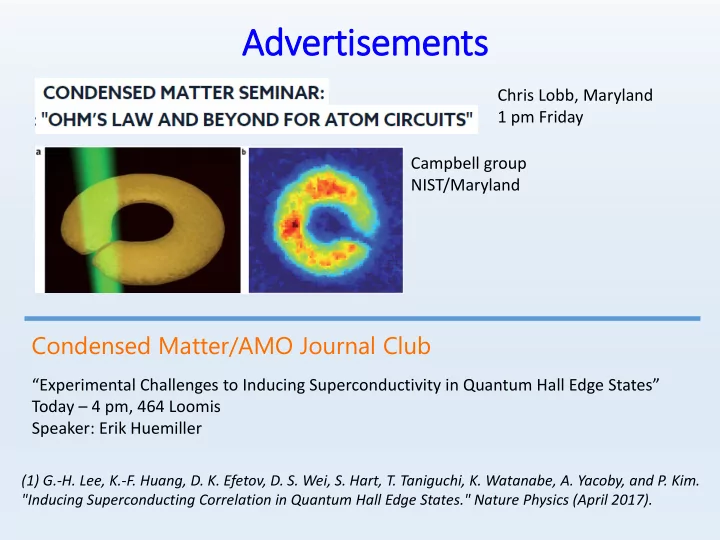
Adver ertisem emen ents Chris Lobb, Maryland 1 pm Friday - - PowerPoint PPT Presentation

adver ertisem emen ents
SMART_READER_LITE
LIVE PREVIEW

Adver ertisem emen ents Chris Lobb, Maryland 1 pm Friday - - PowerPoint PPT Presentation

Adver ertisem emen ents Chris Lobb, Maryland 1 pm Friday Campbell group NIST/Maryland Condensed Matter/AMO Journal Club Experimental Challenges to Inducing Superconductivity in Quantum Hall Edge States Today 4 pm, 464 Loomis


slide-1
SLIDE 1

Adver ertisem emen ents

Campbell group NIST/Maryland Chris Lobb, Maryland 1 pm Friday

Condensed Matter/AMO Journal Club

“Experimental Challenges to Inducing Superconductivity in Quantum Hall Edge States” Today – 4 pm, 464 Loomis Speaker: Erik Huemiller

(1) G.-H. Lee, K.-F. Huang, D. K. Efetov, D. S. Wei, S. Hart, T. Taniguchi, K. Watanabe, A. Yacoby, and P. Kim. "Inducing Superconducting Correlation in Quantum Hall Edge States." Nature Physics (April 2017).

slide-2
SLIDE 2

Three ee-leve vel s systems – “Lam ambda” a” s system em

1 2 e

( )

1 1

1 ϕ ω − −

t i

e

( )

2 2

2 ϕ ω − −

t i

e

Finishing up from last time…

slide-3
SLIDE 3

Three ee-leve vel s systems – “Lam ambda” a” s system em

Time [arb.]

Populations

1 2 e

( )

1 1

1 ϕ ω − −

t i

e

( )

2 2

2 ϕ ω − −

t i

e

Finishing up from last time…

slide-4
SLIDE 4

STImulated ed Ra Raman an A Adiab abatic Passage

Time [arb.] Time [arb.]

Populations Ω1,2

Finishing up from last time…

slide-5
SLIDE 5

Ope pen n quan quantum s systems:

Dissipation

  • n i

in atom

  • mic

c physics cs / / ultracol

  • ld at

atoms

1 2

12

~ ω 

slide-6
SLIDE 6

Ope pen n quan quantum s systems:

Dissipation

  • n i

in atom

  • mic

c physics cs / / ultracol

  • ld at

atoms

We work with fairly well-isolated systems, held in ultrahigh vacuum, but on some timescale it’s going to interact with the “environment.” If we’re not monitoring the environment [hard to do], then we’ll lose information about

  • ur system.

How do we treat this? What role does dissipation play in AMO systems?

ATRAP experiment

slide-7
SLIDE 7

La Lase ser-cooling of g of a atom

  • ms

1 2

12

~ ω 

ALSO – we start with high-entropy ensemble, the degrees of freedom of the light field help accommodate the removal of entropy Photon momentum imparted when the atom is first excited. The decay let’s us “cycle” this process over and over

slide-8
SLIDE 8

T ~ 300-400 K

La Lase ser-cooling of g of a atom

  • ms

1 2

12

~ ω  T ~ few millionths of 1 K many cycles

1997 Nobel Prize in Physics Chu, Phillips, Cohen-Tannoudji

MOT & optical molasses

slide-9
SLIDE 9

Optical p pumping

e.g., ., take e a ther ermal en ensemble a and p prep epare a s spin-pol

  • larized s

samp mple

Let’s say we want to prepare in the state |1/2 , 1/2>  Polarized light + sponteneous decay

slide-10
SLIDE 10

Optical p pumping

e.g., ., take e a ther ermal en ensemble a and p prep epare a s spin-pol

  • larized s

samp mple

1966 Nobel Prize in Physics Alfred Kastler “Optical Methods for Studying Hertzian Resonances” a b if a if b

slide-11
SLIDE 11

Dark st states

States de decoupl upled ed f from rest o

  • f dy

dyna namics – no no excited s ed state compo ponen ent

from Zoller… Dark state Bright state Our 3-level system, with loss

population gets “trapped” in dark state at long times

slide-12
SLIDE 12

Veloci

  • city-select

ctive c coh

  • herent p

pop

  • pulation
  • n t

trapping

sub-rec ecoi

  • il c

cool

  • oling!!!

g!!!

from Zoller… developed by Cohen-Tannoudji/Chu/etc.

also… gray molasses, related techniques…

slide-13
SLIDE 13

OK, K, i impor

  • rtant t

to l

  • laser-cool
  • oling. Wha

hat el else? e?

1 2

12

~ ω 

Can we modify how our system interacts with the environment to influence processes like spontaneous emission?

Enhance : bring some “emitter” near a structure / waveguide matching its frequency

Γ Γ

Purcell enhancement (1940 ; 1952 Nobel) Effectively suppress : put the emitter into a “cavity” with frequency matched to

  • resonance. If photon lifetime in

cavity is long enough, reabsorption more likely than loss

Γ

slide-14
SLIDE 14

OK, K, i impor

  • rtant t

to l

  • laser-cool
  • oling. Wha

hat el else? e?

1 2

12

~ ω 

Can we modify how our system interacts with the environment to influence processes like spontaneous emission?

Enhance : bring some “emitter” near a structure / waveguide matching its frequency

Γ Γ

Purcell enhancement (1940 ; 1952 Nobel) Effectively suppress : put the emitter into a “cavity” with frequency matched to

  • resonance. If photon lifetime in

cavity is long enough, reabsorption more likely than loss

Γ

slide-15
SLIDE 15

Dis issip ipatio ion as a

as a reso source f for man any-body ph physi sics

General theme in many-body physics – going to low energies leads to emergent behavior i.e., due to energetic restriction of accessible Hilbert space

slide-16
SLIDE 16

Dis issip ipatio ion as a

as a reso source f for man any-body ph physi sics

General theme in many-body physics – going to low energies leads to emergent behavior i.e., due to energetic restriction of accessible Hilbert space Total Hilbert space Low-energy region

slide-17
SLIDE 17

Dis issip ipatio ion as a

as a reso source f for man any-body ph physi sics

If we start in some part of Hilbert space, can we restrict ourselves to this region using dissipation? Total Hilbert space Low-energy region

Γ Γ

Basically, just the quantum Zeno effect

 answer, of course

ex: stabilization of ultracold molecules against exothermic chemical reactions

slide-18
SLIDE 18

Dis issip ipatio ion-constrained d dynamics cs

How about for cold atoms? Loss due to 3-body molecular recombination

Stabilization of the p-Wave Superfluid State in an Optical Lattice

Y.-J. Han, Y.-H. Chan, W. Yi, A. J. Daley, S. Diehl, P. Zoller, and L.-M. Duan

  • Phys. Rev. Lett. 103, 070404 – Published 14 August 2009
slide-19
SLIDE 19

Dis issip ipatio ion-constrained d dynamics cs

slide-20
SLIDE 20

“Dark states” i in many-body s systems

Making stable Majoranas through “dark state” engineering Topology by dissipation in atomic quantum wires Sebastian Diehl, Enrique Rico, Mikhail A. Baranov, & Peter Zoller Nature Physics 2011

many, m many more e examples… es…

analog

  • gs of QED

QED new c w cool

  • oling

techniques es etc.