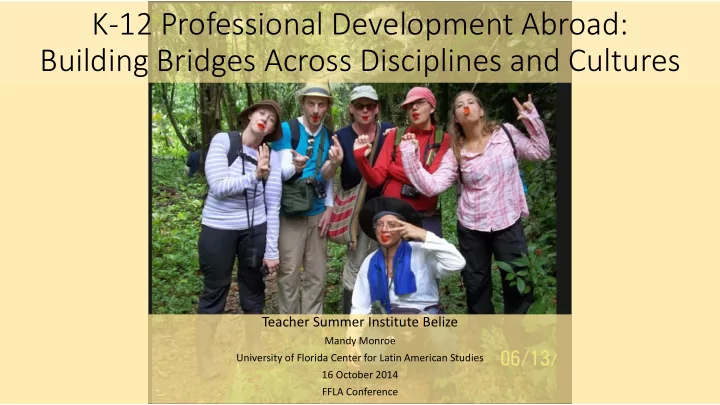
SLIDE 1 K-12 Professional Development Abroad: Building Bridges Across Disciplines and Cultures
Teacher Summer Institute Belize
Mandy Monroe University of Florida Center for Latin American Studies 16 October 2014 FFLA Conference
SLIDE 2 Overview
- Latin America and the Sciences
- Institute History & Framework
- 2014 Case Study
- Why Belize? Why BFREE?
- Technology to Prepare
- Activities in Country
- Reflection & Plans for Classroom
Integration
- Post Trip Outputs
- Where do we go from here?
SLIDE 3 Latin America and the Sciences
- Environmental Science Content & Curricula
Development
- Latin American Ecosystems & Culture Content
- Technology & Experiential Learning in the
Field & Classroom
- Intercultural Competence in Professional &
Personal Interactions
SLIDE 4
Gainesville based Institute in 2011 using an online wikispace, field trips and classroom lectures to connect Latin American studies and the sciences. The institute integrated science and Latin American studies to develop appropriate technology and experiential learning lessons in the classroom.
SLIDE 5 2014: Why Belize? Why BFREE?
- Density of Biocultural Diversity!
- Ecosystem richness
- Subtropical Rainforests, Coastal Mangroves,
Barrier Reef
- Land Preservation
- Cultural richness
- Ethnic Diversity: Creole, Mestizo, Maya,
Garifuna, Mennonite, European
- Linguistic Diversity: English; Spanish; Creole;
Garifuna; Mopan, Ke’kchi, and Yucatec Maya; German
- Flora & Fauna richness
- >500 bird species
- >700 butterfly species
- >180 species amphibians & reptiles
- Healthy mammal populations
SLIDE 6 Self-Identified Participant Goals
= Environmental Science Content & Curricula Development = Technology & Experiential Learning in the Field & Classroom = Intercultural Competence in Professional & Personal Interactions = Latin American Ecosystems & Culture Content
SLIDE 7
Websites, wikispaces, virtual connects and other online technology interfaces help to prepare teachers for their summer institute experience.
SLIDE 8
Activities ranging from a lecture at an artisan cooperative, snorkeling at a national park, cacao agroforestry tours, wildlife viewing, tour and lecture at the Belize Zoo and birding… …offered participants experiential learning opportunities.
SLIDE 9 An overnight homestay in a local Maya village left lasting impressions. Several participants reflected on the homestay in Golden Stream Community as an eye-
- pening experience that they will carry with them in their personal and professional lives.
SLIDE 10
A luncheon with Belizean teachers allowed educators to express their unique challenges cross culturally and to build partnerships around their aspirations. Institute participants are eager to send books, field guides, and digital resources for the Belizean teachers who expressed a desire for classroom enrichment materials.
SLIDE 11 “while students tend to focus on learning as a means of acquiring more knowledge, teachers are more often engaging in new knowledge with the view of later transforming this into learning
- pportunities for their own students.” Wenicke (2010)
“learning is regarded as socially situated in that individuals form a community for a common purpose… it forms as members come together for a particular purpose and when that purpose no longer exists, the members disperse.” Gleeson and Tait (2012)
SLIDE 12
Cultural exchange experience encouraged teachers to innovate in their classrooms. All participants mention culture and science as highlights of their trip to bring to the USA.
SLIDE 13
Post-Trip Outputs
SLIDE 14
Post-Trip Outputs
SLIDE 15
Post-Trip Outputs
SLIDE 16
Where do we go from here?
SLIDE 17 References
- Gleeson, M., & Tait, C. (2012). Teachers as
sojourners: Transitory communities in short study-abroad programmes. Teaching and Teacher Education, 28(8), 1144-1151. doi:10.1016/j.tate.2012.07.005
- Wernicke, M. (2010). Study abroad as
professional development for FSL teachers. Canadian Journal of Applied Linguistics/Revue Canadienne De Linguistique Appliquee, 13(1), 4-18.
- Photo Credits: from the Belize Teachers
Google+ Photo share
SLIDE 18
Thank you!