JUVENILE JUSTICE SYSTEM Judicial Branch: Court Support Services - - PowerPoint PPT Presentation

juvenile justice system
SMART_READER_LITE
LIVE PREVIEW

JUVENILE JUSTICE SYSTEM Judicial Branch: Court Support Services - - PowerPoint PPT Presentation

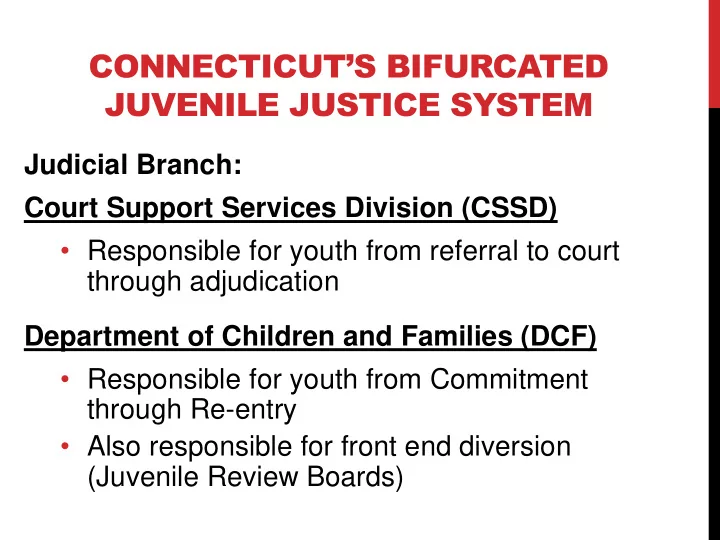
CONNECTICUTS BIFURCATED JUVENILE JUSTICE SYSTEM Judicial Branch: Court Support Services Division (CSSD) Responsible for youth from referral to court through adjudication Department of Children and Families (DCF) Responsible for youth


slide-1
SLIDE 1

CONNECTICUT’S BIFURCATED JUVENILE JUSTICE SYSTEM

Judicial Branch: Court Support Services Division (CSSD)

  • Responsible for youth from referral to court

through adjudication Department of Children and Families (DCF)

  • Responsible for youth from Commitment

through Re-entry

  • Also responsible for front end diversion

(Juvenile Review Boards)

slide-2
SLIDE 2

Cou Court I t Intak ntake

The number of juveniles referred to the court is down 27% since 2007

slide-3
SLIDE 3

DCF DCF Commitme Commitments nts

Commitments have dropped 69% since 1999

slide-4
SLIDE 4

Juv uven eniles R iles Ref efer erred ed for

  • r

Delinque Delinquenc ncy y Char Charge ges

100.0% 79.6% 65.8% 64.9% 47.0% 0.0% 20.4% 34.2% 35.1% 53.0% 0% 10% 20% 30% 40% 50% 60% 70% 80% 90% 100%

2009 2010 2011 2012 2013 Fiscal Year

Delinquent Court Intake By Age Group and Fiscal Year

RTA 16/17 Under 16

slide-5
SLIDE 5

Juv uven enil iles Admitted es Admitted to to Det Deten ention tion Cen Center ters

100.0% 77.0% 60.7% 61.2% 46.9% 0.0% 23.0% 39.3% 38.8% 53.1% 0% 10% 20% 30% 40% 50% 60% 70% 80% 90% 100% 2009 2010 2011 2012 2013 Fiscal Year

Detained Clients By Age Group and Fiscal Year

RTA 16/17 Under 16

slide-6
SLIDE 6

Aver erage ge Dail Daily P y Pop

  • pula

ulation tion Dete Detention ntion Cent Center ers

82.3 68.2 58.2 49.7 47.9 32.1 37.2 32.0 47.2 0.0 20.0 40.0 60.0 80.0 100.0 120.0 2009 2010 2011 2012 2013 Fiscal Year

Average Daily Detention Population By Age Group and Fiscal Year

RTA 16/17 Under 16

slide-7
SLIDE 7

Aver erage ge Case

Caseload load Si Size e Juv uven enile ile Pr Prob

  • bation

tion

28.9 26.4 24.6 23.0 21.2 0.0 1.7 7.6 8.6 9.3 0.0 5.0 10.0 15.0 20.0 25.0 30.0 35.0 2009 2010 2011 2012 2013

Average Caseload Per Officer by Age Group and Fiscal Year

Total RTA Total <16

slide-8
SLIDE 8

12 12-Mont Month R h Rear earrest est Ra Rate te Juv uveniles on S eniles on Super upervision/ vision/Pr Proba

  • bation

tion

Rearrest rates for juvenile probationers have dropped from 51% in 2007 to 45% in 2011

slide-9
SLIDE 9

Raise the Age Pr Raise the Age Proba

  • bation

tion Outcomes to Da Outcomes to Date te

slide-10
SLIDE 10

WHAT NEW POSITIONS WERE ADDED THROUGH ‘RAISE THE AGE?’

  • 57 Total: Various Juvenile Services

positions

 19 Juvenile Probation Officers  5 Clinical Coordinators  15 Juvenile Detention Officers  4 contract oversight positions  Balance of positions to be hired in stages

beginning 10/5/12 through 2/13/13

slide-11
SLIDE 11

WHAT SERVICES HAVE BEEN ADDED FOR 16 AND 17 YEAR OLDS, AND WHAT IS THE COST?

  • Behavioral, Mental Health and Substance Abuse

Programs ($10.7M)

  • Educational and Vocational ($720k)
  • Independent Living Skills ($200k)
  • Residential ($94k)
  • Other ($640k)
  • Infrastructure ($50k)
slide-12
SLIDE 12

WHAT NEW INITIATIVES AND/OR SERVICES ARE BEING PLANNED BY CSSD?

  • Return referrals will continue
  • RESTORE will be piloted in 3 cities
  • JRB direct referrals to FSC
  • Vocational training in Detention
  • New Domestic Violence programming
  • Mentoring
slide-13
SLIDE 13

SYSTEMIC GAPS IN SERVICES

  • Small community-based alternatives to

detention, especially for younger teens

  • Additional educational and vocational

training / supports needed

  • Access to advanced education or vocational

training for older adolescents with HS diploma

  • Family engagement for re-entry from

detention to home / communities

slide-14
SLIDE 14

SYSTEMIC GAPS IN SERVICES

(CONTINUED)

  • Community-based and residential SA

treatment, including access to detox and inpatient treatment

  • Independent living skills training and

supports, especially for youth with chronic issues and developmental disabilities

  • Services for pregnant and parenting teens
  • Services for Limited English Proficient (LEP)

youth / families

slide-15
SLIDE 15

DCF presentation to Juvenile Jurisdiction Planning and Oversight Coordinating Council, October 6, 2012

PROGRAMS ADDED TO DCF SERVICE ARRAY IN RESPONSE TO RTA

PROGRAM LOCATION COST

Supportive Work Transition Program Hartford $ 570,495 Machinist program Manchester $ 50,749 STEP / JCMC Statewide $ 3,382,811 Juvenile Review Board Bridgeport, Hartford, New Haven, Bloomfield, Windham $ 718,845 MST – PSB Statewide $ 1,564,000 Summer Youth Employment Statewide $ 400,000 JJIE / DCFIE Statewide $ 1,958,695

slide-16
SLIDE 16

NOTE: To this we would add substance abuse treatment, both in and out-patient.

DCF’S IDENTIFIED SYSTEMIC GAPS

  • Sex Offender Treatment
  • Life Skills Development
  • Housing / Independent Living
  • Educational / Vocational Training
  • Post Secondary Education and Training
  • Employment

DCF presentation to Juvenile Jurisdiction Planning and Oversight Coordinating Council, October 6, 2012

slide-17
SLIDE 17

HOW WE GOT HERE

  • The legislation that passed “raise the age”

also created a group to determine HOW to implement it. It was charged with looking at necessary statutory changes as well as determining programmatic needs.

slide-18
SLIDE 18

HOW WE GOT HERE (CONTINUED)

  • There was a two-year lag between passage
  • f legislation and the law going into effect.

Time to:

 Think through and address legal and procedural ramifications  Ramp up capacity of state and contracted service providers  Spread out impact on the budget over a longer period of time

(This group was critical to the success of RTA in CT)

slide-19
SLIDE 19

ISSUES WE HAD TO FACE

  • Some items included in implementing

legislation during that two year period that addressed concerns to ensure a smooth implementation:

slide-20
SLIDE 20
  • Allow police discretion to charge by

summons and release juveniles without waiting for a parent.

 Police officers will not have to wait for parents to pick up juveniles and will not need to hold them in local lock ups.

POLICE CONCERNS

slide-21
SLIDE 21
  • Leave all motor vehicle offenses and

infractions for 16 and 17 year olds in adult court.

 Police can quickly process motor vehicle violations.  State and towns continue to benefit from fine revenue from these cases.

Note: Judges have the discretion to send the infractions or motor vehicle cases to juvenile court if the defendant child can benefit from treatment programs

POLICE CONCERNS

slide-22
SLIDE 22

MEETING THE NEEDS OF OLDER YOUTH

  • Ability to identify and meet the needs of
  • lder youth – a completely new population

for this system:

 Legislation clarified that DCF has the ability to keep delinquent youth until age 20 (there was uncertainty as to whether or not their authority ended when the youth turned 18).

 Facilities and providers must update their licenses, etc., so that they can serve youth over the age of 18. They need to be able to house and serve youth up to the age of 20.

slide-23
SLIDE 23
  • Determining how to appropriately and

successfully serve older youth is an ongoing concern for the system and the advocates (Raise the Age was just “completed” July 1, 2012)

MEETING THE NEEDS OF OLDER YOUTH – ONGOING CHALLENGE

slide-24
SLIDE 24
  • CT’s system has changed dramatically

in terms of make-up. That means it isn’t all about NEW dollars to create new services, but how to deploy existing dollars in a way that more accurately meets the needs of the changed system.

MEETING THE NEEDS OF OLDER YOUTH – ONGOING CHALLENGE

slide-25
SLIDE 25
  • Again, that means, how does the

system handle youth who need:  post-secondary education,  soft and hard career readiness and job training,  independent living skills – reentry will be more to independent situations than to a family-of-origin home, etc.

MEETING THE NEEDS OF OLDER YOUTH – ONGOING CHALLENGE

slide-26
SLIDE 26

TAKE AWAYS

  • Good for youth
  • Good for community safety
  • Good for budget
  • Seen as success
  • Deciding to “do it” is the hardest part
  • Taking time to plan for implementation

is critical