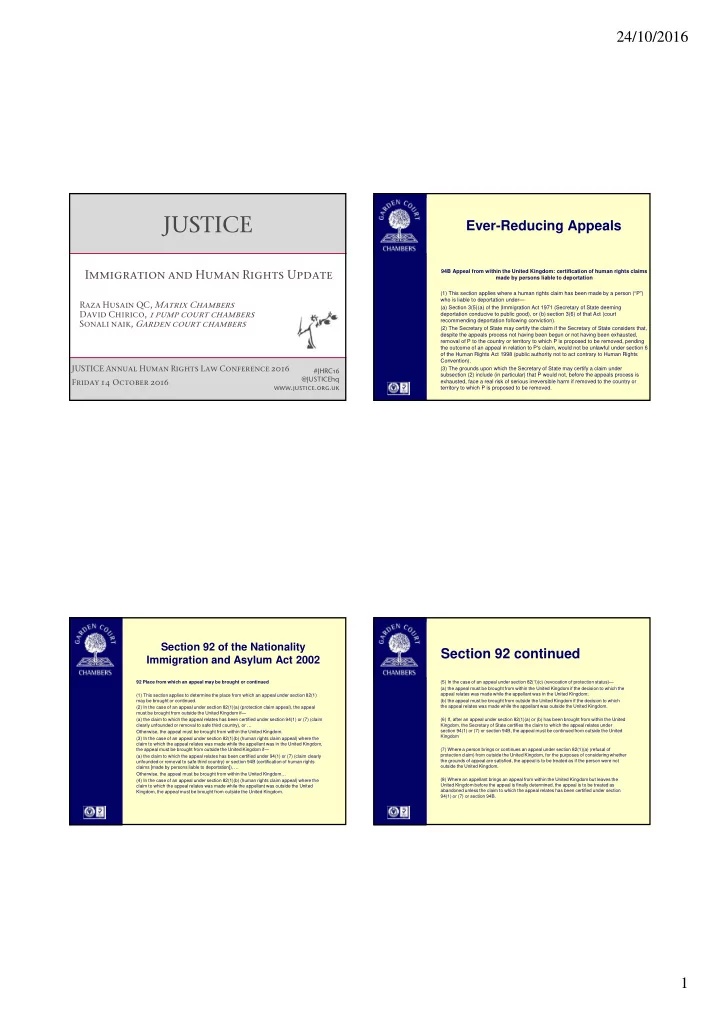
JUSTICE Ever-Reducing Appeals Immigration and Human Rights Update - - PDF document

justice
SMART_READER_LITE
LIVE PREVIEW

JUSTICE Ever-Reducing Appeals Immigration and Human Rights Update - - PDF document

24/10/2016 JUSTICE Ever-Reducing Appeals Immigration and Human Rights Update 94B Appeal from within the United Kingdom: certification of human rights claims made by persons liable to deportation (1) This section applies where a human rights


slide-1
SLIDE 1

24/10/2016 1

JUSTICE

JUSTICE Annual Human Rights Law Conference 2016 Friday 14 October 2016

#JHRC16 @JUSTICEhq www.justice.org.uk

Raza Husain QC, Matrix Chambers David Chirico, 1 pump court chambers Sonali naik, Garden court chambers

Immigration and Human Rights Update

Ever-Reducing Appeals

94B Appeal from within the United Kingdom: certification of human rights claims made by persons liable to deportation (1) This section applies where a human rights claim has been made by a person (“P”) who is liable to deportation under— (a) Section 3(5)(a) of the |Immigration Act 1971 (Secretary of State deeming deportation conducive to public good), or (b) section 3(6) of that Act (court recommending deportation following conviction). (2) The Secretary of State may certify the claim if the Secretary of State considers that, despite the appeals process not having been begun or not having been exhausted, removal of P to the country or territory to which P is proposed to be removed, pending the outcome of an appeal in relation to P's claim, would not be unlawful under section 6

  • f the Human Rights Act 1998 (public authority not to act contrary to Human Rights

Convention). (3) The grounds upon which the Secretary of State may certify a claim under subsection (2) include (in particular) that P would not, before the appeals process is exhausted, face a real risk of serious irreversible harm if removed to the country or territory to which P is proposed to be removed.

92 Place from which an appeal may be brought or continued (1) This section applies to determine the place from which an appeal under section 82(1) may be brought or continued. (2) In the case of an appeal under section 82(1)(a) (protection claim appeal), the appeal must be brought from outside the United Kingdom if— (a) the claim to which the appeal relates has been certified under section 94(1) or (7) (claim clearly unfounded or removal to safe third country), or … Otherwise, the appeal must be brought from within the United Kingdom. (3) In the case of an appeal under section 82(1)(b) (human rights claim appeal) where the claim to which the appeal relates was made while the appellant was in the United Kingdom, the appeal must be brought from outside the United Kingdom if— (a) the claim to which the appeal relates has been certified under 94(1) or (7) (claim clearly unfounded or removal to safe third country) or section 94B (certification of human rights claims [made by persons liable to deportation]), … Otherwise, the appeal must be brought from within the United Kingdom… (4) In the case of an appeal under section 82(1)(b) (human rights claim appeal) where the claim to which the appeal relates was made while the appellant was outside the United Kingdom, the appeal must be brought from outside the United Kingdom.

Section 92 of the Nationality Immigration and Asylum Act 2002

Section 92 continued

(5) In the case of an appeal under section 82(1)(c) (revocation of protection status)— (a) the appeal must be brought from within the United Kingdom if the decision to which the appeal relates was made while the appellant was in the United Kingdom; (b) the appeal must be brought from outside the United Kingdom if the decision to which the appeal relates was made while the appellant was outside the United Kingdom. (6) If, after an appeal under section 82(1)(a) or (b) has been brought from within the United Kingdom, the Secretary of State certifies the claim to which the appeal relates under section 94(1) or (7) or section 94B, the appeal must be continued from outside the United Kingdom (7) Where a person brings or continues an appeal under section 82(1)(a) (refusal of protection claim) from outside the United Kingdom, for the purposes of considering whether the grounds of appeal are satisfied, the appeal is to be treated as if the person were not

  • utside the United Kingdom.

(8) Where an appellant brings an appeal from within the United Kingdom but leaves the United Kingdom before the appeal is finally determined, the appeal is to be treated as abandoned unless the claim to which the appeal relates has been certified under section 94(1) or (7) or section 94B.

slide-2
SLIDE 2

24/10/2016 2

Ever-Reducing Appeals Section 94B (as amended) by section 63 of the Immigration Act 2016: 94B Appeal from within the United Kingdom: certification of human rights claims made by persons (1)This section applies where a human rights claim has been made by a person (“P”) (2)The Secretary of State may certify the claim if the Secretary of State considers that, despite the appeals process not having been begun or not having been exhausted, refusing P entry to, removing P from or requiring P to leave, the United Kingdom, pending the outcome of an appeal in relation to P's claim, would not be unlawful under Section 6 of the Human Rights Act 1998 (public authority not to act contrary to Human Rights Convention). (3)The grounds upon which the Secretary of State may certify a claim under subsection (2) include (in particular) that P would not, before the appeals process is exhausted, face a real risk of serious irreversible harm if refused entry to, removed from or required to leave the United Kingdom.

slide-3
SLIDE 3

Paper produced by Sonali Naik Garden Court Chambers Not to be reproduced in whole or part without permission

1

Ever-Reducing Appeal Rights Introduction .......................................................................................................................... 2 Section 94B ......................................................................................................................... 2 Legislative History ................................................................................................................ 4 Extension of the powers by the Immigration Act 2016 ......................................................... 6 The operation of section 94B certification .......................................................................... 10 Role of the Court ................................................................................................................ 11 The SSHD’s policy guidance ............................................................................................. 12 ‘Serious Irreversible Harm’ ................................................................................................. 15 Common law duties of enquiry and fairness ...................................................................... 18 Procedural fairness and the opportunity to make representations ..................................... 22 Interpretation and application of s.94B .............................................................................. 23 Procedural rights and out-of-country appeals .................................................................... 24 Proportionality Assessment ............................................................................................... 26 Proportionality and ‘Best interests’ ..................................................................................... 28 Kiarie and Byndloss ........................................................................................................... 31

slide-4
SLIDE 4

Paper produced by Sonali Naik Garden Court Chambers Not to be reproduced in whole or part without permission

2

Introduction In addition to the removal by the Immigration Act 2014 of rights of appeal for all but protection and human rights cases under section 82 of the Nationality Immigration and Asylum Act 2002, the 2014 Act also introduced a brand new provision to amend section 94

  • f the 2002 Act to include the discretionary power to certify deportation appeals such that

they could be heard out of country. Section 94 of the 2002 Act was substantially modified by section 17 of the Immigration Act 2014 with effect from 28 July 2014 so as to enable the Secretary of State to require any appeal advanced on Article 8 human rights grounds against deportation to be brought from abroad. Now section 63 of the Immigration Act 2016 provides for the extension of section 94B of the 2002 Act to appeal human rights appeals removing the restriction on such cases to deportation only.1 This means that the judicial review is the only avenue of challenge to such certificates to seek to challenge a decision to certify that the appeal should be out of country. For the moment legal aid is available for such judicial review claims (subject to the permission test

  • f course), unlike funding for the appeal itself (save for Exceptional Case Funding “ECF”).

Hence in practice there may be some positive benefits in case preparation overall obtained through bringing challenges to such certification. Section 94B Section 94B of the Nationality, Immigration and Asylum Act 2002 as it was enacted allows a human rights claim to be certified where the appeals process has not yet begun or is not yet exhausted if the Secretary of State considers that removal pending the outcome of an appeal would not breach section 6 of the Human Rights Act 1998. One ground upon which

1 There is no commencement date for this provision to date

slide-5
SLIDE 5

Paper produced by Sonali Naik Garden Court Chambers Not to be reproduced in whole or part without permission

3

the Secretary of State may certify a claim under section 94B is that the person liable to deportation would not, before the appeal process is exhausted, face a real risk of serious irreversible harm if removed to the country of return. By section 92(3) of the amended 2002 Act, an appeal under s.82(1)(b) must be brought from within the UK unless a certificate has been made under s.94 or s.94B of the 2002 Act2. The result of section 94B certification is that the right of appeal against the decision to refuse the human rights claim is non-suspensive, i.e. it is not a barrier to removal. Any appeal can only be lodged and heard, or continued if the claim is certified after the appeal is lodged, while the person is outside the UK. Section 94B of the Nationality, Immigration and Asylum Act 2002 came into force on 28 July 2014 provided: Appeal from within the United Kingdom: certification of human rights claims made by persons liable to deportation (1) This section applies where a human rights claim has been made by a person (“P”) who is liable to deportation under— (a) section 3(5)(a) of the Immigration Act 1971 (Secretary of State deeming deportation conducive to public good), or (b) section 3(6) of that Act (court recommending deportation following conviction). (2) The Secretary of State may certify the claim if the Secretary of State considers that, despite the appeals process not having been begun or not having been exhausted, removal of P to the country or territory to which P is proposed to be removed, pending the outcome of an appeal in relation to P’s claim, would not be unlawful under section 6 of the Human Rights Act 1998 (public authority not to act contrary to Human Rights Convention).

2 There are also provisions relating to safe third countries which do not apply in the present circumstances.

slide-6
SLIDE 6

Paper produced by Sonali Naik Garden Court Chambers Not to be reproduced in whole or part without permission

4

(3) The grounds upon which the Secretary of State may certify a claim under subsection (2) include (in particular) that P would not, before the appeals process is exhausted, face a real risk of serious irreversible harm if removed to the country or territory to which P is proposed to be removed. Regulations 24AA and 29AA were introduced into the Immigration (European Economic Area) Regulations 2006 on 28 July 2014. Regulation 24AA allows non-suspensive appeals in certain EEA deportation cases to reflect the provision in Article 31 of the Free Movement Directive. The Home Office has separate guidance is available for EEA cases: Regulation 24AA of the Immigration (European Economic Area) Regulations 2006. Although it is primarily used in non-EEA deportation cases, section 94B may also be used in certain EEA deportation cases where the claim under the EEA Regulations is being considered for certification under regulation 24AA, but the claim also constitutes a human rights claim which will give rise to a right of appeal under section 82 of the 2002 Act if refused. Whilst the power is discretionary, the Home Office guidance shows the Home Office will seek to use these powers in all cases: ‘The Government’s policy is that the deportation process should be as efficient and effective as possible and therefore case owners should seek to certify a case using the section 94B power in all cases meeting these criteria where doing so would not result in serious irreversible harm’. Pursuant to the above the power will not be used in protection cases at least, a fact confirmed by Home Office guidance which says: ‘It is not appropriate to certify protection claims made on the basis of the Refugee Convention and/or ECHR Article 2 and Article 3 because there will arguably be a real risk of serious irreversible harm’. Legislative History The section 94B certification provisions were subject to considerable criticism while passing onto the statute books, mainly suggesting that they violated procedural fairness in

slide-7
SLIDE 7

Paper produced by Sonali Naik Garden Court Chambers Not to be reproduced in whole or part without permission

5

the ECHR and at common law. It is clear from the following statement of the then Home Secretary Theresa May during the passage of the bill that the stated aims of the power were ‘Foreign criminals will not be able to prevent deportation simply by dragging

  • ut the appeals process, as many such appeals will be heard only once the

criminal is back in their home country. It cannot be right that criminals who should be deported can remain here and build up a further claim to a settled life in the United Kingdom.’ (House of Commons, Second Reading, 22 October 2013, Column 161) Thus the claimed public interest rationale behind the introduction of the new s.94B certification power were inter alia: (i) Not to allow foreign criminals who should be deported time to remain here and build up a further claim to a settled life in the UK (Second reading, 22 Oct 2013, Hansard, Column 161); (ii) Not to permit the appeals system to be abused or manipulated to delay removal of those who do not have a good case when set against the new immigration rules and statutory public interest provisions which are a complete code3 (Second reading, 22 Oct 2013, Hansard, Column 162) Concerns were raised by MPs regarding the certification process, particularly with regard to maladministration in the SSHD decision-making and appeals process, as well as potential breaches of Article 8 ECHR the Home Secretary confirmed that the appeals system would protect fundamental human rights (Column 62). The following excerpt of Impact Assessment of Reforming Immigration Appeal Rights (dated 17 July 2013), was signed by the Minister:

3 This statement is clearly capable of being distinguished in non-deportation appeals. In any event we await

the pending decisions of the Supreme Court on ‘complete code’ in the context of deportation and the Court

  • f Appeal’s view on the statutory public interest considerations
slide-8
SLIDE 8

Paper produced by Sonali Naik Garden Court Chambers Not to be reproduced in whole or part without permission

6

‘B. Rationale The potential for multiple appeals creates the risk that an extended appeals process is exploited by those seeking to remain in the UK. It can cause delay in an individual being removed. […]’ The following excerpts of Hansard: (a) The then Immigration Minister Mark Harper MP (Conservative), House of Commons, Committee Debate 6th Session, 5 November 2013, Column 206: ‘The reason for [the s.94B NIAA 2002 certification power] came up in the evidence-taking sittings, and it is that many people use the appeal mechanism not because they have a case but to delay their removal from the United Kingdom. In some cases, they attempt to build up a human rights-based claim under article 8, which they subsequently use, sometimes successfully, to prevent their departure. We want to put a stop to that sort of behaviour by people who are criminals or people whose existence in the United Kingdom is not conducive to the public good.’ (b) The then Immigration Minister Mark Harper MP (Conservative), House of Commons, Committee Debate 6th Session, 5 November 2013, Column 206-207: ‘It is difficult to avoid the conclusion that many people who use an appeal […] are doing so as a mechanism for delaying their removal, especially when their removal is inevitable. They do it to try to build up some of their rights under article 8 to try to subvert their removal. I do not think that people who are serious criminals or whose presence is not conducive to the public good should be allowed to get away with misuse of the system.’ On the basis of the above, the true public interest rationale of the s.94B NIAA 2002 certification power is to avoid lengthy, abusive appeals by which an appellant seeks to develop an unmeritorious Article 8 ECHR claim into a meritorious one through an appeals process which is inevitably protracted. Extension of the powers by the Immigration Act 2016

slide-9
SLIDE 9

Paper produced by Sonali Naik Garden Court Chambers Not to be reproduced in whole or part without permission

7

Between July 2014-June 2015, over 230 foreign national offenders were removed under these powers and 67 lodged an appeal, of which three have been determined and were

  • dismissed. In addition, over 1,200 EEA foreign national offenders were removed under

equivalent powers and 288 lodged an appeal. This demonstrates that less than 1 in 3 of those in non-EEA cases lodged appeals and to date there has been 100% dismissal rate in those out of country appeals. Building on the “success” of this policy the Immigration Minister James Brokenshire said at the time of the Immigration Bill in December 2015: “Those with no right to be in the UK should return home – they can do so voluntarily, but if not we will seek to remove them. “Through the Immigration Act 2014, we introduced a ‘deport first, appeal later’ rule for foreign national offenders “And now, through the Immigration Bill, we will now remove even more illegal immigrants by extending this rule to all immigration appeals including where a so- called right to family life is involved, apart from asylum claims.” Hence this led to the enactment of section 63 of the 2016 Act that now extends that to all human rights appeals under this section. At the time of the Immigration Bill, the SSHD sought to extend that power by removing the existing restriction which limits the use of the power to those liable to deportation, such that the effect is to extend the Secretary of State’s power to certify claims on this basis, to all those who have made a human rights claim (and are subject to immigration control). She did so on the basis that this was consistent with the case‐law of the European Court of Human Rights, “which does not require that appeals against all human rights claims must suspend removal”4 . It stated whilst that whilst the Secretary of State must still consider, in each case, whether temporary removal would breach the UK’s human rights obligations and, in particular,

4 Explanatory Notes to the Immigration Bill as introduced in the House of Commons on 17

September 2015 (Bill 74).

slide-10
SLIDE 10

Paper produced by Sonali Naik Garden Court Chambers Not to be reproduced in whole or part without permission

8

whether the person concerned would face a real risk of serious irreversible harm if removed pending the outcome of his appeal. Where such a risk arises, or where removal would otherwise breach the person’s human rights, his claim will not be certified. The statement notes that where the appellant succeeds in his appeal, and no other matters come to light in the interim, he will be allowed to return to the UK. Hence in practice this will mean article 8 claims and not asylum or article 3 claims unless they are separately certified as ‘clearly unfounded’ under section 94 of the 2002 Act. Section 63 provides: “Appeals within the United Kingdom: certification of human rights claims (1)Section 94B of the Nationality, Immigration and Asylum Act 2002 (appeals from within the United Kingdom: certification of human rights claims made by persons liable to deportation) is amended in accordance with subsections (2) to (5). (2)In the heading omit “made by persons liable to deportation”. (3)In subsection (1) omit the words from “who is liable” to the end of paragraph (b). (4)In subsection (2) for the words from “removal” to “removed” substitute “refusing P entry to, removing P from or requiring P to leave the United Kingdom”. (5)In subsection (3) for the words from “removed” in the first place it appears to “removed” in the second place it appears substitute “refused entry to, removed from

  • r required to leave the United Kingdom”.

(6)In section 92(3)(a) of that Act (cases where human rights claim appeal must be brought from outside the United Kingdom) omit “made by persons liable to deportation”. Under that provision an appeal can (and with reference to the stated policy intention it appears) will be certified:

slide-11
SLIDE 11

Paper produced by Sonali Naik Garden Court Chambers Not to be reproduced in whole or part without permission

9

 where the Home Office view is that removal would not breach the HRA 1998 (and therefore the ECHR) (section 94B(2))  where the Secretary of State considers that the person would not, before the appeals process is exhausted, face a real risk of serious irreversible harm if removed to the proposed destination (section 94B(3)) In the House of Lords Committee debate on 3 February 2016 Lord Keen of Elie (the Advocate General for Scotland) emphasised that it was a manifesto commitment to extend the certification power to all article 8 human rights claims: “we suggest that it is in the public interest that we maintain immigration control across the board, that means and included prompt removal in cases where it is safe to do so. It is simply counter-productive to allow people whose human rights claims have bene refused …or rejected to build up their private or family life while they wait for their appeal to be determined” He said the power will never apply and does not apply in its existing form under section 94 in cases based on article 3 of the ECHR. Where it does apply each case will need to be assessed on its own facts: “We will always ask whether there are reasons why an effective appeal could not be brought from outside the United Kingdom and any reasons will be fully considered when deciding whether to certify such a case”. He noted the concerns about out of country appeals as to whether they can be an effective remedy but noted that the Home Office statistics from the 5 years to July 2015 shows that 38% of entry clearance appeals succeeded. In introducing the extension of this provision the Home Office relied on the approach of the Court of Appeal in Kiarie and Byndloss [2015] EWCA Civ 1020 :

slide-12
SLIDE 12

Paper produced by Sonali Naik Garden Court Chambers Not to be reproduced in whole or part without permission

10

“In the first year that the Immigration Act 2014 was in force, over 230 foreign national offenders have been deported before their appeal was heard. Previously, most of these individuals would not have left the UK until their appeal had been

  • determined. The Court of Appeal recently considered two cases concerning the
  • peration of the certification provisions that were introduced in the Immigration Act

2014, in relation to those liable to deportation. It held that the Government are generally entitle to proceed on the basis that an out-of-country appeal would be a fair and effective remedy”. He emphasised that the power was subject to the scrutiny of judicial review and the Home Office have confirmed that where a judicial review claim challenging the decision to certify under the new power, removal would normally be suspended pending a decision on permission. The current operation of section 94B certification The statutory scheme under s.94B is as follows: (i) The decision-maker must consider (s.94B(2)) whether P’s removal from the UK while his/her statutory appeal is pending would be unlawful under s.6 of the Human Rights Act 1998 [“the human rights question”]. If it would be unlawful, then the s.94B certificate must not be applied. (ii) In so considering, the decision-maker should consider (s.94B(3)), as one facet of the human rights question, whether P’s removal would cause him/her to face a real risk of serious irreversible harm [“the serious irreversible harm question”]. If the answer to this question is yes, the s.94B certificate, again, must not be applied.

slide-13
SLIDE 13

Paper produced by Sonali Naik Garden Court Chambers Not to be reproduced in whole or part without permission

11

(iii) If the answers to the human rights question and the serious irreversible harm question are both negative, the decision-maker must then consider whether

  • r not to exercise his/her discretionary power to certify the claim [“the

discretion question”], having regard to all relevant considerations. This follows from the use of ‘may’ in both para. 94B(2) and para. 94B(3). The power thus created is discretionary and in common with any such provision which significantly restricts access to a tribunal, s.94B must be read restrictively. In exercising the discretionary power to certify a claim pursuant to s.94B of the 2002 Act, the Secretary of State must therefore consider the impact of a temporary removal from the UK. Thus, in justifying such removal for the purposes of any qualified human right, the Secretary of State must thus demonstrate that removal of a person before consideration

  • f a person’s ECHR rights has been completed, and for the period while that process is

being completed (thereby requiring his/her absence from the jurisdiction during that process), is justified. In particular, she must demonstrate that there is no less intrusive means of achieving any legitimate aim pursued (see SSHD v Huang [2007] UKHL 11 at 19). For the requirement that a person leave the United Kingdom pending the consideration of his/her human rights claim, see further by analogy the approach of the House of Lords in Chikwamba v SSHD [2008] UKHL 40. Role of the Court The only challenge to a certification decision is by way of Judicial Review. Importantly because of the express terms of section 94B and the reference to a breach of section 6 HRA 1998, the Court of Appeal in Kiarie held [32] : “it follows from all this that the line of cases to the effect that, where a right of appeal exists against a removal decision, judicial review will not lie unless special or exceptional factors are in play […] has no direct relevance in this context” 5.

5 The Secretary of State had argued that the existence of an out-of-country appeal was presumptively an

adequate remedy not only for the deportation decision but for the s.94B certificate. The Court did not accept that approach.

slide-14
SLIDE 14

Paper produced by Sonali Naik Garden Court Chambers Not to be reproduced in whole or part without permission

12

As for the principles applicable to the judicial review (i) the findings of fact made by the Secretary of State are amenable to judicial review on normal Wednesbury grounds; but (ii) for the assessment of proportionality, the Court must “form its own view, while giving appropriate weight (which will depend on the context) to any balancing exercise carried out by the primary decision-maker” [33]. The lawfulness of the decision must be assessed on the basis of the evidence before the Secretary of State at the time of that decision under challenge. The Court rejected the contention that the court should decide the matter for itself on the basis of all the evidence now before the court. That would go beyond the usual parameters if judicial review of the Secretary of State's decisions and would involve a usurpation of her role as the person entrusted by Parliament with the power to certify under section 94B [99]. In order to assess whether there is a breach of section 6 HRA 1998, the Court (and the SSHD) must address why and how the public interest in removal pending appeal requires this on the facts. The Court is a public authority for the purposes of the Human Rights Act 1998 and, accordingly, it must act compatibly with ECHR rights. It is clear from the decision of the Court of Appeal in Kiarie [33] in an application for judicial review of the certification decision, the Court must assess for itself whether the interim removal of the applicant for the indeterminate duration of his appeal proceedings would constitute a disproportionate interference with his rights under Article 8 ECHR (with appropriate weight to be given to the position adopted by the Respondent, which will depend on the circumstances of the case). Para [33], applying the decision of the Supreme Court in R (Lord Carlile of Berriew QC and others) v SSHD [2014] UKSC 60, [2014] 3 WLR 1404): “But as to the assessment of proportionality, the decision of the Supreme Court in R (Lord Carlile of Berriew) v Secretary of State for the Home Department [2014] UKSC 60, [2015] AC 945 shows that the court is obliged to form its own view, whilst giving appropriate weight (which will depend on context) to any balancing exercise carried out by the primary decision-maker”. The SSHD’s policy guidance

slide-15
SLIDE 15

Paper produced by Sonali Naik Garden Court Chambers Not to be reproduced in whole or part without permission

13

The SSHD policy guidance concerning the certification process is entitled Section 94B certification guidance Version 6 09 May 2016. NB the initial version of this ‘Section 94B certification guidance for Non-European Economic Area deportation cases’ (Home Office, Version 3.0, 29 January 2015) was held by the Court of Appeal in Kiarie and Byndloss to be unlawful and procedurally deficient because the guidance focused erroneously on the question of serious irreversible harm and failed to address the statutory question whether removal pending determination of an appeal would be in breach of section 6 of the Human Rights Act and, in particular, whether it would be in breach of a person’s procedural or substantive rights under article 8. The current Guidance in relation to deportation cases seeks to apply the section 94B certification power to as many cases as possible: Section 94B certification must be considered in all deportation cases where a human rights claim has been made and falls for refusal unless it is a case to which section 2 of this guidance applies. [emphasis added] The Government’s policy is that the deportation process should be as efficient and effective as possible. Case owners should therefore seek to apply section 94B certification in all applicable cases where doing so would not result in serious irreversible harm. […] The guidance provides further: (i) The s.94B power should not normally be exercised where a human rights claim can be certified as “clearly unfounded”, because “section 94 is a stronger power which will usually take precedence […]”. (ii) Protection claims “made wholly or in part under Articles 2 and/or 3 of the European Convention on Human rights cannot be certified under section

  • 94B. This is because they must be certified under section 94 if they are

clearly unfounded, and if they are not clearly unfounded, then it will be

slide-16
SLIDE 16

Paper produced by Sonali Naik Garden Court Chambers Not to be reproduced in whole or part without permission

14

arguable that there is a real risk of serious irreversible harm” [emphasis added]. (iii) It follows that (i) Art. 2 and 3 claims cannot be certified under s.94B; and (ii) in any event, that the Home Office’s position is that the discretion to certify should not be used if it is “arguable” that there is a real risk of serious irreversible harm (a higher threshold should not be applied). (iv) The “onus is on the Secretary of State to demonstrate that there is not a real risk of serious irreversible harm” (v) The policy states that a person who claims that a non-suspensive appeal would risk such harm must, however, substantiate that claim with documentary evidence. In relation to the last of these, it seems impossible to read this requirement consistently with the correct statement that the ‘onus’ is on the Secretary of State. Prescriptive requirements about forms of evidence are unlawful. No policy which subjected a person to a risk of a breach of his/her fundamental human rights simply on the basis of a rule about the form or manner of submission evidence would be lawful; nor would a policy which required the Secretary of State to ignore circumstances which are, or should be, known to her because they had not been placed in proper form6. In any event, however, the fact that a person is expected to substantiate such claim clearly presupposes that he/she will be afforded a fair opportunity to do so, and that any substantiating evidence and submissions presenting that evidence will be considered. The Secretary of State’s policy further notes that “reasons for the certification decision, including not certifying, must be clearly set out in CID notes and the case file. This is because a decision to certify can be challenged by judicial review and the Home Office may be required to provide records of the decision-making process”.

6 See by analogy the ECtHR decisions in MA v Switzerland (52589/2013); RC v Sweden (41827/2007).

slide-17
SLIDE 17

Paper produced by Sonali Naik Garden Court Chambers Not to be reproduced in whole or part without permission

15

The policy finally notes that if a person’s out-of-country appeal against the “refusal of a non-protection human rights claim succeeds”, the person is entitled to return to the UK, and consideration “must be given to whether the Home Office must pay for the [person’s] journey back to the UK”. ‘Serious Irreversible Harm’ The test of ‘serious irreversible harm’ originates of course in deliberations on rule 39 by the Strasbourg Court. It has been applied in cases that engage Article 8 (right to respect for private and family life), where there is a potentially irreparable risk to private or family life. This assessment is made according to a proportionality exercise, balancing the various factors in the case, rather than applying a bright line approach, as seen from the case of Nunez v Norway (2011) (Application no. 55597/09). In Amrollahi v. Denmark (no. 56811/00) (11.07.2002), rule 39 was applied to prevent the Applicant’s expulsion until his application had been examined on article 8 grounds. The Court ultimately reached the conclusion that there would be a violation of Article 8 if he were deported to Iran. Hence the substantive merits of the Article 8 claim were relevant to the exercise of the rule 39 remedy. In answer to what is serious irreversible harm, the Home Office stated that all cases would be given individual consideration. The Home Office has published guidance on how to apply the test, which gives the following example of where serious irreversible harm could result: e.g. where the person is the sole carer of a child who is at school and the child would have no choice but to accompany the parent to live abroad until any appeal is concluded, resulting in a significant interruption to the child’s education. They stated that effect on the family will be considered and some may be separated. However the best interests of children in the UK are a primary consideration in any immigration decision, including in deciding whether to certify under the new power. The Court of Appeal in Kiarie did not consider it necessary to say more about the definition

  • f serious, irreversible harm, which was drawn from the jurisprudence of the ECtHR in

making Rule 39 indications [37] (the Court of Appeal referred to Mamatkulov v Turkey (2005) 41 EHRR 25)). The Court of Appeal did not hear submissions as to the difference in

slide-18
SLIDE 18

Paper produced by Sonali Naik Garden Court Chambers Not to be reproduced in whole or part without permission

16

circumstances between Rule 39 (which presupposes that domestic remedies have been exhausted, and s.94B, which is applied before there has been any independent consideration of a claim by a Tribunal. Importantly the Court of Appeal in Kiarie noted that the original guidance focused erroneously on the question of serious irreversible harm and failed to address the statutory question whether removal pending determination of an appeal would be in breach of section 6 of the Human Rights Act and, in particular, whether it would be in breach of procedural or substantive rights under article 8 which was a legal misdirection. However a word of caution as to the nature and degree of evidence suggested in the SSHD’s amended guidance which fails to consider the context in which the ECtHR is

  • perating in considering rule 39 relief. It states:

The terms “serious” and “irreversible” must be given their ordinary meanings. “Serious” indicates that the harm must meet a minimum level of severity, and “irreversible” means that the harm would have a permanent or very long-lasting effect. It will not normally be enough for the evidence to demonstrate a real risk of harm which would be either serious or irreversible – it needs to be both serious and irreversible By way of example, in the following scenarios where a person is deported before his or her appeal is determined, it is unlikely, in the absence of additional factors, that there would be a real risk of serious irreversible harm, or that removal pending appeal would otherwise breach the ECHR, while an out-of-country appeal is pursued:  a person will be separated from his or her partner for several months while appealing against the refusal of a human rights claim;  there is no current subsisting family relationship with a child and although a family court case is in progress to obtain access there is no

slide-19
SLIDE 19

Paper produced by Sonali Naik Garden Court Chambers Not to be reproduced in whole or part without permission

17

evidence that the case could not be pursued while the person is abroad;  a child or partner is undergoing treatment for a medical condition in the UK that can be satisfactorily managed through medication or other treatment and does not require the person liable to deportation to act as a carer;  a person has strong private life ties to a community that will be disrupted by deportation (e.g. a job, a mortgage, a prominent role in a community organisation etc.). The following are examples (as with the preceding paragraph, indicative only and not prescriptive or exhaustive) of when removal pending the outcome of any appeal might give rise to a real risk of serious irreversible harm or otherwise breach the ECHR:  the person has a genuine and subsisting relationship with a partner or parental relationship with a child who is seriously ill and requires full- time care, and there is credible evidence that no one else could provide that care;  the person being deported is the sole carer of a British citizen child who is at school and the child would have no choice but to accompany the parent to live abroad until any appeal is concluded, resulting in a significant interruption to his or her education;  the person to be deported is subject to a court order for a trial period

  • f contact with his or her child, the outcome of that trial period will

determine the future contact between that person and the child, and that future contact could affect the Article 8 assessment. If deportation pending the outcome of the appeal would prevent that person undertaking the trial period of contact, this may amount to serious irreversible harm;  the person has a serious medical condition and medical treatment is not available, or would be inaccessible to the person, in the country of

slide-20
SLIDE 20

Paper produced by Sonali Naik Garden Court Chambers Not to be reproduced in whole or part without permission

18

return, such that removal pending appeal gives rise to a risk of a significant deterioration in the person’s health;  there is credible evidence that the person would, due to reasons

  • utside his or her control, be prevented from exercising his or her right

to an appeal (effectively or at all) against the decision to refuse a human rights claim. For example, where the person suffers from a serious mental health condition or serious physical disability that would prevent him from effectively pursuing his appeal absent the support of his carers in the UK (and where he will not be able to access the requisite assistance from abroad). Common law duties of enquiry and fairness Although the SSHD may seek to certify a human rights claim under section 94B when a preliminary decision to deport is made, the person is invited to make representations as to why he or she could not or should not be expected to appeal from outside the UK. It was the absence of this in the initial phase of the guidance which was held by the Court of Appeal in Kiarie to be pursuant to an unlawful policy which failed to inform persons in advance that consideration was being given to the certification of their human rights claim under section 94B and so were not given a fair opportunity to make representations on the subject, and they could not reasonably have been expected to make such representations in the absence of notice, the course adopted was procedurally unfair. Duty of Enquiry A public body has a duty to carry out a sufficient inquiry prior to making its decision (see Secretary of State for Education and Science v Tameside MBC [1977] AC 1014 at 1065B: the duty to “take reasonable steps to acquaint [itself] with the relevant information to enable [the decision-maker] to answer [the right question] correctly”. The steps which are reasonable in a given case will depend upon all of the circumstances of that case, and the decision about the steps which must be taken are in principle a question for the decision- maker, subject to Wednesbury reasonableness (see e.g. R (Bayani) v Kensington and

slide-21
SLIDE 21

Paper produced by Sonali Naik Garden Court Chambers Not to be reproduced in whole or part without permission

19

Chelsea Royal LBC (1990) 22 HLR 406). The Claimant submits, however, that where fundamental human rights are at stake (as protected under s.6 of the Human Rights Act 1998), and where the duty of anxious scrutiny thus applies, the range of reasonable views about the contents of the duty is correspondingly reduced. The duty of enquiry, in a case where fundamental rights were at stake, was considered by the Court of Appeal in R (Das) v SSHD [2014] EWCA Civ 45, a case concerning the detention under Immigration Act powers of a person suffering from mental illness. It was the existence of “a real (as opposed to a fanciful or insubstantial) possibility” that the policy was engaged which triggered the Secretary of State’s “obligation to take reasonable steps to inform himself sufficiently about the relevant circumstances so as to be able to make an informed judgment […]” (Das at 42). The Court reached its own judgment about the reasonableness of the steps taken by the Secretary of State and found, on the particular facts of that case, that the decision-makers had failed to do so. The Home Office guidance on 94B states that if no representations are made “the case

  • wner does not need to consider whether an out-of-country appeal will meet the

procedural requirements. Case owners do not need to make proactive enquiries, or proactively to investigate the circumstances of a person to establish whether he or she can have a fair and effective appeal if required to appeal from overseas. It is for the person to raise those points”. This is clearly context dependent and open to challenge. If a person is to be removed for example to an IDP camp in Mogadishu then clearly the issue will have to be addressed by the decision-maker irrespective of the representations made especially by an unrepresented individual. Duty of Inquiry in relation to cases involving children Moreover in cases involving children the Court will have to consider the duty of inquiry in assessing how to determine the best interests of children. The SSHD’s duty under section 55 BCIA 2009 requires her to take account of the interests of the children as a primary

slide-22
SLIDE 22

Paper produced by Sonali Naik Garden Court Chambers Not to be reproduced in whole or part without permission

20

consideration pursuant to Article 3 UN Convention on the Rights of the Child (“UNCRC”) and must give effect to the duty to take account of the child’s views during the period of proposed temporary separation (or removal) under Article 12 of UNCRC: “1. States parties shall assure to the child who is capable of forming his or her own views the right to express those views freely in all matters affecting the child, the views

  • f the child being given due weight in accordance with the age and maturity of the

child. “2. For this purpose, the child shall in particular be provided the opportunity to be heard in any judicial and administrative proceedings affecting the child, either directly, or through a representative or an appropriate body, in a manner consistent with the procedural rules of national law.” Article 12 of the UNCRC was referred to by Baroness Hale in ZH Tanzania v SSHD [2011] 2 A.C. 166 [34-37] “consulting the children”. In ZH (Tanzania) and the cases which consider the best interests of children on removal and deportation in both contexts permanent removal is what is envisaged and so the balancing exercise is conducted against that substantive final outcome. Manifestly there can be a different outcome where the justification is for removal is on a temporary basis and the interests of children will weigh differently in that context. Whilst deportation may be regarded as an extension of the sentencing process, where an appeal should lie (in- country or out of country) and whilst not a trump card is highly significant as to the venue for where that substantive appeal to be litigated and different weight as to the impact of their best interests should apply given the different public interest in removal pending appeal and the weight to be attached to it, as opposed to substantive deportation. This is even more telling in seeking to justify removal pending appeal. Furthermore it is different again from the weight to be given to the best interests of children in the circumstances of extradition (as considered by the Supreme Court in R (HH) v Westminster City Magistrate’s Court [2013] 1 AC 338, Lady Hale at 8, 26, and Lord Mance at 97:

slide-23
SLIDE 23

Paper produced by Sonali Naik Garden Court Chambers Not to be reproduced in whole or part without permission

21

“Each case falls for consideration on its own facts, but, speaking generally, I agree that there may be a closer analogy between extradition and the domestic criminal process than between extradition and deportation or expulsion (Lady Hale, para 8(1)). One difference between extradition and deportation or expulsion is that the former process is usually founded on mutual international obligations (Lady Hale, para 31 and Lord Judge, paras 120-121)”. In the Public Sector Equality Statement (“PES”) with respect to the Immigration (Bill as it then was) on 27 October 2015 the SSHD noted in respect of the Welfare of Children: This power will apply to unaccompanied children and to family units that include children. We recognise the potential harm to children which could result from a removal taking place only for the appeal to succeed or from the splitting of a family unit. Decisions on whether to certify an Article 8 claim involving children will be taken on a case-by-case basis and will have regard to the need to safeguard and promote the welfare of children and the potential for harm to family life and the child’s development (under section 55 of the Borders, Citizenship and Immigration Act 2009). The best interests of children are a primary consideration in any immigration decision although not determinative of the outcome. Additionally in respect of Pregnancy and Maternity: the Home Office conclusion was: “It is not anticipated that there will be an adverse impact on grounds of pregnancy and maternity arising from these proposals. Where it is proposed to certify a claim

  • n the grounds that there would not be a real risk of serious irreversible harm or
  • therwise breach human rights from requiring the appeal to be heard out of country,

the decision maker will be required to consider potential harm arising from a temporary separation from family. Issues relating to pregnancy and maternity may be relevant to this consideration.

slide-24
SLIDE 24

Paper produced by Sonali Naik Garden Court Chambers Not to be reproduced in whole or part without permission

22

Procedural fairness and the opportunity to make representations Where a person may be adversely affected by an administrative decision, the decision- maker has a duty to give him/her an effective opportunity to make representations in advance of that decision. In R (New College London) v SSHD [2011] EWHC 856 (Admin) at 56, the Court set out the ambit of this duty: The guiding principles upon which I should act are those which are to be found in the speech of Lord Mustill in R v Home Secretary, ex p. Doody [1994] 1 AC para 531 at page 560. “What does fairness require in the present case? My Lords, I think it unnecessary to refer by name or to quote from, any of the often-cited authorities in which the courts have explained what is essentially an intuitive judgment. They are far too well known. From them, I derive that (1) Where an Act of Parliament confers an administrative power there is a presumption that it will be exercised in a manner which is fair in all the circumstances. (2) The standards of fairness are not

  • immutable. They may change with the passage of time, both in the general and

in their application to decisions of a particular type. (3) The principles of fairness are not to be applied by rote identically in every situation. What fairness demands is dependent on the context of the decision, and this is to be taken into account in all its aspects. (4) An essential feature of the context is that the statute which creates the discretion, as regards both its language and the shape of the legal and administrative system within which the decision is taken. (5) Fairness will very often require that a person who may be adversely affected by the decision will have an opportunity to make representations on his own behalf either before the decision is taken with a view to producing a favourable result; or after it is taken, with a view to procuring its modification; or both. (6) Since the person affected usually cannot make worthwhile representations without knowing what

slide-25
SLIDE 25

Paper produced by Sonali Naik Garden Court Chambers Not to be reproduced in whole or part without permission

23

factors may weigh against his interests fairness will very often require that he is informed of the gist of the case which he has to answer.” Where the “context of the decision” is whether or not a person will suffer serious irreversible harm, or a breach of fundamental rights, the demands of fairness will be at their highest (see by analogy the duty to give anxious scrutiny to all relevant aspects of a claim). Interpretation and application of s.94B The current interpretation and application of s.94B is the subject of the Court of Appeal’s judgment in R (Kiarie and Byndloss) v SSHD [2015] EWCA Civ 1020. There the Court concluded: (i) That the statutory precondition for certification under s.94B is that set out at s.94B(2): the Secretary of State “cannot lawfully certify unless she considers that removal pending the outcome of an appeal would not be in breach of any of the person’s Convention rights […]” [Kiarie and Byndloss at 34]; (ii) That while one “ground” for certification is that a person would not, before the appeals process is exhausted, face a real risk of serious, irreversible harm (if removed), that ground “does not, however, displace the statutory condition in subsection (2), or does it constitute a surrogate for that condition”. This means that, even if the Secretary of State is satisfied that removal would not give rise to such risk, “that is not a sufficient basis for certification” [35]. (iii) It follows that the [originally] published guidance on s.94B is “inaccurate and misleading” in focusing as it does on the criterion of serious, irreversible harm [36]. (iv) In deciding whether a s.94B certificate can be made, (i) consideration must be given “to whether removal pending determination of an appeal would

slide-26
SLIDE 26

Paper produced by Sonali Naik Garden Court Chambers Not to be reproduced in whole or part without permission

24

interfere with the person’s rights under article 8”; (ii) if so, consideration must be given to whether “the interim period would meet the requirements of proportionality”. If the answer to the first question is ‘yes’ and the second ‘no’, then certification is unlawful [38]. (v) In considering proportionality [44]: (i) it “may be thought that less weight attaches to the public interest in removal [of foreign national criminals] in the context of section 94B, when the only question is whether the person should be allowed to remain in the United Kingdom for an interim period”; but (ii) “the fact that Parliament has chosen to allow removal for that interim period, provided that it does not breach section 6 of the Human Rights Act, shows that substantial weight must be attached to that public interest in this context also” [NB this seems a very circular argument; also The Court of Appeal does not appear to have been directed to the judgment of the House of Lords in Chikwamba v SSHD [2008] UKHL 40]; so (iii) public interest is “not a trump card” but is an “important consideration in favour of removal”. (vi) Even if the statutory condition is met, the Secretary of State “has a discretion whether to certify or not” [45]. Procedural rights and out-of-country appeals In Kiarie the Court held: (i) The Secretary of State is entitled to “proceed on the basis that an out of country appeal will meet the procedural requirements of article 8 in the generality of criminal deportation cases” [71]; an out of country of appeal does not by its nature “deprive [… a claimant] of effective participation in the decision-making process” [69]7.

7 For reasons for this conclusion, see paras 64-70 of the Judgment. It is, however, plain that the Court had

very limited evidence to suggest that there might be any difficulties in requiring the Tribunal to comply (in practice) with its obligations of fairness.

slide-27
SLIDE 27

Paper produced by Sonali Naik Garden Court Chambers Not to be reproduced in whole or part without permission

25

(ii) But, importantly, “if particular reasons are advanced as to why an out of country appeal would fail to meet those requirements, they must be considered and assessed” [71]. (iii) There is a clear requirement that a person should be “informed in advance that consideration was being given to the certification of [his/her] claim under section 94B”. Absent that process, a person will not have been “given a fair

  • pportunity to make representations on the subject”. Such procedural failings

“have to be viewed with caution and they will often invalidate a decision” [73(i); 74]. The Court concluded [64] that although an out of country appeal will be less advantageous to the appellant than an in country appeal, article 8 does not require the appellant to have access to the best possible appellate procedure or even to the most advantageous procedure available, it requires access to a procedure that meets the essential requirements of effectiveness and fairness, and with specific comparison to entry clearance appeals. The reality in practice of appellants from abroad seeking to collate evidence and give live evidence will only be seen when the system is operating in practice. The reasons that the appellant would be faced with significant practical difficulties in procuring, preparing and presenting evidence for his appeal were not regarded by the Court as insurmountable. Thus the importance of the process of evidence gathering, including obtaining witness statements and documentary evidence to prove integration (school, social services) and rehabilitation (prison, probation) whilst in the UK making the initial claim. The what seems largely illusory availability of a video link to the UK to give evidence needs to be tested in practice against the facilities available in the UK tribunals let alone from the appellant who is out of country.

slide-28
SLIDE 28

Paper produced by Sonali Naik Garden Court Chambers Not to be reproduced in whole or part without permission

26

Hence the Home Office approach to the principles under which out of country appeals must be considered have been taken from Kiarie and appear in her guidance:

  • 1. an out-of-country appeal is generally fair;
  • 2. oral evidence from the appellant and/or attendance at the appeal by the

appellant are not generally required for an appeal to be fair and effective; and

  • 3. the SSHD is entitled to rely on the specialist immigration judges within the

tribunal system to ensure that the person is given effective access to a remedy against the decision. The person may make representations to the effect that, despite the powers of the Tribunal to secure a fair and effective appeal, his or her personal circumstances mean that he or she would not be able to access a fair and effective remedy. She cites examples of the steps the Tribunal could take to ensure a fair and effective appeal where the appellant is outside the UK are to: consider whether the appeal can be fairly determined without the appellant giving oral evidence including considering any written evidence submitted by the appellant, documentary evidence and oral or written evidence from family members, friends and others. Proportionality Assessment In order to undertake a lawful, fully informed proportionality assessment with the requisite anxious scrutiny, it is submitted that it is quite proper (and, indeed, necessary) for the Court to consider this evidence. Inherent in a lawful section 94B certification must be a recognition that notwithstanding the SSHD’s position on substantive deportation or removal (i.e. that she has taken a decision to deport or remove and concluded that no breach of article 8 ECHR would arise) that there is a right of appeal against that decision and it is open to an immigration judge to conclude differently. Hence the key issue is whether there is breach of section 6 HRA

slide-29
SLIDE 29

Paper produced by Sonali Naik Garden Court Chambers Not to be reproduced in whole or part without permission

27

1998 occasioned by removal pending appeal on the facts by a breach of article 8 ECHR. This reflects Richards LJ in Kiarie §44: “In general terms, and subject to specific factors such as risk of reoffending, it may be thought that less weight attaches to the public interest in removal in the context of section 94B, when the only question is whether the person should be allowed to remain in the United Kingdom for an interim period pending determination of any appeal, than when considering the underlying issue of deportation for the longer term. But the very fact that Parliament has chosen to allow removal for that interim period, provided that it does not breach section 6 of the Human Rights Act, shows that substantial weight must be attached to that public interest in that context too: Parliament has carried through the policy of the deportation provisions of the UK Borders Act 2007 into section 94B. In deciding the issue of proportionality in an article 8 case, the public interest is not a trump card but it is an important consideration in favour of removal”. Manifestly there is a different public interest in temporary removal pending appeal and permanent deportation. Whilst it may be thought less justification is required for temporary removal pending appeal because it is short-term and not permanent, in fact and in particular in cases involving children precisely temporary and unknown period of separation and/or disruption to education and housing by travel abroad go directly to the proportionality of such removal. The stated policy aim of the SSHD in section 94B certification “is that the deportation process should be as efficient and effective as possible”8. It is in this context that the timing of the decision to certify is relevant. The SSHD could have sought to make the deportation decision at the start not the end of the criminal process allowing an appellant pursue his appeal in-country whilst serving his sentence. Hence the delay in taking the decision to deport and certify has deliberately protracted the process and has had the

8 Home Office Guidance on section 94B version 3, 29 January 2015, section 3.2 [C/6] and maintained in version 6, 09

May 2016, section 3

slide-30
SLIDE 30

Paper produced by Sonali Naik Garden Court Chambers Not to be reproduced in whole or part without permission

28

consequence (apparently intended) of preventing appellants from having an in-country right of appeal. The Court should be invited to closely examine the claimed public interest in removal pending appeals against that background and impact. Proportionality and ‘Best interests’ Many cases will raises specific issues about the impact on children and how their best interests should properly be assessed in the context of section 94B certification (temporary separation on removal pending appeal) or temporary removal with parents pending the out

  • f country appeal.

Whilst the SSHD may be [for the purpose of a judicial review] entitled to conclude that there is no substantive breach of article 8 occasioned by deportation or removal in her decision under appeal, manifestly the following factors are discretely relevant to the proportionality of removal pending appeal: (i) Whether it is necessary and proportionate to uproot a child from his home and schooling in the UK for an unknown period of time pending appeal when if it is successful the family would then return to the UK and have to address the disruption to the continuation of their private and family life in the UK, including loss of home and income (ii) In the alternative whether it is necessary and proportionate to disrupt a child’s family life with his parent were he alone to be removed to for an unknown period of time pending appeal when if it is successful he would then return to the UK, with consequent emotional and practical impact on him of that lack of support Where the child is prevented from seeing his parent pending appeal for what are effectively administrative reasons in the interests of immigration control under article 8(2) (albeit expressed on a statutory basis), rather than for public safety or for the prevention of

slide-31
SLIDE 31

Paper produced by Sonali Naik Garden Court Chambers Not to be reproduced in whole or part without permission

29

crime and disorder or the maintenance of immigration control by final removal, the justification for any interference must be greater. By analogy the approach of the family courts in contact cases is relevant. McFarlane LJ in A (A Child) [2013] EWCA Civ 1104 examined the relevance of the Supreme Court decision in Re B (A Child) [2013] UKSC 33. Hence an order refusing all direct contact between parent and child will fall within the parameters of Re B and thus the trial judge's task in a "no contact" order in a private law case was not only to exercise his/her discretion but also to comply with an obligation under HRA 1998, s 6(1) not to determine the application in a way which is incompatible with the Article 8 rights that are engaged. Where an interim measure is likely to sever contact between parent and child for a period

  • f time, the Courts have taken a realistic view of the impact of relatively short periods of

time in the life of a child. So in Re (H) (a child) (Interim Contact: Domestic Allegations) [2013] EWCA Civ 72; [2014] 1 FLR 41 at 61, the Court of Appeal upheld a decision to increase contact between a child and his father (who had been the subject of allegations of violence), where six months remained before the final hearing, on the basis that “six months is a long time in the life of a child”. The child in Re (H) was 8 years old. The Home Office guidance states: “When considering whether to certify a human rights claim pursuant to section 94B, the best interests of any child under the age of 18 whom the available information suggests may be affected by the deportation decision must be a primary

  • consideration. Case owners must carefully consider all available information and

evidence to determine whether or not it is in the child’s best interests for the person liable to deportation to be able to appeal from the UK. This is particularly relevant in considering whether deportation pending appeal would cause serious irreversible harm to the child. The case owner must also consider whether those interests are

  • utweighed by the reasons in favour of certification in the individual case, including

the public interest in effecting deportation quickly and efficiently. Case owners must carefully assess the quality of any evidence provided in relation to a child’s best interests. Original, documentary evidence from official or

slide-32
SLIDE 32

Paper produced by Sonali Naik Garden Court Chambers Not to be reproduced in whole or part without permission

30

independent sources will be given more weight in the decision-making process than unsubstantiated assertions about a child’s best interests or copies of documents”. On the facts of Kiarie and Byndloss there is no direct guidance from the higher courts: there one of the applicants had no children, while in the other (Byndloss) had been found to have no “consistent or parental presence” in his children’s “daily lives” and to offer no “meaningful contribution in terms of practical, financial or emotional support”. The issue of the best interests of children in the context of an interim removal decision squarely arises. Moreover the principle set out by Lord Brown in Chikwamba v SSHD [2008] UKHL 40 there as to whether an individual should be required to seek an entry clearance from abroad: [44] “that only comparatively rarely, certainly in family cases involving children, should an article 8 appeal be dismissed on the basis that it would be proportionate and more appropriate for the appellant to apply for leave from abroad”, is still of direct relevance by analogy to the question before this court. Hence in reaching this conclusion, establishing the true public interest rationale behind the SSHD’s policy was the first stage

  • f Lord Brown’s analysis. While the public interest rationale for s.94B NIAA 2002

certification resulting in interim removal pending appeal is thus broadly related to the public interest rationale for the deportation of foreign national criminals (a matter which is weighed in the balance later, in the substantive appeal against the refusal of the individual’s human rights claim), the public interest rationale for each is distinct and they must not be conflated. In the context of a lengthy appeals process (listings currently taking upwards of 6 months before the First-tier Tribunal; onward appeals may take years) and so an extended separation of a parent from a child whilst this process is undertaken, the SSHD is required to consider the child’s best interests. In reality there are only two possibilities: (a) The child will be separated from an appellant for a significant period of time; or,

slide-33
SLIDE 33

Paper produced by Sonali Naik Garden Court Chambers Not to be reproduced in whole or part without permission

31

(b) The child will be forced to experience a period of significant disruption to schooling and life in general by relocating to a foreign country whilst the appeal process takes place and his parents will have to give evidence in the appeal from abroad (an acknowledged less effective process) Clearly neither of these possibilities are in the child’s best interests and would have a significant detrimental effect on the welfare and development of an appellant’s child but may be outweighed by the public interest where that is demonstrated not to be disproportionate. Kiarie and Byndloss On the facts of the particular cases, the Court of Appeal concluded as follows: (i) The Secretary of State’s decision in Kiarie was flawed because (i) Mr Kiarie had not been given notice of the intention to make a s.94B certificate; and (ii) the unlawful policy had been followed (see para. 73). The same was true of the original decision in Mr Byndloss’s case, but that had been remedied by a later decision (see paras 80-81). (ii) The existence of the discretion “was appreciated by the Secretary of State” in both cases [45]. (iii) The errors in approach in the Kiarie case were not material because: (a) Mr Kiarie, who had no family life in the UK for the purposes of Article 8 [76] would only suffer a “short-term interference” with his right to private life if returned to Kenya pending his appeal and, when weighed against “the removal of a person with Mr Kiarie’s offending” (he had a conviction for supplying class A drugs) this was proportionate. (b) There was no evidence of anything, relating to the preparation of his appeal, which required him to be in the UK [67].

slide-34
SLIDE 34

Paper produced by Sonali Naik Garden Court Chambers Not to be reproduced in whole or part without permission

32

(iv) The errors in approach in the Byndloss case were not material because: (a) They had been remedied by the later decision. (b) The Secretary of State had rationally concluded, on the evidence before her at the date of the decision, that Mr Byndloss had made “no meaningful, parental contribution to [his] children’s daily lives” [see 26 and 90; 93]. (c) The Secretary of State would give consideration to further evidence provided by Mr Byndloss and take a further decision upon it [99]. Importantly the Supreme Court on 22 March 2016 granted permission to appeal in both Kiarie and Byndloss (those appeals are listed for 15 and 16 February 2017). The Court of Appeal has also recently given permission in at least two cases on the arguable difference in the public interest in removal pending appeal as opposed to final deportation, one of which OO (Nigeria) v SSHD which is due to be heard in November

  • 2016. This will need to be re-examined again in any event in the context of removals

pending appeal per se if and when the new provisions are finally commenced. Sonali Naik Garden Court Chambers 5 October 2016

slide-35
SLIDE 35

Whose side is it on? Dublin III, efficiency and protection. David Chirico 1 Pump Court Chambers 14th October 2016

  • A. Introduction
  • 1. Since it took effect on 1st January 2014, Council Regulation 604/2013, the “Dublin III”

Regulation, has laid down the criteria and mechanisms for determining the Member State responsible for examining an application for international protection1.

  • 2. In this paper, I will try to give an overview of some of the innovations introduced by Dublin

III, and some of the questions of interpretation and application which arise. Recital 9 of the Preamble to Dublin III states that: In the light of the results of the evaluations undertaken of the implementation of the first- phase instruments, it is appropriate, at this stage, to confirm the principles underlying Regulation (EC) No 343/2003 [the Dublin II Regulation], while making the necessary improvements, in the light of experience, to the effectiveness of the Dublin system and the protection granted to applicants under that system. […] The balance between the ‘effectiveness’ of the Dublin system (which is generally held to include the speediness of decisions about allocation of responsibility, and the avoidance of ‘forum shopping’ by refugees) underlies much of the debate about Dublin III.

  • 3. It has taken a surprisingly long time for Dublin III to be litigated, either domestically or in

Luxembourg, but cases are now coming in thick and fast. This paper (hopefully) identifies some of them, and suggests how some of them have been or may be resolved. In short, the CJEU has now affirmed that Dublin III strongly increased the protection offered to asylum- seekers during the Dublin system.

  • 4. Almost before the dust has settled on Dublin III, and in light of the events of the last three

years which the Dublin system has proved to be woefully incapable of regulating humanely, the Commission has presented proposals for another recast, presumably the embryonic Dublin

1 Regulation no 604/2013 of the European Parliament and of the Council of 26 June 2013 establishing the

criteria and mechanisms for determining the Member State responsible for examining an application for international protection lodged in one of the Member States by a third-country national or a stateless person (recast).

slide-36
SLIDE 36
  • IV. What will become of that, and what part if any the UK will play in it, will be another

chapter.

  • B. Background to Dublin III
  • 5. Since the European Council of Tampere in 1999, the EU has sought to develop a Common

European Asylum System. That system was originally made up of four instruments: Regulation 343/2003 (“the Dublin II Regulation”); Council Directive 2003/9/EC (“the Reception Directive”); Council Directive 2004/83/EC (“the Qualification Directive”); and Council Directive 2005/85/EC (“the Procedures Directive”). The UK opted in to all four.

  • 6. Each of these instruments has been ‘recast’. The Dublin II Regulation was recast as

Regulation 604/2013, commonly referred to as the “Dublin III” Regulation. The UK opted into the recast Dublin III Regulation (Preamble para. 41), which entered into force on 19th June 2013 and applies to all applications for international protection lodged as from 1st January 2014 (Art. 49). The UK has not opted into the recasts of the three directives, the

  • riginal enactments of which continue to apply. That in itself adds a further layer of

complexity to the interpretation of the Dublin III Regulation in the UK.

  • 7. It is obvious that the different provisions are intended to hang together. The Dublin

Regulations will fall under immense pressure if there are, in fact, massive differences between the treatment which asylum seekers and refugees can expect in different states. Similarly, the CEAS will not work unless there is some way of ensuring a workable division of resources and needs.

  • 8. The final version of Dublin III was shaped by the crisis in the Greek asylum system in the late

2000s and onwards. Its form may be seen as including an attempt to save the Dublin principle in the face of the collapse of the presumption, at least in respect of one major member state, that the minimum standards provisions under the Directives would apply.

  • 9. Hence the increase in references, in Dublin III, to ‘solidarity’ (see Recital 8 and 22) as a

“pivotal element” of the CEAS, which goes “hand in hand with mutual trust”. Mutual trust may, the legislator appears to be saying, consist as much in preventing the overload of a sister Member State’s asylum system as in presuming that the sister Member State has no problems.

  • 10. Helpfully, at the back of the text of the Dublin III Regulation in the Official Journal, there is a

detailed ‘Correlation Table’ which shows most of the rearrangement and the innovation in

slide-37
SLIDE 37

Dublin III. Some of the entirely new provisions include provisions on interviews, entitlement to information, appeal rights and detention. The common theme of many of the new provisions is to strengthen protection for individuals. There is also an ‘override’ system, which provides for the Dublin system to be disapplied for humanitarian purposes. There are no new provisions which increase the powers of the member state in its dealings with an individual – that is a clear indication that the Commission and the legislators felt, as Dublin III was being introduced, that the balance must be tipped back.

  • C. The protection override, Article 3(2) of the Dublin III Regulation and Article 17(1)
  • 11. The Dublin II Regulation had included a ‘sovereignty clause’ at Article 3(2), which gave any

Member State a discretionary power to accept responsibility for an asylum claim made to it, whether or not it was the responsible state according to the formal hierarchy of criteria. This provided a crucial mechanism by which Member States applying the Regulation could avoid breaches of the ECtHR or the Charter of Fundamental rights. The question assumed particular importance because, while the final form of Dublin III was being negotiated, first the Grand Chamber of the ECtHR (in M.S.S. v Belgium and Greece) and then the CJEU (R (NS (Afghanistan)) v Home Secretary (ECJ) [2013] QB 102) considered conditions in Greece, and held that removals to that country would be unlawful as breaching fundamental rights (Art. 3

  • f the ECHR in the first instance; Art. 4 of the Charter in the second).
  • 12. The CJEU in NS (Afghanistan) identified a particular circumstance in which a transferring

Member State could not lawfully remove a person to the Member State responsible (“where [the removing Member State] cannot be unaware that systemic deficiencies in the asylum procedure and in the reception conditions of asylum seekers in that member state amount to substantial grounds for believing that the asylum seeker would face a real risk of being subjected to inhuman or degrading treatment within the meaning of Article 4 of the Charter”). The reference to “systemic deficiencies” created some difficulties for domestic courts, which were put to rest by the Judgment of the Supreme Court in R (EM (Eritrea)) v SSHD [2014] UKSC 12. That Court concluded that the overriding principle remained the standard Soering principle: removal to another country would be unlawful if there were substantial grounds for believing that it would give rise to inhuman or degrading treatment. In that context, the search for systemic deficiencies was only one route to the decision whether there was a real risk of inhuman or degrading treatment; the cause of that treatment and the reasons for that risk were irrelevant; and therefore individual circumstances (including individual history and particular vulnerability) are always potentially material to the ultimate assessment. Importantly, the

slide-38
SLIDE 38

Grand Chamber of the ECtHR has in turn adopted the reasoning of the Supreme Court in Tarakhel v Switzerland (2015) 60 EHRR 282.

  • D. Rights to participate in the Dublin III process, and rights of appeal
  • 13. The first draft of the Dublin III Regulation was introduced by the Commission on 3rd

December 2008 (COM(2008)820 final)3. The Commission stated [p.5] that the main aim of the proposal was “to increase the system’s efficiency and to ensure higher standards of protection for persons falling under the ‘Dublin procedure’” [emphasis added]. While the Dublin III Regulation will generally have the character of a regulation laying down the Member States’ obligations towards each other, it is “proposed that the existing procedural safeguards be ameliorated so as to ensure a higher degree of protection and that new legal safeguards be included so as to better respond to the particular needs of the persons subject to the Dublin procedure, while at the same time seeking to avoid any loopholes in their protection” [p.6; emphasis added].

  • 14. The Commission’s proposal thus includes a separate section on ‘Legal safeguards for the

persons falling under the Dublin procedure’ [page 8; emphasis added]. Under that rubric, the Commission introduced the provisions which later became Articles 4, 5, 27 and 28 of the Dublin III Regulation: (i) Provisions specifying in greater detail the content, form and the timing for providing information to applicants for international protection. These are reflected in Articles 4 and 5 of the draft and final versions of Dublin III. (ii) The laying down of provisions for the “right to appeal against a transfer decision”, and minimum standards for the fair conduct of such appeals. These are reflected in Article 26 of the draft version of Dublin III, which ultimately became Article 27 of the final version. (iii) The introduction of a new provision “recalling the underlying principle that a person should not be held in detention for the sole reason that he/she is seeking international protection” [page 8]. The Commission emphasised that “moreover, in order to ensure that detention of asylum seekers under the Dublin procedure is not arbitrary, limited specific grounds for such detention are proposed” [emphasis

2 The subsequent application of the EM (Eritrea) judgment in the UK, and the Tarakhel judgment in the UK and

  • ther member states, has shown that there continues to be controversy about the way in which the open-textured

assessment of evidence about future risk co-exists forensically with the existence of an evidential presumption that Member States comply with their international obligations. It may be that the Courts seeking to apply those judgments are inadvertently suppressing by the back door the very evidence, about circumstances in individual member states, which the Supreme Court and the Grand Chamber admitted through the front door. Those questions are the subject of ongoing litigation in various Member States, and are outside the scope of this paper.

3 Proposal for a Regulation of the European Parliament and of the Council extablishing the criteria and

mechanisms for determining the Member State responsible for examining an application for international protection lodged in one of the Member States by a third-country national or a stateless person.

slide-39
SLIDE 39

added]. These detention provisions are reflected in Article 27 of the draft Dublin III, which, in amended form, became Article 28 of the final version.

  • 15. One of the first issues which has arisen for litigation in the Dublin III context is the extent to

which any or all of these provisions are directly effective and justiciable. This has culminated in the CJEU’s judgments in in Karim v Migrationsverket (C-155/15) and Ghezelbash v Staatssecretaris van Veiligheid en Justitie (C-63/15), which built in turn upon strongly argued

  • pinions of A-G Sharpston.
  • 16. One of the most striking innovations of the Dublin III Regulation is thus the introduction of

free-standing Article 27, which provides (at 27(1)) that “the Applicant […] shall have the right to an effective remedy, in the form of an appeal or a review, in fact and in law, against a transfer decision, before a court or tribunal” [emphasis added]4.

  • 17. Recital 19 to the Dublin III Regulation spells this out:

In order to guarantee effective protection of the rights of the persons concerned, legal safeguards and the right to an effective remedy in respect of decisions regarding transfers to the Member State responsible should be established, in accordance, in particular, with Article 47 of the Charter of Fundamental Rights of the European Union. In order to ensure that international law is respected, an effective remedy against such decisions should cover both the examination of the application of this Regulation and

  • f the legal and factual situation in the Member State to wh ich the applicant is

transferred.

  • 18. This seems on its face to be a significant development. It refers to the ‘rights of the persons

concerned’ (contrast the position under Dublin II, which both the CJEU5 and the domestic courts treated as regulating relationships between Member States); and it makes clear that the application of the Dublin III Regulation itself must be liable to challenge by individuals. It would certainly appear to create, for an individual who is subject to the Dublin III procedure, an enforceable right that it will be correctly and lawfully applied.

  • 19. Unsurprisingly, the scope of that right was disputed.
  • 20. In Abdullahi v Bundesasylamt (Case C-394/12), a case decided in the twilight months of

Dublin II, the CJEU appeared to conclude that the scope of any review of a Dublin II transfer decision was limited to circumstances where there was a systemic breakdown in the asylum

4 Contrast Art. 19(2) of the Dublin II Regulation, which provided that a transfer decision “may be subject to an

appeal or a review”. Note the absence of any reference to a right, and the absence of any reference to the necessary contents of the appeal or review.

5 See particularly Abdullahi v Bundesasylamt (Case C-394/12); and see

slide-40
SLIDE 40

system in a member state. That conclusion would seem to lead to great difficulties on its own terms – it certainly sits uneasily with the Supreme Court’s Judgment in R (EM (Eritrea) and

  • thers) v SSHD [2014] UKSC 12, and its results are incompatible with the judgement of the

Grand Chamber of the ECtHR in Tarakhel v Switzerland (App. 29217/12; 4 Nov 2014). It, finally, also appears incompatible with the approach taken by the CJEU itself in a trilogy of ‘late period’ Dublin II cases (R (MA (Eritrea) and others) v SSHD [2013] 1 WLR 2961 [“MA and others”]; Migrationsverket v Kastrati [“Kastrati”] [2013] 1 WLR 1 and K v Bundesasylamt [“Applicant K”] [2013] 1 WLR 883), which all proceeded on the basis of a review outwith the scope envisaged in Abdullahi6. It may well be that the outcome in Abdullahi is directed to the very peculiar facts of that case.

  • 21. The question whether the Abdullahi approach should now govern Article 27 of the Dublin III

Regulation was the first Dublin III question to receive an Advocate-General’s opinion, in Karim v Migrationsverket (C-155/15) and Ghezelbash v Staatssecretaris van Veiligheid en Justitie (C-63/15).

  • 22. The core of A-G Sharpston’s reasoning is at 44-84 of Ghezelbash. The A-G concludes that:

(i) The CJEU’s judgment in Abdullahi (C-394/12)) cannot be “simply transposed so as to determine the scope of the right of review” [49]; (ii) this was in part because “the terms of Article 27(1) of the Dublin III Regulation, which the Court is now being asked to interpret, differ significantly from the wording of Article 19(2) of the Dublin II Regulation which the Court rules on in Abdullahi” [53]; (iii) Article 27(1) creates “in unequivocal terms, a ‘right to an effective remedy’” [57] which is mandatory, is to cover both fact and law, and is to provide independent judicial oversight [58]. (iv) Article 27(1) should be read as conferring “a wider right of appeal or review, ensuring judicial oversight of the competent authorities’ application of the relevant law (including the Chapter III criteria) to the facts presented to them” [62; 84]. (v) The reasons for this conclusion are set out at [70-83]. Of particular relevance is A-G Sharpston’s view that it is “oversimplistic to describe the Dublin III Regulation purely as an inter-State instrument” (contrast Dublin II) because “the legislator has introduced and reinforced certain substantive individual rights and procedural safeguards” (as compared with Dublin II) [70]. Examples of these include Articles 4 (an applicant’s right to information) and 5 (the right to a personal interview) [70].

6 A less extreme approach was taken by the domestic courts: there was no dispute that a challenge could be

brought on the basis of any applicable fundamental right, but a challenge could not be brought on the basis of a factual dispute about the application of the Dublin II Regulation: see R (MK (Iran)) v SSHD [2010] 1 WLR 2059 and R (AR (Iran)) v SSHD [2013] EWCA Civ 778.

slide-41
SLIDE 41

(vi) As for the approach which should be taken to the facts relevant to factual review of the correctness of a ‘transfer decision’, the A-G emphasised at [84-91] the normal EU law principle of procedural autonomy, “subject always to the principle of effectiveness” [90] which requires as a minimum “an assessment of the lawfulness of the grounds which were the basis of the transfer decision and whether it was taken on a sufficiently solid factual basis” [91].

  • 23. Given a choice, then, between three options: the very limited review proposed in the

Abdullahi judgment, a review which permits adjudication of fundamental rights but not more; and a review which covers all material elements of a Dublin III transfer decision, the Advocate-General chose the third.

  • 24. As for the observations about procedural autonomy, subject to the principles of effectiveness

and procedural equivalence, the CJEU has recently re-emphasised the application of the principle of procedural equivalence in Benallal v Etat belge Case C-161/15. The case is not a Dublin case at all (it refers to restriction on the timing at which a person may invoke fundament EU law rights while challenging an administrative decision pursuant to the Citizens Directive) but the following passages are pertinent: 24 In that regard [i.e. in respect of the domestic procedures for challenging an adverse decision pursuant to the Directive], it should be recalled that, according to the Court's settled case-law, in the absence of EU rules on the matter, it is for the national legal order of each Member State to establish them in accordance with the principle of procedural autonomy, on condition, however, that those rules are not less favourable than those governing similar domestic situations (principle of equivalence) and that they do not make it excessively difficult or impossible in practice to exercise the rights conferred by EU law (principle of effectiveness) (judgment in Eturas and Others, C- 74/14, EU:C:2016:42, paragraph 32 and the case-law cited). 25 It follows that two cumulative conditions, namely respect for the principles of equivalence and effectiveness, must be satisfied in order for a Member State to be able to assert the principle of procedural autonomy in situations which are governed by EU law.

  • 25. The CJEU built on A-G Sharpston’s opinion in its own judgments in Ghezelbash v

Staatssecretaris van Veiligheid en Justitie C-63/15 and George Karim v Migrationsverket C- 155/15, handed down in June 2016. In particular, paras 45-53 of the Ghezelbash judgment make very clear (i) the significant difference between the Dublin III Regulation and those which preceded it; (ii) the fundamental importance of the procedural protections offered by the Dublin III Regulation; and (iii) the importance that the Dublin III Regulation give to a remedy for the breach of these obligations.

slide-42
SLIDE 42
  • 26. In each case, an initial Member State had originally been responsible for the assessment of the

asylum-seeker’s asylum claim. But in each case, the asylum-seeker relied upon one of the provisions now in Article 19 of the Dublin III Regulation, which provided that if the asylum- seeker leaves the territories of the EU under certain circumstances, or for certain periods, the responsibility of that initial Member State ceases. So, for example, Art. 19(2) provides: The obligations specified in Article 18(1) [to take back an asylum-seeker or to take charge of his/her claim] shall cease where the Member State responsible can establish, when requested to take charge or take back an applicant […]that the person concerned has left the territory of the Member States for at least three months, unless the person concerned is in possession of a valid residence document issued by the Member State

  • responsible. […]
  • 27. Each of the claimants in Karim and Ghezelbash wished to argue that the responsibility of the

initial Member State had ‘ceased’ (and that responsibility had thus passed from the initial Member State to a second Member State). In each case, the state argued that this was an issue between the two member states, and that the individual concerned effectively had no locus to bring a challenge to a decision about transferral based upon the application of Art. 19. The member states argued that the Abdullahi principle still applied.

  • 28. The CJEU strongly disagreed. It started by setting out (45) to describe “the general thrust of

the developments that have taken place in the system for determining the Member State responsible for examining an asylum application made in one of the Member States” by the introduction of the Dublin III Regulation.

  • 29. First, it identified the introduction or enhancement of “various rights and mechanisms

guaranteeing the involvement of asylum seekers in the process for determining the Member State responsible” (46). It gave two examples: (i) Article 4, which confers a “right on the applicant to be informed of, inter alia, the criteria for determining the Member State responsible and the relative importance of those criteria, including the fact that an application for international protection lodged in one Member State may result in that Member State becoming the Member State responsible, even if that designation of responsibility is not based on those criteria” (47). (ii) Articles 5(1), (3) and (6), which “provide[…] that the Member State carrying out the determination of the Member State responsible must, in a timely manner and, in any event, before a transfer decision has been taken, conduct a personal interview with the asylum seeker and ensure that the applicant or the counsellor representing him has access to a written summary of the interview. Pursuant to Article 5(2) of the regulation, the interview does not have to take place if the applicant has already provided the

slide-43
SLIDE 43

information relevant to the determination of the Member State responsible and, in that case, the Member State in question must give the applicant the opportunity to present any further information which may be relevant for the correct determination of the Member State responsible before a decision is taken to transfer the applicant” (48).

  • 30. Secondly, it identified (at para. 49) that the Dublin III Regulation set out “at considerable

length the arrangements for the notification of transfer decisions and the rules governing the remedies available in respect of such decisions”. The importance of those procedural protections was emphasised at para. 50: “It is apparent from Article 27(3) to (6) of [the Dublin III Regulation] that, in order to ensure that those remedies are effective, the asylum seeker must, inter alia, be given the opportunity to request within a reasonable period of time a court or tribunal to suspend the implementation of the transfer decision pending the

  • utcome of his or her appeal and have legal assistance”.
  • 31. Crucially, and marking a departure from its approach to the Dublin II Regulation, the CJEU

concluded (at 51) that “the EU legislature did not confine itself [the Dublin Regulation] to introducing organisational rules simply governing relations between Member States for the purpose of determining the Member State responsible, but decided to involve asylum seekers in that process by obliging Member States to inform them of the criteria for determining responsibility and to provide them with an opportunity to submit information relevant to the correct interpretation of those criteria, and by conferring on asylum seekers the right to an effective remedy in respect of any transfer decision that may be taken at the conclusion of that process.”

  • 32. And the CJEU thus concluded (at 53) that the substantive rights and the procedural rights go

hand in hand: the latter are necessary to protect the former. So the Court gave an important example (53): “the requirements laid down in Article 5 of the regulation to give asylum seekers the opportunity to provide information to facilitate the correct application of the criteria for determining responsibility laid down by the regulation and to ensure that such persons are given access to written summaries of interviews prepared for that purpose would be in danger of being deprived of any practical effect if it were not possible for an incorrect application of those criteria — failing, for example, to take account of the information provided by the asylum seeker — to be subject to judicial scrutiny.”

  • 33. In other words, where a state breaches substantive provisions of the Dublin III Regulation,

which are intended to create directly enforceable rights, that breach must be capable of challenge if breached; otherwise those rights would be deprived of practical effect.

slide-44
SLIDE 44
  • 34. All of this begs wide questions in the UK. First, and at present, the only remedy for a Dublin

III transfer decision is by way of judicial review. Prior to Ghezelbash, however there was no question of the UK courts stepping in to resolve a factual question (such as whether a person had left the territories of the EU for 3 months). But now, presumably, a person will be entitled to the determination of precisely such disputes of fact. Secondly, there are serious questions about the compatibility of procedures in the UK with Articles 4 and 5 of the Dublin III

  • Regulation. There are, in particular, serious questions whether asylum-seekers at the Dublin

state are presently provided with information and an interview process which genuinely informs them of their rights and potential rights pursuant to the Dublin III Regulation.

  • E. Detention
  • 35. Dublin III also introduces provisions (which did not appear in the Dublin II Regulation)

which appear specifically to regulate the detention of people who are in within the ‘Dublin’ process in accordance with principles of legality and proportionality. It must follow that a detention contrary to any restrictive provisions of the Dublin III Regulation is a detention ‘without lawful authority’ for purposes of the domestic tort of false imprisonment and ‘not in accordance with the law’ for the purposes of Article 5 ECHR.

  • 36. Article 28(1) of the Dublin III Regulation provides that member States “shall not hold a

person in detention for the sole reason that he or she is subject to the procedure established by this Regulation”. There is a dispute, which will need resolution, as to whether this provision creates, or regulates, a directly effective right.

  • 37. That provision is then governed by the fundamental EU law principles of necessity and
  • proportionality. So, para. (20) of the Preamble to the Dublin III Regulation observes that

“Detention should be for as short a period as possible and subject to the principles of necessity and proportionality.” It is from the principles of proportionality, which include minimal interference and necessity, that the requirement for individualised consideration of the need for a person’s detention is derived; and these general principles of proportionality and necessity cannot stand alongside any assertion that imminent removal directions give rise, automatically or through generalising presumption, to a necessity for detention.

  • 38. Further, where considering whether to detain a person subject to the Dublin III Regulation,

Article 28(2) (which was also absent from in the Dublin II Regulation) provides the following further limitations: ‘[w]hen there is a significant risk of absconding, Member States may detain the person concerned in order to secure transfer procedures in accordance with this Regulation, on the basis of an individual assessment and only in so far as detention is

slide-45
SLIDE 45

proportional and other less coercive alternative measures cannot be applied effectively’ [emphasis added].

  • 39. There are ongoing issues as to the interpretation of all of these phrases. There is, also, a

dispute as to whether these provisions provide an additional power to detain, or regulate and existing power to detain (and its converse, an existent right to liberty).

  • 40. Further, article 2(n) of the Dublin III Regulation, another new provision, defines a ‘risk of

absconding’ as meaning ‘the existence of reasons in an individual case, which are based on

  • bjective criteria defined by law7, to believe that an applicant or a third- country national or

a stateless person who is subject to a transfer procedure may abscond’ [emphasis added]. In

  • rder to justify detention, that ‘risk’ must be ‘significant’.
  • 41. On the face of it, it might appear that, for anyone to whom Article 28 applies (i) detention

must be in order to secure transfer procedures; but is not permitted on the sole ground that removal is imminent, or that there is a realistic prospect of removal, or for any reason related to administrative convenience or general policies of the detaining state; (ii) the detainee must pose a significant risk of absconding; (iii) this significant risk must be established on the basis

  • f an individual assessment (i.e. generalisations cannot justify); (iv) the detention must be

proportionate; (v) the detention must last ‘for the shortest time possible’ (there are very specific time limits); and (vi) other ‘less coercive alternative measures’ must be incapable of being ‘applied effectively’.

  • 42. Further, the Dublin III Regulation “respects the fundamental rights and observes the

principles which are acknowledged, in particular, in the Charter of Fundamental Rights of the European Union” (para. (39) of Preamble). The Charter rights include the right to a fair trial (Art. 47). It is difficult to see how a fair trial could be protected unless the factors above, and their application to the individual case, were communicated clearly to a detainee in order to render Art. 41 and Art. 47 rights effective.

  • 43. As for the length of detention, the text of the Dublin III Regulation itself emphasises the

minimal interference principle: 28(3). Detention shall be for as short a period as possible and shall be for no longer than the time reasonably necessary to fulfil the required administrative procedures with due diligence until the transfer under this Regulation is carried out.

7 The meaning of this provision is the subject of a reference to the CJEU by the Supreme Administrative Court

  • f the Czech Republic in Al Chodor C-528/15. The Supreme Administrative Court noted that there was no law

in the Czech Republic defining the ‘objective criteria’, and the question referred was: “Does the sole fact that a law has not defined objective criteria for assessment of a significant risk that a foreign national may abscond (Article 2(n) […]) render detention under Article 28(2) of that regulation inapplicable?”.

slide-46
SLIDE 46
  • 44. In addition to that general principle of minimal interference, outer-limit timeframes for

detention are imposed: [28(3)] Where a person is detained pursuant to this Article, the period for submitting a take charge or take back request shall not exceed one month from the lodging of the

  • application. The Member State carrying out the procedure in accordance with this

Regulation shall ask for an urgent reply in such cases. Such reply shall be given within two weeks of receipt of the request. Failure to reply within the two-week period shall be tantamount to accepting the request and shall entail the obligation to take charge or take back the person, including the obligation to provide for proper arrangements for arrival. Where a person is detained pursuant to this Article, the transfer of that person from the requesting Member State to the Member State responsible shall be carried out as soon as practically possible, and at the latest within six weeks of the implicit or explicit acceptance of the request by another Member State to take charge or to take back the person concerned or of the moment when the appeal or review no longer has a suspensive effect in accordance with Article 27(3). When the requesting Member State fails to comply with the deadlines for submitting a take charge or take back request or where the transfer does not take place within the period of six weeks referred to in the third subparagraph, the person shall no longer be

  • detained. Articles 21, 23, 24 and 29 shall continue to apply accordingly.
  • 45. There is ongoing litigation in the UK and elsewhere about the effect of all of this. At first

instance in the UK, in R (Khaled and others) no 2 v SSHD [2016] EWHC 1394 (Admin), Garnham J has concluded that Article 28 does not have direct effect. That judgment is under appeal, and there are at present at least two references to the CJEU in which the scope and applicability of Article 28 arises. It remains to be seen whether the CJEU and higher courts will treat Article 28 as increasing the protections owed by member states to people subject to the Dublin III procedure or whether they consider that Article 28 serves some different function.

  • F. What is the scope of Dublin III?
  • 46. The Dublin III provisions set up a two-stage process. As soon as an application for asylum is

made in a Member State, that member state must determine which Member State is responsible for assessing the substantive claim. That stage (‘the Dublin stage’) is regulated by the Dublin III Regulation, both in respect of the ‘criteria’ for allocation of responsibility and in respect of the procedures adopted. Once responsibility has been accepted, and a person is in the country which has responsibility for assessing his/her substantive claim, then the second, ‘substantive’ stage begins.

slide-47
SLIDE 47
  • 47. This does not, however, mean that protections offered by other parts of the CEAS are

automatically disapplied: in CIMADE v Ministre de l’Intérieur (C-179/11), the CJEU rejected the arguments made by the French authorities that the protections offered by the Reception Directive only applied from the date that an asylum claim had been made in the responsible country: the CJEU held that the minimum provisions of the Reception Directive applied from the moment asylum was claimed, throughout the Dublin stage and, if another country accepted responsibility, right up to the actual transfer.

  • 48. This case (decided by reference to Dublin II and to the original Reception Directive) was

important in showing that the directives and regulation are not intended mutually to undercut the rights and protections which they provide.

  • 49. A recent decision of the CJEU makes clear how important it may be to distinguish between

the ‘Dublin’ stage and the ‘substantive’ stage. Mirza v Bevandorlasi es Allampolgarsagi Hivatal (Regulation No 604/2013) Case C-695/15 is an unusual case in that Mr Mirza had already been transferred from the Czech Republic to Hungary, pursuant to the allocation of responsibility under the Dublin III Regulation. There was no dispute before the CJEU that Hungary was the responsible state for assessing Mr Mirza’s asylum claim pursuant to the hierarchy of responsibility under the Dublin III Regulation. Hungary, however, then decided to remove Mr Mirza to Serbia, which is of course not a member state (and therefore not subject to the Dublin III Regulation); Hungary took this decision on the basis that Serbia was designated as a safe third country pursuant to its own national legislation.

  • 50. The core issue before the CJEU was whether the previous outcome of the ‘Dublin stage’ –

Hungary’s acceptance of responsibility for Mr Mirza’s asylum claim and Mr Mirza’s transfer from Czech Republic to Hungary - barred Hungary from later deciding to transfer him to a safe country outside the EU. The CJEU held, unsurprisingly, that acceptance of responsibility pursuant to the Dublin III Regulation created no such bar (Mirza at 38-53). The Dublin III Regulation was intended to determine the allocation of responsibility for the substantive assessment of an asylum claim as between member states; it had no direct bearing upon the way in which the responsible state should conduct that substantive assessment. Safe Third Country procedures are covered by the Recast Procedures Directive (Directive 2013/32/EU8)

8 See Mirza at The UK has not acceded to the recast directive, but similar provisions are at Article 27ff of the

  • riginal Procedures Directive (2005/85/EU).
slide-48
SLIDE 48

which are not trumped by the Dublin III Regulation and do not limit the scope of that regulation (see Mirza at 41-45)9.

  • 51. The CJEU in Mirza thus determined that the Dublin III Regulation imposed no implicit

restrictions on a receiving state following acceptance of responsibility and transfer.

  • 52. It is important to note what the CJEU was not invited to consider. First, for obvious reasons, it

was not considering any responsibility of the transferring state: Mr Mirza’s transfer had already taken place, and the referring court was a Hungarian court, not a Czech one. The CJEU was, therefore, not asked to consider whether Mr Mirza would have had grounds to challenge the Czech Republic for its decision to transfer him to Hungary. It is a matter of settled Strasbourg law that a member state cannot transfer a person to a second member state if there is a real risk that he/she will be onwardly refouled to an unsafe third country (see the Grand Chamber judgment in M.S.S. v Belgium and Greece (2011) 53 E.H.R.R. 2 at 323-361 and the cases referred to therein).

  • 53. Secondly, the CJEU in Mirza was not asked to adjudicate on the question whether Hungary

was entitled to treat Serbia as a safe third country. There was no suggestion of this in the reference made by the Hungarian court. The Hungarian safe third country system is a matter

  • n which international NGOs and bodies (including the Council of Europe’s Commissioner

for Human Rights) have expressed themselves with some force, but it was not the subject of discussion before the CJEU.

  • G. The discretionary provisions, the Article 8 override, and ZAT
  • 54. As for the potential relevance of the Dublin III Regulation before any asylum claim is made,

the Upper Tribunal engaged with the question in the first of (so far) two judgments relating to unaccompanied minors living in the ‘Jungle’ in Calais. In R (ZAT and others) v SSHD IJR [2016] UKUT 00061, a group of four particularly vulnerable unaccompanied asylum-seekers stuck in the Jungle, three of whom were children and all four of whom had significant mental health problems, claimed to have close relative who had been granted asylum in the UK, and sought urgent reunion with those relatives. The Tribunal referred to stark evidence about their personal circumstances and about conditions in the Jungle.

9 The CJEU also determined that Hungary was not precluded from removing Mr Mirza to Serbia by reason of

the bare fact that she had not informed the Czech Republic about her safe third country policy (Mirza at 54-63); and (ii) that there was no requirement that Hungary resume the examination of Mr Mirza’s claim at the same stage as it had interrupted it.

slide-49
SLIDE 49
  • 55. It is important that the Secretary of State relied upon the fact that none of the children in

Calais had made an asylum claim at all. They were therefore trying to circumvent the Dublin III Regulation. The Tribunal noted, however (and this appears not to have been disputed) that all four vulnerable people would, on the face of it, have a very strong claim for reunion with their UK-based siblings under the take charge provisions of the Dublin III Regulation, provided only that they made an asylum claim and set Dublin III in motion. The reason why they did not wish to pursue this approach was to be found in identified defects in French asylum procedures (including the failure to execute Dublin III Orders). The Tribunal identified that this was a case in which the substantive requirements of Article 8 ECHR (and Article 7 of the Charter) might pull in a different direction from the procedural requirements

  • f the Dublin III Regulation.
  • 56. The Tribunal was plainly troubled by the circumvention of the Dublin III process on the one

hand, but also by extreme circumstances of the particular claimants, in light of “their ages, their vulnerability, their psychologically traumatised condition, the acute and ever present dangers to which they are exposed in ‘the jungle’, the mental disability of the fourth Applicant [and] the (claimed relationships linking all seven Applicants, the particular relationship between the third and the fourth Applicants, and the firm likelihood that the

  • utcome of asylum applications made by the first four Applicants in France would be a ‘take

charge’ acceptance by the United Kingdom” [6]. The Tribunal made clear that the “Dublin Regulation, with its rationale and its overarching aims and principles, has the status of a material consideration of undeniable potency in the proportionality balancing exercise” [52]. But it had regard to the “acutely fact specific matrix” [53], and to the lack of a “specific, considered response and decision on a case by case basis” on the part of the Respondent [57]. It concluded that “the balance tips in favour of the Applicants provided that they are prepared to set in motion their asylum claims processes in France” [58], and ordered that, provided they do this, they should be admitted to the UK.

  • 57. The Court of Appeal allowed the Secretary of State’s appeal from the Upper Tribunal’s

decision, but it crucially identified the principles by which it could be established that, in a particular case, Article 8 (or, by analogy, other provisions relating to fundamental rights) required departure from the formal requirements of Dublin III. In its judgement of 02 August

2016 the Court of Appeal allowed the Secretary of State’s appeal, finding that the test applied by the Upper Tribunal had been incorrect, but making clear that, even applying the correct test, the applicants in that case might well have succeed (see paras 90-91 of the Judgment: the Court of Appeal was not required to determine this point). The Court confirmed that Article 8 could operate to protect

slide-50
SLIDE 50

even children who had not “invoke[ed] the appropriate Dublin III procedures in the relevant Member State”, provided that there was an “especially compelling case” (see para. 8).

  • 58. Whilst, therefore, the Court concluded (at 95) that applications, made directly to the UK without prior

recourse to Dublin proceedings in the country where the child found him/herself, should “only be made in very exceptional circumstances” and while minors should “generally” institute the process “in the country where they are in order to find out and be able to show that the system these is not working in their case”, this was subject to an overriding qualification:

  • 43. This is subject to the point that, as I have stated, these cases are intensely fact-specific.

There will be cases of such urgency or of such a compelling nature because of the situation of the unaccompanied minor that it can clearly be shown that the Dublin system in the other country does not work fast enough.

  • 59. In respect of Article 17 of the Dublin III regulation as a mechanism through which a Member

State may exercise discretion to assume responsibility for the examination of an asylum claim the Court of Appeal noted (at para. 85) that:

Since the relevant officials in the second Member State have power to assume responsibility in a case in which the Regulation assigns it to another Member State, it cannot be said that it is never open to an individual to request that state to do that. Mr Eadie suggested, or came close to suggesting, during the course of the hearing that a refusal to exercise the power under Article 17 was not justiciable. That, in my judgment, is unsound in principle and also finds no support in the authorities. Abdullahi v Bundesasylamt recognised only that the second Member State has a wide margin of discretion in deciding whether to assume responsibility pursuant to the provision in the Dublin II Regulation that is the equivalent of Article 17. In a context in which the exercise of power relates to relations between two Member States as to the operation of a treaty arranging for the allocation of responsibility for examining applications for asylum between Member States, this is clearly correct. There will be a wide range of relevant considerations for the decision-maker to take into account: see all the factors that the Upper Tribunal stated were relevant to the assessment of proportionality”.

  • 60. The Court of Appeal in respect of delay noted (at 84):

The need for expedition in cases involving particularly vulnerable persons such as unaccompanied children is recognised in the Regulation and authorities such as Case C- 648/11 R (MA (Eritrea)) v Secretary of State for the Home Department [2013] 1 WLR 2961 and Manchester City Council v Pinnock [2010] UKSC 45, [2011] 2 AC 104 at [64]. Delay to family reunification may in itself be an interference with rights under ECHR Article 8: see Tanda- Muzinga v France (Application No. 2260/10) 10 July 2014, although it should be noted that in that case the delay was of three years. Mr Eadie accepted that the decisions in R (Chikwamba) v Secretary of State for the Home Department [2008] UKHL 40, [2008] 1 WLR 1420 and Mayeka v Belgium, to which I referred at [64] above, show that the operation of a procedural rule may be disproportionate. I accept Ms Demetriou’s submission that the urgency of particular circumstances may require a shorter period than the periods specified as

slide-51
SLIDE 51

longstops in the Regulation. It is therefore material to consider not only what provisions are made in the procedural rules but how they operate in practice.

  • 61. The recognition that the Dublin III Regulation may not offer sufficient protection to people in

vulnerable circumstances is welcome, and no doubt reflects the extreme public concern about some of the very vulnerable people whose fundamental interests have not been protected by

  • it. Whether, in the long term, a system can survive which is based upon the forced (rather than

voluntary) relocation of people across EU internal borders or their forced retention behind those internal borders, is a question for another day.

slide-52
SLIDE 52

Annexe: Articles 4 and 5 of the Dublin III Regulation

  • 1. As the CJEU emphasised in Ghezelbash, Article 4 of the Dublin III Regulation provides a

right to information. The full text of that article, with relevant provisions highlighted, reads as follows: Article 4 Right to information

  • 1. As soon as an application for international protection is lodged within the meaning
  • f Article 20(2) in a Member State, its competent authorities shall inform the applicant
  • f the application of this Regulation, and in particular of:

(a) the objectives of this Regulation and the consequences of making another application in a different Member State as well as the consequences of moving from

  • ne Member State to another during the phases in which the Member State responsible

under this Regulation is being determined and the application for international protection is being examined; (b) the criteria for determining the Member State responsible, the hierarchy of such criteria in the different steps of the procedure and their duration, including the fact that an application for international protection lodged in one Member State can result in that Member State becoming responsible under this Regulation even if such responsibility is not based on those criteria; (c) the personal interview pursuant to Article 5 and the possibility of submitting information regarding the presence of family members, relatives or any other family relations in the Member States, including the means by which the applicant can submit such information; (d) the possibility to challenge a transfer decision and, where applicable, to apply for a suspension of the transfer; (e) the fact that the competent authorities of Member States can exchange data on him

  • r her for the sole purpose of implementing their obligations arising under this

Regulation; (f) the right of access to data relating to him or her and the right to request that such data be corrected if inaccurate or be deleted if unlawfully processed, as well as the procedures for exercising those rights, including the contact details of the authorities referred to in Article 35 and of the national data protection authorities responsible for hearing claims concerning the protection of personal data.

  • 2. The information referred to in paragraph 1 shall be provided in writing in a

language that the applicant understands or is reasonably supposed to understand. Member States shall use the common leaflet drawn up pursuant to paragraph 3 for that

  • purpose. Where necessary for the proper understanding of the applicant, the

information shall also be supplied orally, for example in connection with the personal interview as referred to in Article 5. 29.6.2013 Official Journal of the European Union L 180/37 EN

  • 3. The Commission shall, by means of implementing acts, draw up a common leaflet, as

well as a specific leaflet for unaccompanied minors, containing at least the information referred to in paragraph 1 of this Article. This common leaflet shall also include information regarding the application of Regulation (EU) No 603/2013 and, in particular, the purpose for which the data of an applicant may be processed within

slide-53
SLIDE 53
  • Eurodac. The common leaflet shall be established in such a manner as to enable

Member States to complete it with additional Member State-specific information. Those implementing acts shall be adopted in accordance with the examination procedure referred to in Article 44(2) of this Regulation.

  • 2. The mandatory information required by Art 4(1)(b) must include information about Article

3(2) and 17(1), which include the following passages […] 3(2). Where no Member State responsible can be designated on the basis of the criteria listed in this Regulation, the first Member State in which the application for international protection was lodged shall be responsible for examining it. Where it is impossible to transfer an applicant to the Member State primarily designated as responsible because there are substantial grounds for believing that there are systemic flaws in the asylum procedure and in the reception conditions for applicants in that Member State, resulting in a risk of inhuman or degrading treatment within the meaning of Article 4 of the Charter of Fundamental Rights of the European Union, the determining Member State shall continue to examine the criteria set out in Chapter III in order to establish whether another Member State can be designated as responsible. […] 17(1). By way of derogation from Article 3(1), each Member State may decide to examine an application for international protection lodged with it by a third-country national or a stateless person, even if such examination is not its responsibility under the criteria laid down in this Regulation.

  • 3. As for Article 5 of the Dublin III Regulation, again summarised by the CJEU in Ghezelbash,

it reads (with relevant sections emphasised): Article 5 Personal interview

  • 1. In order to facilitate the process of determining the Member State responsible, the

determining Member State shall conduct a personal interview with the applicant. The interview shall also allow the proper understanding of the information supplied to the applicant in accordance with Article 4.

  • 2. The personal interview may be omitted if:

(a) the applicant has absconded; or (b) after having received the information referred to in Article 4, the applicant has already provided the information relevant to determine the Member State responsible by other means. The Member State omitting the interview shall give the applicant the opportunity to present all further information which is relevant to correctly determine the Member State responsible before a decision is taken to transfer the applicant to the Member State responsible pursuant to Article 26(1).

slide-54
SLIDE 54
  • 3. The personal interview shall take place in a timely manner and, in any event, before

any decision is taken to transfer the applicant to the Member State responsible pursuant to Article 26(1).

  • 4. The personal interview shall be conducted in a language that the applicant

understands or is reasonably supposed to understand and in which he or she is able to

  • communicate. Where necessary, Member States shall have recourse to an interpreter

who is able to ensure appropriate communication between the applicant and the person conducting the personal interview.

  • 5. The personal interview shall take place under conditions which ensure appropriate
  • confidentiality. It shall be conducted by a qualified person under national law.
  • 6. The Member State conducting the personal interview shall make a written

summary thereof which shall contain at least the main information supplied by the applicant at the interview. This summary may either take the form of a report or a standard form. The Member State shall ensure that the applicant and/or the legal advisor or other counsellor who is representing the applicant have timely access to the summary.

  • 4. There is a clear link between the two Articles. The Article 5 interview is plainly intended to

ensure that an individual has been presented with and properly understood all of the matters set out by Article 4. It is also clearly intended to provide a meaningful opportunity for an applicant to provide all relevant information in response.

  • 5. The Court will note that, in light of the judgment of the Supreme Court in R (EM (Eritrea)) v

SSHD [2014] UKSC 12, the decision as to the member state responsible for the assessment of a person’s asylum claim, by reference in particular to Articles 3(2) and 17(1), may be affected both by evidence about circumstances in the proposed destination country and by evidence about individual characteristics and experience. DAVID CHIRICO 1 PUMP COURT

slide-55
SLIDE 55

1

JUSTICE CONFERENCE, OCTOBER 2016 ARTICLE 8 (FAMILY LIFE) AND IMMIGRATION Raza Husain QC, Matrix Chambers October 2016 BACKGROUND

  • 1. Concerted executive attack since 2012 on seminal HL jurisprudence from 2007-8:
  • a. Huang [2007] 2 AC 167 (Lord Bingham: Rules do not strike the balance
  • verturning Court of Appeal [2006] QB 1, and rejecting analogy with housing

law; Rules cannot do so: immigrants do not enjoy the franchise; interests not represented in the Parliamentary process; exceptionality as a prediction but not a test);

  • b. EB (Kosovo) [2009] 1 AC 1159 (Lord Bingham: delay and Article 8,

exceptionality not even a prediction where nuclear family will be split because not reasonable to expect family relocation: “rarely be proportionate”);

  • c. Chikwamba (Lord Brown: exceptional to insist on policy of rules viz entry

clearance requirement where effect is to split a family: “only comparatively rarely”).

  • d. Beokku-Betts (Lady Hale: family is greater than sum of individual parts and

family interests, not simply appellant’s, justiciable on appeal).

  • 2. Why is family rupture (EB, Chikwamba) so important? Article 8 is not intended to

require states to respect choice as to state of matrimonial residence Abdulaziz (1985) 7 EHRR 471 at §68. But family rupture means there is no “choice”. Hence Strasbourg court is “unsympathetic to actions which will have the effect of breaking up marriages

  • r separating children from their parents”: Razgar [2004] 2 AC 368 at §50 (Lady Hale).

Sezen (2006) 43 EHRR 30 at §49: “to split up a family is an interference of a very serious order.” Starting point.

  • 3. Other important HL/SC cases include:
  • a. EM (Lebanon) [2009] 1 AC 1198 (Lord Bingham “no pre-determined model of

family”; importance of right);

  • b. Quila [2012] 1 AC 621 at §32 (Lord Wilson: age-limit to right to marry in Rules:

refusal of entry and protracted separation, or disruption to settled spouse, involves “colossal interference”; no lack of respect aspect of Abdulaziz to be consigned to history and not followed; “area of engagement … is wider now”);

  • c. ZH (Tanzania) [2011] 2 AC 166 (Lady Hale: child’s best interests; sins of

parent, with “appalling” immigration history not to visited on British citizen children).

  • 4. Theme: individual rights adjudication, rather than macro-policy.
slide-56
SLIDE 56

2

  • 5. Limited judicial resistance in higher courts to concerted executive attack (eg. Nagre

[2013] EWHC 720 (Admin) at §46: Lord Bingham in EB not “authoritative and canonical statement of the law”; Lord Bingham followed by eg. Supreme Court in ZH).

  • 6. Focus of present talk:
  • a. Article 8 and the Immigration Rules (essentially HC 194, July 2012;

subsequently also HC 532, July 2014). Three Supreme Court cases in 2016: Ali and Makhlouf v SSHD (criminal deportation); Agyarko v SSHD (leave to remain; precariousness and insurmountable obstacles); MM (Lebanon) (minimum income requirement and entry).

  • b. Article 8 and the 2014 Act, section 19, inserting sections 117A-D into the 2002
  • Act. Three Court of Appeal cases: MM (Uganda) (unduly harsh); NA (Pakistan)

(exceptional circumstances); Rhuppiah (precarious status). ARTICLE 8 AND THE RULES (1) ALI and MAKHLOUF v SSHD, Supreme Court, heard January 2016

  • 7. Criminal deportation and Article 8. Issues:
  • a. Correctness of MF (Nigeria): Rule form a complete code? Relationship

between Rules and Article 8?

  • b. Correctness of SS (Nigeria): did UKBA 2007 Act (automatic deportation)

contain a legislative policy in favour of deportation so as to tilt Article 8 balance?

  • c. Correctness of N (Kenya): what is the public interest in criminal deportation:

prevention; deterrence; condemnation? (a) The MF (Nigeria) issue: the Rules as a complete code for Article 8 requiring demonstration of exceptional circumstances? The Secretary of State's intention

  • 8. Rules are statements of executive policy subject to legislative imprimatur: Odelola

[2009] 1 WLR 1230 (Lord Brown at §34: “essentially executive, not legislative”). Aim

  • f HC 194 was to (executively) overrule Huang by fully reflecting Article 8 factors in

policy and so establishing “genuinely exceptional circumstances” test where rules are not met: Statement of Intent: Family Migration, 12.6.12, §11.

  • 9. Ambitious: Case of Proclamations (1611) 1 Co Rep 74: “The King by his proclamation

… cannot change any part of the common law, or statute law, or the customs of the realm.”

  • 10. Rules inter alia introduced hard-edged criteria for range of criminal offending failing

demonstration of which “it will only be in exceptional circumstances that the public interest in deportation will be outweighed by other factors”: para 398.

  • 11. Early UT cases reject Secretary of State's ambition: eg. Izuazu [2013] Imm AR 453

(Blake J).

slide-57
SLIDE 57

3

MF in the Court of Appeal

  • 12. Before Court of Appeal in MF (Nigeria) [2014] 1 WLR 544, Secretary of State changes

tack: “The new rules do not seek to change the law”; they seek “properly to reflect the Strasbourg jurisprudence”. (This is a legal question.)

  • 13. Court of Appeal accepts Secretary of State’s submission:
  • a. Rules are not a “perfect mirror”, but read compatibly they form a “complete

code” (in deportation cases) (§§39.44);

  • b. “exceptional circumstances” involves “application of the proportionality test as

required by the Strasbourg jurisprudence”: this is the “capacious basket” (Lord Wilson in argument in Ali) into which the plethora of mandatory relevant factors, not addressed by the Rules, must go (§44);

  • c. Rules do not “herald an exceptionality test”; “exceptional circumstances”

indicate the “great weight” in deporting foreign criminals; Strasbourg has long recognised that there is “generally a compelling interest in deporting foreign criminals [who do not meet the Rules]”; “it is only exceptionally that such foreign criminals will succeed”; “the scales are weighted heavily in favour of deportation and something very compelling (which will be ‘exceptional’) is required” (§§38-42).

  • 14. MF is with respect problematic, but established that (a) Strasbourg jurisprudence (law)

to be given primacy over the Rules (policy); and (b) to form a complete code, the Rules had to be read compatibly. (Query why executive policy should be read compatibly to be saved: Mahad [2010] 1 WLR 48.) Cases subsequent to MF

  • 15. But subsequent Court of Appeal cases instead accorded primary to the Rules over the

jurisprudence: LC (China) [2015] INLR 302 (Rules inform “exceptional circumstances”); AJ (Angola) [2014] EWCA Civ 1636 (Secretary of State or Tribunal must take account of Convention rights “though the lens of the new rules themselves rather than looking to apply Convention rights for themselves in a free-standing way

  • utside the Rules”; guidance of Strasbourg Grand Chamber in Maslov to be

subordinated to the Rules); HA (Iraq) [2015] Imm AR 2 (Rules go a “step further” and effect a “material change” to the jurisprudence); AQ (Nigeria) [2015] Imm AR 990 (“national policy as to the strength of the public interests … is a fixed criterion”); SS (Congo) (“conscientious effort to use the new Immigration Rules to strike the fair balance”; “a strict test of exceptionality”)

  • 16. AJ Angola: “lens of the rules” approach promotes consistency? But
  • a. “consistency, in the eye of the law, does not extend to being consistently

wrong”: Sedley J as he then was in Urmaza [1996] COD 479, 484;

  • b. Strasbourg case law intended to promote consistency: Boultif “guiding

principles”; Maslov GC [2009] INLR 47 criteria are for “domestic courts”; AA [2012] NILR 1 *guide domestic courts”. 3 routes to exceptional circumstances?

  • 17. Route 1: Rules strike balance (Secretary of State's aim; Huang Court of Appeal):
  • hopeless. Not a “perfect mirror”. Understatement: (a) Methodology: hard-edged
slide-58
SLIDE 58

4

criteria contrary to open-textured approach required by HL and Strasbourg authority laying down “guiding principles”: Huang, EB, Quila; Boultif (2001) 33 EHRR 1179 at §48; Uner (2007) 45 EHRR 14 at §§57-60; Maslov [2009] INLR 47; (b) No reference to post-conviction conduct and risk of re-offending; (c) No reference to impact on partner or children (where four year or more prison term; otherwise exceptional circumstances); (d) Applicant’s status improperly reflected: 15 years with leave; (e) Requirement of insurmountable obstacles (see below under Agyarko); (f) No reference to relevance of delay; (g) No recognition of cumulative nature of family and private life; (h) No recognition of impact of long residence; (i) No recognition of quality of private life; (j) No reference to child’s best interests.

  • 18. Route 2: Precarious cases (see below under Agyarko): Sales J (as he then was) holds

in Nagre [2013] EWHC 720 (Admin) that in cases where immigration status is precarious, Strasbourg applies test of exceptional circumstances, involving insurmountable obstacles. Court of Appeal MF approves Nagre. But (a) Nagre is (at least) in tension with at least six HL/SC authorities, including EB where Lord Bingham had rejected the argument; (b) in tension with some Strasbourg cases; (c) in tension with consignment to history of Abdulaziz in Quila.

  • 19. Route 3: Criminal cases. Strasbourg has never applied exceptionality in a criminal

deportation case: Maslov GC: “weight to be attached to the respective criteria will inevitably vary according to the specific circumstances of the case.” Consider (apart from sentence length): nature and seriousness of offence, time elapsed and conduct; age

  • f offender.
  • 20. Margin? Secretary of State's case in Court of Appeal in MF, and written case in

Supreme Court in Ali not put in terms of Rules being an expression of national policy within the margin of appreciation, to which courts should give deference (instead Printed Case argues that scheme in Rules “accurately reflects” Strasbourg, Case at §78, 80 – first time this is argued rather than simply asserted). Cannot be sustained in

  • argument. Thereafter Secretary of State's oral case put in terms of policy. Lord Reed:

this is an “utterly different” case.

  • 21. Article 8 assessment conducted by reference to objective standards rather than

vicissitudes of national policy: Berrehab: Court’s function is “not to pass judgment”

  • n restrictive Dutch policy “as such”. Margin has narrowed: “wide” to “certain”

margin, function of which is to permit court (not executive) to weigh relevant factors: Maslov, AA. Contrast SS (Congo) [2015] Imm AR 1036 citing Draon v France (2006) 42 EHRR 40 as giving “general guidance on the applicable principles”. Draon at §108 refers to the “direct democratic legitimation” of the national authorities. But Draon is not an immigration case; it concerns compensation for medical negligence which was the (§112) “result of comprehensive debate in Parliament” where “legal, ethical and social considerations, and concerns as to the proper organisation of the health service” taken into account. This was the approach rejected by Lord Bingham in Huang. Why has Strasbourg never held in Article 8 immigration cases that “the role of the [executive] domestic policy-maker should be given special weight” on grounds of democratic legitimacy? Perhaps because immigrants are an unpopular minority, unable to vindicate rights through franchise: Huang, Chester [2014] 2 AC 557. Hence margin is for the domestic court, not the executive.

slide-59
SLIDE 59

5

(b) The SS (Nigeria) issue: a legislative policy of deportation?

  • 22. SS (Nigeria) [2014] 1 WLR 998:
  • a. UKBA contains a policy of deporting foreign criminals to which Parliament had

attached “very great weight”; “vividly informed” by declaration in s.33(7) that deportation remains conducive to public good notwithstanding Article 8 success; therefore a “very strong claim indeed” is required (§§53-55);

  • b. Cases show courts afford legislative policy a discretionary area of judgment

(§§29-31);

  • c. Subject matter of policy is “moral and political judgment” which is a further

reason for respect to be afforded (Laws LJ at §52). The Statute

  • 23. Convention rights have primacy over any “policy of deportation”, both at

administrative and appellate level:

  • a. Secretary of State's duty to deport is subject to Convention rights (s.33).
  • b. UKBA preserves rights of appeal (creating a new right of appeal: s.35(3)).
  • 24. UKBA is essentially procedural: it removes (a) any question as to whether deportation

is conducive to the public good by a deeming provision (s.32(4)) and (b) any discretion as to whether to make a deportation order (s.32(5)). See notorious context of enactment: failure to consider deporting over 1000 foreign criminals following sentence

  • completion. Section 33(7) is not directed at the tribunal. The UKBA does not disturb

appellate protection of Convention rights. The cases

  • 25. Cases relied upon (Brown v Stott; Lambert; Poplar Housing; Marcic; Lichniak;

Eastside Cheese):

  • a. Concerned challenges to legislation and issues of social and economic policy.
  • b. Statutory provisions in those cases prevented the decision maker assessing

proportionality.

  • c. Poplar was the very case relied on in Huang CA to support the idea that the

Rules struck the Article 8 balance. Lord Bingham disagreed in HL. Moral and political judgment

  • 26. Neither Strasbourg nor HL decisions see Article 8 adjudication in individual cases as

involving broad issues of social policy: Huang; Chikwamba; Quila; weight given to public interest varies with the circumstances of the case; Strasbourg review will embrace if necessary “both the legislation and the decisions applying it” (Maslov at §76).

slide-60
SLIDE 60

6

(c) The N (Kenya) issue

  • 27. What is the public interest? (Lord Kerr ALBA lecture)
  • a. Primarily “prevention of disorder or crime”: Boultif §§50-55; Maslov §§67-70;

89-90 (compare EU law: Straszewski v SSHD [2016] 1 WLR 1173, CA.

  • b. Deterrence, eg drugs: Huang §16; or immigration offending: Nunez (2014) 58

EHRR 17, §§71-73.

  • c. Condemnation so as to build public confidence (exceptionally).
  • 28. Domestic Court of Appeal case law (N(Kenya) onwards) has underplayed (a);
  • verplayed (b); and wrongly regarded (c) as constant in all cases, which bears only a

remote connection with Article 8(2) (“rights and freedoms of others”), and travels beyond Strasbourg jurisprudence. (2) AGYARKO

  • 29. Article 8 and applications for leave to remain by overstayers. Key issue: what is a

“precarious case”?

  • 30. During hearing, Secretary of State asserts also that Ali is a precarious case: Lord Reed:

this is a (yet further) different case. Secretary of State asserts that in all cases other than where applicant is settled, the case is precarious so that (a) positive obligation in Article 8(1) (only) in play; and (b) heightened test of exceptional circumstances and insurmountable obstacles required, with onus on individual to show right to respect for family life includes duty to grant leave.

  • 31. Five points.
  • 32. First, Secretary of State’s formal submission (positive obligation in play in all cases not

involving settled migrants) is inconsistent with: Razgar; Huang; Chikwamba; EB Kosovo; ZH Tanzania; Quila; Ali and Bibi. Other contexts: negative obligation whenever there is deliberate state action, eg. Limbuela [2006] 1 AC 396 at §6 (Lord Bingham).

  • 33. Second, Secretary of State's substantive submission (exceptional circumstances and

insurmountable obstacles) is also inconsistent with these cases.

  • 34. Third, insurmountable obstacles cannot be informed by state interests: misreads case

law (EB, ZH, Boultif); conceptually unsound because double counting permitted (can spouse be expected to leave; can spouse’s emigration be justified?)

  • 35. Fourth, Jeunesse GC presented as key to Secretary of State’s case. But Jeunesse

reflects line of previous case law considered in HL cases: Abdulaziz and da Silva in Huang; Mitchell and Ayaji in EB; Abdulaziz in Quila.

  • 36. Fifth, Strasbourg does not equate a “settled migrant” to ILR: many of the leading cases

concern refusal of a residence permit: Berrehab; Boultif; Alim (not renewal of a student visa). Lord Reed in argument: distinction between settled and non-settled “may not translate into domestic law”. Where stay becomes but was not precarious, Strasbourg

slide-61
SLIDE 61

7

does not apply exceptional circumstances and insurmountable obstacles: Mokrani (2005) 40 EHRR 5 (considered in EB); Sezen. (3) MM (LEBANON)

  • 37. Minimum income thresholds: social integration; margin; entry.
  • 38. High Court (Blake J) upholds challenge in so far as applied to recognized refugees and

British citizens.

  • 39. Court of Appeal overturns:
  • a. Test for challenging a Rule: “…If the particular immigration rule is one which,

being an interference with the relevant Convention right, is also incapable of being applied in a manner which is proportionate or justifiable or is disproportionate in all (or nearly all cases), then it is unlawful.…” (§134).

  • b. Minimum income threshold not inherently disproportionate: §§136-153.

Hands-off approach given policy element of judgment as to sufficiency of income.

  • 40. Compare R(Bibi and Ali) v SSHD [2015] 1 WLR 5055:
  • a. English language certificate requirement; social integration; margin; entry.
  • b. Rule upheld because capable of being operated in human rights compatible

manner even though likely significant number of cases where does not strike fair balance: §§54, 61, 69 and 101.

  • c. Incompatibility

where compliance impracticable without incurring unreasonable expense to obtain tuition or take test: §74.

  • d. Note: Lady Hale and Lord Wilson don not refer to margin (contrast Lords

Neuberger, Hughes and Hodge). ARTICLE 8 AND SECTION 19, 2014 ACT The statutory provisions (see Annex to paper)

  • 41. Section 19 of the Immigration Act 2014 inserts Part 5A into the 2002 Act, structuring

Article 8 decision making by courts and tribunals.

  • 42. Applies when court or tribunal required to determine whether a decision made under

Immigration Acts breaches family or private life under Article 8.

  • 43. In considering Article 8(2), Court “must (in particular) have regard” to considerations

in s.117B and C (said to reflect Strasbourg case law). Legislative trespass?

  • 44. S.117B (all cases): (1) maintenance of effective immigration control, (2) interests of

economic wellbeing that applicant speaks English, (3) financial independence, (4) and (5) little weight to private life or relationship with qualifying partner (i.e. British/settled) when applicant present unlawfully and little weight to private life when status precarious. (6) removal not required genuine and subsisting relationship with a

slide-62
SLIDE 62

8

qualifying child (i.e. British/+7 years continuous) and unreasonable to expect child to relocate (reverses EV Philippines [2014] EWCA Civ 874 as to assumption made as to location of child when best interests assessed: eg. Rhuppiah, below, at §51?)

  • 45. s117C: additional considerations in cases involving foreign criminals: (1) deportation

is in public interest, (2) the more serious the offence, the greater the public interest in deporting, (3)-(6) exceptions with very high thresholds.

  • 46. Definition of “foreign criminal”: s.117(D)(2).

UT cases

  • 47. Series of Upper Tribunal cases on s.117B factors, including Dube (ss.117A-D);

AM(s.117B); Bossade (ss.117A-D-interrelationship with Rules); Forman (ss117A-C consideration); Deelah and ors s.117B – ambit); Treebhawon and ors (section 117B(6)); and Rajendran.

  • a. No requirement to make express reference to statutory provisions: what matters

is compliance with mandatory considerations as a matter of substance: AM(s.117B) [2015] UKUT 260 IAC at [7]-[8].

  • b. Not exhaustive (“in particular”; e.g. Forman at [17]).
  • c. AM, Deelah and Rajendran: “Precarious” status if continued presence depends
  • n obtaining a further grant of leave.

Court of Appeal cases

  • 48. SSHD v MM (Uganda) [2016] EWCA Civ 450: meaning of “unduly harsh” in exception

2 (genuine and subsisting relationship with qualifying partner or child and effect on partner or child would be unduly harsh): Laws LJ at §§23-24: the more pressing the public interest in removal, the harder it will be to show that the effect on the child or partner will be unduly harsh. Misreading of case law and permits double counting of state interest: see above under Agyarko.

  • 49. NA(Pakistan) v SSHD [2016] EWCA Civ 662
  • a. Drafting error in s.117C: exception ss.(6) “very compelling circumstances over

and above those described in Exceptions 1 and 2” – expressed to apply only to serious offenders (4+ years) intended to apply to medium offenders too (+12 months).

  • b. “very compelling circumstances” can relate to matters referred to in Exceptions

1 and 2. But no near miss principle.

  • c. No exceptionality requirement, but it follows from statutory scheme that cases

where “very compelling circumstances over and above those described in Exceptions 1 and 2” apply will be rare.

  • d. Suggestion that the best interests of the child (i.e. separation from parent) would

not usually be sufficient to amount to such very compelling circumstances;

  • 50. Rhuppiah v SSHD [2016] EWCA Civ 803: (a) s.117B intended to achieve compliance

with ECHR, (b) “precarious” is not a term of art; (c), but the concept extends “to include people who have leave to enter or remain which is qualified to a degree such that they know from the outset that their permission to be in the UK can be described as precarious”; (d) doubts Secretary of State submission that anything short of ILR means status is precarious; (e) “little weight” in ss.4 and 5 is a normative statement, overridden in exceptional case.

slide-63
SLIDE 63

9

2002 ACT , PART 5A ARTICLE 8 OF THE ECHR: PUBLIC INTEREST CONSIDERATIONS 117A Application of this Part (1) This Part applies where a court or tribunal is required to determine whether a decision made under the Immigration Acts— (a) breaches a person's right to respect for private and family life under Article 8, and (b) as a result would be unlawful under section 6 of the Human Rights Act 1998. (2) In considering the public interest question, the court or tribunal must (in particular) have regard— (a) in all cases, to the considerations listed in section 117B, and (b) in cases concerning the deportation of foreign criminals, to the considerations listed in section 117C. (3) In subsection (2), "the public interest question" means the question of whether an interference with a person's right to respect for private and family life is justified under Article 8(2). 117B Article 8: public interest considerations applicable in all cases (1)The maintenance of effective immigration controls is in the public interest. (2) It is in the public interest, and in particular in the interests of the economic well-being of the United Kingdom, that persons who seek to enter or remain in the United Kingdom are able to speak English, because persons who can speak English— (a) are less of a burden on taxpayers, and (b) are better able to integrate into society. (3) It is in the public interest, and in particular in the interests of the economic well-being of the United Kingdom, that persons who seek to enter or remain in the United Kingdom are financially independent, because such persons— (a) are not a burden on taxpayers, and (b) are better able to integrate into society. (4) Little weight should be given to— (a) a private life, or (b) a relationship formed with a qualifying partner, that is established by a person at a time when the person is in the United Kingdom unlawfully. (5) Little weight should be given to a private life established by a person at a time when the person's immigration status is precarious. (6) In the case of a person who is not liable to deportation, the public interest does not require the person's removal where— (a) the person has a genuine and subsisting parental relationship with a qualifying child, and

slide-64
SLIDE 64

10

(b) it would not be reasonable to expect the child to leave the United Kingdom. 117C Article 8: additional considerations in cases involving foreign criminals (1) The deportation of foreign criminals is in the public interest. (2) The more serious the offence committed by a foreign criminal, the greater is the public interest in deportation of the criminal. (3) In the case of a foreign criminal ("C") who has not been sentenced to a period of imprisonment of four years or more, the public interest requires C's deportation unless Exception 1 or Exception 2 applies. (4) Exception 1 applies where— (a) C has been lawfully resident in the United Kingdom for most of C's life, (b) C is socially and culturally integrated in the United Kingdom, and (c) there would be very significant obstacles to C's integration into the country to which C is proposed to be deported. (5) Exception 2 applies where C has a genuine and subsisting relationship with a qualifying partner, or a genuine and subsisting parental relationship with a qualifying child, and the effect of C's deportation on the partner or child would be unduly harsh. (6) In the case of a foreign criminal who has been sentenced to a period of imprisonment of at least four years, the public interest requires deportation unless there are very compelling circumstances, over and above those described in Exceptions 1 and 2. (7)The considerations in subsections (1) to (6) are to be taken into account where a court or tribunal is considering a decision to deport a foreign criminal

  • nly to the extent that the reason for the decision was the offence or offences

for which the criminal has been convicted. 117D Interpretation of this Part (1) In this Part— "Article 8" means Article 8 of the European Convention on Human Rights; "qualifying child" means a person who is under the age of 18 and who— (a) is a British citizen, or (b) has lived in the United Kingdom for a continuous period of seven years or more; "qualifying partner" means a partner who— (a) is a British citizen, or (b) who is settled in the United Kingdom (within the meaning of the Immigration Act 1971 — see section 33(2A) of that Act).