JUST THE MATHS SLIDES NUMBER 1.5 ALGEBRA 5 (Manipulation of - - PDF document

just the maths slides number 1 5 algebra 5 manipulation
SMART_READER_LITE
LIVE PREVIEW

JUST THE MATHS SLIDES NUMBER 1.5 ALGEBRA 5 (Manipulation of - - PDF document

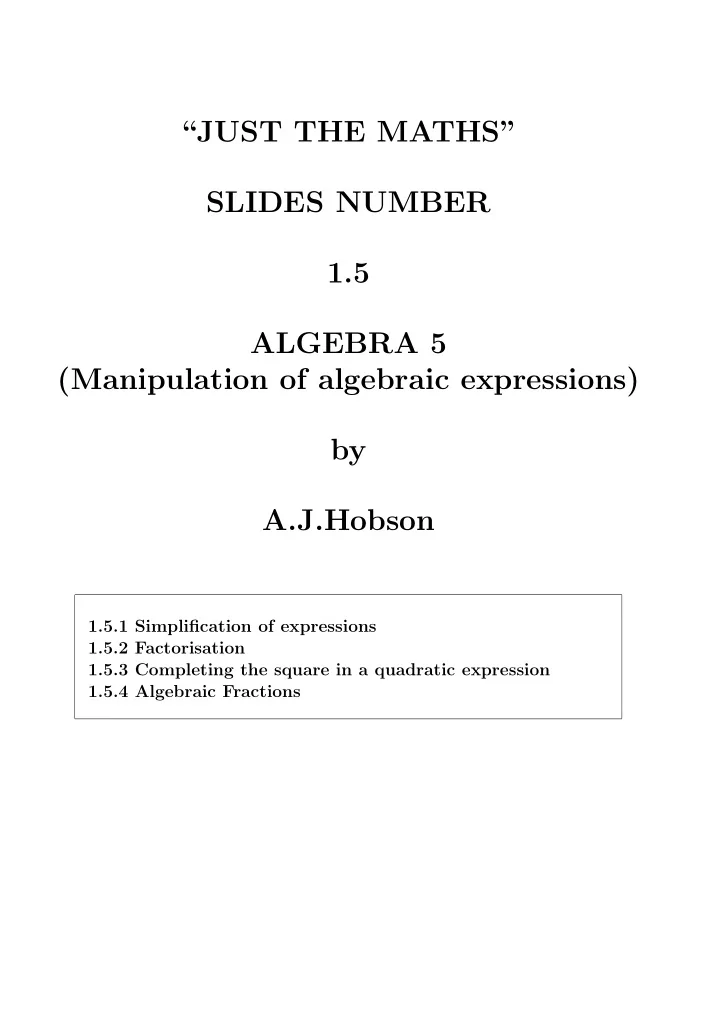
JUST THE MATHS SLIDES NUMBER 1.5 ALGEBRA 5 (Manipulation of algebraic expressions) by A.J.Hobson 1.5.1 Simplification of expressions 1.5.2 Factorisation 1.5.3 Completing the square in a quadratic expression 1.5.4 Algebraic Fractions


slide-1
SLIDE 1

“JUST THE MATHS” SLIDES NUMBER 1.5 ALGEBRA 5 (Manipulation of algebraic expressions) by A.J.Hobson

1.5.1 Simplification of expressions 1.5.2 Factorisation 1.5.3 Completing the square in a quadratic expression 1.5.4 Algebraic Fractions

slide-2
SLIDE 2

UNIT 1.5 - ALGEBRA 5 MANIPULATION OF ALGEBRAIC EXPRESSIONS 1.5.1 SIMPLIFICATION OF EXPRESSIONS Remove brackets and collect together any terms which have the same format Elementary Illustrations

  • 1. a + a + a + 3 + b + b + b + b + 8 ≡ 3a + 4b + 11.
  • 2. 11p2 + 5q7 − 8p2 + q7 ≡ 3p2 + 6q7.
  • 3. a.(2a − b) + b.(a + 5b) − a2 − 4b2 ≡ 2a2 − a.b + b.a +

5b2 − a2 − 4b2 ≡ a2 + b2. Further illustrations

  • 1. x(2x + 5) + x2(3 − x) ≡ 2x2 + 5x + 3x2 − x3 ≡

5x2 + 5x − x3.

  • 2. x−1(4x−x2)−6(1−3x) ≡ 4−x−6+18x ≡ 17x−2.

1

slide-3
SLIDE 3

Two or more brackets multiplied together (a + b)(c + d) = (a + b)c + (a + b)d = ac + bc + ad + bd. EXAMPLES:

  • 1. (x + 3)(x − 5) ≡ x2 + 3x − 5x − 15 ≡ x2 − 2x − 15.
  • 2. (x3 − x)(x + 5) ≡ x4 − x2 + 5x3 − 5x.
  • 3. (x + a)2 ≡ (x + a)(x + a) ≡ x2 + ax + ax + a2 ≡

x2 + 2ax + a2; a “Perfect Square”.

  • 4. (x + a)(x − a) ≡ x2 + ax − ax − a2 ≡ x2 − a2; the

“Difference of two squares”. 1.5.2 FACTORISATION Introduction “Factor” means “Multiplier”. Examples

  • 1. 3x + 12 ≡ 3(x + 4).
  • 2. 8x2 − 12x ≡ x(8x − 12) ≡ 4x(2x − 3).
  • 3. 5x2 + 15x3 ≡ x2(5 + 15x) ≡ 5x2(1 + 3x).
  • 4. 6x + 3x2 + 9xy ≡ x(6 + 3x + 9y) ≡ 3x(2 + x + 3y).

2

slide-4
SLIDE 4

Note: When none of the factors can be broken down into sim- pler factors, the original expression is said to have been factorised into “irreducible factors”. Factorisation of quadratic expressions A “Quadratic Expression” is an expression of the form ax2 + bx + c. The quadratic expression has “coefficients a, b and c”. EXAMPLES: (a) When the coefficient of x2 is 1

  • 1. x2 +5x+6 ≡ (x+m)(x+n) ≡ x2 +(m+n)x+mn;

5 = m + n and 6 = mn; By inspection, m = 2 and n = 3. Hence x2 + 5x + 6 ≡ (x + 2)(x + 3).

  • 2. x2+4x−21 ≡ (x+m)(x+n) ≡ x2+(m+n)x+mn;

4 = m + n and −21 = mn; By inspection, m = −3 and n = 7. Hence x2 + 4x − 21 ≡ (x − 3)(x + 7).

3

slide-5
SLIDE 5

Note: For simple cases, carry out the factorisation entirely by inspection. x2 + 2x − 8 ≡ (x+?)(x+?) ≡ (x − 2)(x + 4). x2 + 10x + 25 ≡ (x + 5)2. x2 − 64 ≡ (x − 8)(x + 8). x2 − 13x + 2 won′t factorise. (b) When the coefficient of x2 is not 1 Determine the possible pairs of factors of the coefficient of x2 and the possible pairs of factors of the constant term. EXAMPLES

  • 1. To factorise the expression 2x2 + 11x + 12,

Try (2x+1)(x+12), (2x+12)(x+1), (2x+6)(x+2), (2x + 2)(x + 6), (2x + 4)(x + 3) and (2x + 3)(x + 4) . 2x2 + 11x + 12 ≡ (2x + 3)(x + 4).

  • 2. To factorise the expression 6x2 + 7x − 3,

4

slide-6
SLIDE 6

Try (6x + 3)(x − 1), (6x − 3)(x + 1), (6x + 1)(x − 3), (6x − 1)(x + 3), (3x + 3)(2x − 1), (3x − 3)(2x + 1), (3x + 1)(2x − 3) and (3x − 1)(2x + 3). 6x2 + 7x − 3 ≡ (3x − 1)(2x + 3). 1.5.3 COMPLETING THE SQUARE IN A QUADRAT EXPRESSION We use (x + a)2 ≡ x2 + 2ax + a2 and (x − a)2 ≡ x2 − 2ax + a2. ILLUSTRATIONS

  • 1. x2 + 6x + 9 ≡ (x + 3)2.
  • 2. x2 − 8x + 16 ≡ (x − 4)2.
  • 3. 4x2 − 4x + 1 ≡ 4
  • x2 − x + 1

4

  • ≡ 4
  • x − 1

2

2.

  • 4. x2 + 6x + 11 ≡ (x + 3)2 + 2.
  • 5. x2 − 8x + 7 ≡ (x − 4)2 − 9.
  • 6. 4x2 − 4x + 5 ≡ 4
  • x2 − x + 5

4

  • 5
slide-7
SLIDE 7

≡ 4

  • x − 1

2

2 − 1

4 + 5 4

  • ≡ 4
  • x − 1

2

2 + 1

  • ≡ 4

  x − 1

2

  

2

+ 4. 1.5.4 ALGEBRAIC FRACTIONS Revision a b ± c d = ad ± bc bd , a b × c d = ac bd, a b ÷ c d = ad bc EXAMPLES 1. 5 25 + 15x ≡ 1 5 + 3x, assuming that x = −5

3.

2. 4x 3x2 + x ≡ 4 3x + 1, assuming that x = 0 or − 1

3.

3. x + 2 x2 + 3x + 2 ≡ x + 2 (x + 2)(x + 1) ≡ 1 x + 1, assuming that x = −1 or − 2.

6

slide-8
SLIDE 8

4. 3x + 6 x2 + 3x + 2 × x + 1 2x + 8 ≡ 3(x + 2)(x + 1) 2(x + 4)(x + 1)(x + 2) ≡ 3 2(x + 4), assuming that x = −1, −2 or −4. 5. 3 x + 2 ÷ x 2x + 4 ≡ 3 x + 2 × 2x + 4 x ≡ 3 x + 2 × 2(x + 2) x ≡ 6 x, assuming that x = 0 or −2. 6. 4 x + y − 3 y ≡ 4y − 3(x + y) (x + y)y ≡ y − 3x (x + y)y.

7

slide-9
SLIDE 9

7. x x + 1 + 4 − x2 x2 − x − 2 ≡ x(x − 2) (x + 1)(x − 2) + 4 − x2 (x + 1)(x − 2) ≡ x2 − 2x + 4 − x2 (x + 1)(x − 2) ≡ 2(2 − x) (x + 1)(x − 2) = − 2 x + 1 assuming that x = 2 or − 1.

8