Jurnal Ilmiah Universitas Batanghari Jambi Vol.15 No.1 Tahun 2015 - - PDF document

jurnal ilmiah universitas batanghari jambi vol 15 no 1
SMART_READER_LITE
LIVE PREVIEW

Jurnal Ilmiah Universitas Batanghari Jambi Vol.15 No.1 Tahun 2015 - - PDF document

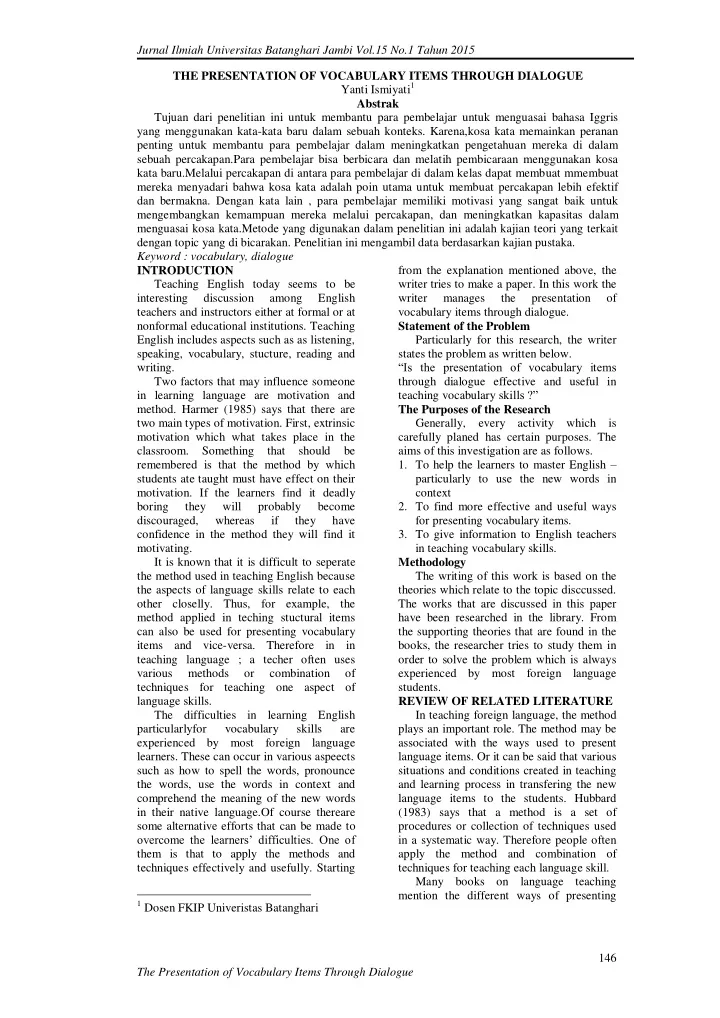
Jurnal Ilmiah Universitas Batanghari Jambi Vol.15 No.1 Tahun 2015 THE PRESENTATION OF VOCABULARY ITEMS THROUGH DIALOGUE Yanti Ismiyati 1 Abstrak Tujuan dari penelitian ini untuk membantu para pembelajar untuk menguasai bahasa Iggris yang


slide-1
SLIDE 1

Jurnal Ilmiah Universitas Batanghari Jambi Vol.15 No.1 Tahun 2015 146 The Presentation of Vocabulary Items Through Dialogue INTRODUCTION Teaching English today seems to be interesting discussion among English teachers and instructors either at formal or at nonformal educational institutions. Teaching English includes aspects such as as listening, speaking, vocabulary, stucture, reading and writing. Two factors that may influence someone in learning language are motivation and

  • method. Harmer (1985) says that there are

two main types of motivation. First, extrinsic motivation which what takes place in the classroom. Something that should be remembered is that the method by which students ate taught must have effect on their

  • motivation. If the learners find it deadly

boring they will probably become discouraged, whereas if they have confidence in the method they will find it motivating. It is known that it is difficult to seperate the method used in teaching English because the aspects of language skills relate to each

  • ther closelly. Thus, for example, the

method applied in teching stuctural items can also be used for presenting vocabulary items and vice-versa. Therefore in in teaching language ; a techer often uses various methods

  • r

combination

  • f

techniques for teaching one aspect of language skills. The difficulties in learning English particularlyfor vocabulary skills are experienced by most foreign language

  • learners. These can occur in various aspeects

such as how to spell the words, pronounce the words, use the words in context and comprehend the meaning of the new words in their native language.Of course thereare some alternative efforts that can be made to RYHUFRPH WKH OHDUQHUV¶ GLIILFXOWLHV 2QH RI them is that to apply the methods and techniques effectively and usefully. Starting

1 Dosen FKIP Univeristas Batanghari

from the explanation mentioned above, the writer tries to make a paper. In this work the writer manages the presentation

  • f

vocabulary items through dialogue. Statement of the Problem Particularly for this research, the writer states the problem as written below. ³,V WKH SUHVHQWDWLRQ RI YRFDEXODU\ LWHPV through dialogue effective and useful in teaching vocabulary skiOOV"´ The Purposes of the Research Generally, every activity which is carefully planed has certain purposes. The aims of this investigation are as follows.

  • 1. To help the learners to master English ±

particularly to use the new words in context

  • 2. To find more effective and useful ways

for presenting vocabulary items.

  • 3. To give information to English teachers

in teaching vocabulary skills. Methodology The writing of this work is based on the theories which relate to the topic disccussed. The works that are discussed in this paper have been researched in the library. From the supporting theories that are found in the books, the researcher tries to study them in

  • rder to solve the problem which is always

experienced by most foreign language students. REVIEW OF RELATED LITERATURE In teaching foreign language, the method plays an important role. The method may be associated with the ways used to present language items. Or it can be said that various situations and conditions created in teaching and learning process in transfering the new language items to the students. Hubbard (1983) says that a method is a set of procedures or collection of techniques used in a systematic way. Therefore people often apply the method and combination of techniques for teaching each language skill. Many books on language teaching mention the different ways of presenting THE PRESENTATION OF VOCABULARY ITEMS THROUGH DIALOGUE Yanti Ismiyati1 Abstrak Tujuan dari penelitian ini untuk membantu para pembelajar untuk menguasai bahasa Iggris yang menggunakan kata-kata baru dalam sebuah konteks. Karena,kosa kata memainkan peranan penting untuk membantu para pembelajar dalam meningkatkan pengetahuan mereka di dalam sebuah percakapan.Para pembelajar bisa berbicara dan melatih pembicaraan menggunakan kosa kata baru.Melalui percakapan di antara para pembelajar di dalam kelas dapat membuat mmembuat mereka menyadari bahwa kosa kata adalah poin utama untuk membuat percakapan lebih efektif dan bermakna. Dengan kata lain , para pembelajar memiliki motivasi yang sangat baik untuk mengembangkan kemampuan mereka melalui percakapan, dan meningkatkan kapasitas dalam menguasai kosa kata.Metode yang digunakan dalam penelitian ini adalah kajian teori yang terkait dengan topic yang di bicarakan. Penelitian ini mengambil data berdasarkan kajian pustaka. Keyword : vocabulary, dialogue

slide-2
SLIDE 2

Jurnal Ilmiah Universitas Batanghari Jambi Vol.15 No.1 Tahun 2015 147 The Presentation of Vocabulary Items Through Dialogue new lexical items. In this case, Hubbard (1983) asserts that some points to bear in mind in presenting nw vocabulary items are : (1) teach and practice the words in spoken form first, then the students try to pronounce the words as they are witten.(2) Put the words into context and get the students to practice them.(3) Present the vocabulary items in a memorable way to start with. Mean while Doff (1988) states that there are few techniques for teaching new words, they are: (1) Say the words clearly and write it on the board.(2) Get the class to repeat the word in chorus.(3) Translate the words into the VWXGHQWV¶RZQODQJXDJH'UDZDSLFWXUHWR show what the word means. (5) Give an English example to show how the word is used.(6) Ask questions using the new word. Other opinions about how to teach vocabulary items are stated by Harmer (1983). According to this author, there are some ways which can be used in presenting vocabulary items such as (1) Realia. It means that the teacher brings real objects into classrooms and shows them to the

  • students. (2) Pictures. Pictures can be used

to explain the meaning of lexical items.(3) Mime, Action and gesture.(4) Contrast, when the visual elements (e,g.picture, realia, mime, etc.) may not be sufficient to explain the meaning of the words, contrast can be

  • used. (5) Enumeration ( list). In this case, the

tacher can make a list of food or list of

  • vegetables. (6) Explanation. The teacher

explains the meaning of vocabulary items by using phrase and definition.(7) Translations, Sometimes the teacher has to translate the PHDQLQJ RI ZRUGV LQWRWKH VWXGHQWV¶ QDWLYH language. Brown (2007) proposed five principles for teaching vocabulary: giving the

  • portunity

to the student in special vocabulary learning time and class, helping students to learn vocabulary in context, using the role of bilingual language, encaurage students to develop strategies for determining meaning of words, and be ready LQ³XQSODQQHG´YRFDEXODU\WHDFKLQJ7KHQ theory from Hall (1995) as cited in Tomlinson (2007) outlined 4 principles in material development : need to communicate, need for long term goal, need for authenticity and last need for Student- Conteredness. In teaching vocabulary items may be not all techniques and method mentioned above can be applied at once. Also it is very different for the teachers to use only one technique to present lexical items. Therefore in making this work, the researher tend to combine two or more techniques to teach the vocabulary items. In this points of view, this author gives examples of presentation of vocabulary items through dialogue in her ERRN ZKLFK LV FDOOHG ³ 7HDFKLQJ (QJOLVK 7KURXJK (QJOLVK´ $QG LQ WKH IROORZLQJ example of the presentation of lexical items, the writer imitates the way which is used by the author, but the words which will be taught are different. Hornby (1995) states that vocabulary is the total number of words

  • f language or vocabulary is arrange of

words known to, or used by a person in trade, profession, etc. Futhermore, it is necessary to explain that before presenting the vocabulary items, the taecher has to determine what techniques will be used and classify the new words which will be presented in the classroom. To choose the techniques aims to find out the procedures which are supposed to be more suitable and nore practical. Then, to classify the words means to group the new words based on their classification, formation and characteristics. THE PRESENTATION OF VOCABULARY THROUGH DIALOGUE The Example of the Presentations Stage This is an elementary class. The students

  • f this class will be taught some new words

about the names of stationary. In this case, the teacher brings real things to the classroom such as pen, book, ruler, a piece

  • f paper, pencil, etc. To make the students

know the name of the things above, the teacher teaches them through a dialogue as written below. List of Words: pen,book, ruler, a piece of paper, pencil, eraser, ballpoint, boardmarker, note book, correct ink, chalk, drawing book, Note : T=Teacher, Ss= Students, S= Student T :Look.What is in here? What is this? SS : Do not know T :Well. It is a pen.pen. can you say it? Ss : It is a pen T : Good.Say it again.Pen. Ss : Pen. T : Good. It is a pen.Everybody! What is this? Ss : No. T :HOO,Q(QJOLVKZHVD\³ERRN´ Ss : Book. T : Good.Everybody! It is a book. Ss : It is a book. T : Good. Now Yanto! What is this? S :It is a book.

slide-3
SLIDE 3

Jurnal Ilmiah Universitas Batanghari Jambi Vol.15 No.1 Tahun 2015 148 The Presentation of Vocabulary Items Through Dialogue T : Good. Now Rini!What is thid? S : It is a book. T : Very good.Now look here again! What is this? Can you say it in English? Ss : No. T :HFDOOLW³UXOHU´ Ss : Ruler. T : Good. Andi! Say it again. S : Ruler. T : Good. Everybody! Repeat after me! It is a ruler. Ss : It is a ruler. T :Good. Now look at something different! Who can say it in English? Ss : No one. T : Well. We say it is a piece of paper.Say it ! Ss : A piece of paper. T : Good. Everybody! It is a piece of paper.Say it! Ss :A piece of paper. T : Good. Everybody! It is a piece of paper. Ss : It is a piece of paper. T : Very good. Now.Santi! Say it again! S : It is a piece of paper. T : Tomy! What is this? S :It is a piece of paper. T : Very good.Now, Look here again! There is something different. Who can guess it? SS : Do not know. T : Right. It is a book? Ss : No. T : Right.Is it a book? Ss : No. T :Is it a pen? Ss : Yes. T : Hmm.......It is not a pen. We say it is a pencil. O>K. Repeay after me! Pencil. SS : pencil. T : Good. Everybody! What is this? Ss :It is a pencil. T :Good. Harsono! What it is this? S :It is a pencil. T : Very good. Now look here again! What is this? Can you say it in English? Ss : Eraser. T : Good. repeat after me! It is an eraser. Ss : It is an eraser. Follow up : The teacher finishes checking their learning, then goes on to present a dialogue to practice the new words in the same way until the meeting time is up. The Advantages of Presentation Through Dialogue When it is viewed from the involvement

  • f the students in the classroom. This will

bring a good effect to the learners. Through the direct communication in the class, the learners will be active in using it in context. They not only recognize the new words but they are also trained to practice the words in various forms

  • f

sentence. Wehmeir (2005:1707) states that vocabulary is the list

  • f words with their meaning especially in a

book for learning a foreign language. According to Gribb (2002:74) vocabulary is

  • ne important language component. Nation

& Newton (1997:45) states that vocabulary is knowledge of words and words meaning. The active bilateral and multiliteral interaction in teaching languageis very

  • necessary. This will make the students

practice their language or produce their new target language many times.By repeating the new words a few times, the new language itHPV ZLOO EH LQWHJUDWHG LQ WKH OHDUQHUV

  • minds. Cameron (2001:75) claims that

someone who has a lot of vocabulary of foreign language, she/he could learn language easily. The way of presenting vocabulary items through a dialouge can cause the learners to accustomed to apply the practical sentences. And by using this way they can also improve their pronounciation and action in speaking

  • English. And it can also be said that in this

way the students are assisted to master other language skills (e.g.speaking, stucture and listening) consciously or unconsiously as well as vocabulary. The Weaknesses of Presentation Through Dialogue The writer realizes that this way also has some new words in a meeting. The teacher cannot present many new words in a

  • meeting. The teacher has difficulty in

involving each of the learners satisfactorily in a big class. When an instructorswants to engage all students by giving each a turn to repeat a word or a sentence, the instructor will spend more time for a meeting;otherwise he or she only can present some words. Also the preparation of this presentation is more difficultthan other

  • presentation. The teacher has to decide what

kind of words willbe presented. When the teacher would like to teach some words, For instance verbs,he or she has tothink how to use those words (verbs) in context or sentence so that the learners can memorize the words easily. But if the planning of the presentation is not so clear, it will be difficult to be applied. CONCLUSION After analyzing the description or

slide-4
SLIDE 4

Jurnal Ilmiah Universitas Batanghari Jambi Vol.15 No.1 Tahun 2015 149 The Presentation of Vocabulary Items Through Dialogue explanation in the previous discussions, the writer comes to the following conclusions. First, by applying the presentation of vocabulary items through dialoguen the students are trained to produce or use the target language

  • rally.

Second, the presentation of vocabulary items through dialogue is supposed to be more effective; because this way can make the learners form their habit formation in using Englis, ecpecially for elementary level or for the beginners.Third, the preparation through dialogue should be carefully managed;otherwise it cannot be applied satisfactorily.Fourth, it is difficult to use this presentation in teaching vocabulary items in a big class with many new words; because the time available for a meeting is limited. REFERENCES Brown, H.Dauglas (2007). Teaching by Principles: An Interactive Approach to Language Pedagogy.USA: Pearson Education. Cameron,Lynne.2001.Teaching Languages to Young Learners. Cambridge: Cambridge University Press. Doff,A.1988.Teach English. Cambridge University Press. Great Britain. Ghrib,E.M.2002.SecondarySchool 6WXGHQWV¶3HUFHSWLRQV RI /HDUQLQJ Difficulties and Strategies. Http:nclrc.org/speaking/spindex/htm. (Accessed from internet on 9th January 2015) Harmer, J.1995.The Practice of English Language Teaching. Longman Group

  • Limited. London.

Hornby,A.S.1995.Oxpord Advanced Learners Dictionary.Great Britain: Cambridge University Press. Hubbard, P.1983. A Training Course for

  • TEFL. Oxford University Press.

London. Nation,P.& Newton,J.1997.Teaching Vocabulary.Cambridge:Cambridge University press. Tomlinson, B.(2007).Developing Material for Language Teaching.New York: Continuum. Willis, J.1981. Teaching English Through

  • English. Longman Group limited.

London. Wehmeir,S.at al.2005.Oxford Advanced /HDUQLQJ¶V 'LFWLRQDU\2[SRUG University Press.