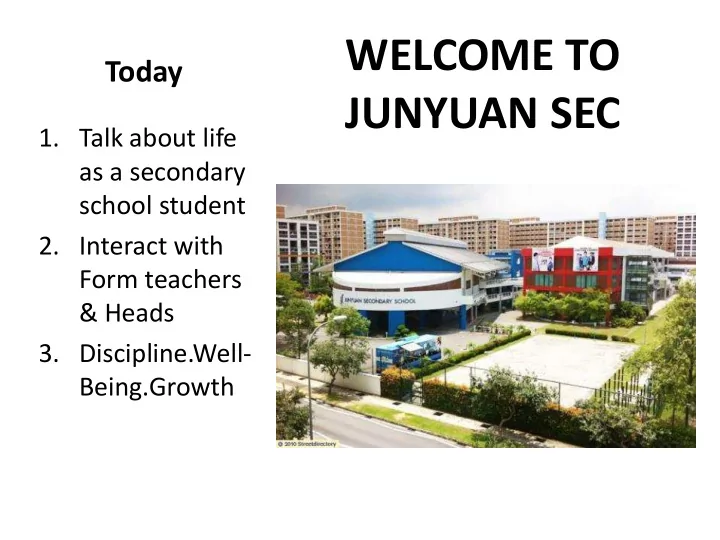
SLIDE 1 Today
WELCOME TO JUNYUAN SEC
as a secondary school student
Form teachers & Heads
Being.Growth
SLIDE 2 SCHOOL LEADERS AND LOWER SEC YEAR HEADS
Principal – Mr Mohamed Razali Vice-Principal – Mr Paul Ng Vice-Principal – Mrs Selina Lum Lower Sec Year Heads Mdm Teo Wil Ping (Year Head Lower Sec) Mr Vaahid (Asst YH, Lower Sec, Subject Head/
History)
SLIDE 3 STUDENT MANAGEMENT TEAM
Mrs Denise Tan HOD Student Mangement Mrs Sharon Tan LH/Student Development Mr Alsagoff [FT of 1T1] Ms Joanna Koh [FT of 3N1] Ms Rachael Teo [FT of 2N2] Mr Ng Chee Keong (School Counsellor) Ms Law Xin Ning (AED/LBS) Ms Zaiha (School Health Advisor)
SLIDE 4 SEC 1 FORM TEACHERS
Sec 1E1 – Miss Thng Wei Wei, Ms Nordiana Sec 1E2 – Ms Nadiah, Mr Seah Cheng Hong Sec 1E3 – Mdm AliciaTan, Ms Debbie Lim Sec 1E4 – Mr Ling Weicong, Ms Belinda Chew Sec 1N1 – Ms Sim Jia En, Mr Loh Chee Teng, Ms Teh
Sim Sim
Sec 1N2 – Ms Nur-Iffah, Mdm Hasanah Sec 1T1 – Mr Alsagoff, Ms Nur Zahirah, Ms Zhuang
Yingmeng
SLIDE 5 GETTING IN TOUCH WITH THE SCHOOL
65873683 or 65873684 (leave a message for a
specific teacher, include child’s name and class)
junyuan_ss@moe.edu.sg (may not be same-day
reply)
1.
The name and class of your child
2.
The teacher's name (if you would like to communicate directly with a particular teacher)
3.
The subject/ department/ activity with which you have a query (if you are not sure who to contact)
SLIDE 6 COMMUNICATING WITH PARENTS
School website – www. junyuansec.moe.edu.sg Facebook Page -
https://www.facebook.com/junyuan.secondary/
E-notification Letters through your child Telephone Email to parents - Junyuan Journal Please update your contact info if there are changes
SLIDE 7
WHAT CAN YOUR CHILD LOOK FORWARD TO IN JUNYUAN?
SLIDE 8 We start with 2 Key Ideas about school
School experience must be a positive
learning experience which grows students to become persons for others
When students leave the school, the key
we give them must open as many doors as possible
SLIDE 9 Reality Check for Everyone …
We can’t give ALL the keys to ALL the
doors
We can only try to make sure that the
keys we give lead them to a room which will allow them to earn the other keys
SLIDE 10
Our Hope as a School:
VISION CHAMPIONS FOR THE COMMUNITY
SLIDE 11 WE START WITH VALUES STATEMENTS …
- Respect - I will value myself and others
- Responsibility - I will perform my role/s
with commitment
- Resilience - I will persevere in the face
- f challenges
- Innovation - I will seek improvement to
make the community a better place
- Excellence - I will strive to do my best
Student Handbook Page 4
SLIDE 12 … WE EXERCISE VALUES-IN-PRACTICE (VIP)
- VIP Week - Term 2 Week 1
- Secondary One
- Service Learning and Innovation Workshop
- 1. Learn skills and tools to identify community
challenges
- 2. Collaboratively design prototypes to address
these challenges through leveraging the Innovation Protocol
- 3. Respect, Responsibility and Innovation
SLIDE 13
SLIDE 14
Bringing Joy to the Community
SLIDE 15
SLIDE 16
Contributing to the Community
SLIDE 17
Learning For Life Programme (LLP)
Cultivating Community Champions Through Youth Leadership
SLIDE 18 Leadership & Social Entrepreneurship
To develop leadership in social
entrepreneurship through pushcart activities
To equip students with problem solving skills
to meet the needs identified in the community.
To establish partnerships with social
enterprises to provide real-world working and learning experience for our students.
SLIDE 19
Partnership with Our Tampines Hub
SLIDE 20
Gold Award & Best Supported Team
SLIDE 21
SLIDE 22 VALUES-IN-PRACTICE (VIP)
- VIP Week - Term 2 Week 1
- Secondary One Aesthetics Programme
- Visual Arts, Music & Dance Appreciation
- 1. Learn, experience and interact with various
aesthetics domains and art practitioners to deepen appreciation and ignite interest
- 2. Respect, Responsibility and Innovation
SLIDE 23
Applied Learning Programme (ALP)
Developing Application-Based Learning Through Food Science
SLIDE 24 Applied Learning Through Food Science
The food industry is a significant
component of Singapore’s economy – almost $10bn annual turnover
Focus on Food science – students explore
& learn more to broaden their life and career options after school
A platform to develop 21st century skills
such as creative and inventive thinking and effective communication skills.
SLIDE 25 How it looks like …
Sec 1 Applied Food Science Module 1:
JY Science Master Chef – Molecular food science and food safety
Sec 2 Food and Technology. Ready for
SMART Nation Coding, Ardunio Programming
- Sec 3 Coffee Barista or Molecular
gastronomy electives. The science and skills behind coffee making and alternative food preparation techniques.
SLIDE 26 Secondary 1
Food Science modules
Food Hygiene Canning Spherification
SLIDE 27 Secondary 2 Showcasing their final prototypes
Automatic food slicer Safety gas detector Automatic cooling rack
SLIDE 28
Secondary 3
Artisanal Ice Cream Making Junior Barista
SLIDE 29 Student Handbook Page 4
SLIDE 30 PROGRESSIVE LEVEL OUTCOMES (STUDENT HANDBOOK – PG 7)
Lvl Level Focus School Wide Programmes Level Programmes / Activities
Sec 1
A respectful & positive student
based Lessons
Modules
Outreach Programmes
Programmes
- 4 NE Core events
- Big Breakfast
- Sports Festival
- Student-Initiated
VIA
Learning Journey Sec 1 Orientation Sec 1 Aesthetics Workshop(VIP) Induction to RP CCA Open House LLP –Yr 1 /VIA/SLC ALP- Masterchef Challenge Kayaking 1-Star
Sec 2
A resilient team player Sec 2 Outdoor Adventure Camp (VIP) Guidance & Subject Information module for Upper Sec LLP – Yr 2/VIA/SLC ECG Fair and Visit to IHLs
Sec 3
A civic- minded contributor Leading & Facilitating school/level programmes Sec 3 Out-of-curriculum Week (VIP) Learning Skills Workshop LLP – CCA pushcart events Student Work Exposure
Sec 4/5
A leader of character Leading & Facilitating school/level based programmes EAE/DSA Talk Sec 4/5 Life Skills Workshop ECG/Visit to IHL
SLIDE 31 PROGRESSIVE – AN EXAMPLE FROM OUTDOOR EDUCATION
- Sec 3 MOE-OBS Programme
- Junyuan will participate in 2018
- Sec 1 – Kayaking 1-Star Certification
- Sec 1 – Cycling Clinic
- Sec 1 – OE lessons
- Sec 2 – during VIP Week
- 25 – 30 km Cycling Expedition
- 10 – 15 km Orienteering
- Dragon Boating/ Kayak Expedition
- Field Cooking
- Communal Living
SLIDE 32 Positive School Experiences
- Ensures a basic but unique educational foundation for all
Junyuan students
- Provides, common purpose, coherence and stability in
student programmes as they progress from one year to the next
- Enhances students’ sense of belonging to the school
- Enables the community to demonstrate school values,
nurture a culture of care and inspires giving back
- Important that every Junyuan student contributes
SLIDE 33
POSITIVE BEHAVIOURAL SHIFT
Current Future
SLIDE 34
Current Future
Lead Initiate/ Inspire Audience Participate
POSITIVE BEHAVIOURAL SHIFT
SLIDE 35
SLIDE 36
YOU ARE NOW YOUNG ADULTS
SLIDE 37 More Subjects, Tests, Assessments, Exams
- English
- Drama (E/NA)
- Mother Tongue
- Mathematics
- Science
- Geography (Exp/NA)
- History (Exp/NA)
- Literature (Exp/NA)
- Social Studies (NT)
- ICT
- Design & Technology/
Technical Studies
Education (FCE)/ Home Economics
- CPA (NT)
- Visual Arts
- Music
- PE
- CCE
SLIDE 38 Longer Time in School
- Unstructured Time
- Waiting for Friends
- Hanging out with Friends
- At the Library
- In the Canteen
- Playing Sports Around the School
- Self-Revision
SLIDE 39 Co-Curricular Activities
Leadership Enrichment Achievement Participation Service
Student Handbook Page 28 - 30
SLIDE 40
Practice of Independence with Responsibility
Be prepared to learn and participate
actively
Don’t wait to be told to do what you
should already know (your attire, punctuality, manners)
Have a timetable for your
unstructured time – surround yourself with friends who have such timetables
SLIDE 41 Restorative Practices (RP) (Student
Handbook pp 7-8)
Building, maintaining and repairing
relationships
Between teachers-students; students-
students; students-parents
Allows the community to reflect on
their actions, make restitution and restore relationships
Many platforms to build relationships –
Form T eacher Family Time, CCE Nuggets, Big Breakfast
SLIDE 42 School Rules & Regulations (Student Handbook pp 13 - 18)
Code of Conduct Support the community to:
- Understand importance of good moral
behaviour
- Develop Respect for self & others
- Create a conducive learning
environment
BUT – rules cannot be created for
every possible thing
SLIDE 43
SUPPORTING YOUR CHILD… AND EACH OTHER
SLIDE 44 Some ideas
- Maintain an interest in each other’s lives –
strike a balance
- Help to manage each other’s time
- Know each other’s friends
- Keep encouraging each other to aspire to
become better
SLIDE 45
WHAT YOU ARE NOW, DOES
NOT DETERMINE WHAT YOU BECOME LATER IN LIFE …
Your Growth = Self-Discipline + Well-Being
SLIDE 46
DISCIPLINE. WELL-BEING. GROWTH.
Managing students so that they are able to manage themselves
SLIDE 47 TODAY’S EMPHASIS :EXPECTATIONS & SUPPORT FROM SM TEAM
- 1. Intention behind our Expectations
- 2. Parents as Partners to Support Child
- 3. Some Common Transitional stress
- 4. Restorative Practices Approach to Disciplinary
Issues
- 5. A Safe & Caring School
SLIDE 48
OUR BELIEF
Schools are not buildings, curriculum, timetables and meetings. In these days and age, certainly not a child depository while adults work. Schools are relationships and interactions among people. (Johnson & Johnson, 1994)
SLIDE 49
WHATWEVALUE
In Junyuan, we value RELATIONSHIPS. Relationships between teacher and student. Relationships between student and student. Relationships between students and the community. Relationships between school and the stakeholders. We trust that with good relationships established right and strong from the start, even when things go wrong, there is empathy, willingness and responsibility to rebuild the relationships. With positive and quality relationships, the child can grow to become a responsible and respectful young adult with a network of support to fall back on in times of failures and challenges.
SLIDE 50 THE RELATIONSHIPS WE BUILD
Teacher – Student Relationship
A Significant Adult for Every Child TSD; Classroom Circles/Relational Circles; Big Breakfast;
CCA etc.
Student – Student Relationship
A Significant Friend for Every Child Classroom Circles/Relational Circles; CCA; Big Breakfast;
Level-wide school experiences etc.
Teacher – Parent Relationship
Dialogues; E-notifications; Restorative Conferences;
Parental Engagement Sessions
SLIDE 51 AN EXAMPLE OF AN EXPECTATION - ATTENDANCE & PUNCTUALITY FOR SCHOOL & LESSONS
We cannot teach an empty chair. Attendance in school is important for learning and engagement.
Regular attendance in school reflects the needs of the child being met (at home, in school and with friends).
When a child is absent without a valid reason from school, a call is
made through the FT. Should a child be absent from school without valid reason and without successful communication for 3 days, a letter is hand-delivered to your residence and the school’s SDT (SL/YHs/HODSM) are informed.
We seek the parents’ support in communicating with the FTs when
your child is unable to attend school. Should there be any difficulties for your child to attend school, feel comfortable to call or email the school for help. It is better to seek help than to avoid attending to the issue.
SLIDE 52 AN EXAMPLE OF AN EXPECTATION - ATTENDANCE & PUNCTUALITY FOR SCHOOL & LESSONS
To reiterate, we cannot teach an empty chair. Punctuality for school and lessons reflects self-discipline and
respect for the institution, the teachers and others.
When a child is late for school, the natural loss is his own time.
He misses lessons and when he walks into the class and the class has to pause for his readiness, he causes others to lose time.
The logical consequences for the school, is then to get him to
‘make up’ for the time loss and put him through some uncomfortable “work” so that he will review his own actions and be on time in future.
SLIDE 53 So when your child is late (even for 1 time), he will have to
report for after-school community cleaning duty. The number
- f times he is late, will be the number of times he reports
for cleaning. It is your child’s responsibility to alert you when he has to report for duty.
However, should your child be persistently late, you will
receive a call from the FTs to discuss about the child’s
- behaviour. We are willing to work together with you to try
help the child.
Habits are usually harder to break if we want the child to do
it himself alone. He needs the adults to help him ‘rewire’ his routines and to role-model the way to achieve that.
AN EXAMPLE OF AN EXPECTATION - ATTENDANCE & PUNCTUALITY FOR SCHOOL & LESSONS
SLIDE 54 SOME COMMON TRANSITIONAL STRESS
- 1. New Friends vs Old (& gold) friendships
- 2. New Environment vs Familiarity
- 3. New (& Higher) Expectations from adults at
home
SLIDE 55 WHAT CAN BE DONE?
Parents Child Remember our responsibility to our children Remember your responsibility and accountability towards your parents Build trusting relationships with our children so that he/she can communicate their challenges to us Build the trust that your parents have in you by demonstrating responsibility and accountability Role-model the values, aptitudes and expectations for your child Respect the decisions and choices that your parents suggest. Their intentions are always for your good.
SLIDE 56 RESTORATIVE PRACTICES APPROACH TO DISCIPLINARY ISSUES
RP is a relational approach. It emphasizes the
wrongdoer’s responsibility to make restitutions for the behaviour and suggest ways to rebuild the relationship(s) with the victim(s).
It is not focused on ‘an eye for an eye’ justice but
part of the Restorative Justice where we focus on ‘rebuilding harmed & damaged relationships’.
SLIDE 57 SCENARIO: BEN CALLED ALAN NAMES. ALAN LOST
HIS TEMPER AND PUNCHED BEN IN THE FACE Traditional Approach Restorative Approach School rules are broken People and relationships are harmed Focus: Establish guilt on Alan Focus: Identifies needs and responsibilities Accountability: Punishment, e.g. suspension for Alan Accountability: Understanding impact and repairing harm Victim, Ben is ignored. Offender, victim and school all have roles in case resolution Limited opportunity for expressing remorse or making amends Opportunity given to make amends and express remorse, work towards positive outcomes and relationships
SLIDE 58 RESTORATIVE PRACTICES APPROACH TO DISCIPLINARY ISSUES
Face-to-Face Clarification with students involved to establish facts. Inform parents of child’s involvement. Case Resolution through Restorative Conferences with all involved parties. Inform parents
RP Script
- What happened?
- What were you thinking
when it happened? Identifies needs and responsibilities
- Who have been affected?
- What have you thought
about since?
Understanding impact on self and others, relationships are harmed
SLIDE 59 RESTORATIVE PRACTICES APPROACH TO DISCIPLINARY ISSUES
Face-to-Face Clarification with students involved to establish facts. Inform parents of child’s involvement. Case Resolution through Restorative Conferences with all involved parties. Inform parents
Closure dialogue with
relationships.
discipline consequences
additional support if needed.
SLIDE 60 RESTORATIVE PRACTICES APPROACH TO DISCIPLINARY ISSUES
RP Script
- What do you think needs to
happen to make things right?
Repairing harm: opportunity given to make amends and express remorse, work towards positive
- utcomes and relationships
Closure dialogue with
relationships.
discipline consequences
additional support if needed.
SLIDE 61 RESTORATIVE PRACTICES APPROACH TO DISCIPLINARY ISSUES
Face-to-Face Clarification with students involved to establish facts. Inform parents of child’s involvement. Case Resolution through Restorative Conferences with all involved parties. Inform parents
Closure dialogue with
relationships.
discipline consequences
additional support if needed.
SLIDE 62 IS THERE NO PUNISHMENT?
An
appropriate disciplinary consequence will be implemented once the SM team has concurred and
- discussed. Please refer to the Student Handbook pg 17-
18 for more information.
If a student has committed a serious offence (e.g
bullying, fighting, smoking etc), his/her conduct grade for the semester will be affected. With a “Poor” or “Fair” grade, the student is not eligible for any bursary awards
- r school-based awards. His / Her discipline case will be
keyed into the School Offence Module (SOM).
SLIDE 63 SOME FINAL WORDS FOR OUR NEW STUDENTS & PARENTS – A SAFE & CARING SCHOOL
It’s relationships, not programmes that change children.
Young people thrive when adults care about them on a
- ne-to-one level, and when they have a sense of
belonging to a caring community.
While the parents continue to be significant adults at
home, we are working towards building a strong relationship between your child and the teacher, the child and other children, as well as the child and the community.
With that, he/she has someone to turn to when needed.
With that, he/she can feel safe, supported and valued in the community throughout the 4-5 years.
SLIDE 64 Secondary Express/ Special Secondary Normal Technical Secondary Normal Academic
GCE O
Polytechnic Diploma (3yrs) Junior College (2yrs) Millenia Institute (3yrs) ITE Higher NITEC
UNIVERSITY DEGREE
GCE A
All Pathways can lead to a University Degree
GCE A Diploma PFP
ITE NITEC
DPP NITEC Higher NITEC Higher NITEC Higher NITEC GCE O GCE N
SkillsFuture
Lifelong Learning
SLIDE 65 ITE progression to Polytechnics
- Can progress directly from the Basic NITEC 2-
year programme
- More than 30 courses that allow your child to
do so – need to get a minimum Grade Point Average of 3.5 (maximum 4.0)
- Aerospace Aveonics, Machine Technology,
Chemical Process Technology, Infocomm Technology (Cloud Computing)
SLIDE 66 Promotion Criteria – Secondary School (Student Handbook pp 20-21)
– Pass EL & pass %age in Average of all subjects – Promotion Criteria not met – move to Sec 2NA
– Grade 5 or better in
- EL & 2 other subjects OR 4 subjects (NA)
- 70% average – consider transfer to 2
Express
T echnical – Grade 5 or better in
- 2 subjects – one must be EL or Maths
- 70% average – consider transfer to 2
Normal Academic
SLIDE 67
Subject-Based Banding (SBB)
Offered in Sec 3 & 4 – NT offered NA
subjects; NA offered Express
Offer in Sec T
wo if your results meet the criteria
Different students have different
strengths; some strengths are discovered later
Remember the caveats I mentioned
during Registration Day
SLIDE 68 If you take a subject in a higher stream …
- You have to work much harder to do well in
the higher-level subjects
- You may find yourself falling behind if you
don’t put in the effort
- Not a guarantee for lateral transfer to a
higher-level stream in Sec 2
SLIDE 69 Year Eligible for JCs % Eligible for Polytechnics % Express Normal Express Normal 2010 36.8 4.1 93.7 67 2011 39.5 8.3 92.2 65.2 2012 35 7.1 90.3 89.2 2013 45.2 9.1 92.9 79.2 2014 46.8 18.7 98.7 76.5 2015 37.0 17.0 92.9 69.8 2016 42.0 93.7 91.9
Eligibility for Post-Secondary – keys to
SLIDE 70 Year Normal Academic Normal Technical Eligible for 5N (%) Comparison with National ELMAB1 Comparison with National
2011 74.3 72.8 7.61 9.07 2012 74.5 72.7 8.81 8.92 2013 82.2 73 8.58 8.83 2014 83.7 74.7 7.82 8.67 2015 92.6 75.1 8.03 8.57 2016 84.3 75.5 7.45 8.25 2017 81.4 77 8.3 8.16
72.9% passed EL, MA, Sci (27 out
Eligibility for Post-Secondary – keys to
SLIDE 71 Our Commitment …
- To do the best that we can for each student
- Develop each to be a Champion for the
Community
- But – it takes two hands to clap
SLIDE 72
better than when you first came to Junyuan
hard to achieve positive goals
- Your belief in the fact that
the school will do what it takes to get you there
SLIDE 73
WIS ISHING HING YOU OU A GREAT T 2018 18