
SLIDE 1
JOSEF FRITZ (Austria, Wagram, Zaussenberg)
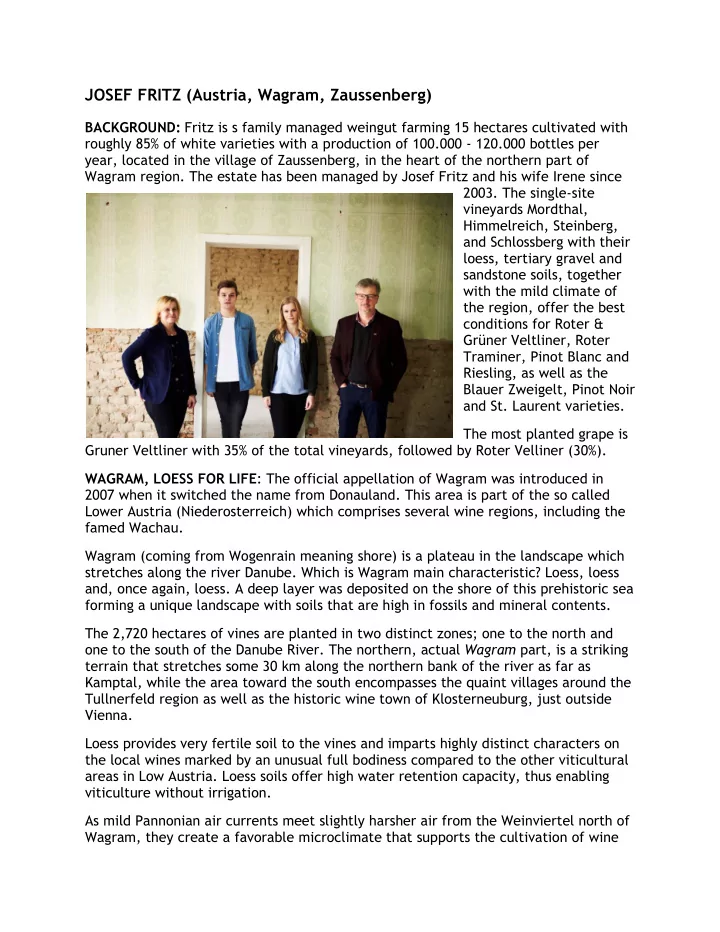
BACKGROUND: Fritz is s family managed weingut farming 15 hectares cultivated with roughly 85% of white varieties with a production of 100.000 - 120.000 bottles per year, located in the village of Zaussenberg, in the heart of the northern part of Wagram region. The estate has been managed by Josef Fritz and his wife Irene since
- 2003. The single-site
vineyards Mordthal, Himmelreich, Steinberg, and Schlossberg with their loess, tertiary gravel and sandstone soils, together with the mild climate of the region, offer the best conditions for Roter & Grüner Veltliner, Roter Traminer, Pinot Blanc and Riesling, as well as the Blauer Zweigelt, Pinot Noir and St. Laurent varieties. The most planted grape is Gruner Veltliner with 35% of the total vineyards, followed by Roter Velliner (30%). WAGRAM, LOESS FOR LIFE: The official appellation of Wagram was introduced in 2007 when it switched the name from Donauland. This area is part of the so called Lower Austria (Niederosterreich) which comprises several wine regions, including the famed Wachau. Wagram (coming from Wogenrain meaning shore) is a plateau in the landscape which stretches along the river Danube. Which is Wagram main characteristic? Loess, loess and, once again, loess. A deep layer was deposited on the shore of this prehistoric sea forming a unique landscape with soils that are high in fossils and mineral contents. The 2,720 hectares of vines are planted in two distinct zones; one to the north and
- ne to the south of the Danube River. The northern, actual Wagram part, is a striking