JOINT MEETING OF THE REGULATORY POLICY COMMITTEE AND THE TRADE - - PDF document

joint meeting of the regulatory policy committee and the
SMART_READER_LITE
LIVE PREVIEW

JOINT MEETING OF THE REGULATORY POLICY COMMITTEE AND THE TRADE - - PDF document

16/11/2015 Expected costs and benefits of regulatory co-operation and divergence: the Pacific Alliance experience JOINT MEETING OF THE REGULATORY POLICY COMMITTEE AND THE TRADE COMMITTEE ON TRADE AND INTERNATIONAL CO-OPERATION Paris, France


slide-1
SLIDE 1

16/11/2015 1

Expected costs and benefits of regulatory co-operation and divergence: the Pacific Alliance experience

1

JOINT MEETING OF THE REGULATORY POLICY COMMITTEE AND THE TRADE COMMITTEE ON TRADE AND INTERNATIONAL CO-OPERATION Paris, France November 5, 2015

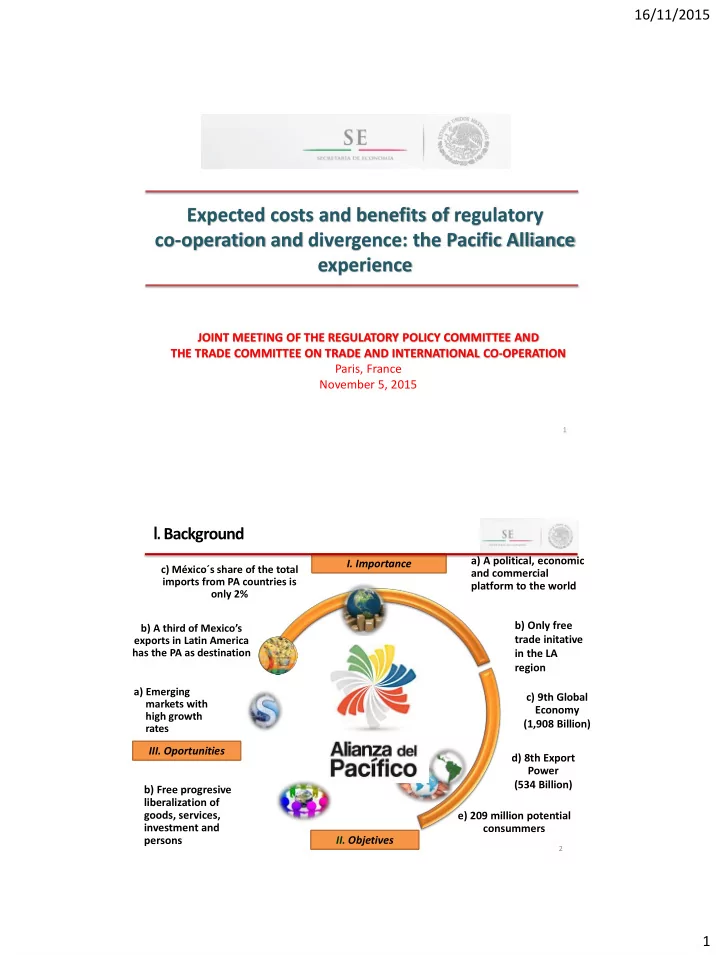
  • I. Background

2

a) Emerging markets with high growth rates

  • III. Oportunities

b) A third of Mexico’s exports in Latin America has the PA as destination c) México´s share of the total imports from PA countries is

  • nly 2%
  • I. Importance

a) A political, economic and commercial platform to the world e) 209 million potential consummers b) Free progresive liberalization of goods, services, investment and persons

  • II. Objetives

b) Only free trade initative in the LA region c) 9th Global Economy (1,908 Billion) d) 8th Export Power (534 Billion)

slide-2
SLIDE 2

16/11/2015 2

  • I. Backgorund (Cont.)
  • Integration initative launched on April 28, 2011 by Chile, Colombia,

México and Perú.

  • 34 Observers from all regions. Panama may join as full members in the

future.

  • Mexico’s participation in Alianza del Pacífico is part of a wider strategy

to increase integration in Latin America.

  • The Alianza del Pacífico is working in the following areas:
  • Trade and integration
  • Services and capitals
  • Business persons movility
  • Cooperation

June 6th, 2012: Framework Agreement (Acuerdo Marco). February 10th, 2014: Additional Protocol (Protocolo Adicional) with 19th Chapters).

  • Objectives:
  • increase and facilitate international trade;
  • ensure that standards, technical regulations and conformity assessment

procedures do not create unnecesary barriers to trade.

  • Parties recognize the existence of differences among their respective conformity

assessment procedures and commit to work to make them compatible to the greater extent possible.

  • Ambitious transparency and regulatory cooperation commitments.
  • Includes the posibility of launching the negotiation of specific Annexes that will be

implemented as a part of the Technical Barriers to Trade Chapter.

  • However, the Regulatory Cooperation activities preceded the negotiation of the TBT

and SPS disciplines.

  • II. Regulatory Cooperation in the AP

Technical Barriers to Trade

slide-3
SLIDE 3

16/11/2015 3

  • The Parties have agreed on a “Regulatory Cooperation Pathway”, which consists of a specific

procedure to select initiatives of interest for the four countries.

  • This Pathway aims to facilitate international trade through the establishment of two-year

programs in specific sectors of interest agreed by the four countries.

  • It is based on a public consultation process and the involvement of the relevant regulatory

authorities and the private sector.

  • The first Workplan was focused in the following sectors:
  • Pharmaceutical products: with the objective of streamlining the registration of this products in

each of the countries.

  • Cosmetics: with the following objectives:

  • I. Armonized definition of cosmetic products;

  • II. Establishment of a “market surveillance system”;

  • III. Elimination of the free sale certificate;

  • IV. Homologation of the ingredients’ revision systems;

  • V. Armonization of labeling requirements;

  • VI. Armonization of good manufacturing practices requirements.
  • II. Regulatory Cooperation in the AP (Cont.)

Results of the First Regulatory Cooperation Work Plan

  • On June 20th, 2013 the four countries’ sanitary authorities subscribed the Inter-

institutional Cooperation Agreement on Pharmaceutical Products.

  • Regarding the cosmetics sector, from 2012 to 2014, the TBT Working Group, supported

by the four countries’ sanitary authorities and industry, worked on a document that formalized the objectives agreed to by the four countries.

  • On July 3, 2015, that document was signed as the “Annex on the Elimination of

Technical Barriers to Trade in Cosmetic Products.”. The document will be incorporated into the Treaty as an Annex to the TBT Chapter

  • Nowadays, the TBT Working Group has already undertaken consultations and is

defining the contents of the Second Regulatory Cooperation Work Plan. The Group expects to define, during 2015, the specific sectors in which the Work Plan will focus.

  • II. Regulatory Cooperation in the AP (Cont.)
slide-4
SLIDE 4

16/11/2015 4

  • Coverage
  • Consensus
  • Feasibility
  • Expected outcome
  • Impact in Trade.
  • II. Regulatory Cooperation in the AP (Cont.)

Criteria to include sectors:

  • Medical Devices
  • Pharmaceutical

products

  • Food Supplements
  • Telecommunications

Equipment

  • Personal care

products

  • Paints
  • II. Regulatory Cooperation in the AP (Cont.)

Yes No

Usefulness

  • f the

regulation

  • i. Attends

a risk

Yes No

  • iii. Generate

unnecessary costs

Yes No

  • 1. To confirm or

create

  • 4. To cancel
  • 3. To modify in order

to armonize with international standards

  • 2. To modify

to elliminate unnecessary costs

  • ii. Is

armonized internationally 8

  • The following methodology was suggested:

Measurement

  • f the

economic impact

  • Unnecessary transaction costs
  • Underinvestment in the specific sector
  • Productivity below international references
  • Economic impact: measures as a GDP porcentage.
  • Frequency of the use and coverage of the regulation.
slide-5
SLIDE 5

16/11/2015 5 1. To define specific activities and concrete goals, with timeframes and well identified steps. 2. To involve and act as a result of an interest from private sectors in all the relevant Parties. 3. To prefer “measures” rather than “sectors” to define activities. 4. To create follow up and assessment mechanisms. 5. To formalize commitments between regulators

  • III. Lessons learned

1. What may work for one sector, may not for another. 2. To obtain mandates and empowerment from the Political Level and High Level Officals. 3. To be flexible with the timeframes and deliverables, 4. To find balances/reciprocity in general and not necessarily in each activity. 5. Lack of methodology and criteria to determine the economic- impact of each activity: is it relevant?

  • III. Lessons learned (Cont.)
slide-6
SLIDE 6

16/11/2015 6

Juan Antonio DORANTES

Director General for International Trade Rules Secretariat of Economy / MEXICO “juan.dorantes@economia.gob.mx”