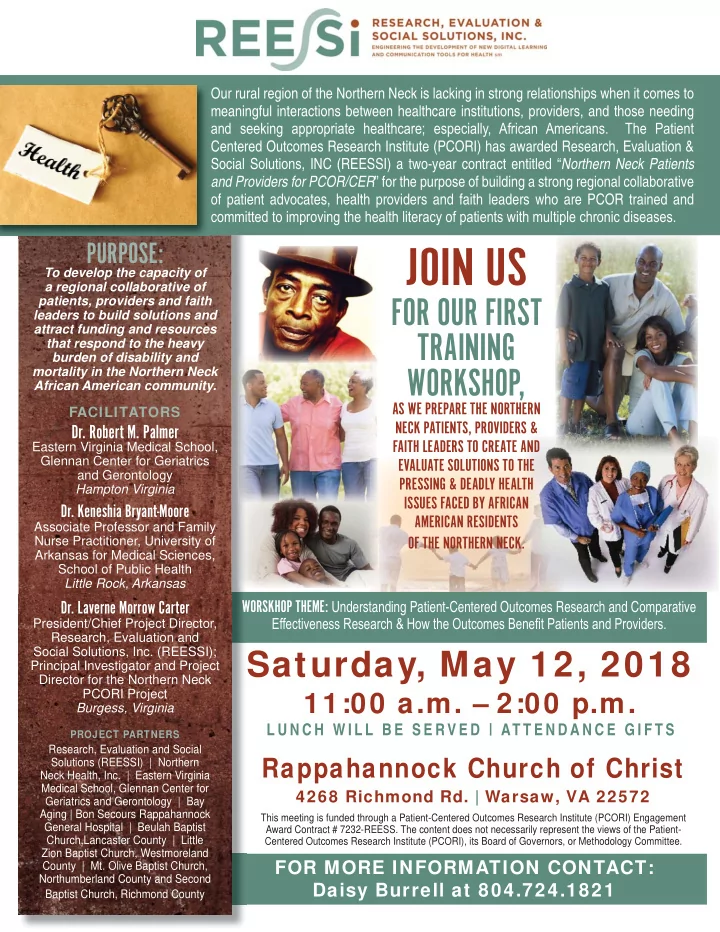
JOIN US To develop the capacity of a regional collaborative of - - PDF document

join us
SMART_READER_LITE
LIVE PREVIEW

JOIN US To develop the capacity of a regional collaborative of - - PDF document

Our rural region of the Northern Neck is lacking in strong relationships when it comes to meaningful interactions between healthcare institutions, providers, and those needing


slide-1
SLIDE 1

FOR MORE INFORMATION CONTACT: Daisy Burrell at 804.724.1821

Saturday, May 12, 2018

11:00 a.m. – 2:00 p.m.

L U N C H W I L L B E S E RV E D | AT T E N D A N C E G I F T S

Rappahannock Church of Christ

4268 Richmond Rd. | Warsaw, VA 22572

This meeting is funded through a Patient-Centered Outcomes Research Institute (PCORI) Engagement Award Contract # 7232-REESS. The content does not necessarily represent the views of the Patient- Centered Outcomes Research Institute (PCORI), its Board of Governors, or Methodology Committee.

JOIN US

FOR OUR FIRST TRAINING WORKSHOP,

AS WE PREPARE THE NORTHERN NECK PATIENTS, PROVIDERS & FAITH LEADERS TO CREATE AND EVALUATE SOLUTIONS TO THE PRESSING & DEADLY HEALTH ISSUES FACED BY AFRICAN AMERICAN RESIDENTS OF THE NORTHERN NECK. WORSKHOP THEME: Understanding Patient-Centered Outcomes Research and Comparative

  • W

Our rural region of the Northern Neck is lacking in strong relationships when it comes to meaningful interactions between healthcare institutions, providers, and those needing Centered Outcomes Research Institute (PCORI) has awarded Research, Evaluation & Social Solutions, INC (REESSI) a two-year contract entitled “Northern Neck Patients and Providers for PCOR/CER” for the purpose of building a strong regional collaborative

  • f patient advocates, health providers and faith leaders who are PCOR trained and
  • PURPOSE:

To develop the capacity of a regional collaborative of patients, providers and faith leaders to build solutions and attract funding and resources that respond to the heavy burden of disability and mortality in the Northern Neck African American community.

FACILITATORS

  • Dr. Robert M. Palmer

Eastern Virginia Medical School, Glennan Center for Geriatrics and Gerontology Hampton Virginia

  • Dr. Keneshia Bryant-Moore

Associate Professor and Family Nurse Practitioner, University of Arkansas for Medical Sciences, School of Public Health Little Rock, Arkansas

  • Dr. Laverne Morrow Carter

President/Chief Project Director, Research, Evaluation and Social Solutions, Inc. (REESSI); Principal Investigator and Project Director for the Northern Neck PCORI Project Burgess, Virginia

PROJECT PARTNERS

Research, Evaluation and Social Solutions (REESSI) | Northern Neck Health, Inc. | Eastern Virginia Medical School, Glennan Center for Geriatrics and Gerontology | Bay Aging | Bon Secours Rappahannock General Hospital | Beulah Baptist Church,Lancaster County | Little Zion Baptist Church, Westmoreland County | Mt. Olive Baptist Church, Northumberland County and Second Baptist Church, Richmond County

slide-2
SLIDE 2
  • Northern Neck Patients and Providers for PCOR-CER

Training Engagement 1

What is PCOR-CER & The Benefits to Patients and Providers?

May 12, 2018 11:00 a.m. – 2:00 p.m. Rappahannock Church of Christ Warsaw, Virginia

Arrival, Lunch and Pre-Test

slide-3
SLIDE 3
  • AGENDA
  • 10:45 a.m. – Arrival, Lunch & Pre-Test
  • 11:00 a.m.. – Review of Goals and Agenda
  • 11:05 a.m. – Opening Video and Definitions

(L. M. Carter)

  • 11:30 a.m. – PCOR-CER and Patients: Inviting Patients to the Table

(K. Bryant-Moore)

  • 12:30 p.m. BREAK
  • 12:45 p.m. – PCOR-CER and Providers

(R. M. Palmer)

  • 1:45 p.m. – Closing, Post-Test and Evaluation
  • 2:00 p.m. – Adjourn

Training Goal: To provide an understanding of PCOR- CER and the benefits to Patients and Providers-Clinicians. Objectives

  • 1. Each participant will be able to define PCOR;
  • 2. Each participant will be able to define CER;
  • 3. Each participant will be able to describe at least three benefits for

Providers-Clinicians; and

  • 4. Each participant will be able to describe three benefits to Patients.
slide-4
SLIDE 4
  • The Value of PCOR in the Mississippi Delta
  • Freddie White-Johnson

Freddie White-Johnson is the Program Director for the Mississippi Network for Cancer Control and Prevention at the University of Southern Mississippi. The network is designed to build on an established community and institutional capacity in order to eliminate cancer health disparities by conducting community-based participatory education, training, and research. She recognized that the traditional healthcare system was more oriented toward treatment than prevention, and because of that, she spearheaded the development of a stakeholder collaboration that led to the founding of the Fannie Lou Hamer Cancer Foundation in 2004, which is a 501(c)3 nonprofit community-based organization.

  • http://events.tvworldwide.com/PCORI2017/VideoId

/2965/opening-plenary-access-to-results-that-matter

DEFINITIONS

Patient - a person receiving or registered to receive medical treatment. Provider -Under federal regulations, a "health care provider" is defined as: a doctor of medicine or osteopathy, podiatrist, dentist, chiropractor, clinical psychologist, optometrist, nurse practitioner, nurse-midwife, or a clinical social worker who is authorized to practice by the State and performing within the scope of their practice as defined by State law. Payer –generally refers to entities other than the patient that finance

  • r reimburse the cost of health services.

Health System – A health system, also sometimes referred to as health care system or as healthcare system, is the organization of people, institutions, and resources that deliver health care services to meet the health needs of target populations.

slide-5
SLIDE 5
  • DEFINITIONS

Stakeholder –one who is involved in or affected by a course of action Research – a detailed study of a subject, especially in order to discover (new) information or reach a (new) understanding Principal Investigator – The primary individual

responsible for the preparation, conduct, and administration of a research project.

Co-Investigator – A person that makes a significant contribution to the management of the research project. They do not have overall authority for the project like the Principal Investigator.

DEFINITIONS

Community Based Participatory Research (CBPR) –

partnership approach to research that equitably involves, for example, community members, organizational representatives, and researchers in all aspects of the research process. Comparative Effectiveness Research (CER) –is research that identifies what clinical and public health interventions work best for improving health. Interventions include not direct clinical care such as diagnosis and treatment protocols, but also innovations in health care delivery, organization and financing, as well as public health interventions in the community, including those intended to modify health awareness, lifestyle, diet, or environmental exposures.

slide-6
SLIDE 6
  • DEFINITIONS

Patient-Centered Outcomes Research (PCOR) – helps

people and their caregivers communicate and make informed health care decisions, allowing their voices to be heard in assessing the value of health care options

Evidence – the available body of facts or information

indicating whether a belief or proposition is true or valid.

Translation and Communication – How the finding

from research are moved into practice in the real world.

Inviting Patients to the Table

slide-7
SLIDE 7
  • BEST WAY TO ENGAGE PATIENTS IN PCOR-CER…

Serve on the investigative team Support decisions about research

questions

Support decisions about data

collection

Support data analyses and

reporting

slide-8
SLIDE 8
  • “The Power of the Faith Community to Promote Health Equity”

June 17, 2016

Funding Source: Patient Centered Outcomes Research Institute (PCORI) EAIN 2975; Health Resources and Services Administration (HRSA)-Nursing Workforce Diversity (NWD); UAMS Translational Research Institute

Conference Aims:

  • Partnership Development &

Continued Engagement

  • Dissemination of Research

Findings, Best Practices, etc.

  • Generation of new research ideas
  • To increase the capacity of

researchers & community members in PCOR

“The Power of the Faith Community to Promote Health Equity, Part II”

April 7, 2017

Funding Source: Patient Centered Outcomes Research Institute (PCORI) EAIN 2975; Arkansas Minority Health Commission; Health Resources and Services Administration (HRSA), Nursing Workforce Diversity (NWD); UAMS Translational Research Institute

slide-9
SLIDE 9
  • Example #1: Patient Engagement

https://uamshealth.com/news/2016/06/02/nih-funds-uams-study-of- depression-program-in-delta/

Roles of Patients in Health Research

Participant Community Review Board Community Advisory Board Consultant Co-Investigator Community Principal Investigator

slide-10
SLIDE 10
  • Roles for Patients in Health Research

Participant

A research participant, also called a human subject

  • r an experiment, trial, or study

participant or subject, is a person who participates in human subject research by being the target of observation by researchers.

Community Review Board Community Advisory Board Consultant Co-Investigator Community Principal Investigator

Roles for Patients in Health Research

Participant Community Review Board

A Community Review Board (CRB) provides a structured forum for academic researchers to

gain valuable community insight on proposed research. In a CRB, members of the researcher’s population of interest serve as community experts.

Community Advisory Board Consultant Co-Investigator Community Principal Investigator

slide-11
SLIDE 11
  • Roles for Patients in Health Research

Participant Community Review Board Community Advisory Board

A community advisory board (often called a CAB)

is a type of advisory board consisting of representatives of the general public who meet with representatives

  • f an institution to relay information between the two groups.

Consultant Co-Investigator Community Principal Investigator

Roles for Patients in Health Research

Participant Community Review Board Community Advisory Board Community Consultant

A member of the community of interest who provides expertise regarding the unique

experiences and circumstances of the community.

Co-Investigator Community Principal Investigator

slide-12
SLIDE 12
  • Roles for community in research

Participant Community Review Board Community Advisory Board Community Consultant Co-Investigator

An individual involved in the scientific development or execution of a project. Can include

roles such as recruitment, data collection, data interpretation, and dissemination

Community Principal Investigator

Roles for Patients in Health Research

Participant Community Review Board Community Advisory Board Community Consultant Co-Investigator Community Principal Investigator

Works with the Principal Investigator to oversee the scientific, fiscal, and administrative

conditions of the award.

slide-13
SLIDE 13
  • Example #2: Patient Engagement

http://www.arkansasmatters.com/news/l

  • cal-news/uams-helping-connect-

homeless-mothers-to- resources/1018183288

WHAT DO YOU SEE AS THE BENEFITS?

Based on the engagement methods and

what you heard in the videos think about the benefits and positive things that can come from patient engagement

Now let’s build a long list of benefits…. How can patients in the Northern Neck

benefit from being part of PCOR- CER?

slide-14
SLIDE 14
  • Keeping it Real: FAST FORWARD EXERCISE

WHAT two topics could a PCOR

  • r CER Study address in the

Northern Neck?

  • 1. Which Health Condition?
  • 2. What about Health Systems?

SHARING from FAST FORWARD Groups Patients

slide-15
SLIDE 15
  • Best way to engage Providers-Clinicians in

PCOR-CER…

Deliver Health Care to Patients Identify Gaps in Evidence Support the Development of Research

Questions

Participate on Research Teams Apply Research Findings in Practice Communicate Findings to other Providers-

Clinicians

The Forsythe Study (2017) – What Providers and Clinicians Think About CER Item 1

Factors That Influence Research Engagement 385 Respondents

% That Responded “Very Important”

Helping My Patients Receive Better Care 75% Contributing to Scientific Knowledge 57% Making Research Studies More Meaningful to Patients 56% Improving My Professional Satisfaction 36% Helping Researchers Decide What to Study 31% Getting Paid for My Time 30% Learning More About How Research Works 23%

slide-16
SLIDE 16
  • The Forsythe Study (2017) – What Providers and Clinicians Think About CER

Item 2

Factors Potentially Preventing Research Engagement 385 Respondents

% That Responded “Very Important”

Lack of time 67% Lack of Training in Research 29% Lack of compensation for time/effort 26% Lack of Interest in Research 19% Lack of access to Researchers 19% My belief that Research will have minimal or no impact 6% Distrust of Researchers 4%

Keeping it Real: “FAST FORWARD” EXERCISE

Based on the Forsythe study results, discuss and list at least two ideas to get providers clinicians that serve patients in the Northern Neck involved in PCOR-CER.

slide-17
SLIDE 17
  • SHARING from FAST FORWARD Groups

Providers-Clinician

POST-TEST & EVALUATION

Post-Test Evaluation of Meeting

slide-18
SLIDE 18
  • CLOSING

Thanks to All… The Next Meeting is Saturday, July 28, 2018

Topic: How is PCOR-CER conducted? Facilitated by Drs. Palmer and Carter