Johnny Symington (John Andrew Douglas Symington) Joint Managing - - PDF document

johnny symington
SMART_READER_LITE
LIVE PREVIEW

Johnny Symington (John Andrew Douglas Symington) Joint Managing - - PDF document

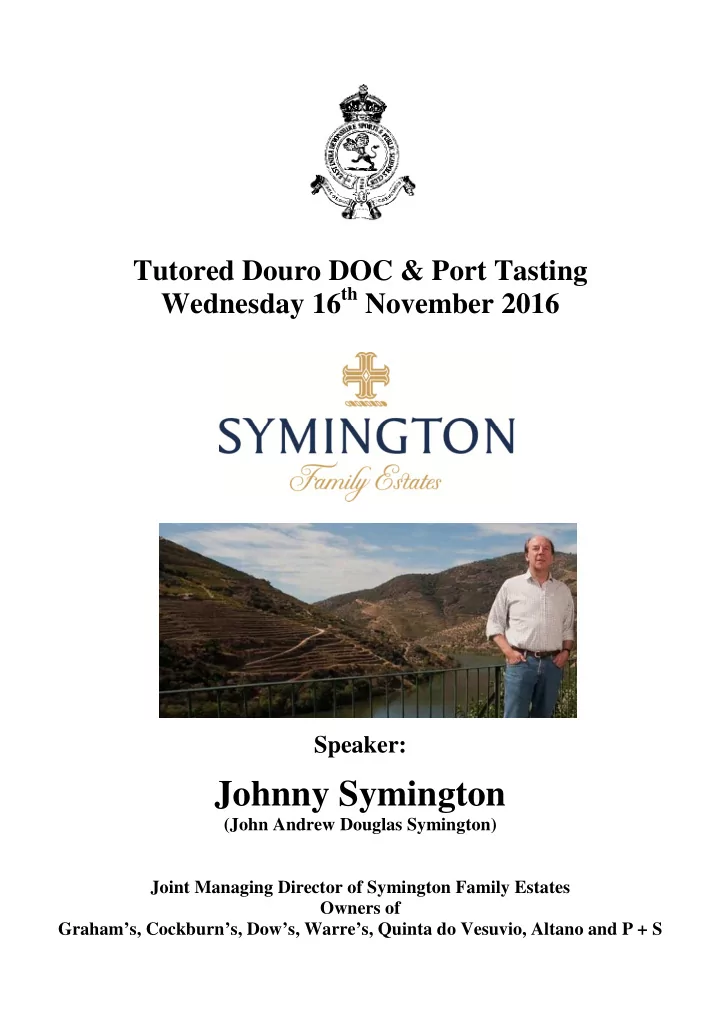
Tutored Douro DOC & Port Tasting Wednesday 16 th November 2016 Johnngton Speaker: Johnny Symington (John Andrew Douglas Symington) Joint Managing Director of Symington Family Estates Owners of Grahams, Cockburns, Dows, Warres,


slide-1
SLIDE 1

Tutored Douro DOC & Port Tasting Wednesday 16th November 2016

Speaker:

Johnny Symington

(John Andrew Douglas Symington) Joint Managing Director of Symington Family Estates Owners of Graham’s, Cockburn’s, Dow’s, Warre’s, Quinta do Vesuvio, Altano and P + S

Johnngton

slide-2
SLIDE 2

www.viniportugal.pt

slide-3
SLIDE 3

www.ivdp.pt

slide-4
SLIDE 4

JOHN ANDREW DOUGLAS SYMINGTON

BIOGRAPHY

Johnny Symington is Joint Managing Director of Symington Family Estates which owns some of the world’s leading Port companies including Graham’s, Cockburn’s, Dow’s and Warre’s. The family are the foremost producers of premium quality Ports as well as being the largest owners of vineyards in the Douro with over 1000 hectares in the finest districts. Since 2000 the Symington family have been amongst a new generation

  • f wine makers producing red and white wines in the Douro region with Quinta do Vesuvio, Altano and

Chryseia (a joint venture with the Prats family). Johnny is on the Board of John E. Fells & Sons, one of the UK’s leading importers of premium wines and is Chairman of Portfolio Vinhos, the leading premium wine distributor in Portugal. The eldest son of Ian and Cynthia Symington, Johnny was born in 1960 in Oporto, becoming one of the fourth generations of Symingtons raised in the Port trade, although his ancestry in Port dates back more than 3 centuries and 13 generations to 1652 through his great-grandmother, Beatriz Atkinson. He was educated at the Oporto British School followed by Downside School in Somerset, England. After school, Johnny joined Smiths Industries Plc and did his Higher National Diploma in Engineering followed by a four year Honours Degree in Business Studies at West London University. Johnny joined Portex Ltd (the Medical Division of Smiths Industries Plc) and for four years was Sales Manager responsible for the Middle East, Far East, Caribbean, Eastern and South Africa, and spent six months living in South Africa setting up their distribution arm. In 1985 Johnny returned to Oporto to join the family Port business. He was subsequently appointed Group Commercial Director and in 1994 was appointed Joint Managing Director. Johnny is a Liveryman in the Vintners Company and is a Freeman of the City of London. He is a member of the Factory House in Oporto where he was Treasurer (President) on two occasions. Johnny Symington lives in Portugal with his wife Helen and they have three children (William, Victoria and Thomas). As well as being Joint Managing Director of his family business, Johnny also farms his own vineyard in the Douro valley. May 2016

slide-5
SLIDE 5

Tutored Douro DOC & Port Tasting

THE WINES OF SYMINGTON FAMILY ESTATES

Wednesday 16th November 2016 Speaker: Johnny Symington

Tasting notes by Head Sommelier Eric LAGRE and Sommelier Magda KOTLARCZYK, WSET Diploma graduates (with the participation of WSET Diploma student Nora ESPINOSA CORONEL)

TASTING LIST

2015, , White Wine, Douro DOC 2011, , Prazo de Roriz, Douro DOC 2013, , Post Scriptum de Chryseia, Douro DOC 20 Year Old Tawny Port 2007 Vintage Port 1997 Vintage Port 1985 Vintage Port 1980 Vintage Port

slide-6
SLIDE 6

Wine Name: Altano White Wine Vintage: 2015 (bottled in December 2015)

Abundant rainfall during November 2014 was followed by an exceptionally dry and cold winter. The dry conditions persisted into the warmer-than-usual spring, which encouraged a precocious start to the growing season. The very dry conditions continued through the summer months. June and July were very hot whilst, fortunately, August was milder, cool night temperatures creating the right conditions for good maturation and even ripening of the grapes. Our winemakers had not seen white grapes of such high quality for years. Good acidity levels were retained hence the wines were well-balanced.

Producer: Symington Family Estates www.symington.com

In 2011, Symington Family Estates announced that, to enable them to focus on their burgeoning still light wine business in the Douro, they had reduced their shareholding in the Madeira Wine Company, thereby returning control in the running of the company to the Blandy family. Since 1882, five generations of Symingtons have been present in the Douro, where the family was producing Port exclusively until only recently. The year 2000 saw the launch of Altano and Chryseia, the latter brand being made in partnership with the Prats family of Bordeaux. 1999 Altano, 2000 Chryseia and 2002 Post Scriptum were the first Douro DOC wines to be marketed by the Symingtons. Table wine from Quinta do Vesuvio was launched in 2009.

Brand: Altano www.altano.pt Winemaker: Charles Symington and Pedro Correia Indication of origin: Douro DOC, Portugal

The grapes were sourced from Quinta da Fonte Branca, near Lamego in the Baixo Corgo, south of the Douro River, and selected growers round Alijó and Favaios in the Cima Corgo, north of the Douro, between the Pinhão and Tua tributaries.

Style: Crisp and aromatic white wine

After de-stemming and a light crushing, some contact between the must and the skin was encouraged in order to extract the desired aromatics. After clarification, the must was fermented at 15-16°C in stainless steel vats with minimum contact with

  • xygen then the wine was bottled soon after to guarantee the maximum retention of primary aromas and innate freshness.

Assemblage: Malvasia Fina, Viosinho, Rabigato and Moscatel Galego Alcohol: 13%abv Residual sugar: 1 g/l Total tartaric acidity: 6.1 g/l PH: 3.23 Stopper: Natural Cork Capacity: 75cl Supplier: Fells (Est. 1858) www.fells.co.uk Average UK retail price: £10.00 inc. VAT according to www.wine-searcher.com as of 02/11/16

Appearance:

This white wine looks clear and bright. It is pale lemon in colour, with a watery rim. Legs and tears appear along the side of the glass.

Nose:

The wine smells clean and exhibits a medium intensity of youthful, quite exotic aromas. White peach, leechy and passion fruit form the core fruit character of this wine. Some grassiness, grapiness and a hint of kiwi convey a sense of freshness and a twist of yellow grapefruit a sense of energy.

Palate:

This medium-minus-bodied wine tastes dry. The medium-plus acidity more than offsets the medium alcohol. There is more orchard fruit than there is exotic fruit on the palate. The green apple and pear of medium intensity is lifted by a twist of lemon rind and yellow grapefruit. One can still taste some white peach and leechy. The underlying grassiness is complimented by some kiwi and unripe pineapple in the finish of medium length.

Assessment of quality:

This wine is very good. When wines like this wine are fermented at fairly cold temperatures, they can end up tasting slightly artificial and characterless, with ubiquitous notes of pear drop and pineapple. But here, the wine has managed to retain a sense of place and elegance. The fruit intensity, the alcohol and the acidity are in perfect balance. This wine does not prove anything as simple as the retail price would lead one to expect. It is actually good value for money. It is best consumed in the two years that follow bottling. Serve it chilled, ideally between 10 and 12°C and try it with grilled fish, shellfish, cold salads or simply as an aperitif on a hot summer’s day.

slide-7
SLIDE 7

Wine Name: Prazo de Roriz Vintage: 2011 (bottled in July 2013)

Whilst 2011 was another exceptionally dry year, abundant rainfall during the winter of 2010-11 created good water reserves deep into the Douro subsoil. These were to prove determinant to the vine’s development and sustenance during the very hot growing and ripening stages. Some timely rain in August and September, coupled with dry and sunny conditions throughout the harvest at Quinta de Roriz and Quinta da Perdiz, paved the way an excellent vintage and wines of very good quality.

Producer: Symington Family Estates www.symington.com

In 2011, Symington Family Estates announced that, to enable them to focus on their burgeoning still light wine business in the Douro, they had reduced their shareholding in the Madeira Wine Company, thereby returning control in the running of the company to the Blandy family. Since 1882, five generations of Symingtons have been present in the Douro, where the family was producing Port exclusively until only recently. The year 2000 saw the launch of Altano and Chryseia, the latter brand being made in partnership with the Prats family of Bordeaux. 1999 Altano, 2000 Chryseia and 2002 Post Scriptum were the first Douro DOC wines to be marketed by the Symingtons. Table wine from Quinta do Vesuvio was launched in 2009.

Brand : P + S (« Prats & Symington » joint venture label) www.chryseia.com Winemaker: Bruno Prats and Charles Symington, Luís Coelho and Pedro Correia Indication of origin: Douro DOC, Portugal

70% of the grapes were grown in the cooler conditions at Quinta de Roriz hence the very aromatic profile of the wine. The remaining 30% were grown in the warmer conditions at Quinta da Perdiz hence the ripeness and velvety softness of the wine. The partners purchased Quinta da Perdiz in 2004 then Quinta de Roriz in 2009. Both Quintas lie in the Parish of São João de Pesqueira of the Cima Corgo, southeast of Pinhão, in the corner formed by the Douro River and the Torto Tributary.

Style: Full-bodied, fruit-driven red wine

The grapes were picked by hand and the bunches were manually sorted at the small dedicated Quinta de Roriz winery. The must was inoculated with selected yeast and maceration was achieved through pumping over. Fermentation temperatures were kept between 22 and 24°C. Part of the wine was aged in stainless steel tanks and the rest in 400-litre French oak barrels.

Assemblage: 39% Tinta Barroca, 15% Touriga Nacional, 15% Touriga Franca, 12% Tinta Roriz, 9% Tinta Amarela, 9% old vines, 1% Sousão Alcohol: 14.3%abv (14.5%abv on the label) Residual sugar: 2.5 g/l Total acidity: 5.0 g/l PH: 3.66 Stopper: Natural Cork Capacity: 75cl Supplier: Fells (Est. 1858) www.fells.co.uk Average UK retail price: £12.00 inc. VAT according to www.wine-searcher.com as of 02/11/16

Appearance:

This red wine looks clear and bright. It is deep ruby in colour, with a ruby rim. Legs and tears appear along the side of the glass.

Nose:

The wine smells clean and exhibits a medium-plus intensity of developing aromas. The plummy fruit is dark and full of blackcurrant and black cherry. The fruit is freshened up by a flowery perfume of violet and herbal notes of mint and

  • eucalyptus. The combination of mint and chocolate creates an After-Eight-like effect. Black tea and black pepper add a

spicy depth to the wine.

Palate:

This medium-plus-bodied wine tastes dry. The alcohol is medium-plus, yet in perfect balance with the medium-plus

  • acidity. The tannins are medium-plus, yet their fine and ripe quality translates into a delightfully velvety texture. The

sweetness of vanilla adds to the appeal the flavour profile, which mirrors exactly the aromas described on the nose. The finish of medium-plus length is juicy.

Assessment of quality:

This wine is very good. It is the least ambitious and more entry level wine in the range after Chryseia and its second wine, Post Scriptum, but it is the offering that shines through in this vintage. Its understated complexity, gentle concentration, underlying freshness and perfect balance is a reflection of the quality of the vintage. The wine drinks well now and will carry on delivering great drinking for a few more years. Serve it with duck, roast meats or game.

slide-8
SLIDE 8

Wine Name: Post Scriptum de Chryseia Vintage: 2013 (bottled in April 2015)

The 2012-13 viticultural year was atypical in the Douro Region. During winter, rainfalls and temperatures were below-

  • average. Conversely, spring was wet and temperatures variable, yet on the cooler side. This affected the vine’s vegetative

cycle and resulted in significant delays in the maturation process. Summer was hot and dry as usual. Harvest took place in hot and stormy conditions from the end of September into October. The vintage posed many challenges which were

  • vercome through close monitoring of the vines and rigorous selection prior to vinification.

Producer: Symington Family Estates www.symington.com

In 2011, Symington Family Estates announced that, to enable them to focus on their burgeoning still light wine business in the Douro, they had reduced their shareholding in the Madeira Wine Company, thereby returning control in the running of the company to the Blandy family. Since 1882, five generations of Symingtons have been present in the Douro, where the family was producing Port exclusively until only recently. The year 2000 saw the launch of Altano and Chryseia, the latter brand being made in partnership with the Prats family of Bordeaux. 1999 Altano, 2000 Chryseia and 2002 Post Scriptum were the first Douro DOC wines to be marketed by the Symingtons. Table wine from Quinta do Vesuvio was launched in 2009.

Brand : P + S (Prats & Symington) www.chryseia.com Winemaker: Bruno Prats and Charles Symington, Luís Coelho and Pedro Correia Indication of origin: Douro DOC, Portugal

The grapes were grown at Quinta de Roriz and Quinta da Perdiz. Both Quintas lie in the Parish of São João de Pesqueira of the Cima Corgo, southeast of Pinhão, in the corner formed by the Douro River and the Torto Tributary.

Style: Full-bodied, oak-aged red wine

The grapes are double selected, on the vine and in the winery. They are de-stemmed then passed through a berry-by-berry mechanical-selection bench prior to gentle crushing. The must is inoculated with selected yeast and fermented in vats at around 25°C. Maceration is very gentle and adjusted in such a way as to produce a wine intended for early drinking, yet a wine endowed with a great potential for ageing. The wine is aged for 14 months in 400-litre French oak barrels.

Assemblage: 59% Touriga Nacional, 30% Touriga Franca, 5.5% Tinta Roriz, 5.5% Tinta Barroca Alcohol: 13.85%abv (13.5%abv on the label) Residual sugar: 0.8 g/l Total tartaric acidity: 4.9 g/l PH: 3.62 Stopper: Natural Cork Capacity: 75cl Supplier: Fells (Est. 1858) www.fells.co.uk Average UK retail price: £18.00 inc. VAT according to www.wine-searcher.com as of 02/11/16

Appearance:

This red wine looks clear and bright. It is deep ruby in colour, yet not as deep as the 2011 Prazo de Roriz. The rim indicates the purple hue of a young wine. Legs and tears appear along the side of the glass.

Nose:

The wine smells clean and exhibits a medium-plus intensity of developing aromas. The dark fruit is dominated by black cherry and freshened up by notes of eucalyptus and chocolate mint. There is a defined scent of black pepper and clove that gives the wine an almost savoury edge. The wood treatment translates into delicate notes of vanilla and cinnamon.

Palate:

This medium-plus-bodied wine tastes dry. The medium-plus acidity more than offsets the medium-(plus-ish) alcohol. The tannins are medium-plus and, for now, quite grippy. The fruit of medium-plus intensity displays flavours of plum, raspberry and black cherry with flowery undertones. The finish of medium-plus length almost tastes like a black- pepper infusion with sweet notes of vanilla.

Assessment of quality:

This wine is very good, yet it feels young and nothing as together and approachable as the 2011 Prazo de Roriz. The fruit is elegant and its level of concentration is in perfect balance with the alcohol and the acidity. The oak character dominates the aromatic profile of the wine and it will take time for it to integrate with the fruit flavours. The wine could be drunk now, but one should wait and let the wine develop is potential in the bottle. This wine will prove a great accompaniment to roast meats.

slide-9
SLIDE 9

Port: Graham’s 20 Year Old Tawny Port Style: Age-dated Tawny Port

Small reserves of the most concentrated wines are set aside during the month of January that follows each vintage. They are made from grapes grown in five top-graded quintas, one in the Douro Superior (Quinta do Vale de Malhadas) and four in the Cima Corgo (Quinta dos Malvedos, Quinta do Tua and Quinta da Vila Velha in the Rio Douro downstream from Tua and Quinta das Lages in the Rio Torto). These wines are judged to be powerful-enough to withstand an average of 20 years of maturation in 625 litre casks. These pipes are the smallest ageing containers in the Port industry. Over that period of ageing in seasoned wood, the wines are racked annually. These extreme oxidative conditions gradually turn the deep ruby colour of a young wine into a medium tawny and the fruit aromas and flavours from primary to ever more dry-fruity, spicy and nutty. Nuttiness is the signature character of Tawny Port. The blend is sent downriver to the coastal town of Vila Nova de Gaia to mature gently in the lodges. Being deliberately oxidised and stripped of its deposit with every racking, Old Tawny Port is bottled ready to drink and does not require decanting.

Indication of Age: 20 Year Old (this indication refers to the average age, not the minimum age of the blend bottled in 2016) Producer: Symington Family Estates www.symington.com

The Symingtons have been present in the Douro for five generations since 1882. Today, Symington Family Estates is the largest vineyard owner in the Douro, the 2nd largest producer of Port with 1/5 of the production, the leading producer of premium Port (Reserve, Aged Tawny, LBV and Vintage Port) with 1/3 of the production and the leading port group in the UK with nearly 40% of the market. The Symingtons acquired Warre’s (Est. 1670) in 1908, having been given partnerships in 1905, and Dow’s (Est. 1798) in 1961 having been given partnerships back in 1912. They also acquired Quarles Harris (Est. 1680) in 1917, Graham’s (Est. 1820), Smith Woodhouse (Est. 1784) and Gould Campbell (Est. 1797) in 1970, Quinta do Vesuvio (Est. 1830) in 1989, Martinez (Est. 1790) in 2006 and Cockburn’s (Est.1815) in 2010.

Brand: Graham’s (Est. 1820) www.grahams-port.com Winemaker & blender: Peter Symington for 45 years until he retired in 2009 and his son Charles Symington since 1995 Bottle capacity: 75cl Closure: T-top cork (usually a sign that the Port wine is ready to drink and does not require decanting) Blend: Traditional varieties (Touriga Nacional, Touriga Francesa, Tinta Roriz, Tinta Barroca, Tinta Cão...) Alcohol: 20%abv Residual sugar: around 125 g/l (4 Baumé) Total tartaric acidity: 4.7 g/l PH: 3.45 Supplier: Fells (Est. 1858) www.fells.co.uk Average UK retail price: £36.00 inc. VAT according to www.wine-searcher.com as of 02/11/16

Appearance:

This red wine looks clear and bright. It is medium tawny in colour, with red highlights. Legs and tears run along the side of the glass.

Nose:

The wine smells clean and displays a medium-plus intensity of deliberately oxidised aromas. The nose is very complex and combines in the most integrated way the three signature aromatic elements that characterise a quality Old Tawny Port: dry fruit, spice and nuttiness. Orange peel adds a twist to fig, sultana, date and maraschino cherry. That fruit character is underpinned by roasted almond and hazelnut, plus a touch of bread crust. The entire aromatic profile is infused with tobacco leaf, toffee, Demerara sugar, mocha, vanilla and curry spice, notably fenugreek and turmeric.

Palate:

This medium-plus-bodied wine is sweet. The wine is fortified to a high level of alcohol and the medium-plus acidity does not totally manage to offset that potency. This is a common feature in Tawny Port hence one often advises to serve it slightly chilled to restore a sense of balance. The tannin levels are so low that one would forget to even notice them. The flavours of medium-plus intensity mirror the aromas described on the nose. The tang of orange juice and orange peel is more obvious on the palate if anything. Notes of coffee bean unravel in the finish of long length, thereby conveying a sense of balancing bitter dryness.

Assessment of Quality:

This wine is outstanding. The fruit displays great intensity and complexity. The acidity fails to balance the high alcohol, but the tangy, tartaric quality of acidity makes up for it. Moreover, the sweetness of the attack is balanced by the dryness of the finish. This wine will pair well with desserts flavoured with figs, almonds and caramel. It will accompany Crème Brûlée

  • r a plate of wild strawberries particularly well too. Tawny Port will also drink well on its own, especially when served

slightly chilled in the summer, or in accompaniment of simple walnut and dried fruit nibbles.

slide-10
SLIDE 10

Port: Dow’s 2007 Vintage Port Style: Classic Vintage Port

Such top-quality Port is only made in the very best or “declared vintage” years. The backbone of the house blend is wine primarily drawn from two flagship quintas owned by Dow’s, namely Quinta da Senhora da Ribeira in the Douro Superior and Quinta do Bomfim near Pinhão in the Cima Corgo. Both quintas were acquired in 1890 and 1896 respectively, making Dow’s

  • ne of the first port houses to invest in premium vineyards. A classic vintage Port is held for two winters in old wood before it

is blended then bottled with no treatment or filtration and put to market straight away. It is so concentrated that decades of maturation in bottle are needed for it to become ready to drink. Decanting is an absolute necessity before serving.

Vintage: 2007 (bottled in 2009)

The end of 2006 was thankfully sufficiently wet to replenish the water tables, for the winter into the New Year proved unusually dry and mild. Consequently, the vegetative cycle began early and flowering was precocious. June was decidedly un- summery with a very wet middle of the month and July brought more showers hence an outbreak of fungal diseases had to be prevented. Due to the colder weather, veraison was considerably delayed. The moderate temperatures in the run up to harvest, combined to good soil humidity, gave the grapes good acidity and soft skins with excellent potential for colour

  • extraction. Perfect weather during harvest meant that the fruit arrived at the wineries at very good temperatures and in

perfect condition. The excellent 2007 vintage was declared universally by all the port houses. Dow’s 2007 Vintage Port was awarded the perfect 100 points by the Wine Spectator and still is the only Port produced in the 21st century with 100 points.

Producer: Symington Family Estates www.symington.com

The Symingtons have been present in the Douro for five generations since 1882. Today, Symington Family Estates is the largest vineyard owner in the Douro, the 2nd largest producer of Port with 1/5 of the production, the leading producer of premium Port (Reserve, Aged Tawny, LBV and Vintage Port) with 1/3 of the production and the leading port group in the UK with nearly 40% of the market. The Symingtons acquired Warre’s (Est. 1670) in 1908, having been given partnerships in 1905, and Dow’s (Est. 1798) in 1961 having been given partnerships back in 1912. They also acquired Quarles Harris (Est. 1680) in 1917, Graham’s (Est. 1820), Smith Woodhouse (Est. 1784) and Gould Campbell (Est. 1797) in 1970, Quinta do Vesuvio (Est. 1830) in 1989, Martinez (Est. 1790) in 2006 and Cockburn’s (Est.1815) in 2010.

Brand: Dow’s (Est. 1798) www.dows-port.com Winemaker: Peter Symington for 45 years until he retired in 2009 and his son Charles Symington since 1995 Bottle capacity: 75cl Closure: Natural cork (take it as a sign that the Port requires cellaring and decanting) Blend: Traditional varieties (Touriga Nacional, Touriga Francesa, Tinta Roriz, Tinta Barroca, Tinta Cão...) Alcohol: 20 %abv Residual Sugar: around 95 g/l (3.4 Baumé) Total Tartaric Acidity: 4.6 g/l PH: 3.65 Supplier: Fells (Est. 1858) www.fells.co.uk Average UK retail price: £89.00 inc. VAT according to www.wine-searcher.com as of 02/11/16

Appearance:

This red wine looks clear and bright. It is deep ruby in colour. The rim is ruby also. Legs and tears appear along the side of the glass.

Nose:

The wine smells clean. Considering that this is a wine of tremendous concentration and power, the developing aromas of medium-plus intensity prove rather closed-in. If one happens to pull the cork now, expecting this Vintage Port to deliver intensity and complexity, they are bound to be disappointed, for, at this stage of development, many will find that the nose is somewhat blank and the aromas quite simple. The ripe black fruit, notably black cherry and plum, is given a dry edge by black pepper, dark chocolate and coffee bean. That dryness and some savouriness from the little time the wine spent in seasoned wood are freshened up by delightful hints of cassis

  • leaf. The nose is all about fruit and there is not a hint of fortifying spirit in sight.

Palate:

This medium-plus-bodied wine is sweet and fortified to a high level of alcohol. The medium-plus acidity does not manage to offset the fiery potency of alcohol that is so common in young Port, though, in this instance, one is as close to perfect balance as one can get. The flavours of medium-plus intensity are packed full of black cherry (flesh, stone and all), plum, blackcurrant and blackberry. The tannins are very high, yet they are extraordinarily fine and ripe. That density of tannins, which virtually causes the mouth to dry, explains why the sweet vanilla and cinnamon spice eventually turns into drier dark chocolate and coffee bean in the finish of medium-plus length.

Assessment of Quality:

This Vintage Port is outstanding. Young port often proves fiery, but here, the wine already displays near perfect balance between the concentrated fruit, the acidity and the potency of alcohol. This powerful and fine offering is going to require two more decades of maturation in bottle to deliver its true potential. Please, do wait for it to age fabulously. Walnuts, dried apricots and figs, as well as various cheeses such as Stilton and Dorset Blue Vinny are excellent accompaniments to a “matured” Vintage Port. It would be a shame to pull the cork now, but if you do, treat this young Vintage Port like the ultimate style of Ruby Port and pair it with chocolate desserts.
slide-11
SLIDE 11

Port: Warre’s 1997 Vintage Port Style: Classic Vintage Port

Such top-quality Port is only made in the very best or “declared vintage” years. The backbone of the house blend is wine primarily drawn from three quintas owned by Warre’s. Here, the fruit was principally sourced from the two quintas that are located in the Cima Corgo, namely Quinta da Cavadinha in the Rio Pinhão and Quinta do Retiro Antigo in the Rio Torto. Full

  • wnership of these quintas was gained in 1980 and 2006 respectively. Fruit from Quinta de Telhada is a new addition to the
  • blend. The quinta, which is situated on the north bank of the Douro River in the far eastern stretches of the Douro Superior,

belonged to Cockburn’s until their assets were bought in 2006. A classic vintage Port is held for two winters in old wood before it is blended then bottled with no treatment or filtration and put to market straight away. It is so concentrated that decades of maturation in bottle are needed for it to become ready to drink. Decanting is an absolute necessity before serving.

Vintage: 1997 (bottled in 1999)

The winter of 1997 got off to an unusually cold start, with snowfalls covering the quintas belonging to or associated with Warre’s in the Cima Corgo in early January. In contrast, February and March were beautifully warm, with maximum temperatures reaching 30°C. This provoked bud burst two weeks early then rapid vine development, thereby raising the spectre of spring frosts. Fortunately, frost did not occur, and, even though cold and wet weather returned in April and May, doing some damage in the “Altos” (the higher areas), flowering and fruit set in the river side quintas took place under ideal

  • conditions. The weather in the rest of spring was cool, allowing the vines an even and balanced development. Hot and dry

conditions returned mid-August and continued throughout September. The 1997 vintage was generally declared and considered very good or excellent. 38% less wine than in 1996 was produced by Warre’s. However, the quality was excellent.

Producer: Symington Family Estates www.symington.com

The Symingtons have been present in the Douro for five generations since 1882. Today, Symington Family Estates is the largest vineyard owner in the Douro, the 2nd largest producer of Port with 1/5 of the production, the leading producer of premium Port (Reserve, Aged Tawny, LBV and Vintage Port) with 1/3 of the production and the leading port group in the UK with nearly 40% of the market. The Symingtons acquired Warre’s (Est. 1670) in 1908, having been given partnerships in 1905, and Dow’s (Est. 1798) in 1961 having been given partnerships back in 1912. They also acquired Quarles Harris (Est. 1680) in 1917, Graham’s (Est. 1820), Smith Woodhouse (Est. 1784) and Gould Campbell (Est. 1797) in 1970, Quinta do Vesuvio (Est. 1830) in 1989, Martinez (Est. 1790) in 2006 and Cockburn’s (Est.1815) in 2010.

Brand: Warre’s (Est. 1670) www.warre.com Winemaker: Peter Symington for 45 years until he retired in 2009 and his son Charles Symington since 1995 Bottle capacity: 75cl Closure: Natural cork (take it as a sign that the Port requires cellaring and decanting) Blend: Traditional varieties (Touriga Nacional, Touriga Francesa, Tinta Roriz, Tinta Barroca, Tinta Cão...) Alcohol: 20 %abv Residual Sugar: around 95 g/l (3.4 Baumé) Total Tartaric Acidity: 4.36 g/l PH: 3.65 Supplier: Fells (Est. 1858) www.fells.co.uk Average UK retail price: £46.00 inc. VAT according to www.wine-searcher.com as of 02/11/16

Appearance:

This red wine looks clear and bright. It is deep ruby in colour. The rim is starting to turn garnet. Legs and tears appear along the side of the glass.

Nose:

The wine smells clean. It exhibits a medium intensity of developing aromas. The fresh fruit, with notes of black cherry and cassis liquor, is on the cusp of turning dried-fruity. A combination of brandy (and one could accuse the nose of being slightly spirity for that matter) sweet spices and milk chocolate is reminiscent of Christmas pudding. Undertones of tomato stalk and “Lee & Perrin” sauce give the wine a contrasting savoury edge. Flowery notes of rock rose lift that richness altogether.

Palate:

This medium-plus-bodied wine is sweet and fortified to a high level of alcohol. The high acidity does offset that potency, at least on the attack. The tannins are medium to medium-plus and fine and ripe in quality. The fruit of medium-plus intensity is dominated by prune and fig, though there is some fresh fruit there still. Contrasting dry and sweet spices, notably mocha, coffee bean, clove, liquorice, cinnamon and vanilla reinforce the Christmas-pudding-like character that was hinted on the

  • nose. The finish of medium-plus length feels a bit hot in alcohol.

Assessment of Quality:

This vintage Port is very good. It does not showcase the same sense of concentration and harmony as in the 2007 Dow’s. Nevertheless it is a charming wine with a positive potential for ageing. Walnuts, dried apricots and figs, as well as various blue cheeses are excellent accompaniments to this style of Vintage Port.

slide-12
SLIDE 12

Port: Graham’s 1985 Vintage Port Style: Classic Vintage Port

Such top-quality Port is only made in the very best or “declared vintage” years. The backbone of the house blend is wine primarily drawn from three quintas owned by Graham’s, all of which are situated in the Cima Corgo. Graham’s flagship Quinta dos Malvedos is located on the right bank of the Douro River downstream from Tua and it has been part of Graham’s portfolio of quintas since 1890. Quinta das Lages in the Rio Torto has formed an important part of Graham’s blend since 1924. The auinta managed by the Symingtons was formerly independently owned but was eventually leased to Graham’s in 2002 for 25 years. Fruit from Quinta do Tua is a new addition to the blend. The quinta, right in the corner of where the Tua tributary meets the Douro River, belonged to Cockburn’s until the company’s assets were bought in 2006.

Vintage: 1985 (bottled in 1987)

The winter and spring of 1985 was extremely wet, with a cold spell in May, hence the vines were some three weeks behind normal development. Hot and dry weather in July and August brought development back on tracks. The summer-like weather with moderate temperatures of 30°C continued from early September right through harvest, only interrupted by a few cool nights and showers in early October. The grapes were uniformly healthy and fresh, with no trace of mould, rot or

  • ther defects. The 1985 vintage was generally declared and considered very good or excellent.

Producer: Symington Family Estates www.symington.com

The Symingtons have been present in the Douro for five generations since 1882. Today, Symington Family Estates is the largest vineyard owner in the Douro, the 2nd largest producer of Port with 1/5 of the production, the leading producer of premium Port (Reserve, Aged Tawny, LBV and Vintage Port) with 1/3 of the production and the leading port group in the UK with nearly 40% of the market. The Symingtons acquired Warre’s (Est. 1670) in 1908, having been given partnerships in 1905, and Dow’s (Est. 1798) in 1961 having been given partnerships back in 1912. They also acquired Quarles Harris (Est. 1680) in 1917, Graham’s (Est. 1820), Smith Woodhouse (Est. 1784) and Gould Campbell (Est. 1797) in 1970, Quinta do Vesuvio (Est. 1830) in 1989, Martinez (Est. 1790) in 2006 and Cockburn’s (Est.1815) in 2010.

Brand: Graham’s (Est. 1820) www.grahams-port.com Winemaker: Peter Symington Bottle capacity: 75cl Closure: Natural cork (take it as a sign that the Port requires cellaring and decanting) Blend: Traditional varieties (Touriga Nacional, Touriga Francesa, Tinta Roriz, Tinta Barroca, Tinta Cão...) Alcohol: 20 %abv Residual Sugar: around 100 g/l (3.6 Baumé) Total Tartaric Acidity: 4.13 g/l PH: 3.75 Supplier: Fells (Est. 1858) www.fells.co.uk Average UK retail price: £67.50 inc. VAT according to www.wine-searcher.com as of 02/11/16

Appearance:

This red wine looks clear and bright. It is medium garnet in colour with tones of red amber on the rim. Legs and tears appear along the side of the glass.

Nose:

The wine smells clean, though one seems to detect a hint of volatility, unless the tingling sensation is just an effect of the spirit on the nose. The wine exhibits a medium-plus intensity of fully-developed aromas. There is still a faint trace

  • f fresh black cherry under the dried fruit. The sultana, date and fig fruit is underpinned by curry spice, notably

fenugreek, as well as cinnamon and vanilla. That spicy sweetness is complimented by toffee. Dryer notes of leather, walnut, mocha and liquorice give the nose an almost savoury edge.

Palate:

This medium-bodied wine is sweet. It is fortified to a high level of alcohol and the medium-plus acidity does not manage to offset that potency. The tannins have precipitated in the bottle and the fine and ripe tannins leftover from the decanting process feel no more than medium-minus. The flavours of medium-plus intensity are predominantly dried-fruity, with notes of sultana, fig, date and maraschino cherry and undertones of walnut and

  • hazelnut. The sweetness of vanilla and cinnamon is gradually taken over by the dryness and bitterness of burnt sugar

and dry liquorice in the rather spirity finish of medium plus length.

Assessment of Quality:

This wine is very good. The aromatic profile is not without intensity, yet the wine is now at its peak and the fruit no longer has the power to balance the potency of alcohol. One should drink this wine now. Walnuts, dried apricots and figs, as well as various blue cheeses will prove excellent accompaniments to such a matured Vintage Port.

slide-13
SLIDE 13

Port: Warre’s 1980 Vintage Port Style: Classic Vintage Port

Such top-quality Port is only made in the very best or “declared vintage” years. The backbone of the house blend is wine primarily drawn from three quintas owned by Warre’s. Here, the fruit was principally sourced from the two quintas that are located in the Cima Corgo, namely Quinta da Cavadinha in the Rio Pinhão and Quinta do Retiro Antigo in the Rio

  • Torto. 1980 was actually the year when Warre’s acquired its flagship Quinta da Cavadinha. Quinta de Telhada, which is

situated on the north bank of the Douro River in the far eastern stretches of the Douro Superior, belonged to Cockburn’s until the company’s assets were bought in 2006. A classic vintage Port is held for two winters in old wood before it is blended then bottled with no treatment or filtration and put to market straight away. It is so concentrated that decades

  • f maturation in bottle are needed for it to become ready to drink. Decanting is an absolute necessity before serving.

Vintage: 1980 (bottled in 1982)

In the adega (winery), the colour was superb. The attractive fresh smell of the must reminded one of 1977. Dr João Serôdio, the owner of Quinta do Retiro Antigo, which historically supplied fruit to Warre’s and was eventually acquired by the Symington family in 2006, said that the sent reminded him of 1948. Either impression indicated that an excellent wine was being made. 1980 was indeed an excellent vintage for the only few port houses that declared it a classic vintage year.

Producer: Symington Family Estates www.symington.com

The Symingtons have been present in the Douro for five generations since 1882. Today, Symington Family Estates is the largest vineyard owner in the Douro, the 2nd largest producer of Port with 1/5 of the production, the leading producer of premium Port (Reserve, Aged Tawny, LBV and Vintage Port) with 1/3 of the production and the leading port group in the UK with nearly 40% of the market. The Symingtons acquired Warre’s (Est. 1670) in 1908, having been given partnerships in 1905, and Dow’s (Est. 1798) in 1961 having been given partnerships back in 1912. They also acquired Quarles Harris (Est. 1680) in 1917, Graham’s (Est. 1820), Smith Woodhouse (Est. 1784) and Gould Campbell (Est. 1797) in 1970, Quinta do Vesuvio (Est. 1830) in 1989, Martinez (Est. 1790) in 2006 and Cockburn’s (Est.1815) in 2010.

Brand: Warre’s (Est. 1670) www.warre.com Winemaker: Peter Symington and António Serôdio Bottle capacity: 75cl Closure: Natural cork (take it as a sign that the Port requires cellaring and decanting) Blend: Traditional varieties (Touriga Nacional, Touriga Francesa, Tinta Roriz, Tinta Barroca, Tinta Cão...) Alcohol: 20 %abv Residual Sugar: around 95 g/l (3.4 Baumé) Total Tartaric Acidity: 4.3 g/l PH: 3.65 Supplier: Fells (Est. 1858) www.fells.co.uk Average UK retail price: £70.00 inc. VAT according to www.wine-searcher.com as of 02/11/16

Appearance:

This red wine looks clear and bright. It is deep garnet in colour and there is a real vibrancy of tone on the rim. Legs and tears appear along the side of the glass.

Nose:

The wine smells clean. It exhibits a medium-plus intensity of developing aromas. The nose is packed full of medicinal roots and herbs reminiscent of Agostura bitters. The freshness of mint, eucalyptus, tobacco leaf and rock rose lifts the richness of the sultana and dried fig. That dried-fruity sweetness is contrasted by dry notes of dark chocolate, coffee bean, black tea, clove, liquorice and leather.

Palate:

This full-bodied wine is sweet and fortified to a high level of alcohol. The medium-plus acidity does not manage to

  • ffset that potency. The tannins of very fine and ripe quality are medium-plus. The medium-plus intensity of cherry

liquor, prune and raisin is scented with a complex mix of medicinal roots and herbs, flowers, liquorice, cinnamon and

  • range peel that is very reminiscent of some herbal and medicinal sweets. Dark chocolate, coffee bean and burnt

caramel convey a sense of dryness to the finish of medium-plus length.

Assessment of Quality:

This Port from a solid and unsung vintage is very good. It looks incredibly fresh in the glass for a wine of 36 years of age, which indicates a real potential for further ageing in the bottle. The aromatic profile is impressive and complex, yet the wine feels rather hot in alcohol. Alcoholic unbalance is the unfortunate reflection of a time when even the finest Port houses had no control over the quality of the spirit they were provided with by the Casa do Douro. Walnuts, dried apricots and figs, as well as various blue cheeses are excellent accompaniments to Vintage Port.