John G. Ruggie UN SRSG for Business & Human Rights Keynote - - PDF document

john g ruggie un srsg for business human rights keynote
SMART_READER_LITE
LIVE PREVIEW

John G. Ruggie UN SRSG for Business & Human Rights Keynote - - PDF document

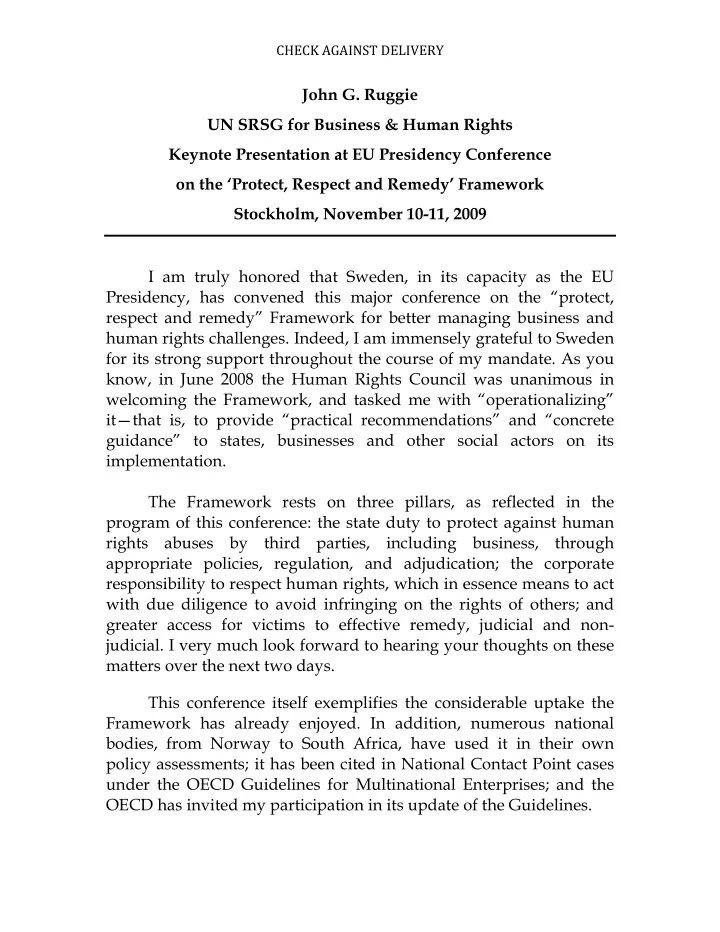
CHECK AGAINST DELIVERY John G. Ruggie UN SRSG for Business & Human Rights Keynote Presentation at EU Presidency Conference on the Protect, Respect and Remedy Framework Stockholm, November 10-11, 2009 I am truly honored that Sweden, in


slide-1
SLIDE 1

CHECK AGAINST DELIVERY

John G. Ruggie UN SRSG for Business & Human Rights Keynote Presentation at EU Presidency Conference

  • n the ‘Protect, Respect and Remedy’ Framework

Stockholm, November 10-11, 2009 I am truly honored that Sweden, in its capacity as the EU Presidency, has convened this major conference on the “protect, respect and remedy” Framework for better managing business and human rights challenges. Indeed, I am immensely grateful to Sweden for its strong support throughout the course of my mandate. As you know, in June 2008 the Human Rights Council was unanimous in welcoming the Framework, and tasked me with “operationalizing” it—that is, to provide “practical recommendations” and “concrete guidance” to states, businesses and other social actors on its implementation. The Framework rests on three pillars, as reflected in the program of this conference: the state duty to protect against human rights abuses by third parties, including business, through appropriate policies, regulation, and adjudication; the corporate responsibility to respect human rights, which in essence means to act with due diligence to avoid infringing on the rights of others; and greater access for victims to effective remedy, judicial and non-

  • judicial. I very much look forward to hearing your thoughts on these

matters over the next two days. This conference itself exemplifies the considerable uptake the Framework has already enjoyed. In addition, numerous national bodies, from Norway to South Africa, have used it in their own policy assessments; it has been cited in National Contact Point cases under the OECD Guidelines for Multinational Enterprises; and the OECD has invited my participation in its update of the Guidelines.

slide-2
SLIDE 2

2

For my part, I am road-testing ideas for the Framework’s

  • perationalization to ensure they make sense when I turn them loose
  • n the world. For example, two weeks ago I announced that a small

but representative group of states will work with the mandate in an informal and off-the-record brainstorming series, on what states can do to help companies operating in conflict zones to avoid getting drawn into human rights abuses. The participants include Brazil, China, Colombia, Nigeria, as well as Norway, Switzerland, the UK and the US, among others. In a different vein, five companies are running year-long pilot projects to test the guidance I have developed for company-based grievance mechanisms. They are Cerrejon Coal in Colombia; Esquel Group, a Hong-Kong based garment manufacturer’s operations in Vietnam; Hewlett Packard and two of its suppliers in China; Sakhalin Energy in Russia; and Tesco, the retailer, piloting a grievance mechanism in its South African fresh fruit supply chain. And just last week a Canadian law school hosted a consultation in support of my work on corporate and securities law. This work has been assisted by 19 law firms from around the world, including Sweden, that have examined whether corporate law facilitates or impedes company recognition of human rights—and it identifies possibilities for policy and legal reform where necessary. These are but three of more than a dozen such projects through which I am “operationalizing” the Framework. As you can see, this is no academic exercise. My aim, as I stated in my very first report as the Special Representative, is to provide practical solutions for where they matter most: in the daily lives of people. In the time I have this morning, I would like to delve further into one area of our work: extraterritorial jurisdiction. This has been the elephant in the room that polite people have preferred not to talk

  • about. But now the European Commission as well as the Netherlands

have launched studies of it. And last month when I addressed the UN General Assembly’s Third Committee several delegations asked

slide-3
SLIDE 3

3

for my views on the issue. I indicated that, for starters, I hope to promote an honest and non-doctrinal discussion. I approach this subject as I have all others in the mandate: without preconceptions and through detailed research. I have examined what international human rights law requires, permits and encourages states to do. I have reviewed what international human rights mechanisms recommend. And I have surveyed the use of extraterritorial jurisdiction in various other policy domains, including anti-corruption, anti-trust, securities regulation, environmental protection, and general civil as well as criminal jurisdiction. Brevity does not allow for subtlety. And I do want to stress that the subject of extraterritorial jurisdiction is enormously complex and needs to be handled with great care. But let me draw out from my research six preliminary observations to get the discussion started. First, there is a critically important distinction between true extraterritorial jurisdiction exercised directly in relation to overseas actors or activities, and domestic measures that have extraterritorial

  • implications. Unfortunately, they are too often lumped together.

In cases of direct extraterritorial jurisdiction, such as criminal regimes governing child sex tourism, states usually rely on a clear nationality link to the perpetrator as the basis of jurisdiction. In contrast, domestic measures with extraterritorial implications are addressed to decisions and operations made or carried out at home. Thus, such measures rely on territory as the jurisdictional basis, even though they may have extraterritorial implications. An example would be a reporting requirement imposed on the corporate parent with regard to a company’s overall human rights impacts, which may include those of its overseas subsidiaries. Second, there are complex rules in civil and common law systems restraining the judicial exercise of extraterritorial jurisdiction and courts generally seem reluctant to exercise such jurisdiction without clear and strong legislative or executive support.

slide-4
SLIDE 4

4

Third, the last twenty years have witnessed a steady increase in states exercising extraterritorial jurisdiction over individuals in relation to international crimes, such as war crimes or crimes against

  • humanity. There is also the growing potential for states to exercise

such jurisdiction over companies as legal persons where states have adopted the Rome Statute and corporate criminal liability already

  • exists. In relation to such crimes as terrorism and money-laundering,
  • verarching international agreements now exist that directly address

corporate responsibility. Fourth, when it comes to state actions to influence the broad spectrum of corporate conduct overseas, domestic measures with extraterritorial implications are more common than direct extraterritorial jurisdiction—but they, too, can be controversial. Fifth, because of genuine legal, political and cultural differences among states, principles-based approaches to standards that apply extraterritorially or have extraterritorial implications appear to be less problematic than detailed rules-based approaches. They also may make business compliance with differential regulatory regimes more feasible. One example is securities regulation, where some argue that complex rules applying to companies’ operations abroad often ignore perfectly reasonable systems already in place, privileging form over substance. Sixth, in all the domains I’ve explored there have been calls for greater international consultation and cooperation between states. This can avoid duplication of standards, as well as promote their acceptability, their consistent and effective implementation, and host state capacity. These developments generally have been driven by major incidents or by increasingly globalized threats to core state interests. Yet even with similar motivations in place, we have not seen comparable movement in the business and human rights realm, with the limited exception of international crimes.

slide-5
SLIDE 5

5

Clearly, both home and host states are most apprehensive about direct extra-territorial jurisdiction—often viewing it as inappropriate interference in others’ domestic affairs. Business too has concerns—particularly the uncertainty and competitive disadvantage that can result from conflicting requirements. These are legitimate issues. But the debate must be had because the business and human rights agenda ultimately is about closing governance gaps. To take one striking example, the international human rights regime cannot possibly work as intended in a conflict affected area where functioning institutions may not exist. What message should home countries send the victims of corporate-related human rights abuses in those situations? Sorry? Good luck? Or that, at a minimum, we will work harder to ensure that companies based in our jurisdictions do not contribute to the human rights abuses that so often accompany such conflicts, and to help remedy them when they do occur? Surely the last is preferable. So where does this leave us? Reflect for a moment on the patterns of practice I have just described. They indicate that extra- territorial jurisdiction is not a binary matter but constitutes a range of

  • measures. That should put heated arguments in some perspective.

For the sake of illustration, imagine a matrix. It has two rows: direct extraterritorial jurisdiction over parties or activities abroad, and domestic measures with extraterritorial implications. And it has three columns: public policies, prescriptive regulations, and enforcement

  • action. The combination yields six cells—six broad types of measures

with differing extraterritorial reach— not all of which are equally controversial or as likely to trigger objections and resistance. But when we examine current state practice with regard to business and human rights through the lens of our imagined matrix, we find that all cells—not only the most difficult and controversial— are under-populated. This is true even where governments are involved in or are supporting a business enterprise, for example as providers of export credit or investment insurance.

slide-6
SLIDE 6

6

And so we have the oddity of home states promoting investments abroad—extra-territorially, if you will—often in conflict affected regions where bad things are known to happen, but not requiring adequate due diligence from companies because doing so may be perceived as exercising extra-territorial jurisdiction. This status quo does no favors to victims of corporate-related human rights abuse; to host governments that may lack the capacity for dealing with the consequences; to companies that may face

  • perational disruptions or find themselves in an Alien Tort Statute

suit for the next decade; or to the home country itself, whose own reputation is on the line. In sum, if we are to achieve practical progress on this difficult subject, we need to pierce the mystique of extraterritorial jurisdiction and sort out what is truly problematic from what is entirely permissible under international law and would be in the best interests of all concerned. Friends, I have addressed only one of the many elements that have to work together to provide a systemic solution to global business and human rights challenges. There is no single silver bullet. The “protect, respect and remedy” Framework is intended to generate an interactive dynamic among the different roles and responsibilities of states and businesses, producing progress on a cumulative basis. With your continued engagement and support, I have every expectation that we will succeed in our critically important mission. Thank you.

John G. Ruggie is the Berthold Beitz Professor in Human Rights and International Affairs at Harvard’s Kennedy School of Government; Affiliated Professor in International Legal Studies at Harvard Law School; and Special Representative of the UN Secretary-General for Business & Human Rights.