Java Primitive Types, Operators, and Strings (Java: An Eventful - - PDF document

java primitive types operators and strings
SMART_READER_LITE
LIVE PREVIEW

Java Primitive Types, Operators, and Strings (Java: An Eventful - - PDF document

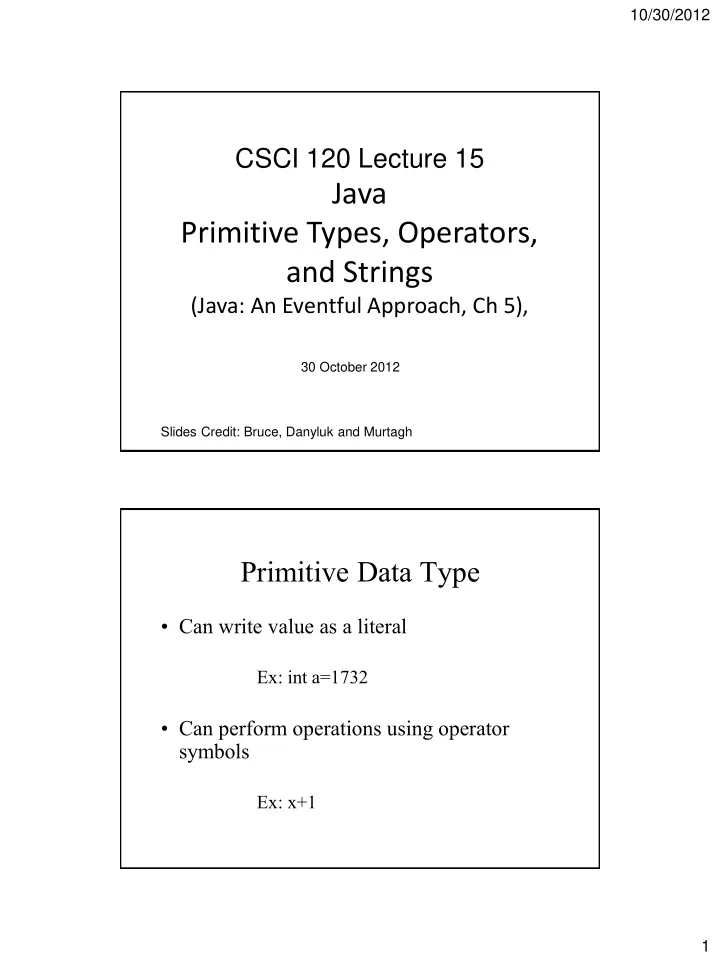
10/30/2012 CSCI 120 Lecture 15 Java Primitive Types, Operators, and Strings (Java: An Eventful Approach, Ch 5), 30 October 2012 Slides Credit: Bruce, Danyluk and Murtagh Primitive Data Type Can write value as a literal Ex: int a=1732


slide-1
SLIDE 1

10/30/2012 1

Java Primitive Types, Operators, and Strings

(Java: An Eventful Approach, Ch 5),

Slides Credit: Bruce, Danyluk and Murtagh

CSCI 120 Lecture 15

30 October 2012

Primitive Data Type

  • Can write value as a literal

Ex: int a=1732

  • Can perform operations using operator

symbols

Ex: x+1

slide-2
SLIDE 2

10/30/2012 2

Operators vs. Method Invocations

  • Operators produce new values

Ex: if the value of count is 3 count+1 will produce 4, but will not change count

  • Method Invocations can modify objects

Ex: box.move(-1,-1); changes the position of the box

Operators and Precedence Rules

  • Arithmetic and logical negations, - and !
  • Multiplication and division: * and /
  • Addition and subtraction: + and –
  • Comparisons: <,<=,>,>=
  • Equality and inequality: == and !=
  • And: &&
  • Or: ||

Ex: a+b*c is the same as a+(b*c) but not (a+b)*c

slide-3
SLIDE 3

10/30/2012 3

Numeric Types

  • Integers:

Ex: int anInt=99;

  • Real numbers:

Ex: double aDouble=98.6;

An int can be converted into a double without loss of precision, but not vice versa

Dividing int and double

int double int int result double result double double result double result

Clearly, unless an integer is divided by another integer, all results are double. Ex: 3.0 / 4.0 = 0.75 3 / 4.0=0.75 3 / 4 = 0

The following table summaries the types of result one will get when dividing two integers, two doubles, or a double and an integer

slide-4
SLIDE 4

10/30/2012 4

How a double is displayed

  • If you print a double, the output is always accompanied by

a decimal place. Ex: double a=1000;

System.out.print(a);

will output 1000.0

  • Large numbers use scientific notation

Ex: double a=1000000000;

System.out.print(a); will output 1.0E9

Selecting a Numeric Type

  • Use int whenever you need whole numbers
  • nly.
  • Use double when you need non-integer

values

  • Use int when methods demand it

Ex: setColor( int, int, int )

slide-5
SLIDE 5

10/30/2012 5

Useful Functions on double

Math.pow(a,b) ab Math.exp (b) eb Math.ln(a) ln(a) Math.sqrt(a) Square root of a

System.currentTimeMillis()

  • Used to check elapsed time

Ex: printing out the duration of a mouse press

public void onMousePress(Location point){ startingTime=System.currentTimeMillis(); } public void onMouseRelease(Location point){ System.out.println(System.currentTimeMillis()-startingTime)); }

slide-6
SLIDE 6

10/30/2012 6

String

  • Java uses String to manipulate textual data
  • Quoted text is of type String
  • Programs can combine String objects

Ex: String a="He"; String b="llo"; System.out.print(a+b); will print out Hello

  • String accumulators:

b = b + " world";

Student To Do’s

  • HW09

– Exercise 4.9.2 (Dicey) – Exercise 3.12.3 (Random Box) – Due Monday 11/5 by 1:25pm – Submit your .java files and bluej project file.

  • Read Java: An Eventful Approach

– Ch. 5 (Today)

12