Japanese Higher Education Hybrid of models Towards privatisation? - - PDF document

japanese higher education
SMART_READER_LITE
LIVE PREVIEW

Japanese Higher Education Hybrid of models Towards privatisation? - - PDF document

2 nd International Workshop on Reform of Higher Education in Six Countries 8-9 July 2004, Wiener Gartenhotel Altmannsdorf, Vienna, Austria Japanese Higher Education Hybrid of models Towards privatisation? Restructuring of the national


slide-1
SLIDE 1

1

Towards privatisation? Restructuring

  • f the national universities in Japan

Jun Oba

RIHE/Hiroshima University, Japan

  • ba@hiroshima-u.ac.jp

2nd International Workshop on “Reform of Higher Education in Six Countries 8-9 July 2004, Wiener Gartenhotel Altmannsdorf, Vienna, Austria

2

Japanese Higher Education

  • Hybrid of models

– German model – American model

  • Coexistence of three sectors

– national (national governmental) – local public (local governmental) – private (non-profit)

  • Large proportion of private universities

3

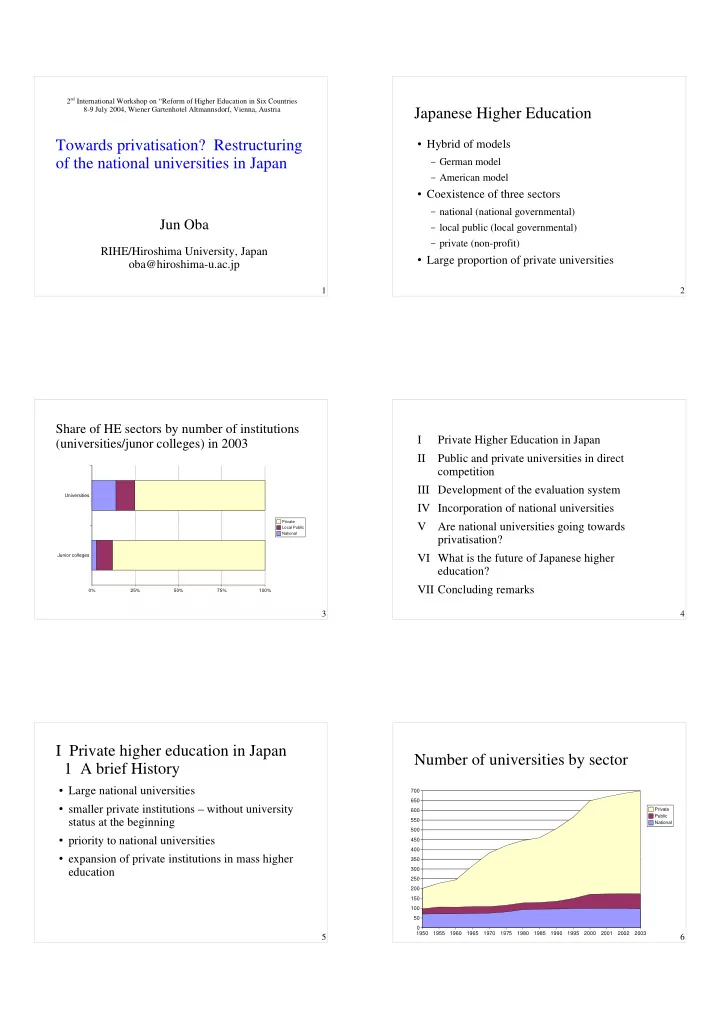
Share of HE sectors by number of institutions (universities/junor colleges) in 2003

Junior colleges Universities 0% 25% 50% 75% 100%

Private Local Public National

4

I Private Higher Education in Japan II Public and private universities in direct competition III Development of the evaluation system IV Incorporation of national universities V Are national universities going towards privatisation? VI What is the future of Japanese higher education? VII Concluding remarks

5

I Private higher education in Japan 1 A brief History

  • Large national universities
  • smaller private institutions – without university

status at the beginning

  • priority to national universities
  • expansion of private institutions in mass higher

education

6

Number of universities by sector

1950 1955 1960 1965 1970 1975 1980 1985 1990 1995 2000 2001 2002 2003 50 100 150 200 250 300 350 400 450 500 550 600 650 700

Private Public National

slide-2
SLIDE 2

7

Student enrolment in universities

1955 1960 1965 1970 1975 1980 1985 1990 1995 2000 2001 2002 2003 250,000 500,000 750,000 1,000,000 1,250,000 1,500,000 1,750,000 2,000,000 2,250,000 0% 25% 50% 75%

National Public Private Share of Private Universi- ties

8

Number of entrants to HE institutions

1949 1950 1951 1952 1953 1954 1955 1956 1957 1958 1959 1960 1961 1962 1963 1964 1965 1966 1967 1968 1969 1970 1971 1972 1973 1974 1975 1976 1977 1978 1979 1980 1981 1982 1983 1984 1985 1986 1987 1988 1989 1990 1991 1992 1993 1994 1995 1996 1997 1998 1999 2000 2001 2002 2003

50,000 100,000 150,000 200,000 250,000 300,000 350,000 400,000 450,000 500,000 550,000 600,000 650,000 700,000 750,000 800,000 850,000

Junior Colleges Universities Total

9

18-year-olds and access to HE

1965 1966 1967 1968 1969 1970 1971 1972 1973 1974 1975 1976 1977 1978 1979 1980 1981 1982 1983 1984 1985 1986 1987 1988 1989 1990 1991 1992 1993 1994 1995 1996 1997 1998 1999 2000 2001 2002 2003 25 50 75 100 125 150 175 200 225 250 0% 5% 10% 15% 20% 25% 30% 35% 40% 45% 50%

18-year-olds Entrants (universities & junior colleges) Ratio of the age group advancing to universities and junior colleges

tens of thousands

10

I-2 Public financing to private institu- tions

  • Article 89 of the Japanese Constitution
  • 1952 Private School Association
  • 1970 Private School Promotion Foundation
  • 1975 Private School Subsidy Law

11

General subsidies & Special subsidies to private institutions for the current expenditures (100 million yen)

2004 2003 2002 2001 2000 1999 1998 1997 1996 1993 1988 1985 1980 1975 1970 500 1,000 1,500 2,000 2,500 3,000 3,500

Special subsidies General subsidies

12

Current expenditures of private HE institutions and Government subsidies

1970 1971 1972 1973 1974 1975 1976 1977 1978 1979 1980 1981 1982 1983 1984 1985 1986 1987 1988 1989 1990 1991 1992 1993 1994 1995 1996 1997 1998 1999 2000 2001 2,500 5,000 7,500 10,000 12,500 15,000 17,500 20,000 22,500 25,000 27,500 30,000 0.0% 2.5% 5.0% 7.5% 10.0% 12.5% 15.0% 17.5% 20.0% 22.5% 25.0% 27.5% 30.0%

Total cost (100 million yen) Subsidies (100 million yen) subsidies/total cost (%)

slide-3
SLIDE 3

13

II Public and private universities in direct competition

  • Government appropriation in FY2003

– National institutions : 1,525,606 million yen – Private institutions : 321,750 million yen

  • Strong pressure from private universities on the

Government

  • Spiral of tuition fees

14

Tuition fees (entrance fees included) by sector

1975 1976 1977 1978 1979 1980 1981 1982 1983 1984 1985 1986 1987 1988 1989 1990 1991 1992 1993 1994 1995 1996 1997 1998 1999 2000 2001 2002 100,000 200,000 300,000 400,000 500,000 600,000 700,000 800,000 900,000 1,000,000 1,100,000 0.00 0.25 0.50 0.75 1.00 1.25 1.50 1.75 2.00 2.25 2.50 2.75 3.00 3.25 National Universities Local public universities Private universities Private/National

Yen

15

Public expenditure on HE in OECD Countries (2000)

Australia Austria Belgium Canada Czeck Rep. Denmark Finland France Germany Greece Hungary Iceland Ireland Italy Japan Korea Mexico NL Norway Poland Portugal Spain Sweden Switzerland UK USA OECD Total 0.0 0.5 1.0 1.5 2.0 2.5 3.0 3.5 4.0 4.5 5.0 3.2 2.7 2.6 4.7 1.8 4.6 4.2 2.0 2.4 2.1 3.0 2.6 4.1 1.8 1.6 2.7 4.3 2.9 4.1 1.8 2.3 2.4 3.6 3.4 2.5 3.5 2.9 1.2 1.4 1.3 2.0 0.8 2.5 2.0 1.0 1.1 0.9 1.0 1.1 1.3 0.8 0.5 0.7 0.9 1.3 1.7 0.8 1.0 1.0 2.0 1.2 1.0 1.1 1.2 as a percentage of total public expenditure as a percentage of GDP

16

Increase in competitive funds open to public and private institutions

  • Increase in special subsidies to private

institutions

  • Government funds indifferently open to public

and private institutions

– The 21st Century COE Programme

  • Grants-in-Aid for Scientific Research open to

private companies

17

Number of COE projects adopted by the MEXT, by sector

National universities Public universities Private universities 10 20 30 40 50 60 70 80 90 100

84 4 25 97 5 31 2002 2003

18

Top 15 universities ranked by the amount

  • f competitive research funds awarded by

the Government (million yen)

Tokyo Kyoto Osaka Tohoku Nagoya Kyushu Hokkaido TITech Keio (private) Tsukuba Hiroshima Chiba Waseda (private) TMDU Kobe 5,000 10,000 15,000 20,000 25,000 30,000 35,000 40,000 37,177 18,601 15,591 11,924 8,784 8,420 7,640 5,924 4,978 4,169 3,138 2,586 2,586 2,554 2,517

slide-4
SLIDE 4

19

III Development of the evaluation system

  • National Institution for Academic Degrees and

University Evaluation (NIAD-UE)

  • A new quality assurance system

– a continual third-party evaluation

  • an evaluation once every seven years

– recognition of evaluation bodies by the Government

20

IV Incorporation of national universities

  • 89 national university corporations
  • Increased autonomy over the management,
  • rganisational structure, personnel affairs,

budgeting, and so forth

  • Medium-goals/plan presented or approved by the

Minister of Education

  • People from outside the university participating

in the management

21

National University Corporation

President

Executives Board of directors

Internal representatives designated by the president

Administrative council

Internal representatives concerning education and research

Education and research council President selection committee Auditors External experts 22

External members of the Administrative Council of Hiroshima University

Name Occupation (former)

  • W. Imanaka

President, Chugoku Newspaper

  • K. Inai

President, Japan Audio Visual Educational Association (Former Secretary to the Minister of Education)

  • B. Johnstone

Professor of Higher and Comparative Education, State University of New York at Buffalo (Former President of State University of New York)

  • M. Ogasawara

President, Board of Education of Hiroshima Prefecture

  • M. Onami

Special Advisor, Kyoto Tachibana Women’s University (Former President of Ritsumeikan University)

  • T. Shiiki

Lawyer

  • S. Takasu

Chairman, Chugoku Economic Federation / Chairman of the Board of Directors, Chugoku Electric Power Co. Ltd.

  • K. Tanabe

Secretary-General, Tokyo Conference for the Collaboration in Chugoku (Former Director-General, Chugoku Bureau of Economy, Trade and Industry (METI Chugoku))

23 MEXT

Evaluation Committee for National University Corporations

National university corporations

Draft (opinions)

  • f MTG

Preparation of MTP Preparation of annual plan Presentation

  • f MTG

Approval of MTP

Opinions on MTG/MTP, etc. Independent Administrative Institution

National Institution for

Academic Degrees and University Evaluation (NIAD-UE)

Report on the results of evaluation

  • n education and research

Peer review

Evaluation

Commission on Policy Evaluation and Evaluation of Independent Administrative Institutions (Ministry of Public Management and Home Affairs) Report on the results of evaluation Opinions, if necessary MTG: medium-term goals MTP: medium-term plan (See below for details) Recommendations, if necessary Consultations on MTG/MTP, etc.

24

Examples of numerical targets

National University Corporation Target Muroran Institute of Technology Increase external research funds, including the Grants-in-Aid for Scientific Research, by around 10% within 6 years. Tsukuba University Maintain the the ratio of successful applicants for the National Medical Practitioners Qualifying Examination over 90%. Tsukuba University Organise job guidance activities more than 30 times every year. Tokyo University of Agriculture and Technology Increase the number of faculty members engaged in commissioned research or joint research by 10% in comparison with the mean value of FY 2000-2003, for the period of medium-term goals. Shizuoka University Double the number of patents obtained (25 to 50) by the end of the medium-term goals/plan. Kyushu Institute of Technology Set up at least 5 research projects involving the whole university with a view to solving world-wide problems. Takaoka Junior College Open up over half of the classes to the local community.

slide-5
SLIDE 5

25

V Are national universities going to- wards privatisation?

  • Continuous discussions on the privatisation of

national universities

– Prime Minister Koizumi at the Diet – Opposition party's policy – Newspapers' questionnaire

etc.

  • Where are national universities going?

26 State Facility Model State Management Model State Trust Model Corporate Model

Based on the model presented by M. Kaneko

US (state universities) United Kingdom Germany Japan (former national universities) China ? US (private universities) Japan (private universities)

Government control Strong Weak Financial autonomy Weak Strong

France ? ? ? ? 27

  • Increasingly blurred distinction between public

and private sectors

28

Principal differences between national and pri- vate universities can be seen in

  • the nomination of the president and the auditors by the

Minister of Education;

  • the presentation of medium-term goals and the ap-

proval of the medium-term plan by the Minister of Education;

  • systematic institutional evaluations by the evaluation

committee;

  • development and maintenance of important facilities;
  • regulations on tuition fees and other important regula-

tions;

  • some programmes restricted to national universities.

29

  • Declining Government institutional support to

national universities

– reduction of the operational grants by 1% a year

30

VI What is the future of Japanese higher education?

  • Closing distance between the public and private

sectors.

  • National universities will survive, at least for the

time being.

slide-6
SLIDE 6

31

  • Functional differentiation being more important.
  • Difficult institutional evaluation.
  • The Government should be more supportive.

– rather than controls or evaluations – paraeducational activities or services

32

VII Concluding remarks

  • Increased presence of private higher education
  • Public and private sectors in direct competition

for increasingly scarce resources

  • Privatisation of national universities is unlikely,

for the time being at least. It will remain a political affair.

  • Difficult institutional evaluation
  • Increasingly important functional differentiation
  • Redefinition of the Government's roles is

necessary.