SLIDE 1
Page 1 of 9
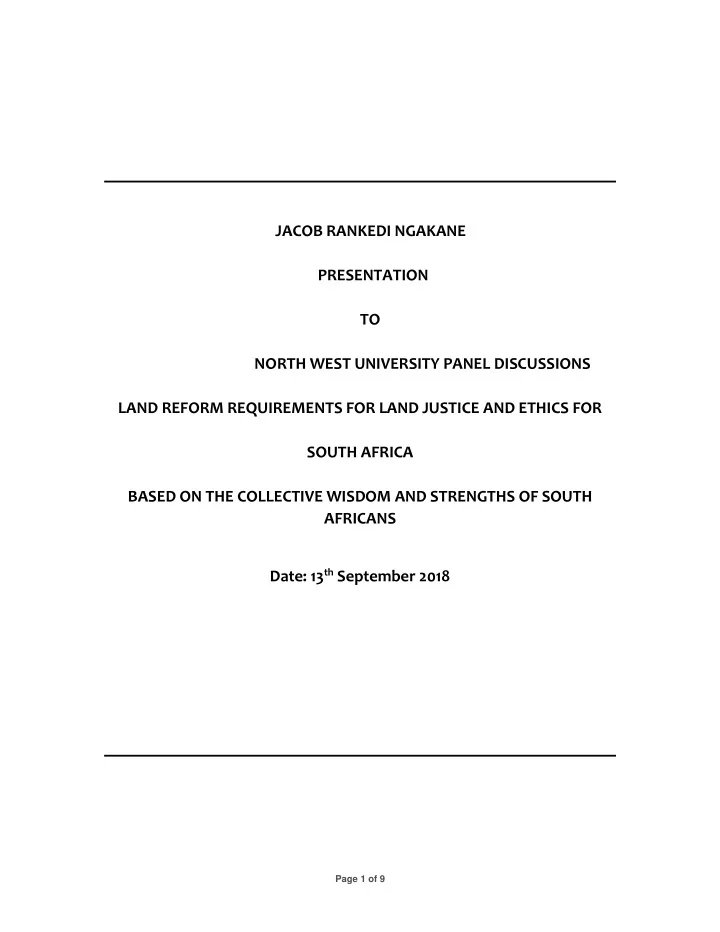
JACOB RANKEDI NGAKANE PRESENTATION TO NORTH WEST UNIVERSITY PANEL DISCUSSIONS LAND REFORM REQUIREMENTS FOR LAND JUSTICE AND ETHICS FOR SOUTH AFRICA BASED ON THE COLLECTIVE WISDOM AND STRENGTHS OF SOUTH AFRICANS Date: 13th September 2018
SLIDE 2
Page 2 of 9
Introduction Program director, distinguished guests, friends, leadership of the NWU present here today, fellow panellists good afternoon. Firstly I would like to thank the NW University for creating open and constructive platforms for local and international communities from all walks of life to share ideas around issues facing our beloved country and the world. Prof Christa and colleagues, you are doing a fantastic job and for those who may not be aware, you are offering South Africans and our global friends’ ways to prevent chaos, self-destruction, and loss of lives we witness throughout the world. If the USA can go through so much pains being the so called first world, what about SA and other countries just for failing to engage constructively. That is why I have chosen to talk about “LAND REFORM REQUIREMENTS FOR LAND JUSTICE AND ETHICS FOR SOUTH
AFRICA BASED ON THE COLLECTIVE WISDOM AND STRENGTHS OF SOUTH AFRICANS”
As a country we come from the worst past. The former President Nelson Mandela, at the dock stated “I am against white Domination and will be against black domination”, but he went further and sated some very strong but prophetic words which ended like, “if needs be my Lord, it is an ideal for which I am prepared to die for”. When you make any reference to Nelson Mandela you must be careful as you cannot quote him selectively. Our former statesman value systems and his fellow comrades, as well as convictions, laid a solid base for our democracy that we enjoy today. It is his wisdom amongst others that I will be using to guide my input. I have chosen this topic, relying on the wisdom and strengths of South Africans, black and white that have laid the foundation, and provided the
SLIDE 3 Page 3 of 9
leadership to navigate a complex resolution of our South African difficult
- past. It is those lessons and wisdom that we need to deal with in the land
reform with special focus on; a) Requirements for land justice. b) How we can include ethics to land reform. c) Unpack our collective wisdom to prevent giving the ruling party a blank cheque. Any Reform is Disruptive & Emotional, the Same for Land Reform Let me acknowledge the unscientific and shallow argument presented to us that the arrival of Europeans in 1652 resulted in the discovery of Africans and SA. It is the fact of our history that what happened to our country was our colonisation. We also all acknowledge as South Africans, the negative impact the 1913 land and wealth dispossession had on the majority of black South Africans, leading to our white fellow South Africans enjoying the wealth arising from Land, develop generational wealth etc. it is a fact of our history that this was done through the infamous June 1913 land act. This fact of history was accompanied by expropriation of land WITHOUT COMPENSATION from majority South African population, and apart from land, livestock was the “pasela” hence my humble and painful submission that it should actually be described correctly as land and wealth expropriation without compensation. The end result was family disruption etc So today, in our country, we are dealing with the second and possibly the very humane expropriation of land dispossession without compensation. This most important land reform requirement has been approached
SLIDE 4 Page 4 of 9
responsibly so far, and we require the collective wisdom to do it properly for the good of all South Africans. In closing this part of my argument, as South Africans, in the past 10 years we have seen the worst of our democratic government and how corruption and state capture led to abuse of office, stealing relentlessly from the public purse with impunity to date. Therefore, to give this democratic government a blank cheque, which may be abused by those who may be undetectable for now, is a huge right of land without terms and conditions. In my view it would be irresponsible and a refusal to learn by all South African compatriots. We have a collective duty and strength to ensure that we tighten our check and balances policies, not only to make a serious crime to steal from the government but to make sure that both the Ministers and DG’s, inclusive of top management from each directorate found guilty, get a collective punishment of life imprisonment as an example if we talk about a deterrent. LAND AND PUBLIC SECTOR INTEREST CANNOT BE A RIGHT FOR GIRLS/BOY FRIENDS BIRHTDAY GIFTS. Unfortunately we leave it to the politicians and law makers to finalise our fate, by either not participating, not voting, or hurling insults and talking war, hoping that the item on the table will go away. It does not, for a simple reason that you were consulted and did not use this right
- effectively. Any unlawful conduct will be dealt with, until we all comply.
Repeat of the past brutality of inhumane land and wealth dispossession, has been replaced by a more human but sophisticated processes and policies.
SLIDE 5 Page 5 of 9
The Importance of Ethics & Accountability On Land Discourse Missing during the public hearing on the constitutional land reform has been Ethics & Accountability. These principles must be attached to the land debate to inform policy and law makers to put in place solid ethics and accountability requirements. However, given our South African lesson, there is a need that these two principles must form part of our education system as well. At primary and high school levels, they should form part of the syllabus and one of the requirements to proceed to the next grade, but more stricter when you exit high school so that grade 12’s can understand that there is no short cut to wealth accumulation. The same with tertiary. They must understand that there is even a “state of emergency” that as a Country, we will not allow hell again to form part of our society, and we will not celebrate it The courts and employment requirements at both public and private sectors, must display a heavy handed attitude of intolerance for corruption and the consequences thereof. As South Africans, we must know and understand that there is declaration of war at all levels where corruption can potentially be conducted in all of its forms. At supply chains, there should be a form to be completed by CEO’s, DG’s pre signed by Ministers, who will undertake to be responsible for employment and having been placed in this position, they will enjoy its benefits but accept full accountability to hold those below their level, responsible for any act of corruption. Failure to do so, they would accept full responsibility and the consequences thereof. We must even take this intolerance to family levels at churches, and every corner of our daily lives. Before marriages, there should be full disclosure along the following lines “this union is not based on the fruits
- f corruption”. It is a pity that there are no longer confessions at church
SLIDE 6 Page 6 of 9
- levels. Maybe we dropped the ball there, but let us not blame the church
because they are, and can be effective to save us. Let me move to our collective wisdom, and more on additional tools available for us to free ourselves from this hell, and really see the potential necessity of land reform for the mutual benefit of all South Africans. Collective Wisdom & Strengths of South African A few weeks ago, without the courts, we have seen a highly sophisticated speedy, cost effective justice meted against a sick fellow
- n holiday in Greece, by all level headed South Africans. We reduced the
courts’ workload and saved legal costs. The second collective wisdom and strengths were displayed at our Parliamentary subcommittee on land reform. At the beginning, I was sitting watching and listening to a fellow tearing my heart apart and I knew I was not the only one. I battled to find rational as to how I forgive this fellow or how best he can be rehabilitate. It took a few minutes to recover when I saw the most appropriate collective responses from parliamentarians across the political and colour lines. I recovered within a few minutes from the trauma. As South Africans, we should thank those parliamentarians for their collective wisdom and strengths. These two examples demonstrate that we are a maturing democracy, and all political parties understand that there is no longer a “free lunch”. The same with racists, the space is gradually closing up on them. At the dinner tables families should be approaching these matters responsibly,
- r otherwise irreparable damage on the good name of the family will
- result. Our children will bear the brunt of our conduct in the future,
having to put up with an unpardonable sin against humanity.
SLIDE 7
Page 7 of 9
The Restorative Land Justice We Again South African Can Lead Agri SA provides an excellent leadership for the farming community by engaging with the ruling party. They are practical and solution driven in their approach. There is nothing more solid than finding common grounds on working together as South Africans. We see the same with Afgri SA on approaching black South African farmers and sharing their expertise, providing tools of trade which includes technology, funding solutions, markets etc. When approaching black farmers they do not opt for insults or insensitive backward language such as they discovered black famers. My history teachers had tough times with me then when they tried to convince us that Jan Van Reebeck discovered us. Today, that other fellow tried unsuccessfully to insult us because we were properly represented. Therefore, the processes started by parliament, and the developments and responses of Afgri and Agri SA provides the necessary leadership this country requires. We can also make our inputs, thanks to NWU for creating this platform. Yes we can rebuild South Africa based on our collective wisdom using all tools at our disposal. One area I would like to pick up on, which in my view, is the biggest mistake done in the past which our current democratic government seems to be enjoying as well, is the mistake of thinking that paying traditional leadership unequal salaries gives them a right to exploit them and their communal land. The following are few examples; a) The exclusion or share gross negligence of tribal land in the spatial planning for more than 22 years since the new dawn of SA
SLIDE 8 Page 8 of 9
continues to subject rural communities to the continuation of the hardships inherited from the past. b) The manner in which the current government deals with land claims, lack of accountability by officials, speaks volumes about this contradiction. How on earth do you keep your job for more than 20 years performing at less than 10% of your target? c) The DRDLR post settlement support is not given without complications and rural communities or claimants having to find lawyers to process grants due to them. d) How do we manage local and foreign investors to exploit communal and natural resources without repeating the land injustices of the past? It is not correct to continuously turning traditional leadership and rural communities from being spectators
- n the exploitation of their land and natural resources.
e) How do we convince government that consultation is not enough, there should be agreement with communities, they must be capacitated to negotiate from position of strength through legislative and other material support. Closing comments Our company, Tisella Investment Group together with the NWU and the Ndebele Kingdom are working on a comprehensive integrated and sustainable land use master plan development model applying, and I our pipeline we have three rural communities in the NW and the Ndebele Kingdom. We are together seeing very exciting results wherein the community plays central role and learning the art of mega socio-economic
- development. We do it with them, and not for them.
SLIDE 9
Page 9 of 9
Our beloved country and its people, especially urban and rural communities deserve best from all of us, not only from government. Yes, we can make money whilst doing good, for the greater of humanity. It is greed and corruption that kills.
LAND REFORM REQUIREMENTS FOR LAND JUSTICE AND ETHICS FOR SOUTH AFRICA BASED ON THE COLLECTIVE WISDOM AND STRENGTHS OF SOUTH AFRICANS IS INDEED ACHIEVABLE.
Thank you.