Jaak Vilo vilo@egeen.ee Estonian Computer Science Theory days: - - PDF document

jaak vilo
SMART_READER_LITE
LIVE PREVIEW

Jaak Vilo vilo@egeen.ee Estonian Computer Science Theory days: - - PDF document


slide-1
SLIDE 1

1

✂✁☎✄✝✆✟✞✡✠☞☛✍✌✎✌✑✏✒☛✝✏✔✓✕✏✍✌✒✄✗✖✙✘✍✁✚✠✙✛✡☛ ✜ ✞✢✆✑✘✍✁✣✘✥✤✦✠☞☛✗✠☞☛✍✌✎✘✡✧✑✧✑✓✕✛✑✘✗★✡✩✝✏✍✪

Jaak Vilo

vilo@egeen.ee

Estonian Computer Science Theory days: Pedase, 3.10.2003

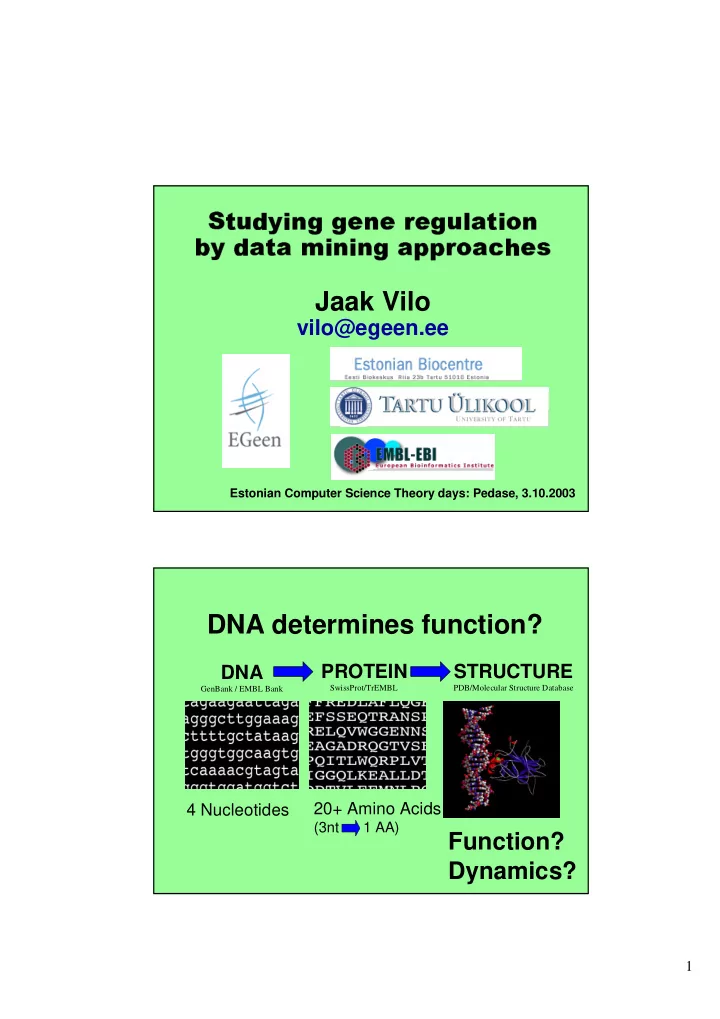
DNA

GenBank / EMBL Bank

PROTEIN

SwissProt/TrEMBL

STRUCTURE

PDB/Molecular Structure Database

DNA determines function?

4 Nucleotides 20+ Amino Acids

(3nt 1 AA)

Function? Dynamics?

slide-2
SLIDE 2

2 David S. Goodsell http://www.scripps.edu/pub/goodsell/

A Simple Gene

ATCGAAAT TAGCTTTA

✂✁ ✄☎✁ ✆✞✝✠✟✞✡✂☛ ☞✌☛ ✍✞✎✞✏✑☛ ✟✓✒☎✔

Upstream/ promoter Downstream

DNA:

✕ ✁
slide-3
SLIDE 3

3

F.C.P. Holstege, E.G. Jenning, J.J. Wyrick, Tong Ihn Lee, C.J. Hengartner, M.R. Green, T.R. Golub, E.S. Lander, and R.A. Young Dissecting the Regulatory Circuitry of a Eukaryotic Genome

Cell 95: 717-728 (1998) Model of RNA Polymerase II Transcription Initiation

  • Machinery. The machinery

depicted here encompasses over 85 polypeptides in ten (sub) complexes: core

RNA polymerase II (RNAPII) consists of 12 subunits; TFIIH, 9 subunits; TFIIE, 2 subunits; TFIIF, 3 subunits; TFIIB, 1 subunit, TFIID, 14 subunits; core SRB/mediator, more than 16 subunits; Swi/Snf complex, 11 subunits; Srb10 kinase complex, 4 subunits; and SAGA, 13 subunits.

TGTTCTTTCTTCTTTCATACATCCTTTTCCTTTTTTTCC TTCTCCTTTCATTTCCTGACTTTTAATATAGGCTTACCA TCCTTCTTCTCTTCAATAACCTTCTTACATTGCTTCTTC TTCGATTGCTTCAAAGTAGTTCGTGAATCATCCTTCAAT GCCTCAGCACCTTCAGCACTTGCACTTCATTCTCTGGAA GTGCTGCACCTGCGCTGTCTTGCTAATGGATTTGGAGTT GGCGTGGCACTGATTTCTTCGACATGGGCGGCGTCTTCT TCGAATTCCATCAGTCCTCATAGTTCTGTTGGTTCTTTT CTCTGATGATCGTCATCTTTCACTGATCTGATGTTCCTG TGCCCTATCTATATCATCTCAAAGTTCACCTTTGCCACT TTCCAAGATCTCTCATTCATAATGGGCTTAAAGCCGTAC TTTTTTCACTCGATGAGCTATAAGAGTTTTCCACTTTTA GATCGTGGCTGGGCTTATATTACGGTGTGATGAGGGCGC TTGAAAAGATTTTTTCATCTCACAAGCGACGAGGGCCCG AGTGTTTGAAGCTAGATGCAGTAGGTGCAAGCGTAGAGT CTTAGAAGATAAAGTAGTGAATTACAATAGATTCGATAC
slide-4
SLIDE 4

4

Patterns: AT

Patterns: [AT][ACT]AT (WHAT)

slide-5
SLIDE 5

5 Genome Research, 1998 Upstream Random

LASER, scanning

culture 1 culture 2

mRNA cDNA hybridise

DB Analysis of biological samples with microarrays

slide-6
SLIDE 6

6

From microarray images to gene expression data

Raw data

Array scans Image quantifications

Spots Spot/Image quantiations

Intermediate data

Samples

Genes Gene expression levels

Final data

Cluster of co-expressed genes, pattern discovery in regulatory regions

✂✁✂✁☎✄✝✆✂✞ ✟✡✠✝✆☞☛ ✌ ✞ ✍ ✎ ✏ ✑ ✒ ✓ ✓ ✔ ✕✗✖✘✏ ✑ ✕ ✙ ✔ ✚ ✒ ✓ ✛✢✜✤✣✗✥ ✦ ✧✤★✪✩✫✦ ✧✤✬✪✭ ✮✪✯✰✣ ✱ ✟✝✲ ✌ ☛ ✟✝✳✗✟ ✴✤✵ ✶✰✷✹✸✰✺✡✻ ✻ ✼✪✽ ✶✤✾❀✿✤❁✤✼✪✽ ❂ ✽ ✼✪✸❃✽ ✼✰✾✝✼✪✶✡✻ ✼✰✷❅❄❆✵ ✻❈❇✰✵ ✶❊❉✤❋
  • ✤✾❈✻
✼✪✽

Genome Research 1998; ISMB (Intelligent Systems in Mol. Biol.) 2000

slide-7
SLIDE 7

7

>YAL036C chromo=1 coord=(76154-75048(C)) start=-600 end=+2 seq=(76152-76754)

TGTTCTTTCTTCTTCTGCTTCTCCTTTTCCTTTTTTTCCTTCTCCTTTTCCTTCTTGGACTTTAGTATAGGCTTACCATCCTTCTTCTCTTCAATAACCTTCTTTTCTTG CTTCTTCTTCGATTGCTTCAAAGTAGACATGAAGTCGCCTTCAATGGCCTCAGCACCTTCAGCACTTGCACTTGCTTCTCTGGAAGTGTCATCTGCACCTGCGCTGCTTT CTGGATTTGGAGTTGGCGTGGCACTGATTTCTTCGTTCTGGGCGGCGTCTTCTTCGAATTCCTCATCCCAGTAGTTCTGTTGGTTCTTTTTACTCTTTTTCGCCATCTTT CACTTATCTGATGTTCCTGATTGCCCTTCTTATCCCCTCAAAGTTCACCTTTGCCACTTATTCTAGTGCAAGATCTCTTGCTTTCAATGGGCTTAAAGCTTGAAAAATTT TTTCACATCACAAGCGACGAGGGCCCGTTTTTTTCATCGATGAGCTATAAGAGTTTTCCACTTTTAAGATGGGATATTACGGTGTGATGAGGGCGCAATGATAGGAAGTG TTTGAAGCTAGATGCAGTAGGTGCAAGCGTAGAGTTGTTGATTGAGCAAA_ATG_ >YAL025C chromo=1 coord=(101147-100230(C)) start=-600 end=+2 seq=(101145-101747) CTTAGAAGATAAAGTAGTGAATTACAATAAATTCGATACGAACGTTCAAATAGTCAAGAATTTCATTCAAAGGGTTCAATGGTCCAAGTTTTACACTTTCAAAGTTAACC ACGAATTGCTGAGTAAGTGTGTTTATATTAGCACATTAACACAAGAAGAGATTAATGAACTATCCACATGAGGTATTGTGCCACTTTCCTCCAGTTCCCAAATTCCTCTT GTAAAAAACTTTGCATATAAAATATACAGATGGAGCATATATAGATGGAGCATACATACATGTTTTTTTTTTTTTAAAAACATGGACTCGAACAGAATAAAAGAATTTAT AATGATAGATAATGCATACTTCAATAAGAGAGAATACTTGTTTTTAAATGAGAATTGCTTTCATTAGCTCATTATGTTCAGATTATCAAAATGCAGTAGGGTAATAAACC TTTTTTTTTTTTTTTTTTTTTTTTGAAAAATTTTCCGATGAGCTTTTGAAAAAAAATGAAAAAGTGATTGGTATAGAGGCAGATATTGCATTGCTTAGTTCTTTCTTTTG ACAGTGTTCTCTTCAGTACATAACTACAACGGTTAGAATACAACGAGGAT_ATG_

...

>YBR084W chromo=2 coord=(411012-413936) start=-600 end=+2 seq=(410412-411014) CCATGTATCCAAGACCTGCTGAAGATGCTTACAATGCCAATTATATTCAAGGTCTGCCCCAGTACCAAACATCTTATTTTTCGCAGCTGTTATTATCATCACCCCAGCAT TACGAACATTCTCCACATCAAAGGAACTTTACGCCATCCAACCAATCGCATGGGAACTTTTATTAAATGTCTACATACATACATACATCTCGTACATAAATACGCATACG TATCTTCGTAGTAAGAACCGTCACAGATATGATTGAGCACGGTACAATTATGTATTAGTCAAACATTACCAGTTCTCGAACAAAACCAAAGCTACTCCTGCAACACTCTT CTATCGCACATGTATGGTTCTTATTGTTTCCCGAGTTCTTTTTTACTGACGCGCCAGAACGAGTAAGAAAGTTCTCTAGCGCCATGCTGAAATTTTTTTCACTTCAACGG ACAGCGATTTTTTTTCTTTTTCCTCCGAAATAATGTTGCAGCGGTTCTCGATGCCTCAAGAATTGCAGAAGTAAACCAGCCAATACACATCAAAAAACAACTTTCATTAC TGTGATTCTCTCAGTCTGTTCATTTGTCAGATATTTAAGGCTAAAAGGAA_ATG_

101 Sequences relative to ORF start

GATGAG.T 1:52/70 2:453/508 R:7.52345 BP:1.02391e-33 G.GATGAG.T 1:39/49 2:193/222 R:13.244 BP:2.49026e-33 AAAATTTT 1:63/77 2:833/911 R:4.95687 BP:5.02807e-32 TGAAAA.TTT 1:45/53 2:333/350 R:8.85687 BP:1.69905e-31 TG.AAA.TTT 1:53/61 2:538/570 R:6.45662 BP:3.24836e-31 TG.AAA.TTTT 1:40/43 2:254/260 R:10.3214 BP:3.84624e-30 TGAAA..TTT 1:54/65 2:608/645 R:5.82106 BP:1.0887e-29 ...

GATGAG.T TGAAA..TTT

YGR128C + 100

Pattern selection criteria Binomial distribution

5 out of 25, p = 0.2

Background - ALL upstream sequences Cluster: π

π π π occurs 3 times

P(3,6,0.2) is probability

  • f having ≥3 matches

in 6 sequences

P(π π π π,3,6,0.2) =0.0989

slide-8
SLIDE 8

8

Set overlap 5 6

P( choose 6 balls randomly from 25, of which 5 reds, and observe 3 or more red )

25 genes

3

slide-9
SLIDE 9

9

Pattern vs cluster “strength”

The pattern probability vs. the average silhouette for the cluster The same for randomised clusters

Vilo et.al. ISMB 2000

Regular patterns (SPEXS)

  • Substrings

ATCGA

  • Add groups

ATC[GC][AT]

  • Add (unrestricted) wildcards AT*CG
  • Add restricted wildcards AT*(2,5)CG
  • Combine all above

AT[GC]*(1,3)[GT]AC TGC…………ACG

slide-10
SLIDE 10

10

✂✁✂✄☎✂✁✂✝✆ ✄✞✟✆ ✆ ✆ ✄✡✠ ☛✌☞✎✍ ✏✌✑✓✒ ✔✖✕✎✍ ✗ ☞✌☞✌☞ ✘ ✗✎✠✎✂✁✂✄✞✂✁✙✟✆ ✄✞✝✆ ✆ ✆ ✄✚✠ ✛✌☞✎✍ ✏✌✑ ✘ ☛✜✠✎✂✁✂✄✞✂✁✙✟✆ ✄✞✝✆ ✆ ✆ ✄✚✠ ✢✌✣✎✍ ✏✌✑

Consensus matrix building

TACGAT TATAAT TATAAT GATACT TATGAT TATGTT TATAAT TATRNT [GT]A[CT][AG][ACT]T Consensi: A 0 6 0 3 4 0 C 0 0 1 0 1 0 G 1 0 0 3 0 0 T 5 0 5 0 1 6

i b G T C A b i b i

f f I

, 2 , . . , log

2

+ =

i b i b

f f

, 2 , log

slide-11
SLIDE 11

11 Upstream sequence (600bp)

GATGAG.T TGAAA..TTT

GATGAG.T W/30 TGAAA..TTT 1 mismatch

Probabilistic motifs Combinatorics Pattern + Sequence + Expression data combined view

slide-12
SLIDE 12

12

  • 1: ..[AG][AG][AG]CAGTCAC[AG]..

Homol-D 121 vs 249

Probability < 1e-117

  • 1: ..[AG]CCCTA[CA]CCT..

Homol-E 58 vs. 159

  • S. Pombe GO+genome

Cytosolic Ribosome

187 vs. 4897 genes in total ATG W C

SPEXS - Sequence Pattern EXhaustive Search

Jaak Vilo, 1998, 2002

  • User-definable pattern language: substrings, character

groups, wildcards, flexible wildcards (c.f. PROSITE)

  • Fast exhaustive search over pattern language
  • “Lazy suffix tree construction”-like algorithm
  • Analyze multiple sets of sequences simultaneously
  • Restrict search to most frequent patterns only (in each set)
  • Report most frequent patterns, patterns over- or

underrepresented in selected subsets, or patterns significant by various statistical criteria, e.g. by binomial distribution

slide-13
SLIDE 13

13

Suffix tree – represent all suffixes

CATAT => suffix tree 123456 CATAT$ 1 ATAT$ 2 TAT$ 3 AT$ 4 T$ 5 $ 6

AT CATAT$ T $ AT$ $ AT$ $ 2 4 1 3 5 6

O(n) time and space

“Lazy” construction of trie

ATACATAT$

  • Suffix trie
  • O(n²)
  • Kurtz, Giegerich
  • Good in practice

A T $ C {1,3,5,7} {4} {2,6,8} {9} T $ C {2,6,8} {8} {4} {3,7} A

123456789 ATACATAT$

slide-14
SLIDE 14

14

SPEXS: pattern discovery based on pattern trie.

  • Substrings
  • Group characters
  • Wildcard positions
  • Variable length wildcards
  • Restrictions on the number on

each separately

  • At least k occurrences
  • Exact occurrences locations

for each pattern

A T {1,3,5,7} {2,6,8} [CT] C ∪

∪ ∪ ∪ T

*A {3,5,7} {2,4,6,8}

ATACATAT$ 123456789 Vilo 1998, 2002

Sequence patterns: the basis of the SPEXS

✂✁☎✄✝✆ ✞ ✟✡✠☞☛✍✌✏✎ ✑✒✎ ☛✔✓✍✌✍✕ ✄ ✖✄ ✄ ✂✁☎✄✝✆ ✄✗✞ ✘✙✠☞☛☞✌✏✎ ✑✒✎ ☛✏✓✍✌✍✕ ✆ ✁
✁ ✁ ✂✁☎✄✝✆ ✄✂✚ ✁ ✂✁☎✄✝✆ ✄✂✚
slide-15
SLIDE 15

15

SPEXS: specify the pattern language and

parameters for pattern discovery

Sequences Background Pattern frequency Pattern language “Fitness” Search order

Combinatorics of sites

  • Which binding sites tend to co-occur

frequently together in upstreams

  • Association rules data mining
  • #(A,B) = 200 , #(A,B,C) = 180
  • A,B => C (90%)
  • Alvis Brazma, Jaak Vilo, Esko Ukkonen and Kimmo Valtonen

Data Mining for Regulatory Elements in Yeast Genome. Fifth International Conference on Intelligent Systems for Molecular Biology, ISMB-97 (pp. 65-74) June, 1997. AAAI Press.

slide-16
SLIDE 16

16

Research goals

  • Generate a (full) list of hypothetical

regulatory signals (for each and every gene)

  • Maintain a DB of all known or predicted inf.
  • How does this correlate to known information

and/or experimental data (e.g. ChIP on chip)

  • Predict from unannotated DNA where are the

promoters (and genes)

  • Predict from DNA how the gene is expressed

given concentrations of all TF-s in cell

  • Predict the alternative splicing isoforms
  • Evolution & comparative genomics approaches

How to know what is known?

  • After in silico predictions the first

question should be

  • How does that compare to current

knowledge?

  • But what if databases do not allow to

answer such questions easily?

slide-17
SLIDE 17

17

Similarity? Fast (approximate) search?

CCTAGTAG GTAA..CCT..CCT

✂✁✄✁✆☎✞✝✠✟☛✡✌☞✍✁✆✎☛✏✑✏✓✒✆✟✌✔✖✕✘✗ ✙✛✚✢✜✢✣✢✤ ✥ ✦★✧ ✩✪✚✬✫✮✭✢✥ ✯ ✫✪✧ ✰✲✱ ✫✪✧✴✳★✥ ✦✢✧ ✫✢✙✢✧ ✧ ✙✮✰✄✵✢✩✪✶✬✩✄✩✬✷✸✚✬✧ ✩✬✭✮✭✢✥ ✫✢✶✄✹✢✙✮✯ ✙ ✺✼✻✸✻✢✽✿✾❁❀✛❂❄❃❁✻✬❅❁❆✄❆

MIAMExpress

Expression Profiler MAGE-ML Internet

❇✴❇✴❇

MAGE-ML

slide-18
SLIDE 18

18

✂✁☎✄✝✆✟✞✡✠☎☛

Expression data

✌☞✂✍✝✎✌✏✑☞✓✒

sequence, function, annotation

✒✕✔✂☞✟✖✡✒

discover patterns

✗✙✘✛✚ ✏ ✄✙✔

provide links

✜ ✫✪✳★✚✬✫✢✶✬✩✪✶✮✯ ✭✄✫✬✱ ❀✿❂❄❃❁✻✬❅❁❆✄❆✌✢ ✣✥✤✧✦ ✻★✣✪✩✫✢ ✬ ❅ ✻ ✭✯✮ ✮✱✰✟✲ ✳ ✳ ✴✓✰✟✵ ✴✓✶✟✷ ✵ ✸✟✹✓✵ ✺✓✻✯✳

Expression data

External data, tools pathways, function, etc.

✔✏✄✝✆✛✏ ✄✝✆ ✁✡✼

visualise patterns

✂✁☎✲ ✽✙✾

GeneOntology

✂✁☎✲ ✁✂✁❀✿

Prot-Prot ia.

✒✕☞☎❁ ✚ ✎✂✙✎
  • Simple Web UI: Basic Architecture
  • XML Component Descriptions & XSLT Rendering
  • Chainable Components
❂❄❃ ❃ ❅ ❆ ❇ ❈ ❉ ❃ ❊ ❋ ❋
  • ✂❍
■✱❏ ■▲❑◆▼ ❖▲■ P ❇◆❑☎◗ ❘ ❙ ❊ ❏ ❋ ❆ ❋ ❚ ❊ ❯ ❇◆❑☎◗ ❘ ❙ ❊ ❏ ❋ ❆ ❋ ❚ ❊ ❯

Web Interface (Services/UI/etc.)

Request Response

XSLT

Processor

EP Component (EPC) XML EP Component (EPC) XML EP Component (EPC) XML EP Component

(EPC) XML

EPC Rendering

XSL

External Services Access EP Database Internal and 3rd party Components

slide-19
SLIDE 19

19

Expression Profiler

(component interface)

SUBSELECT CLUSTER

Projects started at Tartu

  • Database for gene regulation information
  • Tools for using that database
  • Pattern matching and discovery
  • Alternative splicing regulation (3yr EU

project)

  • (Fast) gene expression data clustering
  • Data mining seminar series;
  • other DM and ML methods
  • ...
slide-20
SLIDE 20

20

Gene regulation

  • Promoter analysis, also in higher eukaryotes
  • Alternative Splicing data analysis
  • Genetic networks
  • Gene expression data analysis
  • Integration of many different data types
  • Protein-protein interactions
  • Phenotypes
  • Metabolic pathways
  • Signaling pathways

Pattern discovery

  • Pattern discovery and pattern matching in

sequences; sequence algorithms

  • Regulatory sequence analysis
  • GPCR receptor bioinformatics
slide-21
SLIDE 21

21

Data mining

  • Data mining methods development for

bioinformatics

  • Fast clustering methods
  • Gene networks and regularities
  • Machine learning methods
  • Text Mining
  • Information extraction
  • categorization
  • Information retrieval, dictionaries
  • Medical and clinical data handling and storage,

population and statistical genetics, pharmacogenetics.

Software engineering

  • Database development, software

engineering

  • UML based development and code generation
  • XML based UI-s
  • Expression Profiler
  • Farm and GRID computing
slide-22
SLIDE 22

22

Acknowledgements

Alvis Brazma Misha Kapushesky + the EBI microarray team Frank Holstege, and Patrick Kemmeren, UMC Utrecht Mike Croning, Steffen Möller (ex EBI) Esko Ukkonen, U. of Helsinki Inge Jonassen, Bergen U. Meelis Kull Hedi Peterson Ireen Meho … + ~ 10 new faces

slide-23
SLIDE 23

23

Running time for hierarchical clustering

Clustering 10,100, 1000 dim Distances 10 attrib. Distances 100 attrib

T i m e i n s e c

  • n

d s

1minute 10K 20K 5min Data size 15K

Limits of standard clustering

  • Hierarchical clustering is (very) good for

visualization (first impression) and browsing

  • Speed for modern data sets remains

relatively slow (minutes or even hours)

  • ArrayExpress database needs some

faster analytical tools

  • Hard to predict number of clusters

(=>Unsupervised)

slide-24
SLIDE 24

24

Approximate distances

  • Triangle inequality for metrics

A C B d(A,B) and d(B,C) allow us to estimate d(A,C) within certain limits

|d(A,B) – d(B,C)| <= d(A,C) <= d(A,B) + d(B,C)

GPCR coupling

Current perspective G-protein

Signal: Agonist

Effector Enzyme channels

Intracellular messengers GPCR:

slide-25
SLIDE 25

25

Our Computational Approach

  • Using a new membrane topology prediction algorithm

(designed specifically for GPCRs), we constrained our pattern search to the intracellular domains of ≈ 100 receptor sequences with well-characterised, and non-promiscuous coupling (split into Gs, Gi/o and Gq/11)

Receptor Match Positions

Croning, Vilo, Möller, ISMB 2001

slide-26
SLIDE 26

26

[RK]....R.{0,9}EK DR.{4,11}H...[AGS] FR....[RK].{0,3}L S...L.{1,10}T[ILV] C.[FWY].{2,11}K [ILV].L.{6,10}A.T S....[RK]A.{3,10}S A[ILV].{1,5}Y..[ILV].T LR.{1,9}T...[ILV]

slide-27
SLIDE 27

27

Determine the significance of GO term for a cluster of genes

GO term CLUSTER A: |G

  • C| / min( |G|, |C|)

B: P( choose |C| from N with |G|, observe |G

C|+)

N genes

G

✁ C

Annotation of clusters

GO:0042254 <U:L> Process: ribosome biogenesis and assembly (+2:15) (depth=7) [sgd:2:187] GO:0042254: 47 from cluster (size 98) vs 187 in this class (including subclasses) GO:0006364 <U:L> Process: rRNA processing (+3:3) (depth=8) [sgd:50:126] GO:0006364: 35 from cluster (size 98) vs 126 in this class (including subclasses) GO:0006360 <U:L> Process: transcription from Pol I promoter (+6:14) (depth=8) [sgd:23:155] GO:0006360: 38 from cluster (size 98) vs 155 in this class (including subclasses) GO:0005730 <U:L> Component: nucleolus (+10:17) (depth=6) [sgd:154:210] GO:0005730: 45 from cluster (size 98) vs 210 in this class (including subclasses) GO:0030515 <U:L> Function: snoRNA binding (depth=6) [sgd:23:23] GO:0030515: 17 from cluster (size 98) vs 23 in this class (including subclasses) GO:0030490 <U:L> Process: processing of 20S pre-rRNA (depth=9) [sgd:33:33] GO:0030490: 18 from cluster (size 98) vs 33 in this class (including subclasses) GO:0005732 <U:L> Component: small nucleolar ribonucleoprotein complex (depth=6) [sgd:30:30] GO:0005732: 16 from cluster (size 98) vs 30 in this class (including subclasses) GO:0006396 <U:L> Process: RNA processing (+7:52) (depth=7) [sgd:7:370] GO:0006396: 40 from cluster (size 98) vs 370 in this class (including subclasses)

slide-28
SLIDE 28

28

Protein-protein interactions: which to trust more?

Answer: Use the distance measure alone

slide-29
SLIDE 29

29

Kemmeren et.al.

Randomized expression data Yeast 2-hybrid studies Known (literature) PPI MPK1 YLR350w SNF4 YCL046W SNF7 YGR122W

Molecular Cell, Vol. 9, 1133–1143, May, 2002

Results from PPI & expression

  • Confidence in 973 out of 5342 putative two-hybrid

interactions from S. cerevisiae is increased.

  • Besides verification, integration of expression and

interaction data is employed to provide functional annotation for over 300 previously uncharacterized genes.

  • The robustness of these approaches is

demonstrated by experiments that test the in silico predictions made.

  • This study shows how integration improves the

utility of different types of functional genomic data and how well this contributes to functional annotation.

slide-30
SLIDE 30

30

Start summarizing…