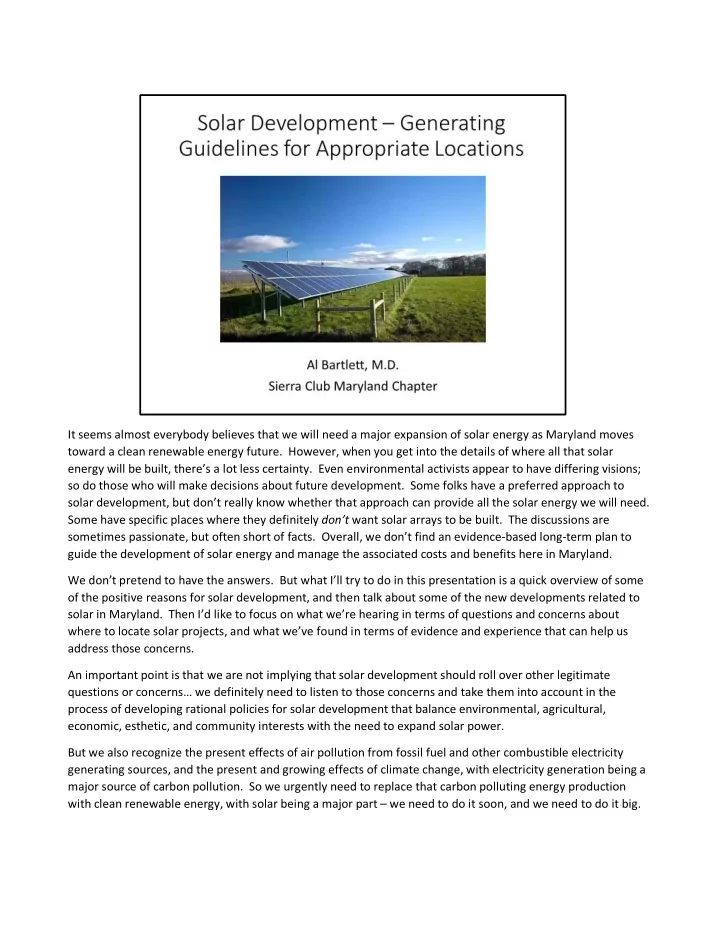
SLIDE 1 It seems almost everybody believes that we will need a major expansion of solar energy as Maryland moves toward a clean renewable energy future. However, when you get into the details of where all that solar energy will be built, there’s a lot less certainty. Even environmental activists appear to have differing visions; so do those who will make decisions about future development. Some folks have a preferred approach to solar development, but don’t really know whether that approach can provide all the solar energy we will need. Some have specific places where they definitely don’t want solar arrays to be built. The discussions are sometimes passionate, but often short of facts. Overall, we don’t find an evidence-based long-term plan to guide the development of solar energy and manage the associated costs and benefits here in Maryland. We don’t pretend to have the answers. But what I’ll try to do in this presentation is a quick overview of some
- f the positive reasons for solar development, and then talk about some of the new developments related to
solar in Maryland. Then I’d like to focus on what we’re hearing in terms of questions and concerns about where to locate solar projects, and what we’ve found in terms of evidence and experience that can help us address those concerns. An important point is that we are not implying that solar development should roll over other legitimate questions or concerns… we definitely need to listen to those concerns and take them into account in the process of developing rational policies for solar development that balance environmental, agricultural, economic, esthetic, and community interests with the need to expand solar power. But we also recognize the present effects of air pollution from fossil fuel and other combustible electricity generating sources, and the present and growing effects of climate change, with electricity generation being a major source of carbon pollution. So we urgently need to replace that carbon polluting energy production with clean renewable energy, with solar being a major part – we need to do it soon, and we need to do it big.
SLIDE 2
Who thinks about where their electricity is coming from when they turn on the light switch at 5:00 PM in February, or their A/C in August? But it’s worth thinking about. Where does electricity in Maryland come from? Actually, about 80% of the electric power generated in the state comes from two sources: nuclear (a bit more than 40%, all from the Calvert Cliffs nuclear plant) and coal (a bit less than 40%, from the 7 coal-fired power plants in the state – more than any other state on the East Coast). Our state’s Renewable Portfolio Standard now includes a mandatory carve-out of 2.5% of total energy used to come from solar by 2025; since it’s only 2017, we are presently required to get less than 2% of our power from solar. The RPS also has a mandatory carve-out of 2.5% from offshore wind – but right now there is none (and while the legislature and the Public Services Commission have approved the building of two offshore wind projects to serve Maryland, you may have heard that a single one of our congressmen has blocked that offshore wind development with a sneaky amendment to a budget bill… so we’ll see how that plays out). Bottom Line: We’re a huge distance away from the amount of wind and solar we need to reach our state’s Greenhouse Gas Reduction goals of 40% carbon reduction by 2030, and to achieve a 100% clean energy future by 2050, which is what need to confront climate change.
SLIDE 3 Here are a few graphs that show why it’s possible to do that – to expand solar energy rapidly in the coming
- years. This one shows that the cost of solar energy – in this case, the cost of power produced by solar
photovoltaic (PV) cells themselves – has dropped tremendously, and continues to drop. This drop in cost is largely the effect of market forces, but also includes the increased efficiency in terms of energy output by solar cells themselves.
SLIDE 4
With this huge drop in cost - in this case, shown by the orange line, which shows the price paid for solar power, now approaching $1.50 or less per watt of power production capacity - has come a correspondingly large increase in the amount of solar installed each year. (But still, not just in Maryland, but across the U.S., solar is as yet a very small fraction of all power production.)
SLIDE 5
And, with the increase in the amount of solar energy being built has come a corresponding increase in the number of jobs in the solar industry… and in the rate of increase in jobs. Some people say that there are 3 times more jobs now in solar than in coal. The official U.S. government report - from the national Energy Information Administration of the Dept. of Energy - is much stricter in their definitions of coal and solar jobs… but even they find the number of solar jobs to be well over twice the number of coal jobs. And, solar jobs are growing.
SLIDE 6
This slide simply shows that those national trends are relevant to Maryland as well. The slide, which shows solar build-out year-by-year through 2016 with estimates out to 2021, makes a few key points. One is that solar installation in MD has increased and will likely continue to increase year over year. Another is that, while residential solar installation (the yellow* at the bottom of each bar) has been most of the growth so far, in coming years, larger scale solar projects - especially utility scale projects – are likely to make up a larger share of the growth. And, solar is already providing jobs in Maryland… the number of solar jobs added last year was the greatest yet. * “CSP” is Concentrated Solar Power, which would be at the top of each bar. CSP is the process of concentrating solar heat using mirrors, to create steam and drive turbines. It is part of the solar mix largely in the southwest U.S., but isn’t technically or economically very viable in the northeast and mid-Atlantic.
SLIDE 7 One of the forces that is helping to support solar development in the U.S. is the federal Investment Tax Credit. This is a major incentive – it was ended a few years ago but restored in Congress’s budget deal back in 2015 (when Republicans got more funding for the Pentagon, and the Democrats got, among other things, restoration of tax credits for wind and solar). The ITC allows those who finance solar projects to take a dollar-for-dollar credit off their taxes for a substantial percentage of the cost of building the project. Note that the amount of the credit - now 30% - starts to drop after 2019, and goes down to a fixed 10% after 2021. While many experts say that the solar market is robust and would continue to grow without an ITC, there’s no doubt that this credit is still an important promoter of solar development. (If needed, discuss the likelihood that the Trump administration will cancel the ITC, but doing so will put the
- ther terms of the Congressional budget agreement in danger as well.)
SLIDE 8 Another important incentive for solar energy is Renewable Energy Credits, or “RECs.” Basically, if you are getting solar power from your own rooftop panels, you are making money in 3 ways.
- You’re saving money because you’re not paying for the power that comes from your roof into your
- wn home.
- If you generate more power than you use, you get paid (credited) for the remainder you export onto
the grid (“net metering”). But also…
- You earn one “REC” for every megawatt (or portion thereof) that you generate.
In state’s like Maryland with mandatory Renewable Portfolio Standards, these RECs are themselves worth money, because utilities buy them to meet the requirements for renewable energy in their mix. The market for RECs is complex, but there are agencies that will do it for you. So homeowners with solar on their roof get checks every month for the RECs they generate, beyond the savings on their electric bills. And… where there are carve-outs for specific types of renewable energy - as Maryland has for solar and for
- ffshore wind - those special RECs (“SRECs” for solar) have generally been worth a lot more than RECs from
- ther sources.
(More on this later.)
SLIDE 9
There are also some important new types of solar project that should contribute to acceleration of solar energy production in Maryland. One of these is the state’s new Community Solar Pilot Program. These happy people are “subscribers” to this community solar project (it is not in Maryland – maybe in Colorado… we haven’t built any yet, though it’s about to begin being built). They either have signed up to buy shares of power from the multi-user array behind them, or they may actually own some of the panels in that array (community solar can work either way).
SLIDE 10
Maryland’s legislators - with a lot of push from the environmental community - authorized this 3 year “pilot” program to evaluate the possibility of making solar accessible to the estimated more than half of MD residents who for various reasons can’t put solar on their own roof. Maybe their roof faces the wrong way, or has too many dormers, or is too shady; or maybe they live in a condo or apartment and don’t actually own the roof. There are lots of possible reasons, but the important thing is that Community Solar is one way to open up this huge share of the potential solar market! For the past two years, the Public Services Commission has led a “Net Metering Working Group” that includes utilities, solar developers, other agencies like the Dept. of Environment (MDE) and the Office of People’s Counsel, and some non-profits to develop the regulations and other rules and procedures to make the Community Solar program happen. (I’ve been a member – 2 years of weekly 2-hour phone calls!). But finally it’s happening – in June and July, organizations interested in developing community solar projects were reviewed for approval by the PSC. In August, those approved are now getting permission from their respective utility - like Pepco or BGE - to connect to the grid. That interconnection agreement is the last step before actually building projects. Community solar projects aren’t huge – they’re limited to a maximum of 2 megawatts. And this is a pilot, so not every group that applies will get to build, at least this year. One important feature of this program is that the legislature’s intention to promote solar in beneficial ways is built into the pilot: 30% of the program’s capacity is set aside for projects built on brownfields, churches, etc. And 30% is set aside for projects that include low and moderate income participants, who are usually the last to benefit from clean energy.
SLIDE 11 The other thing that’s happening in Maryland is that larger – “utility scale” – solar projects are beginning to be
- built. This is one of the largest, just outside of Hagerstown in Washington County. It’s on public land… actually
built around the state correctional facility. It has 30 megawatts of solar generating capacity – enough to supply thousands of homes.
SLIDE 12 Of course, it looks gigantic. So I took this screenshot from Google Earth from a bit higher up. If you look closely, you’ll see the prison and the surrounding solar panels in the yellow circle. But you can also see that it’s relatively small in terms of the surrounding landscape, which is semi-rural, not being that far from the center
- f Hagerstown, the county seat.
You’d think that the beginning of these new phases of solar development – Community Solar and utility scale solar – would be good signs for the accelerated growth of solar that we need to reach Maryland’s clean energy goals. But it hasn’t been quite that straightforward…
SLIDE 13 For one thing, as solar development has picked up, there are a lot more SRECs being generated. The result is that the market value of SRECs has dropped steeply – just a decade ago they were worth over $300 per REC. In 2015 they were still worth $130. But by this year, the value has dropped to sometimes less than $10. This has had a number of effects. One of course is disappointment when rooftop solar owners open their monthly checks. But it has also caused a bit of a pause in rooftop solar development: the lesser “return on investment” and longer time to recover their investment have made some home and business owners hesitate in making the solar decision. As a result, some jobs have actually been lost. However, the solar market has proven fairly resilient, rooftop solar is still being built, and with more commercial solar, Community Solar, and
- ther projects being lined up, solar growth is still happening… but maybe not as fast.
The other effect of lower SREC value is that it makes the profit margin for solar project investors and developers much tighter. So anything else that affects cost of project building or operation in Maryland becomes more critical now in the success of a project, or the decision to undertake one in the first place.
SLIDE 14 Also, as Community Solar and larger solar projects are being proposed, there have been increasing questions and concerns coming from various stakeholders who see their interests being affected. Under Maryland law, decisions and regulations regarding buildings, property, and land use are devolved to the local jurisdiction level. So it’s county and municipal governments that are hearing these questions and
- concerns. And they are in some cases being pushed to make decisions about whether and where solar
projects can be built. Especially sensitive are questions about building solar projects on the ground, on open
- land. One of the questions we’ve heard repeatedly is “Why build on good land at all – why not build all solar
- n rooftops; or on power line rights of way where there’s a lot of space and there’s already electric wires; or
- n brownfields - old industrial sites or other contaminated areas - and landfills?”
The idea of putting solar under power lines has been around since at least 2010. By one estimate, solar on all the land under power lines in the U.S. could supply up to 20% of all our present electricity. Some of that power line land is in mountainous terrain or other places that couldn’t be used; but that doesn’t seem to be the main issue. Neither is the possibility that the current flowing in high voltage lines will disturb the electricity being produced by a solar array – the solar production is DC (until made AC by an “inverter”), while the current in high voltage lines is AC. Engineers say “no interference.” But there are some issues that affect this possibility of solar under power lines. One is that utilities need to keep space under the lines clear for access for service and emergency repairs. The other is that in most cases the utilities don’t actually own the land under the lines; they get use of it by a series of easements with different parties – it may be a county or municipality in one area, individual landowners in another.
- Complicated. Despite the power lines overhead, actual connection points to the electricity grid may be far
- away. Finally, in areas with fewer sunlight hours or less sunlight intensity, the shadows of overhead lines and
nearby structures could reduce the efficiency of solar panels. While it seems that none of these complications couldn’t be overcome, we have not found any state in which this approach is actually happening.
SLIDE 15 Roofs are certainly often good places to build solar arrays. Right now in Maryland almost all solar is on home and commercial/industrial rooftops. When you fly out of BWI, it looks like the world is filled with big roofs that look perfect for solar. More businesses - like Home Depot recently - are making this decision. In most cases, the power is for their own use at the facility. There are some limiting factors to rooftop solar building. For one, solar arrays have a useful life of about 25 years; so if the roof needs to be replaced in 10 years or so, you’d have to take the whole thing apart and then put it back together on the new roof – expensive! Best time to install solar on a roof is at the same time as the roof is built or replaced. Second best is on a recently built or replaced roof. Also, building on a roof is quite a bit more complicated, and more expensive, than building on the ground. And while many roofs look good for solar, there may be design, structural, or other engineering or zoning issues that may prevent it from happening. Building solar on parking lots seems like a “no-brainer.” Again, however, it’s not so straightforward. It’s one thing to build on a roof, where people don’t often go, and another to build over places where humans are
- underneath. Solar developers inform me that the structural requirements for building over parking areas, and
the resulting cost of elements like better grade steel and other safety requirements, make parking lot solar a less attractive option to businesses or solar investors than it would otherwise seem.
SLIDE 16
As for retired brownfields and landfills, this is another area that has definite potential… and some of this potential is already being used, including in Maryland. A brownfield is defined as “real property, the expansion, redevelopment, or reuse of which may be complicated by the presence or potential presence of a hazardous substance, pollutant, or contaminant.” The Dept. of Environment website has a master list of “archived” (closed) brownfield sites by county, plus information on its “Historic Landfill Initiative”: (http://mde.maryland.gov/programs/Land/MarylandBrownfieldVCP/Pages/errp_factsheets.aspx). The National Renewable Energy Lab (NREL) calculates that in the U.S. there are about 29 million acres of land in brownfields – about 1/10th as much as in agriculture. NREL estimates that about 1/4th of this brownfield area could be used for solar development. Most of the largest brownfields are in the South and Southwest; but there are a large number of brownfield sites of various sizes across Maryland, plus a smaller number of retired landfills, some of which are certainly suitable for solar development. MDE is positive about the prospect of solar development on such sites. Doing so requires some extra (but not complicated) review of project plans and some special engineering considerations: both retired landfills and closed brownfields are “capped” – landfills with a membrane or clay layer covered by at least 2 ft. of topsoil, brownfields usually with concrete or asphalt. As long as the “caps” aren’t penetrated, building on these sites is not usually a problem. The good news is that solar array designs for such sites don’t need to penetrate the cap – they generally use cement footings built on the surface to support the arrays; so cap penetration would not be an issue. Brownfields and landfills often have other important advantages for solar development. They are frequently located near population and commercial centers that can use the energy generated without expensive and relatively inefficient long transmission distances. They are often close to good points of interconnection with the electricity grid and to infrastructure such as roads and rail connections, facilitating construction. Their use as solar sites offers opportunities for state-local-private partnerships and is frequently welcomed by surrounding communities. For these reasons, some states offer proactive technical support and other incentives for solar development on brownfields and landfills.
SLIDE 17
Ken Clark of the Howard County Group noted this recent article in the Smithsonian magazine, about floating solar arrays. This one, on a manmade lake in China, produces 40 megawatts, enough to power roughly 15,000 homes there. There’s also one on a reservoir in the U.K. The advantages are that they don’t require large amounts of dry land area, and that the water actually serves as a coolant to the photovoltaic and conduction components, maintaining higher efficiency. Obviously these have to be on relatively calm and contained waters… we won’t expect to see them on the Chesapeake Bay or in the waves off Ocean City. But they do offer one more option, although of limited overall scope.
SLIDE 18 Certainly rooftops, brownfields, and landfills can play an important role in solar development, and their use needs to be considered and even prioritized in renewable energy planning. A key question is, can these sites provide all the solar capacity that Maryland needs? By 2030, to reach our GGRA goals (and have the jobs be in Maryland), the MD-based Institute for Energy & Environmental Research (IEER) calculates that we will require about 7,000 megawatts of solar PV, and about the same amount of offshore wind to produce almost half the energy we consume. By 2050, that amount of both solar and offshore wind would need to double. That will make the surface area requirement for solar about 57 million square meters. And - even with greater energy efficiency success - if we move heating, transportation, and other carbon-pollution sources to electricity, the requirement for solar and wind will actually increase. In terms of rooftops, the U.S. Dept. of Energy’s National Renewable Energy Lab has published national and state-specific estimates of rooftop solar PV “technical potential,” based on large-scale lidar assessments of roofs and other parameters. They conclude that:
- Individual rooftops have the lowest potential to be used for solar (about 26% of roofs); medium and
large roofs have much greater potential. But there are so many more household roofs that they actually make up almost 2/3rds of solar potential in the U.S.
- Overall, with wide variation across states, the total potential for rooftop solar electricity generation in
the U.S. is 39% of current energy consumption. Maryland also comes in at 39%.
- Full “technical potential” is unlikely to be reached, because of structural, legal, and other factors.
- Getting all this rooftop energy will require large investments in restructuring the electricity grid.
(and, electrification of transportation and other sectors will increase total electricity requirements.) And, although there isn’t a good estimate of the total area of retired landfills and closed brownfields in Maryland, NREL’s overall estimates indicate that their land area won’t be enough to make up the difference in generating all the solar energy we’ll need.
SLIDE 19
So it appears that to meet our clean renewable energy goals, we will need to include some amount of ground-mounted solar beyond what can be put on brownfields and landfills. In fact, ground-built solar will be necessary to achieve the lowest potential cost and the economies of scale that can provide solar energy most economically to the greatest number of homes and businesses. However, building solar on land is a topic that elicits more concerns and more intense emotions. These are some of the most frequent concerns we’ve been hearing, and what we know about them: “Ugliness” - (I think cell phone towers are much uglier, especially the ones that pretend to be trees – but we all love our phones, so we live with them.) In most places, zoning regulations require landscaping and setbacks that shield the view, and most solar developers are sensitive to this issue. Solar arrays certainly don’t belong in historic or other especially important landscapes. Glare - Solar cells function by absorbing light, not reflecting it. Modern solar panels are made with anti-glare surfaces, which can be required in permitting. Property value - Multi-year studies in states including Oregon have found that proximity to a large solar array has had no negative effect on property values. In many communities across the U.S., having rooftop solar actually increases property value; as solar expands, living near a local source of clean renewable energy may also come to increase value. There’s more to say about Runoff and Local Flora & Fauna in the coming slides… but these are also subject to usual zoning and permitting requirements for project design. At minimum, generally solar arrays are required to have drainage management mechanisms like gravel and are not permitted to allow runoff into vulnerable watershed areas. Zoning and permitting generally also require fencing that keeps out large animals like deer (and people). All electricity-carrying components are shielded by conduit and other mechanisms that protect small animals from eating them (thus being electrocuted and blacking out the neighborhood in the process). But the most frequent and intense concern generally has to do with use of agricultural land for solar.
SLIDE 20 Virtually all counties in Maryland - even Montgomery, where I live - have substantial rural components. As we noted earlier, as Community Solar and larger solar projects have begun to be proposed and built in Maryland, stakeholders in many counties have begun to express concern about the potential loss of good agricultural
- land. The result has been stories like these cited here, asking “Should building solar on farmland even happen
at all?” What sometimes is missing in these discussions is an overall perspective. Part of that perspective could come from the discussions we’ve already had, about the potential of rooftops, brownfields, and other sites to provide the solar power that Maryland needs to achieve a clean renewable energy economy. Another perspective that is often missing is the “Big Picture” of the potential of solar to cover the landscape. We’ve all seen the pictures of massive solar arrays in the desert out west. What are we talking about for Maryland?
SLIDE 21 This slide presents some useful calculations that give some of that Big Picture. Bottom line is that by 2030, if 50% of the solar energy production we would need were built on land designated as “farmland,” it would use
- nly 1 per cent of such land. Excluding all of the land designated “prime agricultural,” solar would use 1.7 per
cent of the remaining less productive land. So it should be possible to develop rational siting practices for land-based solar that are feasible, environmentally and agriculturally sound, and responsive to the need for some ground-based solar energy. The last bullet point on the slide deserves some special attention. There are energy authorities who report that in western states where renewable energy is more widely established, the income that farmers who actually farm are receiving from leases - largely wind farms, but also solar farms - is actually what is allowing them to keep their farms and keep farming. Also, more environmentally positive approaches like organic farming are more expensive, and so have more risk, but are also more remunerative if successful. So the solar lease income may allow a farmer take that risk, or take a chance on sustainable, carbon-sequestering agricultural methods. The IEER has also done another interesting set of analyses: from USDA data it is estimated that about 500,000 acres of Maryland farmland produce corn that is processed to make ethanol. Given the amount of sunlight energy needed to grow the corn and the energy yielded by the ethanol, the energy efficiency yield for the sunlight alone is just 0.19%. Factoring in the energy required by the farm machinery operation and fertilizer that are added to the sunlight input to grow the corn, the net efficiency yield drops to 0.04%. The ethanol is then added to gasoline, which is burned in conventional cars, which only get about 20% efficiency from the fuel they burn. So the overall efficiency of using sunlight to grow corn to make ethanol to power cars is about 0.008% - 1 unit of energy effectively used for 12,000 units of energy put in. Using the same land for solar generation of electricity, and using that electricity to power an electric vehicle, would be about 500 times more efficient!
SLIDE 22
There are also new approaches that are already being applied at commercial scale in places like Minnesota, involving ways that make two of the best things that we can do with sunlight - agriculture and solar power - mutually compatible and even value-added… “Co-location” of agriculture and solar energy generation. Here’s one example: there are many crops that benefit from partial shade, and solar arrays can be designed to facilitate their cultivation and harvesting.
SLIDE 23
Here’s a different example. Most of the cost of solar power is up-front, that is, building the solar project itself. But one of the recurrent costs through the life of the project is upkeep and maintenance. For ground-based solar, that often means mowing. Mowing large arrays requires a tractor, which means the space between rows of panels has to be fairly large, which in turn reduces the efficient use of the land itself. Plus it burns fuel and therefore produces carbon pollution. This is an alternative – some solar projects are renting herds of sheep to graze the land among the solar panels (they rent them from local farmers… solar developers aren’t likely to want to own their own sheep!). This provides income for the farmer and proves more cost effective than mechanical mowing.
SLIDE 24 And here’s perhaps the best “value-added” example… in Minnesota and elsewhere, large-scale commercial solar projects are planting the areas of their arrays with mixes of native grasses and flowers that attract
- pollinators. Evaluations of these projects have demonstrated increases in the number of pollinators on the
surrounding farmlands, providing a definable benefit to local farmers. Based on such examples, in its 2017 legislative session the Maryland General Assembly passed, and the governor signed, the “Department of Natural Resources — Solar Generation Facilities — Pollinator-Friendly Designation” Bill (SB1158). This new law establishes standards for pollinator-friendly solar development in Maryland and includes study of the effects of this approach as part of the state’s energy research program. Recently, the state’s first large-scale solar project designed to be pollinator-friendly was approved for development in Frederick County… one of our counties where agricultural interests have been reluctant to allow solar development. https://www.oneenergyrenewables.com/news/maryland-paving-way-commercial-solar-power-plants- become-pollinator-friendly/
SLIDE 25
And this approach has additional benefits in terms of runoff management, soil conservation and renewal, and local ecology. Unlike the lawn-type grasses with shallow roots that are characteristically used in commercial development, native plants and grasses tend to have deeper roots and don’t require artificial fertilizer.
SLIDE 26
So – There are a lot of factors and forces to consider as our state and its local governments work to map out a path to the clean renewable energy future we want and must build. One thing that emerges from this review is that a passive approach is unlikely to achieve the growth of solar energy that we need. Given the various cost pressures and uncertainties facing solar developers, it’s not enough to assume that “market forces” alone will get us to our goals. We’ll need to balance restrictions on inappropriate or undesirable solar development approaches with forward-looking plans that give priority to appropriate solar development. There may be room - and need - for technical or tax-related incentives for such appropriate development. We’ll need to learn from our own experience and experiences of other states. We’ll need state and local governments to be aware of the need for clean renewable energy development and committed to their role in facilitating it. The Maryland Sierra Club Chapter has received a small grant to help in this early stage of the process. These are the steps the grant aims to undertake, with the objective of providing evidence and experience-based inputs along the lines we’ve been discussing in this presentation. The bottom line is to provide our local volunteers, other stakeholders, and local decision-makers with the basis for developing environment-, agriculture-, economy-, and community-friendly long term plans to achieve that clean renewable energy future.
SLIDE 27
Thanks… and if you’d like to participate in this work, we definitely can use the help!