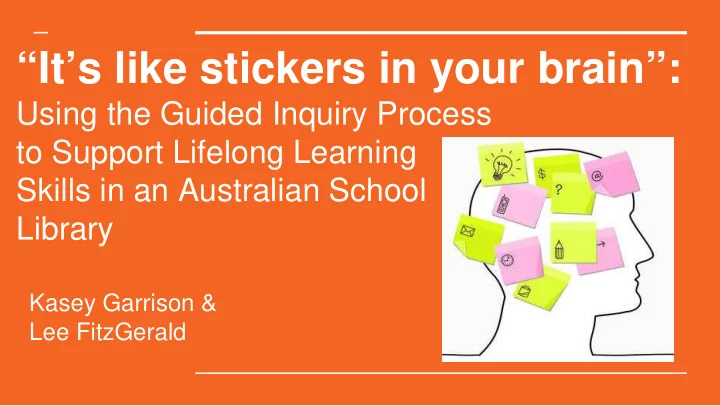
Its like stickers in your brain: Using the Guided Inquiry Process - - PowerPoint PPT Presentation
Its like stickers in your brain: Using the Guided Inquiry Process to Support Lifelong Learning Skills in an Australian School Library Kasey Garrison & Lee FitzGerald What is Guided Inquiry (GI)? Pedagogy grounded in a
What is Guided Inquiry (GI)?
- Pedagogy grounded in a constructivist approach to learning
based on the Information Search Process (ISP) (Kuhlthau;
1989a; 2004)
- Enriched with the Guided Inquiry Design process (GID)
(Kuhlthau, Maniotes & Caspari, 2012; 2015)
- Focus on student autonomy in pursuing own interests
- Reflection in developing self-regulating learning skills
- Continuous support from teachers and teacher librarians
Kuhlthau, Maniotes and Caspari (2015) describe GI as “tak[ing] students beyond the pre-digested format of the text book into learning from a variety of sources to construct their own understandings” (p. 61).
- Community of research from various scholars
Gordon & Todd, 2009; Kuhlthau, 1985, 1987, 1989a, 1989b, 1991, 1993, 2004, 2005; Kuhlthau, Heinstrom, & Todd 2008; Kuhlthau, Maniotes, & Caspari, 2012, 2015; Todd, 2012; Todd, Gordon, & Lu, 2010
Timely in Australian Context
- Curriculum changes emphasising inquiry learning
○ …but omitting a process to support it (Lupton, 2012)
- Supports in the form of ISP and GID (Kuhlthau, Maniotes, & Caspari,
2012; 2015)
- Introduction to
the project
- Building
curiosity and interest in topics
- Maintaining an
- pen mind
- Developing
and identifying background knowledge
- Connecting to
content
- Discovering
interesting ideas
- Pursuing what
becomes personally interesting
- Ponder what
was discovered in the first stages
- Identifying an
inquiry question and topic
Icons used with permission.
- Collecting information
- n the topic and
question
- Researching broadly
and deeply
- Answering inquiry
question through synthesis of research
- Creating final product
to communicate ideas
- Sharing with
classmates and researchers
- Assess the
achievement of learning goals
- Reflect on the content
and creation
- Reflection on the
process
Research Question
➔How do students use and interpret the GID process whilst engaged in research projects?
Participants
- Year 7 Students
- All girls independent
Catholic school in Sydney
- 33 volunteers
Complete data from 16 GI Unit
- Research in History and
Geography
- Semesters 1 and 2
- Research booklet
○ Document process
- Final Product- Essay
and Oral Presentation
Study Progression- 2015 school year
GI Unit 1
Research Booklets marked Final Products marked
Focus Groups 1
Semi-structured interview guide
GI Unit 2
Research Booklets marked Final Products marked
Focus Groups 2
Less structured interview guide
April-May June September-October November
Content Analysis of Transcripts
- Deductive Approach
Emergent Codes and Subcodes
- GID Stages
- Element of Choice
- Personal & Academic
Rewards
- Reflection
Stages of the GID Process
- Noted as positive, helpful aspects of breaking into stages
- Found in previous research with TLs (Garrison & Spruce, 2016)
Holly Bell “…they don't just push you in with all
- f the information...They really take
you through it with the different stages, so ok, I’ve finished this stage, then the next stage.” Madalyn “I am splitting it up so I can get each little part done as efficiently as possible.”
Specific stages noted as useful.
Eternity “because you could get to find out about more, not just your area of focus…I found that really fun.” Sleeping Beauty “helped me reflect
- n what I already
- knew. So that really
helped me because I knew what to go for.”
Choice is good.
Sleeping Beauty “creating your own question meant we could kind of explore our interests and decide what we wanted to find out about those places.” Cinderella “it was good that we were able to make our own [question] because sometimes that can make more sense than what you are given because it is what you think rather than what you are told to.”
Ariel
“…I really liked the GI actually, I found it was really refined… using it to create questions and stuff that I feel as if, it’s more the way to kind of be a part of it, more than just writing a speech or something like that, whereas answering questions and stuff makes you feel more connected to the project.”
Personal Rewards
Royal
“I found many more websites and things I could look at in
- ther subjects as well so not
just history and this area, but I’ve learnt to do it in English and other subjects, and learning about more reliable sources.”
Academic Rewards
Reflection
“I also really, really dislike reflecting mainly because I think it’s totally therapeutic and I don't like those sort of things that you get in a therapy session.”
Eternity
“...reflecting on the whole process kind of brought the whole thing together.” “it’s kind of just,
- k, I finished
now just what did I do? What worked? What didn't for next time?”
Madalyn Anastasia
Limitations
- Teachers’ inexperience
with GID process ○ Lack of understanding
- Nature of sample
○ Small, Catholic independent all girls school in affluent urban suburb Future Directions
- Working on GI with the
teachers ○ Professional development sessions ○ More ownership of GI
- Following same girls
through Year 8
- Replicate with a dissimilar
sample of students
SIGNIFICANCE
- Development of
metacognitive skills and strategies
- Need for collaboration
between teachers and teacher librarians
- Importance of
growing a wider base
- f research on the