Its a death penalty case until someone tells a court it isnt. - - PDF document

it s a death penalty case until someone tells a court it
SMART_READER_LITE
LIVE PREVIEW

Its a death penalty case until someone tells a court it isnt. - - PDF document

3/27/2017 Its a death penalty case until someone tells a court it isnt. Anon. Federal Death Penalty Resource Counsel Jean D. Barrett, Esquire Anthony L. Ricco, Esquire David A. Ruhnke, Esquire New York Law SchoolMarch 27,


slide-1
SLIDE 1

3/27/2017 1

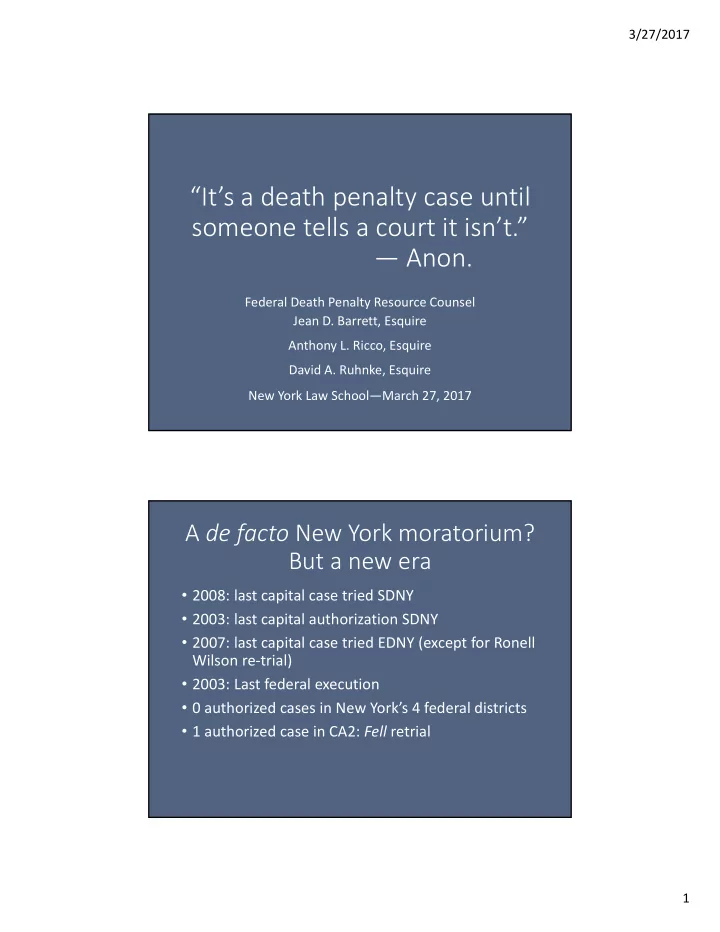
“It’s a death penalty case until someone tells a court it isn’t.” ― Anon.

Federal Death Penalty Resource Counsel Jean D. Barrett, Esquire Anthony L. Ricco, Esquire David A. Ruhnke, Esquire New York Law School—March 27, 2017

A de facto New York moratorium? But a new era

  • 2008: last capital case tried SDNY
  • 2003: last capital authorization SDNY
  • 2007: last capital case tried EDNY (except for Ronell

Wilson re‐trial)

  • 2003: Last federal execution
  • 0 authorized cases in New York’s 4 federal districts
  • 1 authorized case in CA2: Fell retrial
slide-2
SLIDE 2

3/27/2017 2

The Sovereign District of New York: is race an issue?

The Donald Fell litigation (D. Vt.)

As the court's findings indicate, the Federal Death Penalty Act, 18 U.S.C. §§ 3591, et seq. ("FDPA"), falls short of the standard required in Furman v. Georgia, 408 U.S. 238, 92 S. Ct. 2726, 33 L. Ed. 2d 346 (1972), and in Gregg for identifying defendants who meet objective criteria for imposition of the death penalty. Like the state statutes enacted after Furman, the FDPA operates in an arbitrary manner in which chance and bias play leading roles.

slide-3
SLIDE 3

3/27/2017 3

The Donald Fell litigation (D. Vt.)

One preliminary point is important. Through two weeks of hearings,

  • nly three issues were contested through the admission of

conflicting testimony and other evidence. These were bias arising from the race of the victim (Part II (B)), the effects of solitary confinement on death row (Part III (B)), and the statistical evidence

  • f a deterrent effect on the murder rate achieved through capital

punishment (Part III (D). With respect to deterrence in particular, the parties demonstrated the existence of a lively and continuing debate among statisticians, economists and social scientists about the deterrent effect of the death penalty. In all other areas, however, the evidence was one sided and came only from the defense.

DOJ protocol re local submission

§9‐10.080 In any case in which the United States Attorney . . . is contemplating requesting authorization to seek the death penalty, or otherwise believes it would be useful to the decision‐making process to receive a submission from defense counsel, the United States Attorney . . . shall give counsel for the defendant a reasonable opportunity to present information . . . which may bear on the decision whether to seek the death penalty.

slide-4
SLIDE 4

3/27/2017 4

DOJ protocol

  • § 9‐10.060: Mandatory pre‐indictment

review or explain why not.

  • § 9‐10.070: Expedited review includes

(5):

  • Any case where the US Att’y is able to

recommend that death not be sought even with no input from defense counsel.

  • § 9‐10.080: Non‐expedited review where

US Att’y believes a submission from defense counsel helpful.

Revised protocols ‐ Highlights

  • § 9‐10.010: Applies immediately all pending

and future cases.

  • § 9‐10.030: Consistent even‐handed

national application; cannot consider impermissible factors, e.g., race.

  • § 9‐10.050: Confidentiality. Not extend to

whether request for expedited review made

  • r level case is in process, e.g. still here, at

committee, AG has it.

slide-5
SLIDE 5

3/27/2017 5

The protocol— what (they say) matters to them

  • § 9‐10.140
  • Not race, ethnicity or religion (§ 9‐10.030)
  • Fairness
  • National consistency
  • Law‐enforcement objectives
  • Strength of the evidence
  • Role of Defendant in offense
  • Offense intended to obstruct justice, witness‐killing,

retaliation

What they say . . . .

  • Victim also engaged in criminal conduct as relevant

circumstance of the murder

  • Defendant history of un‐prosecuted misconduct
  • Already serving substantial sentence
  • Defendant’s conduct history while incarcerated
  • Acceptance of responsibility by willingness to plead to

life or near‐life

slide-6
SLIDE 6

3/27/2017 6

Questions from the Court

“Ms. AUSA, has this case undergone the mandatory pre‐indictment review called for by the Attorney Generals’ capital case protocol?” “Mr. AUSA, please enlighten the Court as to where exactly in the authorization process this case is?”

Saving Lives Since 1988: Federal Death Penalty Resource Counsel Project

503 authorized defendants 238 plea bargains 231 trials 151 life verdicts (65%) 83 death verdicts (35%) 60 on death row 3 executions 10 awaiting trial

www.capdefnet.org/fdprc

slide-7
SLIDE 7

3/27/2017 7 Timothy McVeigh – June 11, 2001 Juan Raul Garza – June 19, 2001 Louis Jones – March 18, 2003

Do’s and Don’ts at Start of Potential CJA Capital Case

  • Don’t accept the case if you are not on the capital

panel; inform USMJ or USDJ

  • Do contact Resource Counsel and FDNY: Deirdre von

Dornum in EDNY, David Patton in SDNY

  • Do seek appointment of learned counsel in advance of

assembling a team

  • Do assemble a team, ABA Standards minimum:
  • Two attorneys, one capital‐qualified
  • Fact investigator
  • Mitigation specialist
  • And someone qualified to identify symptoms of mental illness
slide-8
SLIDE 8

3/27/2017 8

Do’s and don’ts cont’d . . . .

  • Do try to diversify team; consider associate counsel
  • Do call Jerry Tritz to start budget process
  • Do visit client early and often
  • Do set up communication and case documentation

tools

  • Do schedule regular team meetings
  • Do remember there are unique concerns and

additional responsibilities if client is a foreign national

Do’s and don’ts cont’d . . . .

  • Don’t send in a mental health professional “to see

what I’ve got;” wait; unless need to document

  • ngoing mental decompensation/psychosis
  • Do consider a consulting mental health expert
  • Do have a comprehensive, multi‐generational social

history, including all available records, before any mental health evaluation

  • Do familiarize yourself with the tests your expert

plans to administer

  • Don’t permit your expert to administer personality

testing

slide-9
SLIDE 9

3/27/2017 9

Do’s and don’ts cont’d . . . .

  • Do work from the presumption that client is

intellectually disabled

  • Do insist on ample time to conduct investigation

before any submission to the Government

  • Do seek pre‐authorization discovery of information

relevant to the decision whether to seek death as punishment

  • Do have a plea strategy
  • Don’t say, “This case will never be authorized . . . .”