
SLIDE 1
Application Layer 1
ISO Layering Architecture ISO Layering Architecture
Srinidhi Varadarajan
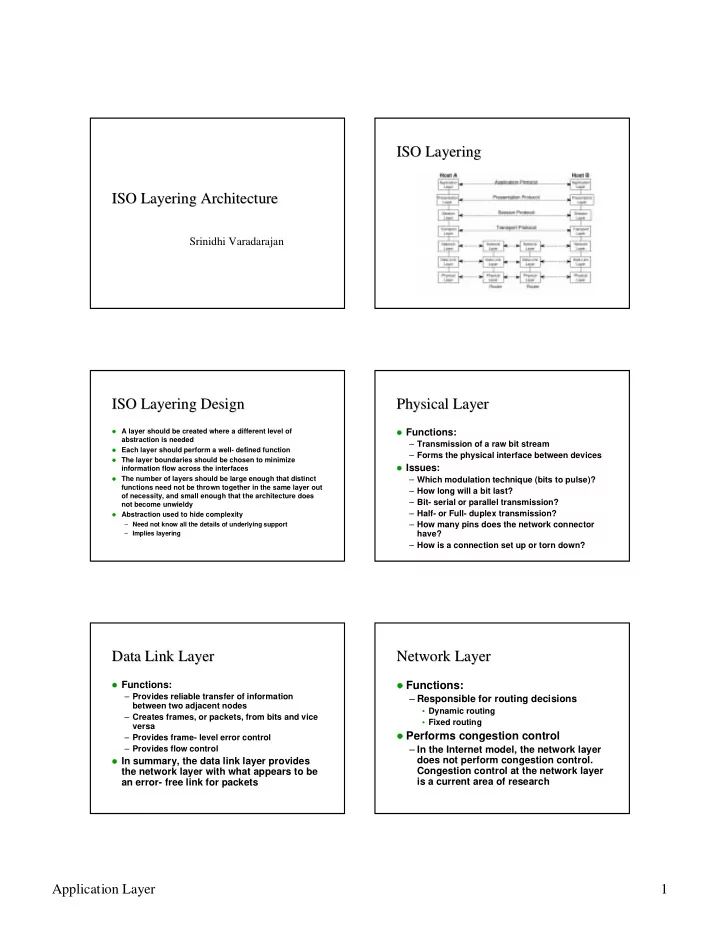
ISO Layering ISO Layering ISO Layering Design ISO Layering Design
z A layer should be created where a different level of
abstraction is needed
z Each layer should perform a well- defined function z The layer boundaries should be chosen to minimize
information flow across the interfaces
z The number of layers should be large enough that distinct
functions need not be thrown together in the same layer out
- f necessity, and small enough that the architecture does
not become unwieldy
z Abstraction used to hide complexity
– Need not know all the details of underlying support – Implies layering
Physical Layer Physical Layer
z Functions: – Transmission of a raw bit stream – Forms the physical interface between devices z Issues: – Which modulation technique (bits to pulse)? – How long will a bit last? – Bit- serial or parallel transmission? – Half- or Full- duplex transmission? – How many pins does the network connector have? – How is a connection set up or torn down?
Data Link Layer Data Link Layer
z Functions: – Provides reliable transfer of information between two adjacent nodes – Creates frames, or packets, from bits and vice versa – Provides frame- level error control – Provides flow control z In summary, the data link layer provides
the network layer with what appears to be an error- free link for packets
Network Layer Network Layer
z Functions: – Responsible for routing decisions
- Dynamic routing
- Fixed routing