ISLANDS ON ALGEBRAIC SURFACES Curtis T McMullen Harvard - - PowerPoint PPT Presentation

islands on algebraic surfaces
SMART_READER_LITE
LIVE PREVIEW

ISLANDS ON ALGEBRAIC SURFACES Curtis T McMullen Harvard - - PowerPoint PPT Presentation

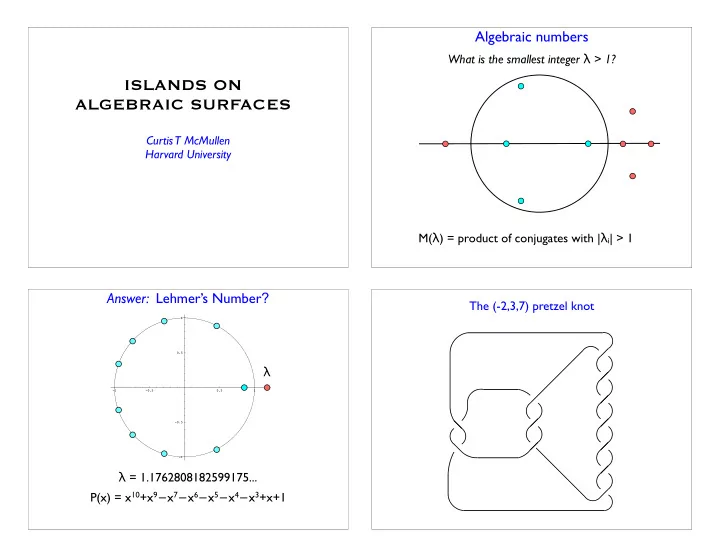
Algebraic numbers What is the smallest integer > 1? ISLANDS ON ALGEBRAIC SURFACES Curtis T McMullen Harvard University M( ) = product of conjugates with | i | > 1 Answer: Lehmers Number ? The (-2,3,7) pretzel knot 1 0.5


slide-1
SLIDE 1

ISLANDS ON ALGEBRAIC SURFACES

Curtis T McMullen Harvard University

Algebraic numbers

What is the smallest integer > 1? M() = product of conjugates with |i| > 1

Answer: Lehmer’s Number?

  • 1
  • 0.5

0.5 1

  • 1
  • 0.5

0.5 1

= 1.1762808182599175... P(x) = x10+x9x7x6x5x4x3+x+1

  • The (-2,3,7) pretzel knot
slide-2
SLIDE 2

Coxeter Groups

<ei,ei> = 2 e2 e1 e4 e3 e6 e5 e8 e7 e10 e9 <ei,ek> = 0 or -1 W ⊂ O(n,Z) : generated by reflections si in ei Coxeter element w = s1 s2 s3 s4 ... s10

Coxeter element Lehmer’s polynomial = det(xI-w) for E10 Theorem. The spectral radius of any w in any Coxeter group satisfies r(w) = 1 or r(w) Lehmer > 1.

Coxeter system λ(W, S) det(xI − w) Ah4 2.36921 (2.26844) 1 − x − 3x2 − x3 + x4 Ah5 2.08102 (1 + x)(1 − x − 2x2 − x3 + x4) Ah6 1.98779 (1.96355) 1 − 2x2 − 3x3 − 2x4 + x6 Ah7 1.88320 (1 + x)(1 + x + x2)(1 − 2x + x2 − 2x3 + x4) Ah8 1.83488 (1.82515) 1 − x2 − 2x3 − 3x4 − 2x5 − x6 + x8 Bh5 1.72208 (1 + x)(1 − x − x2 − x3 + x4) Bh6 1.58235 1 − x2 − 2x3 − x4 + x6 Bh7 1.50614 (1 + x)(1 − x − x3 − x5 + x6) Bh8 1.45799 1 − x2 − x3 − x5 − x6 + x8 Bh9 1.42501 (1 + x)(1 − x − x3 + x4 − x5 − x7 + x8) Dh6 1.72208 (1 + x)2(1 − x − x2 − x3 + x4) Dh7 1.58235 (1 + x)(1 − x2 − 2x3 − x4 + x6) Dh8 1.50614 (1 + x)2(1 − x − x3 − x5 + x6) Dh9 1.45799 (1 + x)(1 − x2 − x3 − x5 − x6 + x8) Dh10 1.42501 (1 + x)2(1 − x − x3 + x4 − x5 − x7 + x8) Eh8 1.40127 (1 + x + x2)(1 − x2 − x3 − x4 + x6) Eh9 1.28064 (1 + x)(1 − x3 − x4 − x5 + x8) Eh10 1.17628 1 + x − x3 − x4 − x5 − x6 − x7 + x9 + x10

The 38 minimal Coxeter systems

slide-3
SLIDE 3

Coxeter system λ(W, S) det(xI − w) K343 2.08102 (1 + x)(1 − x − 2x2 − x3 + x4) K3433 1.88320 (1 + x)2(1 − 2x + x2 − 2x3 + x4) K44 2.61803 (1 + x)2(1 − 3x + x2) K53

5

2.15372 (1 + x)2(2 − 3x − √ 5x + 2x2) K533

5

1.91650 (1 + x)(2 − x − √ 5x − x3 − √ 5x3 + 2x4) L33433 1.58235 1 − x2 − 2x3 − x4 + x6 L34333 1.40127 1 − x2 − x3 − x4 + x6 L353

5

1.84960 2 + x − √ 5x − 2 √ 5x2 + x3 − √ 5x3 + 2x4 L4343 1.88320 (1 + x)(1 − 2x + x2 − 2x3 + x4) L443 2.08102 1 − x − 2x2 − x3 + x4 L5333

5

1.36000 (1 + x)(2 − x − √ 5x + 2x2 − x3 − √ 5x3 + 2x4) L534

5

1.91650 2 − x − √ 5x − x3 − √ 5x3 + 2x4 L54

5

2.15372 (1 + x)(2 − 3x − √ 5x + 2x2) L633

6

1.72208 1 − x − x2 − x3 + x4 L73

7

1.63557 (1 + x)(1 + x + x2 − 4x cos2 π/7) Q3 3.09066 (2.89005) (1 + x)(1 − 2x − √ 2x + x2) Q4 2.57747 1 − x − x2 − 2 √ 2x2 − x3 + x4 Q5 2.43750 (2.3963) (1 + x)(1 − 2x + x2 − √ 2x2 − 2x3 + x4) X5 2.61803 (1 + x)3(1 − 3x + x2) X6 2.61803 (1 + x)4(1 − 3x + x2)

Dynamics

f : X X holomorphic diffeomorphism

  • f a compact complex manifold

What is the simplest interesting dynamical system?

Bowties Complex Surfaces

Theorem (Cantat) A surface X admits an automorphism f : X X with positive entropy only if X is birational to:

  • the projective plane P2
  • a complex torus C2/, or
  • a K3 surface.
slide-4
SLIDE 4

Elliptic islands

A=2

(1+x2)(1+y2)(1+z2)+Axyz = 2

Stochastic Sea

A=2.5

Ergodicity

A=8

Tame blowup

slide-5
SLIDE 5

A family of K3 surfaces Complex Orbit There exists a K3-surface automorphism f : XX with a complex invariant island -- a Siegel disk. Analysis Hodge theory: study f* on H2(X) = H2,0 ⊕H1,1⊕H0,2 Lefschetz: Tr(f*)= -1 ⇔ f has a unique fixed point P Atiyah-Bott: f* determines rotation DfP on TPX Transcendence: DfP not resonant Siegel: f ~ linear rotation near P

Islands Theorem

Number theory: P(t) = det(tI-f*|H2(X)) Gross-M: P(t) ⇒ f* acting on II3,19 = H2(X,Z) Torelli: f* ⇒ [X and f:XX]

Synthesis

P(t) = 1+t-t3-2t4-3t5-3t6-2t7+2t9+4t10+5t11 +4t12+2t13-2t15-3t16-3t17-2t18-t19+t21+t22 Key ingredient: Degree 22 Salem number of trace -1 X is not projective!

slide-6
SLIDE 6

Rational Surfaces

X = blowup of P2 at n points H2(X,Z) ≃ Z1,n ⊃ KX⊥ ≃ [En lattice] Theorem (Nagata) Every automorphism of X lies in the Weyl group Wn ⊂ O(Z1,n). KX⊥ = (-3,1,1,...,1)

Realization Theorem

The Coxeter element of Wn can always be realized by an automorphism Fn : XnXn

  • f P2 blown up at n special points.

1 2 3

Example: F3(x,y) = (y,y/x)

(x,y)(y,y/x)(y/x,1/x)(1/x,1/y)(1/y,x/y)(x/y,x)(x,y)

X3 P2

  • Lehmer’s automorphism

First case where h(Fn) > 0

  • Theorem. The map F10 has minimal positive entropy

among all surface automorphisms, namely h(F10) = log(Lehmer). F10 : X10X10

10 points on a cuspidal cubic

(x,y) (y,y/x) + (a,b)

slide-7
SLIDE 7

Synthesis

X = blowup of n points on a cuspidal cubic C in P2 [En lattice] ≃ Pic0(Xn) Pic0(C) ≃ C ! ! Coxeter element w Eigenvalue of w ⇒ positions of n points on C

12 points on 3 lines 11 points on a conic + line

Speed of convergence

slide-8
SLIDE 8

Island on a rational surface