ISBE: Mission, Vision, and Goals 2 VISION Illinois is a state of - - PDF document

isbe mission vision and goals
SMART_READER_LITE
LIVE PREVIEW

ISBE: Mission, Vision, and Goals 2 VISION Illinois is a state of - - PDF document

9/18/2018 Preschool for All Lynn Burgett Early Childhood Division Supervisor Alicia Lynch-Deatherage Budget and Data Coordinator Principal Consultant Whole Child Whole School Whole Community 1 ISBE: Mission, Vision, and Goals 2


slide-1
SLIDE 1

9/18/2018 1

Preschool for All

Lynn Burgett Early Childhood Division Supervisor Alicia Lynch-Deatherage Budget and Data Coordinator Principal Consultant

Whole Child • Whole School • Whole Community

1

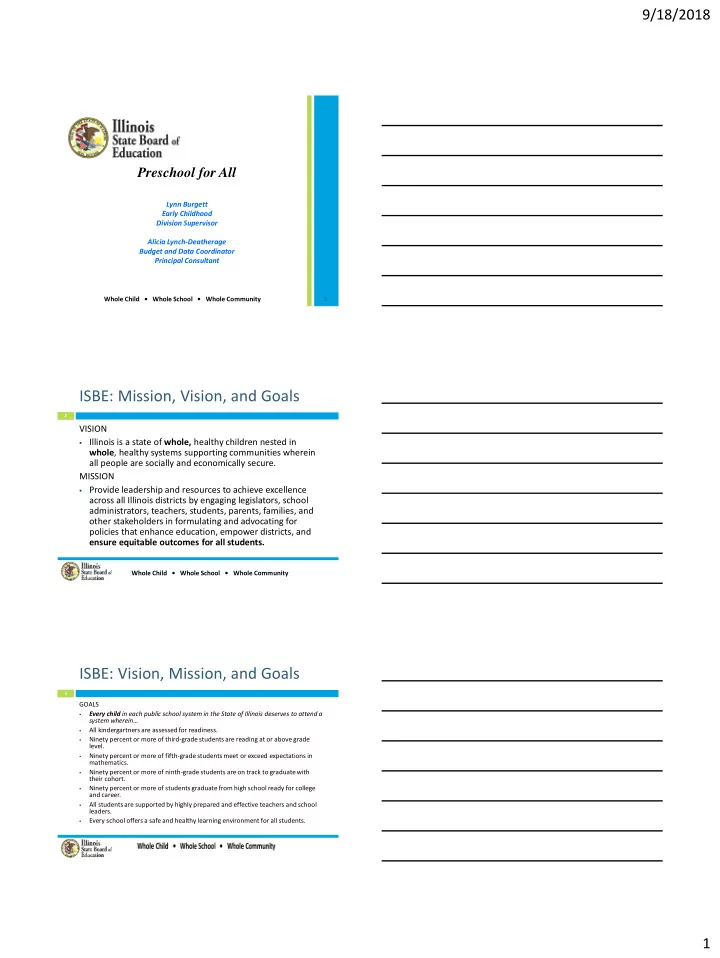
ISBE: Mission, Vision, and Goals

2

VISION

  • Illinois is a state of whole, healthy children nested in

whole, healthy systems supporting communities wherein all people are socially and economically secure. MISSION

  • Provide leadership and resources to achieve excellence

across all Illinois districts by engaging legislators, school administrators, teachers, students, parents, families, and

  • ther stakeholders in formulating and advocating for

policies that enhance education, empower districts, and ensure equitable outcomes for all students.

Whole Child • Whole School • Whole Community

ISBE: Vision, Mission, and Goals

3

GOALS

  • Every child in each public school system in the State of Illinois deserves to attend a

system wherein…

  • All kindergartners are assessed for readiness.
  • Ninety percent or more of third-grade students are reading at or above grade

level.

  • Ninety percent or more of fifth-grade students meet or exceed expectations in

mathematics.

  • Ninety percent or more of ninth-grade students are on track to graduate with

their cohort.

  • Ninety percent or more of students graduate from high school ready for college

and career.

  • All students are supported by highly prepared and effective teachers and school

leaders.

  • Every school offers a safe and healthy learning environment for all students.
slide-2
SLIDE 2

9/18/2018 2

Preschool for All

Whole Child • Whole School • Whole Community

Basic Requirement of the Preschool for All Grant:

5

  • Staff/child ratio of 1 to 10
  • 20 children per session. Minimum of 15 children using an inclusive model, unless exception

due to Head Start or DCFS licensing

  • Children files include proof of family income
  • Homeless plan on file (for school districts)
  • Screening results on file for each child using a research based screening tool
  • Weighted eligibility criteria is used to enroll children with multiple risk factors, prioritizing the

children determined to be most at-risk

  • Program meets for a minimum of two and a half hours per day, five days a week
  • Child care centers have a current and valid license from the Department of Children and Family

Services

  • Mission statement on file
  • Research based curriculum that meets the Illinois Early Learning and Development Standards
  • A snack and/or meal that meets USDA guidelines is available for children
  • A research based assessment tool that aligns with the curriculum is used and portfolios are

maintained for each child

Basic Requirements Continued:

6

  • A written plan for transiting children to kindergarten
  • A written policy for prohibiting expulsion and suspension.
  • A written plan for community collaboration
  • Preschool for All (PFA) teacher has current Professional Educator License (PEL)

with an early childhood education endorsement or proper temporary approval according to PA 100-0645.

  • Paraprofessional has documentation of paraprofessional educator license
  • PFA/ECSE blended classroom teacher has current PEL with early childhood

endorsement and early childhood special education approval unless itinerant services are provided per the IEP

  • English Learners in a full-time TBE program are provided instruction in the

native language and English by teachers that are properly licensed and hold the bilingual endorsement or the district has submitted the plan required under 23 ILCS 228.35 (c)3.

  • English Learners in TBE or TPI program are provided instruction in English as a

second language by teachers holding the ESL or ENL endorsement or the district has submitted the plan required under 23 ILCS 228.35 (c)3

slide-3
SLIDE 3

9/18/2018 3

And more basic requirements:

7

  • Directors (or building principals) of preschool programs administered by school districts

shall hold a professional educator license endorsed for principal or general administrative

  • Directors of child care centers shall have either a minimum of a baccalaureate degree in

child development or early childhood education or the equivalent (i.e., baccalaureate in any discipline with a minimum of 24 semester hours of credit in child development, early childhood education, or early childhood special education, including relevant field experience) and a Gateways to Opportunity Level II or III Illinois Director Credential

  • Written Staff Development Plans for each teacher and paraprofessional
  • A family education and involvement component is developed and implemented
  • Home Language Survey is administered to each student upon entering school for the

first time. Each child identified as having a language background other than English is screened for English language proficiency.

  • Annual self-assessment
  • Annual continuous quality improvement plan
  • Special education supports and services are provided in the classroom and embedded

into the activities and routines of the day

Preschool for All 3-5 IWAS Grant Applications

8

Whole Child • Whole School • Whole Community Due to delay in publishing this FY19 application, the initial application is due on or before September 30, 2018 to establish a July 1, 2018 start

  • date. If the Initial application is received after September 30, the date of

receipt establishes the project begin date.

Performance Reports

9

IWAS-Quarterly Expenditure Reports

  • Quarter 1-October 20, 2018
  • Quarter 2 -January 20, 2019
  • Quarter 3 -April 20, 2019
  • Quarter 4 -July 20, 2019

If the project end date is extended after June 30, the expenditure report is due 20 days after the new end date.

IWAS-Grantee Periodic Reporting System

Reporting is based on programmatic risk assessment (reporting is done at a minimum quarterly. Some grantees may be required to report monthly)

  • Quarter 1-October 20, 2018
  • Quarter 2 -January 20, 2019
  • Quarter 3 -April 20, 2019
  • Quarter 4 -July 20, 2019
slide-4
SLIDE 4

9/18/2018 4 Program Data Reporting Requirements

10

All grantees must submit the following data to the Illinois State Board of Education (ISBE) via the ISBE Web Application Security (IWAS) system, for the Preschool for All project for which the grantee is funded

  • Student Health Data-Immunization
  • Student Information System (SIS) Early Childhood

Data

  • Employment Information System (EIS) Teacher,

Administrator, and Other School Personnel Data

  • Public Act 100-105 Data Collection

Student Information System (SIS)

11

All children must be enrolled and exited in the Student Information System (SIS). Please make sure that children are entered into the correct program.

  • Preschool for All
  • Preschool for All State Expansion

Whole Child • Whole School • Whole Community

SIS-Sign up for system

12

slide-5
SLIDE 5

9/18/2018 5 SIS Student Demographics Enrollment Data School Year 2019

13

  • Classroom Location
  • Preschool for All Classroom
  • IDEA Services Received
  • Inclusive IEP Service
  • Preschool for All Expansion
  • Head Start Funding
  • CPS Value Preschool
  • Title I Funding
  • IDEA Funding
  • Local District Funding
  • Tuition Based Funding
  • Previous Enrollment in an Early Childhood Program
  • Early Head Start (Birth to 3)
  • Prevention Initiative (Birth to 3)
  • Early Intervention (Birth to 3)
  • Child Care

SIS Student Demographics Enrollment Data

14

  • Referral by CFC
  • EI Number
  • Eligibility Determination Date
  • Reason for Delay in Transition
  • IEP Completion Date
  • Date Services Began
  • Screening for Program Eligibility indicated Multiple Risk Factors
  • Family Structure
  • Household Income Criteria
  • Child Welfare Involvement Within the Past Year
  • Child has been a Youth in Care
  • Family has an Open Intact Family Services Case
  • Child’s parent is Youth in Care
  • Student's Family is receiving TANF
  • Student's Family is receiving WIC
  • Student's Family is receiving SNAP
  • Student's Family is receiving Housing Subsidy

SIS-Household Income Criteria Mandatory

15

Whole Child • Whole School • Whole Community

Programs are required to collect and review proof of family income to determine eligibility and priority points for every student as part of the screening process for eligibility into Early Childhood Block Grant program (except for homeless and children with IEP’s). Proof of family income must be placed in each child’s folder. During compliance monitoring visits, monitors will look for this documentation. Income has always been a component of screening for eligibility into programs, but now income must be verified for data collection and reporting. Income can be documented by the following Pay Stubs (two most recent, consecutive) Proof of WIC benefit Proof of Supplemental Nutrition Assistance Program (SNAP) benefit Proof of Temporary Assistance for Needy Families (TANF) benefit Proof of Supplemental Security Income (SSI) Benefit Proof the family received Child Care Assistance Program (CCAP) Tax return (most recent) Wages and tax statement (most recent W-2) Verification/letter from employer Proof that parent is enrolled in Medicaid (medical card with the child’s name does not prove income eligibility) Signed written statement from the family (provide form for families with no income)

slide-6
SLIDE 6

9/18/2018 6

Household Income-Con’t

16

Children with IEP’s-If the best placement for a child with an IEP has been determined to be the Preschool for All/Preschool for All Expansion blended program, then best efforts should be made to collect income verification and a weighted eligibility from should still be filled out. However, if proper financial documentation is not obtained, the child CANNOT lose enrollment status, but the lack of information should be noted on the eligibility from and the financial status of that family cannot be counted as an at risk factor until proper documentation is obtained to prove otherwise. Children experiencing homelessness-Best efforts should be made to collect income verification and a weighted eligibility from should still be filled out. However, if proper financial documentation is not obtained, the child CANNOT lose enrollment status, but the lack of information should be noted on the eligibility from and the financial status of that family cannot be counted as an at risk factor until proper documentation is obtained to prove otherwise. Whole Child • Whole School • Whole Community

SIS Student Enrollment-Early Childhood Link

17

SIS Early Childhood Data Entry Screen

18

slide-7
SLIDE 7

9/18/2018 7 SIS-Student Course Assignment

Whole Child • Whole School • Whole Community

  • There is a new validation this year that is intended to improve the Teacher to

Student link data quality. The validation requires that at least one active teacher course assignment for a course be present in the system before any student course assignments are created or modified for that course. The validation is ensuring that there will always be a teacher assigned to a course with students.

GATA-Grant Accountability and Transparency Act

20

  • The purpose of the Grant Accountability and

Transparency Act (GATA) is to increase accountability and transparency in the use of grant funds while reducing the administrative burden on both state agencies and grantees. The law provides for the development of a coordinated, non-redundant process to establish effective and efficient oversight of the selection and monitoring of grant recipients, ensuring quality programs; limiting fraud, waste, and abuse; and defining the purpose, scope, applicability, and responsibilities in the life cycle of a grant.

GATA Portal

21

https://www2.illinois.gov/sites/GATA/grantee/pages/default.aspx

slide-8
SLIDE 8

9/18/2018 8

GATA-Indirect Cost Rate

  • The federal Uniform Guidance at 2 CFR 200 requires

that grantees be provided the opportunity to seek indirect cost reimbursements based on negotiated indirect cost reimbursement rates.

  • The Grant Accountability and Transparency Act (GATA)

adopts those federal regulations for state programs as well.

  • These changes in requirements necessitate changes in

ISBE indirect cost reimbursement policies to maintain

  • compliance. The changes described in the following

presentation will be implemented for the FY2019 grant cycle.

GATA-Indirect Costs for LEAs

  • LEA indirect cost rates are developed in accordance

with a delegation of authority agreement between ISBE and USDE.

  • The plan includes both a restricted and unrestricted

rate for each individual LEA.

  • Both the restricted and unrestricted LEA rates are

published annually on the ISBE website. The FY19 rates are available at: https://www.isbe.net/Pages/Indirect- Cost-Rate-Plan.aspx.

  • In the past, only the restricted rate was allowed when

budgeting indirect cost reimbursements.

GATA-Indirect Cost Rates for LEAs

  • Starting this year, LEAs have the ability to seek indirect

cost reimbursement at the published unrestricted rate for any program other than those identified as restricted by USDE.

  • Newly organized LEAs, Regional Offices of Education

Intermediate Service Centers, area vocational centers, charter schools, university laboratory schools and governmental entities formed by a joint agreement among LEAs utilize either the statewide average of LEA unrestricted or restricted indirect rates as appropriate, depending upon the grant program.

Whole Child • Whole School • Whole Community

slide-9
SLIDE 9

9/18/2018 9 GATA-Indirect Cost Rates for Non-LEAs

  • For programs eligible for an unrestricted indirect cost rate,

not for profit entities, community/faith based

  • rganizations and other non-LEA, non-university

subgrantees utilize rates negotiated through the GOMB centralized process where they will have the option to:

  • Select the 10% diminimus rate
  • Submit documentation supporting a rate determined through

negotiation with their federal cognizant agency

  • Negotiate a rate.
  • Choose not to seek indirect cost reimbursement.
  • Non-LEA, non-university grantees may initiate the

unrestricted indirect cost rate negotiation process through the GATA grantee portal at: https://grants.illinois.gov/portal/.

Whole Child • Whole School • Whole Community

GATA-Indirect Cost Rates for Colleges and Universities

  • Colleges and Universities will be limited to a

maximum indirect cost rate of 8% or other indirect cost rate calculated by their cognizant federal agency, whichever is less, for all grants and IGAs administered by ISBE.

Whole Child • Whole School • Whole Community

GATA-Indirect Cost Rates for Non-LEAs

  • For federal programs requiring the use of a

restricted indirect cost rate, not for profit entities, community/faith based organizations and other non-LEA subgrantees shall utilize the 8% default rate described at 34 CFR 76.564.

Whole Child • Whole School • Whole Community

slide-10
SLIDE 10

9/18/2018 10

GATA Public Act 100-997

28

  • Notwithstanding any provision of law to the contrary, all grants

made and any grant agreement entered into, renewed, or extended on or after the effective date of this amendatory Act of the 100th General Assembly, between a State grant-making agency and a nonprofit organization, shall require the nonprofit

  • rganization receiving grant funds to maintain those funds in an

account which is separate and distinct from any account holding non-grant funds. Except as otherwise provided in an agreement between a State grant-making agency and a nonprofit organization, the grant funds held in a separate account by a nonprofit

  • rganization shall not be used for non-grant-related activities, and

any unused grant funds shall be returned to the State grant-making agency.

Electronic Grants Management System (eGMS)-NEW

  • Modified Total Direct Cost (MTDC) is used as the

basis for calculating the indirect amount. In order to calculate MTDC, each contract greater than $25,000 will have to be listed on a separate line of the budget.

Whole Child • Whole School • Whole Community

eGMS

  • Indirect cost rates for FY 2019 weren’t available at

the start of the fiscal year. eGMS grants that

  • pened prior to rate availability had 0% indirect

cost rate. Grantees will need to file an amendment to request their indirect cost rates when the rates are loaded.

Whole Child • Whole School • Whole Community

slide-11
SLIDE 11

9/18/2018 11

eGMS

  • Grants using an unrestricted rate will not be

allowed to claim indirect if any amount is listed in function 2540 - Operation and Maintenance Plant Services.

Whole Child • Whole School • Whole Community

  • Promotional items of any kind
  • Graduation/Promotion-related expenses
  • Itinerant services provided by special education staff (These expenditures should be

covered by special education funds.)

  • Compensation for principal, assistant principal, superintendent, directors of childcare

centers, etc.-If used it must be claimed as an indirect cost

  • Vehicle purchase
  • Building purchase or any other permanent structure. (Rent may be allowable, if there

is a need for space that is NOT already owned by district/fiscal agent.)

  • Staff Tuition reimbursement
  • Out of state travel – (50 mile radius Example, St Louis)
  • Capital Construction, renovation, modernization, or other facilities-related activities

What is not allowable on the Grant?

Whole Child • Whole School • Whole Community

Common Audit Findings

33

  • Not filling accurate and/or timely expenditure reports
  • Not maintaining separate general ledgers
  • Time and Effort Logs: If an employee is being charged to multiple

grants/funding sources, the time and effort must be maintained at the program in order to ensure (1) program is not supplanting, (2) there is justification for the amount budgeted and claimed.

  • Cost Allocation Plans (CAP) – anytime something is being prorated. The

plan must be kept in the expenditure files.

  • Purchases not indicated in the approved in budget prior to purchase or
  • rder date. This will be an audit finding and will not be allowed.
  • Documentation of current staff’s qualification status (both educator and

paraprofessional). If staff is found to be not certified and registered, the PFA grant will not pay the salary and/or benefits. Programs will have to cover this expense at a local level.

  • Purchasing promotional material
slide-12
SLIDE 12

9/18/2018 12 Financial Record Retention State Funds (105 ILCS 5/2-3.33)

Whole Child • Whole School • Whole Community

  • For state funds, a grantee shall retain records for three years from the

final date for filing of a claim any claim for reimbursement to any school district if the claim has been found to be incorrect and to adjust subsequent claims accordingly, and to recompute and adjust any such claims within six years from the final date for filing when there has been an adverse court or administrative agency decision on the merits affecting the tax revenues of the school district.

  • All purchase orders, time and effort sheets, and other supporting

documentation must be retained at the local level and be available for review or audit any time within three years after termination of the project or until the local entity is notified in writing from ISBE that the records are no longer needed for review or audit.

Public Act 100-105

35

Legislation was introduced in Illinois in 2016 which passed the Illinois General Assembly with strong bipartisan support in May 2017. This legislation was signed into law by Governor Rauner on August 14,

  • 2017. It is known as Public Act 100-105, and focuses on preventing

expulsion of children ages birth to five from early childhood programs because of the child’s behavior. The law became effective on January 1, 2018. Simply stated, the goals of PA 100-105 are

  • To ensure early childhood programs engage in best practices in

their disciplinary actions by prohibiting expulsions of young children due to child behavior

  • To connect providers to existing available resources and supports to

address the various needs of children

  • To track transitions due to child behavior, providing data to better

understand the issue and identify the need for additional resources

Public Act 100-105-Continued

36

  • When a child exhibits consistently challenging behaviors, the

Early Childhood Educator provider must document:

  • Initial observations of challenging behaviors
  • Communication with & participation of family
  • Intervention plan & strategies, including the use of or

attempts to access available external resources

  • Instances where child is ultimately transitioned out of

program The Illinois State Board of Education (ISBE) is currently working on rules, definitions, guidance, identifying resources, and collecting data.

slide-13
SLIDE 13

9/18/2018 13

Public Act 100-105-Continued

37

Effective October 1, 2018, you will be required by law to start collecting data to be reported to the Illinois State Board of Education in support of this law.

  • A good portion of the data required to meet the objectives of the law is

already collected by ISBE, however, there are a few new data elements that will be tracked (such as mental health consultant hours, when applicable, of infant and early childhood contact with program leaders, staff, and families). Additional data, such as tracking the total number of children served (and who left) over the course of the program year, and total number of teachers in the classroom will also be tracked.

  • The ISBE website will have articles and links available to you that will ease

the collection of this data. The collection of data will be via the Student Information System (SIS) and will follow along the same lines as what is being collected for disciplinary data for children grades K-12. More information will be forthcoming so please check the ISBE website frequently at https://www.isbe.net/Pages/Early-Childhood.aspx

Links to ISBE PFA Resources

  • Preschool for All 3-5

https://www.isbe.net/Pages/Preschool-For-All.aspx

  • Early Childhood Preschool Expansion Model

https://www.isbe.net/Pages/Preschool- Development-Grant-Expansion-Grant.aspx

  • Early Childhood Special Education

https://www.isbe.net/Pages/Early-Childhood-Special- Education-Services.aspx

  • Early Childhood Professional Development

https://www.isbe.net/Pages/Early-Childhood- Professional-Development.aspx

  • Preschool For All Implementation Manual

https://www.isbe.net/Pages/Preschool-For- All.aspx#collapse25zone6

  • Preschool English Language Learners

https://www.isbe.net/Pages/Preschool-English- Language-Learners.aspx

  • State and Federal Grant Administration Policy, Fiscal

Requirements, and Procedures https://www.isbe.net/Documents/fiscal_procedure_h andbk.pdf#search=fiscal%20policies

  • Compliance Checklist

https://www.isbe.net/Documents/PFA-Compliance- Checklist.pdf

  • Early Childhood Environment Rating Scale (ECERS-3)

https://www.ersi.info/ecers3.html

  • ExceleRate Illinois

www.excelerateillinoisproviders.com

  • Preschool Homeless Education Plan

https://www.isbe.net/documents/preschool_homeles s.pdf

  • Appropriate Technology Integration in Early Childhood

Programs https://www.isbe.net/Pages/Technology- Integration-In-Early-Childhood-Programs.aspx

Whole Child • Whole School • Whole Community

Questions?

Whole Child • Whole School • Whole Community

slide-14
SLIDE 14

9/18/2018 14

Illinois State Board of Education Early Childhood Division

http://www.isbe.net/earlychi/

earlychi@isbe.net

217-524-4835

Contact Information

Whole Child • Whole School • Whole Community