Is my baby okay? 1. Review the workup of bleeding in the first - - PDF document

is my baby okay
SMART_READER_LITE
LIVE PREVIEW

Is my baby okay? 1. Review the workup of bleeding in the first - - PDF document

Objectives Is my baby okay? 1. Review the workup of bleeding in the first trimester Evaluation of First trimester Bleeding 2. Apply evidencebased principles to ectopic pregnancy Ectopic, Early Pregnancy Loss, or Normal Pregnancy (EP)


slide-1
SLIDE 1

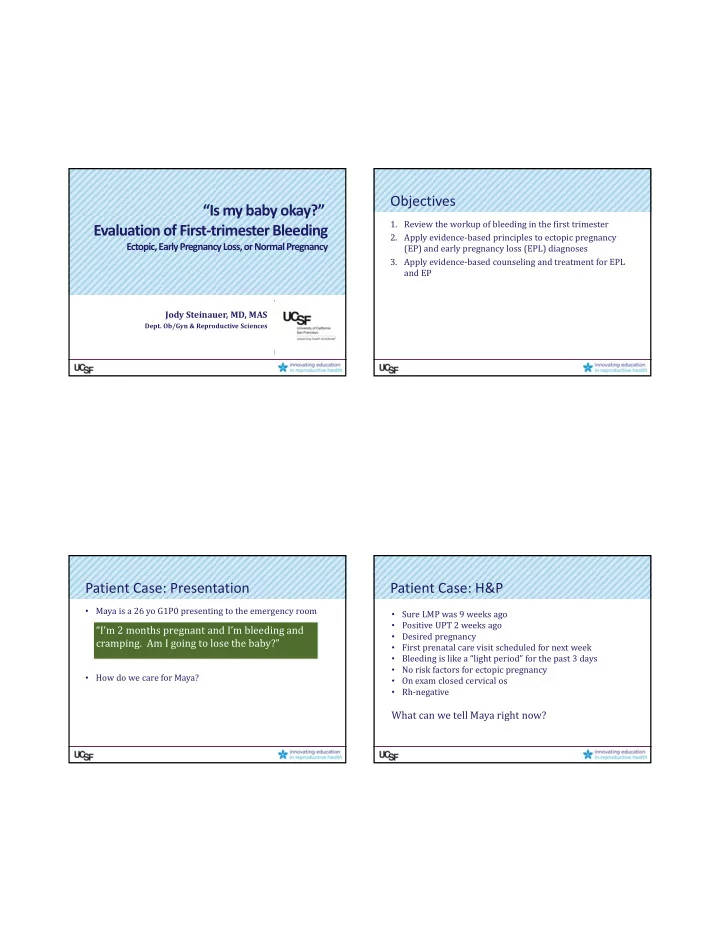
“Is my baby okay?” Evaluation of First‐trimester Bleeding

Ectopic, Early Pregnancy Loss, or Normal Pregnancy

Jody Steinauer, MD, MAS

  • Dept. Ob/Gyn & Reproductive Sciences

Objectives

  • 1. Review the workup of bleeding in the first trimester
  • 2. Apply evidence‐based principles to ectopic pregnancy

(EP) and early pregnancy loss (EPL) diagnoses

  • 3. Apply evidence‐based counseling and treatment for EPL

and EP

Patient Case: Presentation

  • Maya is a 26 yo G1P0 presenting to the emergency room
  • How do we care for Maya?

“I’m 2 months pregnant and I’m bleeding and

  • cramping. Am I going to lose the baby?”

Patient Case: H&P

  • Sure LMP was 9 weeks ago
  • Positive UPT 2 weeks ago
  • Desired pregnancy
  • First prenatal care visit scheduled for next week
  • Bleeding is like a “light period” for the past 3 days
  • No risk factors for ectopic pregnancy
  • On exam closed cervical os
  • Rh‐negative

What can we tell Maya right now?

slide-2
SLIDE 2

Symptomatic Early Pregnancy Evaluation

Symptomatic Early Pregnancy

  • Ectopic pregnancy must be ruled out, but we must

not diagnose a desired IUP as abnormal

– There are new guidelines for the hCG discriminatory zone

  • Management is a preference‐sensitive decision

Symptomatic Early Pregnancy: Presentation

  • Urgent or emergency care visit

– Vaginal bleeding – Abdominal or pelvic pain or cramping – Passage of pregnancy tissue from the vagina – Loss of pregnancy‐related symptoms – Hemodynamic instability

  • Incidental clinical finding

– Bimanual exam inconsistent with LMP – Ultrasound suggestive of abnormal pregnancy

Bleeding in Early Pregnancy

  • Keep the patient informed.

– Provide reassurance that not all vaginal bleeding & cramping = an abnormality, but avoid guarantees that “everything will be all right” – Assure that you are available

  • What does the bleeding mean?

– Up to 20% chance of ectopic pregnancy – 50% ongoing pregnancy with closed cervical os – 85% ongoing pregnancy with viable IUP on sono – 30% of normal pregnancies have vaginal bleeding

slide-3
SLIDE 3

Evaluation

  • History

– Risk factors for ectopic pregnancy

  • Physical exam

– Vital signs – Abdominal and pelvic exam

  • Ultrasound

– Transvaginal often necessary

  • Lab

– Rh factor – Hemoglobin or Hematocrit – β‐hCG when indicated Is the pregnancy desired?

Ectopic Pregnancy

  • 1‐2% of all pregnancies
  • Up to 20% of symptomatic pregnancies
  • ½ of ectopic patients have no risk factors
  • Mortality has dramatically declined: 0.5/100,000

– 6% of pregnancy‐related deaths – 21 deaths per year in US

  • Early diagnosis important
  • Concern about management errors

Early Pregnancy Loss (EPL)

  • 15‐20% of clinically

recognized pregnancies

  • 1 in 4 women will

experience EPL

  • Includes all non‐viable

pregnancies in first trimester = miscarriage

Pregnancy of Unknown Location

  • When the pregnancy test is positive, but no signs
  • f intrauterine or extrauterine pregnancy on u/s

– We try to follow these women until a diagnosis is made – We have to weigh risk of ectopic pregnancy (EP) – Sometimes there is never a final diagnosis as both EPL and EP may resolve spontaneously

  • More commonly encountered in symptomatic

early pregnancy, but can also be encountered in asymptomatic women, especially when u/s early

slide-4
SLIDE 4

Positive pregnancy test, vaginal bleeding and/or abdominal pain 61% Ongoing IUP 28% Spontaneous Abortion 9% Ectopic Pregnancy

Dx upon presentation (80%) 77% Ongoing IUP 16% Spontaneous Abortion 6% Ectopic Pregnancy 49% of all women with Ectopic Dx at presentation Dx with additional testing (20%) 11% Ongoing IUP 77% Spontaneous Abortion 17% Ectopic Pregnancy 51% of all women with Ectopic Dx after outpatient follow‐up

Simplified Workup of Bleeding &/or Pain

1. Where is the pregnancy?  U/S (same day) 2. If the pregnancy undesired?  uterine aspiration 3. If desired and we can’t tell where it is: Is it normal

  • r abnormal?  quantitative (serial) Beta‐HCG

– If Bhcg above threshold and no IUP = Abnormal – Serial beta HCGs:

  • If Bhcg drops > 50% in 48 hours = Abnormal
  • If Bhcg rises > 50% in 48 hours = Most likely normal (can be

EP) – Continue to follow and repeat u/s

  • If between = Most likely abnormal (still can be normal) –

Continue to follow and repeat u/s

  • 4. Once pregnancy clearly abnormal, if undesired or if

patient desires definitive dx  uterine aspiration

IUP=Intrauterine pregnancy

β‐hCG Utility in Symptomatic Early Pregnancy Diagnosis

  • β‐hCG median serum concentration:

– 4 weeks: 100 mIU/ml (5‐450) – 10 weeks: 60,000 (5,000 – 150,000)

Discriminatory Level

  • Serum β‐hCG at which a normal intrauterine

pregnancy should be visualized on ultrasound

– If >2000 nl IUP unlikely but possible  new values

  • Once above, limited role for “following betas”

Discriminatory & Threshold level

  • 366 ♀ with VB/pain nl IUP

Old value of 2000= 91% prob.

  • f seeing GS in viable IUP

99% Predicted Probability of Detection Discriminatory Threshold Gestational sac Yolk sac Fetal pole 3510 17,716 47,685 390 1094 1394

Connolly 2013 Obstet Gynecol

Highest seen in the study with no sac: 2,300

Connolly, Obstet Gynecol, 2013.

slide-5
SLIDE 5
  • HCG 2000 ‐ 3000

– Non‐viable pregnancy most likely, 2X ectopic – Ectopic is 19 x more likely than viable pregnancy – For each viable pregnancy:

  • 19 ectopic pregnancies
  • 38 nonviable pregnancies

– 2% chance of viable pregnancy

  • HCG > 3000

– Ectopic 70 x more likely than viable pregnancy 0.5% chance viable IUP

In women with desired pregnancy consider beta hcg cut‐off of >= 3000.

Society of Radiologists in Ultrasound: No Gestational Sac Balance of Diagnostic Tests

  • Maximize sensitivity at the cost of diagnosing

some IUPs as Ectopic Pregnancies

– Error – interrupting desired IUP

  • Maximize specificity at the cost of diagnosing

some EPs as IUPs

– Error – delay diagnosis resulting in rupture

  • Use cut‐off of 3,000 v. repeat beta hcg or u/s

Simplified Workup of Bleeding &/or Pain

1. Where is the pregnancy?  U/S (same day) 2. If the pregnancy undesired?  uterine aspiration 3. If desired and we can’t tell where it is: Is it normal

  • r abnormal?  quantitative (serial) Beta‐HCG

– If Bhcg above threshold and no IUP = Abnormal – Serial beta HCGs:

  • If Bhcg drops > 50% in 48 hours = Abnormal
  • If Bhcg rises > 50% in 48 hours = Most likely normal (can be

EP) – Continue to follow and repeat u/s

  • If between = Most likely abnormal (still can be normal) –

Continue to follow and repeat u/s

  • 4. Once pregnancy clearly abnormal, if undesired or if

patient desires definitive dx  uterine aspiration

IUP=Intrauterine pregnancy

β HCG trends in normal IUP

Barnhart 2004 Obstet Gynecol

99% of nl IUPs 1 day rise ≥ 24% 2 day rise ≥ 53% Median rise: 1 day= 50% 2 day =124%

Slowest expected 48‐hour increase for normal pregnancy = 53% (20% of ectopics increase)

slide-6
SLIDE 6

β HCG trends : Other Key Points

  • Two hcg values may not be enough
  • If close to the thresholds – check another

Barnhart, Ob Gyn, 2002

Simplified Workup of Bleeding &/or Pain

1. Where is the pregnancy?  U/S (same day) 2. If the pregnancy undesired?  uterine aspiration 3. If desired and we can’t tell where it is: Is it normal

  • r abnormal?  quantitative (serial) Beta‐HCG

– If Bhcg above threshold and no IUP = Abnormal – Serial beta HCGs:

  • If Bhcg drops > 50% in 48 hours = Abnormal
  • If Bhcg rises > 50% in 48 hours = Most likely normal (can be

EP) – Continue to follow and repeat u/s

  • If between = Most likely abnormal (still can be normal) –

Continue to follow and repeat u/s

  • 4. Once pregnancy clearly abnormal, if undesired or if

patient desires definitive dx  uterine aspiration

IUP=Intrauterine pregnancy

If Diagnose as Abnormal…

  • Presumed ectopic pregnancy – uterine

aspiration before MTX

– High HCG nothing in the uterus (50% SAB) – Very low HCG with abnormal rise or definite fall (25% SAB)

Role of Ultrasound in Ectopic Diagnosis

  • Only 2% of u/s are diagnostic for EP

– “Diagnostic” = Gestational Sac with yolk sac or fetal pole visualized outside uterus

  • Normal adnexal exam does not exclude ectopic
  • Suggestive of ectopic
  • Empty uterus + hCG above discriminatory zone
  • Complex mass + fluid in cul‐de‐sac (94% are EP)
  • Should still follow them if desired pregnancy

Main role of U/S is to rule in IUP

slide-7
SLIDE 7

Ultrasound Findings to R/o EP

  • Remember that an EP has not been ruled out until

there is an intrauterine pregnancy

– Gestational sac with a yolk sac and/or embryo

Simplified Workup of Bleeding &/or Pain

1. Where is the pregnancy?  U/S (same day) 2. If the pregnancy undesired?  uterine aspiration 3. If desired and we can’t tell where it is: Is it normal

  • r abnormal?  quantitative (serial) Beta‐HCG

– If Bhcg above threshold and no IUP = Abnormal – Serial beta HCGs:

  • If Bhcg drops > 50% in 48 hours = Abnormal
  • If Bhcg rises > 50% in 48 hours = Most likely normal (can be

EP) – Continue to follow and repeat u/s

  • If between = Most likely abnormal (still can be normal) –

Continue to follow and repeat u/s

  • 4. Once pregnancy clearly abnormal, if undesired or if

patient desires definitive dx  uterine aspiration

IUP=Intrauterine pregnancy

Incomplete abortion, treat as indicated Peritoneal signs or hemodynamic instability Non‐obstetric cause

  • f bleeding identified

ED Diagnose and treat as indicated Threatened abortion; repeat TVUS if further bleeding Transvaginal ultrasound (TVUS) and β‐hCG level Products of conception (POC’s) visible on exam Presume ectopic; refer for high‐level TVUS and/or treatment Viable intrauterine pregnancy (IUP) Ectopic or signs suggestive of ectopic pregnancy Nonviable IUP Embryonic demise, anembryonic gestation,

  • r retained POC’s;

discuss treatment options Repeat TVUS in

  • ne week and/or

follow serial β‐ hCG’s Physical exam Bleeding in desired pregnancy, < 12 weeks gestation See Figure 2

Figure 1. Evaluation of first‐trimester bleeding

Patient stable, no POC’s or

  • ther cause of bleeding

No IUP, no ectopic seen IUP, viability uncertain IUP seen on prior TVUS? Yes No Completed abortion; expectant management

Reproductive Health Access Project/October 2013 www.reproductiveaccess.org

First‐trimester Bleeding Algorithm

Repeat β‐hCG fell < 50% or rose < 53%*** Suggests completed abortion; ectopic precautions, follow β‐hCG weekly to zero** β‐hCG < 1500 – 2000* Ectopic precautions, Repeat β‐hCG in 48 hours Suggests viable pregnancy but does not exclude ectopic; follow β‐hCG until > 1500 – 2000*, then TVUS for definitive diagnosis Repeat β‐hCG > 1500 – 2000* Suggests early pregnancy failure or ectopic; serial β‐hCG’s +/‐ high‐level TVUS until definitive diagnosis or β‐hCG zero** Repeat β‐hCG rose > 53%*** Ectopic precautions, repeat β‐hCG in 48 hrs Repeat β‐hCG fell > 50% β‐hCG > 1500 – 2000* Repeat β‐hCG < 1500 – 2000* Repeat β‐hCG fell > 50% Repeat β‐hCG fell <50%

  • r rose

Single β‐hCG > 1500 – 2000* and bleeding history consistent with having passed POC’s Obtain high‐level TVUS & serial bhCGs to differentiate between ectopic, early IUP, and retained POCs’ treat as indicated Single β‐hCG > 1500 – 2000* and bleeding history not consistent with having passed POC’s Serial β‐hCG’s rising and > 1500 – 2000*

NO IUP or EP seen on TVUS

IUP seen on prior TVUS? Yes No Completed abortion; expectant management

Figure 2. Evaluation of first‐trimester bleeding with no intrauterine pregnancy on ultrasound

Continued from Figure 1

* The β‐hCG level at which an intrauterine pregnancy should be seen on transvaginal ultrasound is referred to as the discriminatory zone and varies between 1500 – 2000 mIU depending on the machine and the sonographer. ** β‐hCG needs to be followed to zero only if ectopic pregnancy has not been reliably excluded. If a definitive diagnosis of completed miscarriage has been made there is no need to follow further β‐hCG levels. *** In a viable intrauterine pregnancy there is a 99% chance that the β‐hCG will rise by at least 53% in 48 hours. In ectopic pregnancy, there is a 21% chance that the β‐hCG will rise by 53% in 48 hours.

Repeat TVUS; See TVUS in Figure 1

Modified from Reproductive Health Access Project/October 2013 www.reproductiveaccess.org

First‐trimester Bleeding Algorithm

If patient stable repeat bHCG and once higher than 3000 and no IUP – uterine aspiration to rule

  • ut EPL and treat for EP if no IUP
slide-8
SLIDE 8

EPL Diagnosis, Counseling, and Management

EPL – Making the diagnosis

Spontaneous abortion

Vaginal bleeding + IUP, <20 wks threatened, inevitable, incomplete, complete

Embryonic demise

Embryo with no cardiac activity

Anembryonic gestation

Gestational sac without embryonic pole

Clinical diagnosis: Ultrasound diagnosis:

Ultrasound Diagnosis of EPL: Anembryonic Gestation

Mean sac diameter >=21mm (20 mm = 0.5% false positive) AND no fetal pole (n>1000, 100% specificity)

Abdallah et al 2011 (Aug) Ultrasound Obstet Gynecol

Ultrasound Diagnosis of EPL: Embryonic Demise

Fetal pole >= 5.3 AND no cardiac activity

Abdallah et al 2011 (Aug) Ultrasound Obstet Gynecol

slide-9
SLIDE 9

Fetal pole – 7 mm MSD – 25 mm

Radiologists in Ultrasound: Account for Margin of Error Ultrasound Milestones

Normal IUP findings When should you see it? Abnormality if landmark is absent Gestational Sac Discriminatory Level β = 3,000? 3,500? Completed EPL Multiple gestation Ectopic pregnancy Yolk sac MSD > 13‐16mm Suspicious for EPL Fetal pole MSD ≥ 21mm (new

rec 25 due to variability)

Anembryonic gestation Cardiac activity CRL ≥ 5.3mm

(new rec 7mm)

Embryonic demise Interval growth (MSD or CRL) 1 mm/day

(over 3‐7 days)

Confirmed EPL

Patient Case: Counseling

  • Maya was diagnosed with an embryonic demise.
  • How do we counsel her about management
  • ptions?

EPL Management

slide-10
SLIDE 10

EPL Management: A Preference‐Sensitive Decision

  • Best choice for management reflects the woman’s

values and preferences

  • Patients have strong and widely divergent

preferences

– Challenges in recruitment for RCTs – Report higher satisfaction when treated according to patient’s preference

Wieringa‐de Waard 2002; Dalton 2006; Smith 2006

Expectant Medication Office-based aspiration Operating room aspiration

EPL Management: Patient Preferences

No ‘one best way’ to treat miscarriage that suits all individuals. Expectant management is preferred

  • ver aspiration by 40‐70% of women.

When aspiration is indicated or preferred, the majority of women will choose an office‐based procedure over

  • ne in the OR

Smith 2006; Wieringa‐de Waard 2002; Dalton 2006

Research on EPL Counseling

  • Women want unbiased and comprehensive counseling

about options for this preference‐sensitive decision.

  • Women perceive communication during EPL diagnosis

as a critical time to initiate discussions of management.

  • Women are often weighing personal priorities to make

decisions about EPL management.

  • Use of a decision aid may offer a systematic counseling

approach for a patient‐centered decision‐making process.

Early Pregnancy Failure: Counseling

  • Women blame themselves (“was it the stress?”)
  • Wonder if will happen again

Patient counseling should include:

  • How common it is (encourage to talk to friends)
  • Reassurance that it is beyond her control and unlikely to

recur (“Nothing could have been done to prevent it.”)

  • Acknowledge/validate grieving
  • No need to wait to attempt another pregnancy. Ok to try

after resumption of menses (when emotionally ready)

slide-11
SLIDE 11

Early Pregnancy Loss (EPL) Management

  • Four options for the clinically stable patient
  • 1. Aspiration w/ general/deep sedation (operating room)
  • 2. Aspiration w/ local/moderate sedation (office‐based)
  • 3. Medication (misoprostol +/‐ mifepristone)
  • 4. Expectant
  • All methods are effective, with equivalent safety

and patient acceptability = clinical equipoise

NSFG 2004; Chen 2007; Wieringa‐de Waard, 2002; Zhang 2005; Trinder 2006

Reference: Helping your patient to choose treatment for EPF

Misoprostol (800 PV): Success: 80%

Advantages: Privacy, availability, most can avoid surgical tx, decreased infection, similar satisfaction as surgical Disadvantages: multiple visits, 30% require 2nd dose, more pain, N/V & bleeding than surgical

Uterine Aspiration: Success: ~100%

Advantages: 2‐4 hrs, high success rate, less blding & pain Disadvantages: less available, rare surgical complications, increased infection

Expectant: Success: 66% at 2wks.

Advantages: Privacy, some can avoid surgical treatment, decreased infection Disadvantages: up to 6 wks to complete, more bleeding & more visits, less patient satisfaction

Expectant Management

  • “Watchful waiting”
  • Proven safety up to 8 weeks
  • Type of EPL affects expected efficacy
  • Acceptable to patients with realistic expectations about:

Duration, Discomfort, and potential D&C

slide-12
SLIDE 12

Expectant Management

Advantages

  • Non‐invasive
  • Body naturally expels

non‐viable pregnancy

  • Avoids anesthesia and

surgery risks

  • Allows for patient

privacy and continuity of care

Disadvantages

  • Unpredictable outcome

and timescale

  • Process can last days to

weeks

  • Can have prolonged

bleeding and cramping

  • Despite waiting, may

still need uterine aspiration

Expectant Management

Contraindications

  • Uncertain diagnosis
  • Suspected gestational

trophoblastic disease

  • Indicated karyotyping
  • Severe hemorrhage or pain
  • Infection
  • IUD in place

Same contraindications for medication management

Medication Management

  • Use of medications for active management of EPL
  • Misoprostol

– Stimulates uterine contractions & softens cervix – Inexpensive, easy storage

  • Mifepristone

– Anti‐progestin used for pregnancy termination – Current research does not support routine use in non‐ viable pregnancies

Medication Management

Advantages

  • Highly cost‐effective
  • Non‐invasive
  • Safe
  • Can be highly effective
  • Avoids anesthesia and

surgery risks

  • Allows for patient privacy

and continuity of care

Disadvantages

  • Increased need for

analgesics and pain control

  • May cause heavier or

longer bleeding

  • May cause short‐term

gastrointestinal and other side effects

  • May still need uterine

aspiration

slide-13
SLIDE 13

Practice Integration for Medication Management

  • Evaluation

– Exam, lab, or sono?

  • Medications

– Dispensed in clinic or Rx?

  • 24 hour call service
  • Back‐up plan for aspiration

– Emergent vs. non‐urgent

  • Follow‐up plan

Misoprostol for EPL

Recommended in ACOG Practice Bulletin 800 mcg vaginally (PV) with

  • ptional repeat dose >3

hours later if no initial response

Medications for Symptoms and Side Effects

Cramping Ibuprofen 600 mg Q6 hrs or 800 mg Q8 hrs (or other NSAID) Severe cramping pain not relieved by ibuprofen Hydrocodone/APAP 5/500 or 5/325 Q 4‐6 hrs prn Nausea/vomiting Promethazine 25 mg Q 4‐6 hrs prn or other anti‐emetic

Typical Follow‐Up

Phone contact Call patient 1‐2 days after first misoprostol dose to assess need for second dose. In‐person visit 1‐2 weeks after choosing expectant or medication management to assess:

  • 1. If miscarriage is not complete – Is patient

interested in alternate treatments?

  • 2. Confirm completion (see below)

Confirming completion

  • 1. Clinical history consistent with complete

miscarriage plus β‐hCG decline of >50% or negative urine pregnancy test

  • 2. Clinical history plus disappearance of

intrauterine pregnancy on transvaginal ultrasound

slide-14
SLIDE 14

EPL Expectant/Medical Management

  • Clinical checklist for care options:

– Clear diagnosis – Patient is stable – Access to phone & emergency care – Pain control options available – Anticipatory guidance for bleeding, s/sx infection – Rh status – Reliable follow‐up

Aspiration for EPL

  • Historically done in operating room under general

anesthesia

  • Terminology:

– Surgical “D&C” – Suction curettage with manual or – electric vacuum aspiration

Operating Room Aspiration

Advantages

  • Predictable
  • Offers fastest resolution of

miscarriage

  • Reduced duration of bleeding
  • Low risk (<5%) of needing

further treatment

  • Can be asleep

Disadvantages

  • Rare risks associated with

invasive procedure and general anesthesia

  • More cost than office‐based

procedures

  • More time and physical exams

than office‐based procedures

  • May be more bleeding

complications under general anesthesia than in office‐based procedures

Office‐based Aspiration

Advantages

  • Predictable
  • Offers fastest resolution of

miscarriage

  • Reduced duration of bleeding
  • Low risk (<5%) of needing

further treatment

  • Pain control with local plus oral
  • r IV meds

Disadvantages

  • Rare risks of invasive procedure
  • Less pain control options in some

settings Compared to OR management:

  • May allow improved patient access

and continuity of care

  • Improved privacy
  • Less patient and staff time
  • Resource and cost savings
slide-15
SLIDE 15

Patient Case: Management

  • How do we manage Maya?
  • Chance of success for embryonic demise:

– Expectant  1 week (30%) 2 weeks (60%) 6 weeks (75%) – Medical  1 week (88%) – Aspiration  In office or OR (97‐100%)

EPL: Patient‐Centered Care

  • 1. Keep her informed throughout the diagnostic work‐up
  • 2. Use clear but compassionate language
  • 3. Be prepared to discuss management options at dx
  • 4. Present advantages and disadvantages of each
  • 5. Facilitate recognition of patient’s priorities
  • 6. Ensure follow‐up and allow opportunity to change

management decision

Patient Case: Management

  • Maya chose to use misoprostol at home
  • She placed the pills vaginally and began having

cramping and bleeding 2 hours later

  • Her heavy bleeding lasted 4 hours, and she noticed
  • ne particularly large clot
  • She still has some light bleeding at her follow‐up

appointment, 7 days later

How do we confirm success of treatment?

EPL Management: Follow‐up

  • Use both history and exam to confirm completion

– β‐HCG drop >50% in 48 hours or negative UPT @ 3‐4 wks – Vaginal ultrasound

  • Treat the patient, not the ultrasound
  • Address fertility desires

– Contraception vs prenatal vitamins

  • Offer grief counseling follow‐up or referrals
slide-16
SLIDE 16

Vaginal Ultrasound

*Thickness of endometrium NOT associated with need for future intervention

ACOG Practice Bulletin Early Pregnancy Loss (May 2015)

Level A

  • 800 mcg misoprostol for medical management
  • Use of anticoagulants doesn’t reduce risk

Level B

  • US preferred modality to verify viable IUP
  • D&C not required for thick stripe after treatment if

asymptomatic

  • Rh‐ patients should receive Rhogam

Level C

  • Can safely accommodate preferences
  • Doxycyline before surgical management

Explore the resource page and link to the learning module: www.earlypregnancylossresources.org

slide-17
SLIDE 17

Ectopic Pregnancy Management

Treatment of EP

Surgery

  • If hemodynamically unstable, patient desires surgery,

contraindications to or failed MTX treatment

  • Laparoscopy (or laparotomy)
  • Salpingectomy or salpingostomy

– Salpingectomy if tube significantly compromised

  • 10% failure rate if salpingostomy, require b‐hcg followup

Expectant management

  • If beta HCG <200 88% resolve spontaneously
  • Declining beta HCG ‐ third value less than first
  • Asymptomatic, informed consent

Medical Treatment of EP

Methotrexate

  • Antimetabolite that interrupts DNA

synthesis in actively dividing tissues

  • Successful in 80‐95%
  • Beta HCG levels >5000 higher failure

rate with single‐dose tx (14% v. 4% if less than 5000)

  • Single‐, two‐, multi‐dose regimens
  • Start with single‐dose if b‐hcg <5000
  • Multi‐dose for cervical or interstitial

ectopics

Also: Inability to follow‐up ACOG Practice Bulletin # 94

Lipscomb et al NEJM 1999

Serum -hCG Success Rate

<1,000 98% (118/120) 1,000-1,999 93% (40/43) 2,000-4,999 92% (90/98) 5,000-9,999 87% (39/45) 10,000-14,999 82% (18/22) >15,000 68% (15/22)

Success of Single Dose MTX for EP

slide-18
SLIDE 18

Conclusion

Conclusions

  • Bleeding in early pregnancy is common.
  • Take possibility of ectopic pregnancy seriously!
  • Pregnancy of unknown location takes patience to sort out.

– New beta‐HCG cutoffs – New ultrasound measurement cutoffs – If abnormal – do uterine aspiration before giving MTX

  • Patient preference is important.

Thanks to Robin Wallace, Carolyn Sufrin, Meg Autry, Rebecca Jackson