
SLIDE 1
IS ISLAM
HOW TO EFFECTIVELY MINISTER TO THE MUSLIM BROTHER AND SISTER
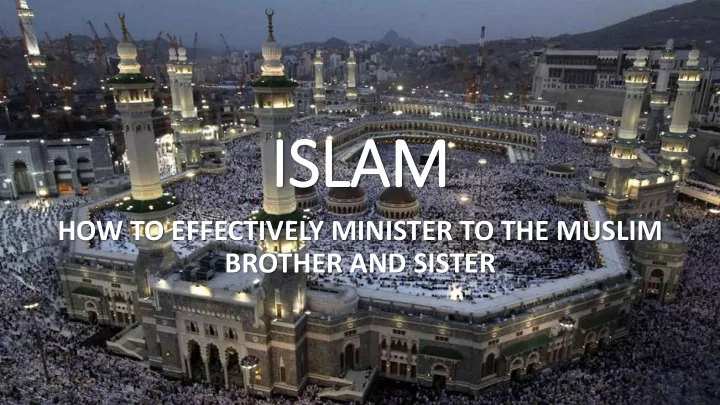
IS ISLAM HOW TO EFFECTIVELY MINISTER TO THE MUSLIM BROTHER AND - - PowerPoint PPT Presentation
IS ISLAM HOW TO EFFECTIVELY MINISTER TO THE MUSLIM BROTHER AND SISTER The founder of Islam is the prophet Muhammad. He was born around the year AD 570 in the commercial city of Mecca. He began his prophetic ministry at the age of 40
HOW TO EFFECTIVELY MINISTER TO THE MUSLIM BROTHER AND SISTER
The “founder” of Islam is the prophet Muhammad. He was born around the year AD 570 in the commercial city of Mecca. He began his prophetic ministry at the age of 40 (AD 622 and moved to Medina. He died in AD 632. Muslims make pilgrimage to Muhammad’s home, Mecca. Neither Muhammad, nor Muslims would claim that Muhammad is the “founder” of the religion called Islam.
He believed that he simply brought back the ancient faith of Abraham and the other prophets. He believed that he was the prophet to restore the “true religion” and the praise of Allah all over the world. Islam considers Muhammad to be the last and greatest of the prophets. They believe that the fullness of the revelation of God (Allah) was revealed to Muhammad in the “Qur’an.”
TIMELINE for Founding of Islam
TIMELINE for Founding of Islam
Rapid Influence of Islam – Let History Be Our Teacher !
Muslim Influence and Occupation Today (shown in green). Notice culture surrounding Israel.
Put It In Context: ISIS Territory ISIS = Islamic State in
Iraq and Syria
In order to dialog with someone, you need to have some common language points. In order to understand how the Muslim thinks, we need to define some key terms: 1.ISLAM – Arabic term which means submission. It is also the religion that formed out of the revelations to and the teachings of Muhammad. 2.MUSLIM – Arabic term meaning “one who submits.” It also refers to one who practices the religion of Islam. 3.ALLAH – the Islamic term for God. Allah is called the “One True Deity.” 4.QUR’AN – the sacred texts of Islam (Scriptures). The word means “recitations.” 5.SURAH – divisions within the Qur’an
Islam.
“collected traditions.”
was sacred duty to kill anyone who rejected the true faith).
Before we go further…Cults, False Religious Systems, Philosophies, Strange Ideologies, and Heresies:
Consider: Genesis 3:1-7 The Fall
1Now the serpent was more crafty than any of the wild animals the
LORD God had made. He said to the woman, “Did God really say, ‘You must not eat from any tree in the garden’?”
2 The woman said to the serpent, “We may eat fruit from the trees in
the garden, 3 but God did say, ‘You must not eat fruit from the tree that is in the middle of the garden, and you must not touch it, or you will die.’”
4“You will not certainly die,” the serpent said to the woman. 5“For God knows that when you eat from it your eyes will be
6When the woman saw that the fruit of the tree was good
for food and pleasing to the eye, and also desirable for gaining wisdom, she took some and ate it. She also gave some to her husband, who was with her, and he ate it.
7Then the eyes of both of them were opened, and they
realized they were naked; so they sewed fig leaves together and made coverings for themselves.
Before we go further…Cults, False Religious Systems, Philosophies, Strange Ideologies, and Heresies: Founded on Lies (Continued): Matthew 4: 4-11 Jesus Is Tested in the Wilderness
4 Then Jesus was led by the Spirit into the wilderness to be
tempted by the devil. 2 After fasting forty days and forty nights, he was hungry. 3 The tempter came to him and said, “If you are the Son of God, tell these stones to become bread.”
4 Jesus answered, “It is written: ‘Man shall not live on bread
alone, but on every word that comes from the mouth of God.’”
5 Then the devil took him to the holy city and had him stand on
the highest point of the temple. 6 “If you are the Son of God,” he said, “throw yourself down. For it is written: “‘He will command his angels concerning you, and they will lift you up in their hands, so that you will not strike your foot against a stone.’”
7 Jesus answered him, “It is also written: ‘Do not put the Lord
your God to the test.’”
8 Again, the devil took him to a very high mountain and
showed him all the kingdoms of the world and their splendor.
9 “All this I will give you,” he said, “if you will bow down and
worship me.”
10 Jesus said to him, “Away from me, Satan! For it is written:
‘Worship the Lord your God, and serve him only.’”
11 Then the devil left him, and angels came and attended him.
Cults:
(who is this ???)
social conditions
EVOLUTION of Islam as a religion: It is important for us to understand that Islam grew out of a culture and a context. Consider the following historical events leading up to the introduction of Islam: 1.Day of Pentecost and the birth of the Christian church. 2.Persecution by the Jewish establishment (esp. Temple Priests. NOTE also Saul’s rebellion, Paul’s conversion and missionary activity spreading the activity of the church). 3.During the 2nd and 3rd Centuries, Christianity suffered ridicule and accusation of heresy by philosophers of the day (especially Gnostics who claimed to have special knowledge of salvation based on knowledge and not faith).
4. After the Apostles passed on, Church “Fathers” took over the mantle of defending the faith against internal and external enemies doubting the qualification of Jesus to save. 5. Many wrote writings that they wanted to be considered part of the sacred writings of Scripture and there came a need to create a “standard” or canon for the God-inspired writings. 6. Questions on salvation and sin caused great disruption to the church’s growth. Creeds were established to universalize the beliefs of Christians.
7. Controversies over the Holy Spirit began to surface as well as the rise of the Roman empire and the papacy. 8. ISLAM arose in this culture of the church’s struggle.
Example: Heresy: - belief or opinion contrary to orthodox religious (especially Christian) doctrine.
Gnosticism A prominent, heretical movement of the 2nd-century Christian Church, partly of pre-Christian origin. Gnostic doctrine taught that the world was CREATED and RULED by a lesser divinity (the demiurge), and that Christ was an emissary (diplomatic representative) of the remote supreme divine being, esoteric (specialized) KNOWLEDGE (Greek: “gnosis – knowledge of spiritual mysteries) of whom enabled the redemption of the human spirit.
These heresies were meant to “shake the foundation” of the
followed heresies:
became itself a heresy (strict fasting, moral discipline, celibacy…).
baptism) and “auditors”. Promoted ministers as intermediaries.
ANYTHING BUT GOD ! ANY WAY BUT JESUS ! ANY “CONCOCTION” (a mixture of various
ingredients or elements)
BUT THE WORD !
Facts About Islam That Are Important For Us To Know: 1.Second largest religion in the world. 2.Introduced in a culture of “uncertainty” (heresies and compensating heresies). 3.Islam accepts the traditions of the other two “Religions Of The Book,” but with final “revelation.” 4.In Islam there is no distinction between social and religious life. “Sharia Law” governs them both.
Facts About Islam That Are Important For Us To Know:
“And God heard the voice of the lad; and the angel of God called to Hagar from heaven, and said to her, "What troubles you, Hagar? Fear not; for God has heard the voice of the lad where he is. Arise, lift up the lad, and hold him fast with your hand; for I will make him a great nation." Then God opened her eyes, and she saw a well of water; and she went, and filled the skin with water, and gave the lad a drink. And God was with the lad, and he grew up; he lived in the wilderness, and became an expert with the bow. He lived in the wilderness of Paran; [northern Arabia] and his mother took a wife for him from the land of Egypt.”
Genesis 25:6,12-18, RSV. “But to the sons of his concubines Abraham gave gifts, and while he was still living he sent them away from his son Isaac, eastward to the east country."
Different Divisions In Islam There are two different main groups (sects) in Islam: 1.SUNNITE – “Sunnis” practice a moderate Islamic
East. 2.SHIA’ITE – “Shia’ites” practice a much more literal interpretation and application of the Qur’an. They are generally much more fanatical than the Sunnis. 3.AHMDIYANS – very visible on American college campuses – proselytize American students. 4.SUFI – mystical group within Islam not recognized by many Muslims.
The Practice of Islam: What They Believe
Muslim Christian
God = Allah (one true God) God = Father + Son + Spirit Jesus = prophet Jesus = Messiah Holy Spirit – creation of Allah like angels Holy Spirit – God in Third Person Sin & Salvation – handled through work and fate. Sin & Salvation – sin expiated (atoned) by the sacrifice/blood of Jesus Afterlife – Paradise obtained at discretion of Allah. Afterlife – John 3:16 Sex & Marriage – OT foundations with cultural influences from Qur’an Sex & Marriage – OT foundation Genesis 2:24 Race Relations – Brothers = All who believe ! Race Relations – Revelation 7:9
ISLAM: WHAT THEY BELIEVE
ISLAM: WHAT THEY BELIEVE
“La ilaha illa Allah, Muhammadur rasoolu Allah.” There is no true God but Allah, and Muhammad is his prophet
ISLAM: WHAT THEY BELIEVE
Muslims pray 5 prayers per day
PILGRIMAGE
PRACTICE
PASSION
The Qur’an (Koran)
Believed to be the word of God (Allah)
the archangel Gabriel
“voice of God,” (not revelation of himself)
Ministering to The Muslim: The Central Problems
2.How they see Jesus – Jesus (Isa) is one of the many prophets of Allah. Jesus was sinless but did not die on the cross – he was taken bodily into heaven without having died (Surah 4:157). 3.Bible unreliable – corrupted by man.
“Is The Bible Unreliable ?” Acknowledging their descent from Abraham, Muslims believe in the Law of Moses, The Psalms of David and the “Injil” – the gospel of Jesus Christ. BUT…they believe that the Christian Scriptures were superseded by the revelation given to Muhammad. Therefore they believe that the Bible used by Jews and Christians is distorted. If there is a contradiction in what the Qur’an says, they believe the Bible is in error.
“Is The Bible Unreliable ?” (Continued): 2 Peter 1:21 (KJV) For the prophecy came not in old time by the will of man: but holy men of God spake as they were moved by the Holy Ghost. (NIV) For prophecy never had its origin in the human will, but prophets, though human, spoke from God as they were carried along by the Holy Spirit.
“Is The Bible Unreliable ?” (Continued): Tests of Canonicity (Does it belong to the set of
sacred, inspired writings ? Does is meet the standard) ?
1.Testimony of the Early Church Fathers.
approved other ?
instruction consistent with standards set by apostles ?
“Is The Bible Unreliable ?” (Continued): Ephesians 2:19-20
19 Consequently, you are no longer foreigners and
strangers, but fellow citizens with God’s people and also members of his household, 20 built on the foundation
as the chief cornerstone.
“Is The Bible Unreliable ?” (Continued): Romans 3:1-2
1 What advantage, then, is there in being a Jew,
every way! First of all, the Jews have been entrusted with the very words of God.
Ministering to The Muslim: Things To Keep In Mind When Ministering To The Muslim: 1.Heaven (Paradise) is obtained only by a combination of their acceptable “works” and fate.
God (Allah is judgmental).
to God to obtain possible salvation. “Lukewarm” believers in Jesus are a turn-off and especially ridiculed.
Ministering to The Muslim: Things To Keep In Mind When Ministering To The Muslim (Continued):
“common-link” between Islam and Christianity.
Muhammad nor the Qur’an.
“Ministering” To The Muslim: Consider using knowledge
The Qur'an also speaks of the Injil (the Gospel) as one of the other great books (Sura 5:46; 48:29). In the Gospels, Jesus taught, "Whoever believes in the Son Jesus (Isa) has eternal life, but whoever rejects the Son will not see life, for God’s wrath remains on them" (John 3:36 NIV). Whereas in the Qur'an Jesus (Isa) is presented as a prophet, the Injils or Gospels present Jesus as the Son of God who can provide assurance of eternal life.
“Ministering” To The Muslim: Consider using knowledge
This is not a new problem! Keep in mind that the Bible teaches that the Jews were ZEALOUS for God but their zeal was not based on
so much so that it was blinding them from seeing God’s way of salvation. Cults are characterized by such zeal – diligent, but diligently wrong – religiously wrong ! ( see Romans 10:2).
QUESTION: Can you see that the church has (since its birth) suffered persecution – both internal and external at the hands of a disbelieving culture ? What evidence is there today that the culture is still striving against the church, and why ?