
SLIDE 1
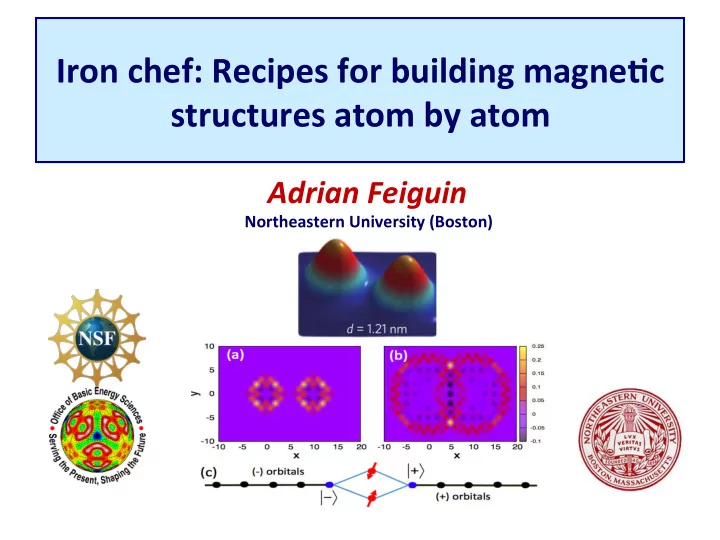
Iron ¡chef: ¡Recipes ¡for ¡building ¡magne6c ¡ structures ¡atom ¡by ¡atom ¡
Adrian ¡Feiguin ¡
Northeastern ¡University ¡(Boston) ¡
Iron chef: Recipes for building magne6c structures atom by - - PowerPoint PPT Presentation
Iron chef: Recipes for building magne6c structures atom by atom Adrian Feiguin Northeastern University (Boston) Northeastern University Boston Assistant chefs
Northeastern ¡University ¡(Boston) ¡
Carlos ¡Busser ¡ Andrew ¡Allerdt ¡ References: ¡ A.Allerdt, ¡C. ¡A. ¡Büsser, ¡S. ¡Das ¡Sarma, ¡A. ¡E. ¡Feiguin ¡(in ¡prepara<on). ¡ ¡A. ¡Allerdt, ¡C. ¡A. ¡Büsser, ¡ ¡G. ¡B. ¡Mar<ns, ¡and ¡A. ¡E. ¡Feiguin, ¡Phys. ¡Rev. ¡B ¡91, ¡085101 ¡(2015). ¡ ¡ ¡
4 Computer and
automation
pick-up motors Consumer electronics
Automotive & transportation
Medical industry
equipment
Factory automation
Alternative energy
Appliances & systems
Military
satellites
Courtesy of Luke G. Marshall: Table adapted from: Lewis, L. H. & Jiménez-Villacorta, F. “Perspectives on Permanent Magnetic Materials for Energy Conversion and Power Generation.” Metall. Mater. Trans. A 44, 2–20 (2012). Systems information from USMMA RE-Weapons Systems DoD Supply Chain Assessment, 10/07/2010: http://bit.ly/1THp1uM
5
Clean energy TeChnologies and
solar Cells Wind Turbines Vehicles lightjng
MaTerial
PV fjlms Magnets Magnets Batueries Phosphors lanthanum
Criticality Matrix
Figure 2. Medium-Term (5–15 years) Criticality Matrix
DOE ¡Report, ¡2010 ¡(see ¡also ¡DOD ¡reports) ¡
hNp://www.planetaryresources.com ¡
Asteroid ¡Redirect ¡Mission ¡(NASA ¡and ¡Planetary ¡Resources) ¡
hNp://www.planetaryresources.com ¡
Topological ¡states ¡ ¡ Spin ¡liquids ¡ Spin ¡glasses ¡ Many-‑body ¡localiza<on ¡
No ¡work ¡
No ¡work ¡= ¡no ¡change ¡in ¡energy ¡= ¡no ¡magne<za<on!!! ¡
Simple ¡proof: ¡
H = pi +eA(r
i)
2
2m
i
+other terms
i
M = − ∂F ∂B " # $ % & '
T,V
= − 1 β ∂ logZ ∂B " # $ % & '
T,V
= 0 Actual ¡proof: ¡ The ¡vector ¡poten<als ¡can ¡be ¡“gauged ¡out”, ¡the ¡integral ¡is ¡independent ¡of ¡B ¡
The ¡Bohr-‑van ¡Leeuwen ¡theorem ¡shows ¡that ¡magne<sm ¡cannot ¡be ¡accounted ¡for ¡
and ¡diamagne<sm ¡(In ¡equilibrium!). ¡
Main ¡contribu6on ¡for ¡free ¡atoms: ¡
Electronic structure Moment H: 1s M ∼ S He: 1s2 M = 0 unfilled shell M ≠ 0 All filled shells M = 0 AFM ¡ interac<ons ¡ FM ¡ interac<ons ¡
Source: ¡www.boundless.com ¡
Magne<sm ¡in ¡the ¡solid ¡state ¡is ¡much ¡rarer ¡than ¡in ¡gases, ¡since ¡in ¡gases ¡atoms ¡ preserve ¡their ¡par<ally ¡filled ¡shells ¡ ¡
Source: ¡www.boundless.com ¡ Colors ¡represent ¡s, ¡i, ¡d, ¡and ¡f ¡blocks ¡
Hund’s rule ( L-S coupling scheme ): Outer shell electrons of an atom in its ground state should assume
J = L + S for more than half-filled shells. Causes:
For filled shells, spin orbit couplings do not change order of levels. Mn2+: 3d 5 (1) → S = 5/2 exclusion principle → L = 2+1+0−1−2 = 0 Ce3+: 4 f 1 L = 3, S = ½ (3) → J = | 3− ½ | = 5/2 Pr3+: 4 f 2 (1) → S = 1 (2) → L = 3+2 = 5 (3) → J = | 5− 1 | = 4
2 5/2
F
3 4
H
L = 0 From Kittel’s “Solid State Physics” In ¡these ¡ions, ¡the ¡magneton ¡numbers ¡agree ¡well ¡with ¡the ¡spin ¡predic<on, ¡as ¡ though ¡the ¡orbital ¡moment ¡were ¡not ¡present ¡(it’s ¡said ¡to ¡be ¡“quenched”) ¡ ¡ ¡
Paramagne<sm ¡ Ferromagne<sm ¡ An<-‑Ferromagne<sm ¡ Ferrimagne<sm ¡ An<-‑Ferromagne<c ¡interac<ons ¡can ¡ yield ¡counter-‑intui<ve ¡states ¡of ¡ purely ¡quantum ¡origin, ¡such ¡as ¡ “spin-‑liquids” ¡
Andreas ¡Heinrich, ¡Physics ¡Today ¡(March ¡2015) ¡
resolu<on, ¡such ¡as: ¡
Gerd Binnig and Heinrich Rohrer 1986 Nobel Price
In ¡some ¡cases, ¡such ¡as ¡in ¡quantum ¡informa<on ¡processing, ¡spins ¡are ¡extremely ¡sensi<ve ¡to ¡ decoherence, ¡a ¡randomiza<on ¡of ¡the ¡spin ¡state ¡caused ¡by ¡entanglement ¡with ¡the ¡environment ¡ ¡
environment is in
In ¡other ¡circumstances, ¡this ¡coupling ¡is ¡crucial, ¡and ¡can ¡be ¡used ¡to ¡engineer ¡magne<c ¡structures ¡ with ¡arbitrary ¡interac<ons ¡
Science (2013)
Ladders ¡and ¡magne<c ¡clusters ¡ Spin ¡chains ¡ Frustra<on ¡
Spinelli et al
B = -0.625 T
1 nm 0.5 Å
Khajetoorians et al
Khajetoorians et al Science (2011)
Skyrmions ¡
Von Bergmann
Khajetoorians et al Science (2011)
Magne<c ¡devices ¡
Isolated ¡single ¡ atoms ¡ Insula<ng ¡substrate ¡ Metallic ¡substrate ¡ Single ¡atom ¡ proper<es ¡ Coopera<ve/many-‑body ¡ correla<on ¡effects ¡ Kondo ¡ effect ¡ Distance ¡ dependent ¡ interac<ons ¡ (RKKY) ¡ Magne<c ¡ nano-‑ structures ¡
Lagce ¡details ¡and ¡dimensionality ¡do ¡not ¡play ¡a ¡relevant ¡role ¡in ¡the ¡**universal** ¡ physics ¡of ¡the ¡single ¡impurity, ¡unless: ¡
Wilson: ¡Regardless ¡of ¡the ¡dimensionality, ¡the ¡Kondo ¡problem ¡is ¡essen<ally ¡one-‑ dimensional ¡. ¡ It ¡can ¡be ¡solved ¡with ¡Numerical ¡Renormaliza<on ¡Group ¡(Wilson, ¡Krishnamurthy, ¡ Wilkins), ¡or ¡Bethe ¡Ansatz ¡(Tsvelik, ¡Andrei). ¡
Metal surface Magnetic atom
Yong-‑Hui ¡Zhang, ¡Nature ¡Comm. ¡(2013) ¡
808
Kenneth
group
states correspond
(roughly)
to spherical
layers surrounding the imp urity, as shown in
is, the wave function for the second state of the Kondo basis is nonzero (except for small tails)
in the first spherical shell marked g 1 in Fig. 13, with width
rameter &1; it can be chosen arbitrarily. See below. For accidental reasons the width
is denoted
A& rather
than
state
is predominantly con- tained in shell g2, etc. The shells increase in width; and correspondingly the momentum spread of succeeding
states decreases.
All wave
functions
in the Kondo
basis are de- fined so that their average momentum is the Fermi mo- mentum. As n increases the nth
state
is concentrated closer and closer to the
Fermi surface; thus the energy scale for these states decreases being
A "I' for
the nth state.
Onion-like spherical shells giving the location of successive wave functions in the Kondo basis. The size of the smallest (inner) shell is a few Angstrom units.
energy
12 with
two energy levels
per scale is thus an oversimplification. Here and throughout the Kondo calculations the
em- phasis is
properties
conduction band rather than the impurity
think that the peculiar nature
is due to the magnetic im-
purity, not the conduction band. The importance
impurity is simple: it forces one to study the conduction band as a many-electrori
fiip
scat tering
impurity, which is possible
when
the impurity
is magnetic
(i.e., has a spin). Suppose
two electrons,
both
with spin up, try to spin-Rip
scatter
from a spin-down impurity.
The first electron can spin-Aip scatter, but the result is to leave the impurity
with spin up.
The second
electron
now cannot spin-Rip
scatter
because this
would
violate
spin
conservation. Thus
cannot treat the electrons
band independently:
treat
the conduction band as a many electron system. Inevitably, as a many-electron system, the con- duction band has the energy
level structure
indicated
in
each energy scale corresponding to a dif- ferent set of electrons. The normal description
electrons
in
the conduction band
is in terms of plane wave or Bloch wave
states. This
description is poorly
the Kondo calculations. The trouble is that there are too many plane wave states with almost the same energy (due to the plane wave states being close to a continuum for a sample
size). For the Kondo calculation
it was
necessary to define a new basis of states in the conduction band which emphasizes those states with the largest direct
indirect interaction with the impurity. The states chosen are closer to the localized Wannier states than the Bloch waves. The first state is (at least roughly) a Wannier
state localized about the impurity,
as localized as possible
while still being in the
conduction
band. The remaining In
this basis, electron states are neglected where the electron is far away from the impurity in position space and far away from the Fermi surface in momentum
space. The motivation for this
is as follows.
The
reason for considering
states far away
from the impurity
at all
is that at very low temperatures
very close to the Fermi surface are thermally
the Fermi surface in momentum space means the elec- trons have very broad wave functions in position space. At
low
temperatures the impurity interacts with these states near the Fermi surface; hence they must be included
in the basis.
It is possible
to add more states to the Kondo basis to make it complete. This is explained later
in this Section.
It turns
(for static ther- modynamic calculations) to neglect these extra states. See later in this Section for more discussion. The conduction band is now approximated by an infinite set of discrete electron
levels (called
the "Kondo basis") arranged much like layers
surrounding the impurity.
The energy scale on the nth level is of order A "I'. The heart
is a solution
Kondo Hamiltonian
in the Kondo basis using numerical
methods. This proceeds
in
steps. First
solves the impurity coupled
to the first Kondo state
(in the num- bering
to add the second layer
namely the terms involving the second Kondo state, and solve the combined coupling
first and second conduction band
states to the impurity. Then one adds the third state, then the
fourth
state, and so forth. This corresponds to solving for
the eigenvalues
at successively
smaller and smaller energy scales in Fig. 12.
Beyond the first
few steps
this calculation cannot be done exactly: there are too many
there are 2'"+' states in the nth step; when n is about 5
this number is too large for an exact calculation. Therefore, an approximate method is used which generates
the lowest energy
levels
at each step;
in practice this means calculating
about the first 1000 energy levels. Note that for large n, say n = 100, the first 1000 energy
levels are a negligible
fraction of the total number
(2"' for n = 100).
spherical ¡(s-‑wave ¡symmetry ¡-‑-‑All ¡other ¡symmetry ¡channels ¡are ¡ignored, ¡it ¡can ¡be ¡ shown ¡that ¡they ¡don’t ¡play ¡a ¡role) ¡
around ¡the ¡Fermi ¡energy ¡and ¡ ¡enables ¡an ¡RG ¡analysis ¡ ¡
...
−1 1 1
()
t
V
t 0
1 2 1 2 3b) a) c)
Wilson’s ¡RMP(75), ¡Bulla, ¡Cos<, ¡Pruschke, ¡RMP(08). ¡
¡ ¡
2 Ψi−1
r
0 0
We ¡choose ¡a ¡basis ¡of ¡concentric ¡orbitals ¡that ¡expand ¡radially ¡from ¡the ¡impurity ¡a ¡la ¡
n=0 ¡ seed ¡ n=1 ¡ n=2 ¡ n=3 ¡ n=4 ¡ n=5 ¡ n=6 ¡ n=7 ¡ n=8 ¡
1
1
ici−1 + h.c.)+
i=0 N
i=1 N
Same ¡as ¡Wilson’s ¡approach, ¡the ¡Hamiltonian ¡now ¡is ¡in ¡Tri-‑Diagonal ¡Form: ¡
η→0 ImG0(ω +iη)
representa<on), ¡and ¡the ¡many-‑body ¡terms ¡only ¡act ¡on ¡that ¡link. ¡
Observa6ons: ¡
number ¡of ¡channels ¡<mes ¡the ¡entanglement ¡of ¡a ¡1d ¡chain. ¡
couple ¡to ¡the ¡impurity. ¡
contribute ¡to ¡the ¡physics!!! ¡
In ¡finite ¡systems, ¡when ¡orbitals ¡reach ¡the ¡ boundary, ¡they ¡“bounce ¡back” ¡and ¡retrace ¡ their ¡path. ¡ ¡ ¡
Unless ¡the ¡lagce ¡has ¡the ¡same ¡symmetry ¡of ¡ the ¡orbitals, ¡the ¡channels ¡will ¡couple ¡at ¡the ¡
Typically, ¡one ¡considers ¡“infinite ¡system/ ¡ thermodynamic ¡ ¡boundary ¡condi<ons”, ¡ where ¡the ¡orbitals ¡expand ¡indefinitely ¡ (same ¡as ¡Wilson’s ¡RG) ¡
interac<ons. ¡
Khajetoorians, ¡A. ¡A., ¡Wiebe, ¡J., ¡Chilian, ¡ B., ¡Lounis, ¡S., ¡Blügel, ¡S., ¡Wiesendanger, ¡ R.,Nature. ¡8, ¡497-‑503. ¡(2012) ¡ ¡ Wahlström, ¡E.,Ekvall, ¡I ¡ Olin, ¡H., ¡Walld, ¡L. ¡Appl. ¡
(1998) ¡ Prusser ¡et ¡al, ¡Nature ¡Communica<ons ¡5, ¡5417 ¡(2014) ¡ ¡
r
1 0
r2 0
αα α0 − a0 αβ β0
ββ α0 − a0 βα β0
λγ γi γ
λγ γi−1 γ
Computa=ons: ¡Vol. ¡1: ¡Theory ¡ ¡(SIAM, ¡Philadelphia, ¡2002), ¡Vol. ¡41. ¡ ¡ See ¡also ¡T. ¡Shirakawa, ¡S. ¡Yunoki, ¡PRB ¡(14) ¡
1
1
1
See ¡also: ¡Phys. ¡Rev. ¡B ¡90, ¡195109 ¡(14). ¡Tomonori ¡Shirakawa ¡and ¡Seiji ¡Yunoki ¡ ¡
1 2 c† 1 +c2 †
1 2 1 + 2
1 2 c† 1 −c2 †
1 2 1 − 2
1 +
2
Auer ¡rota<ng ¡to ¡the ¡new ¡basis ¡: ¡ Iden<cal ¡to ¡the ¡Hamiltonian ¡considered ¡in ¡NRG ¡and ¡theore<cal ¡ calcula<ons, ¡but ¡in ¡“real ¡space” ¡(See ¡work ¡by ¡Wilkins, ¡Jones, ¡Varma, ¡ Affleck, ¡Ludwig, ¡etc) ¡
Doniach ¡(1977) ¡
T JK
TK ∝exp − 1 JD(EF) # $ % & ' ( TRKKY ∝ J 2D(EF)
RKKY Kondo Free moments
χ(R) ~ sin(2k f R+ πd
2 )
Rd
χ(r
1,r 2) = 2Re
r
1 n
n r
2
r
2 m
m r
1
En − Em
En>E f >Em
Lindhard ¡func<on: ¡ (Free ¡electron ¡suscep<bility) ¡
χ(r
i,rj) = − 1
2π Im dEG+ r
i,rj,E
( )G− r
i,rj,E
( )
−∞ ∞
half-‑filling ¡ We ¡expect ¡the ¡interac<ons ¡to ¡ alternate ¡between ¡FM ¡and ¡AFM ¡
Andrew ¡Allerdt, ¡C. ¡A. ¡Büsser, ¡G. ¡B. ¡Mar<ns, ¡and ¡A. ¡E. ¡Feiguin ¡PRB ¡91, ¡085101 ¡(2015) ¡ In ¡agreement ¡with ¡old ¡QMC ¡results ¡on ¡small ¡ lagces: ¡Fye, ¡Hirsch, ¡Scalapino, ¡PRB ¡(87); ¡Fye ¡ Hirsch, ¡PRB ¡(89); ¡Fye, ¡PRL ¡(94). ¡ ¡ QMC ¡does ¡not ¡resolve ¡Kondo ¡physics ¡due ¡to ¡ finite ¡temperatures. ¡ ¡ In ¡2D ¡and ¡3D ¡Kondo ¡dominates ¡when ¡ impuri<es ¡are ¡on ¡same ¡sublagce. ¡FM ¡only ¡ survives ¡at ¡very ¡short ¡distances! ¡ (Independent ¡confirma<on ¡by ¡A. ¡Mitchell, ¡ Derry ¡and ¡Logan, ¡PRB ¡(2015)). ¡ ¡ In ¡agreement ¡with ¡Affleck ¡and ¡Ludwig, ¡and ¡ PoNhoff ¡and ¡Schwabe ¡(See ¡Schwabe’s ¡PhD ¡ Thesis, ¡and ¡references ¡therein) ¡ DMRG, ¡L=204, ¡M~3000 ¡
Andrew ¡Allerdt, ¡C. ¡A. ¡Büsser, ¡G. ¡B. ¡Mar<ns, ¡and ¡A. ¡E. ¡Feiguin ¡PRB ¡91, ¡085101 ¡(2015) ¡ DMRG, ¡L=204, ¡M~3000 ¡ DOS ¡not ¡ enough ¡to ¡ explain ¡the ¡ physics! ¡
(*) ¡W. ¡B. ¡Thimm, ¡J. ¡Kroha, ¡and ¡J. ¡von ¡Delu, ¡Phys. ¡Rev. ¡LeN. ¡82, ¡2143 ¡(1999); ¡P. ¡SchloNmann, ¡Phys. ¡Rev. ¡B ¡65, ¡024420 ¡(2001). ¡
Linear ¡contribu<on ¡to ¡TK ¡coming ¡ from ¡“Kondo ¡box”(*) ¡physics ¡(A. ¡ Schwabe, ¡D. ¡Gütersloh, ¡and ¡M. ¡ PoNhoff, ¡PRL. ¡109, ¡257202 ¡(2012)). ¡
studied in this paper.
x-‑direc<on ¡ y-‑direc<on ¡ Free ¡moment ¡ regime ¡
AA ¡stacking ¡ for ¡BLG ¡
x-‑direc<on ¡ y-‑direc<on ¡
y-‑direc<on ¡
43% ¡ 37% ¡
N-‑site ¡
equal ¡to ¡the ¡number ¡of ¡impuri<es. ¡
disorder, ¡and ¡quantum ¡chemistry. ¡ ¡
impurity ¡at ¡an ¡edge/surface, ¡and ¡another ¡in ¡the ¡bulk ¡(topological ¡insulators, ¡Shockley ¡ surfaces) ¡
universal ¡behavior. ¡ ¡
RKKY ¡problem ¡is ¡non-‑trivial. ¡
consistent ¡with ¡Schwabe/PoNhoff ¡and ¡Affleck/Ludwig ¡arguments ¡(Energe<cs ¡+ ¡symmetry ¡of ¡ the ¡wave ¡func<ons). ¡(This ¡is ¡a ¡zero-‑T ¡result!) ¡
Experimentalists ¡need ¡new ¡intui<on ¡based ¡on ¡new ¡numerical ¡methods. ¡
Open ¡issues: ¡
¡channels ¡and ¡Hund ¡physics. ¡
¡