Ionosphere from the ISS from the LITES instrument Susanna Finn - - PowerPoint PPT Presentation

ionosphere from the iss
SMART_READER_LITE
LIVE PREVIEW

Ionosphere from the ISS from the LITES instrument Susanna Finn - - PowerPoint PPT Presentation

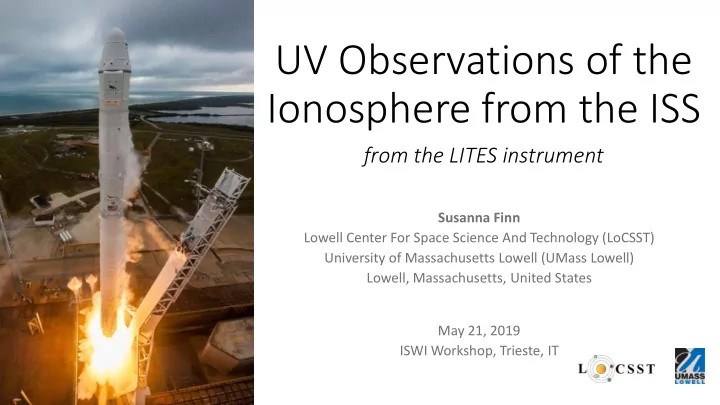
UV Observations of the Ionosphere from the ISS from the LITES instrument Susanna Finn Lowell Center For Space Science And Technology (LoCSST) University of Massachusetts Lowell (UMass Lowell) Lowell, Massachusetts, United States May 21, 2019


slide-1
SLIDE 1

UV Observations of the Ionosphere from the ISS

from the LITES instrument

Susanna Finn Lowell Center For Space Science And Technology (LoCSST) University of Massachusetts Lowell (UMass Lowell) Lowell, Massachusetts, United States May 21, 2019 ISWI Workshop, Trieste, IT

slide-2
SLIDE 2

Acknowledgments

LITES Team: UMass Lowell: Supriya Chakrabarti, Tim Cook, Jason Martel, George Geddes (PhD student) NRL: Andrew Stephan (PI), Scott Budzien

LITES was integrated and flown on the International Space Station as part of the Space Test Program – Houston 5 (STP-H5) payload under the direction of the DoD Space Test Program. Funding for the refurbishment of the LITES sensor was provided to the University of Massachusetts Lowell by the Office of Naval Research and the National Science Foundation. Research at the U.S. Naval Research Laboratory was supported by the Chief of Naval Research as part of the NRL Basic Research Program. Integration and testing support for LITES was provided by STP.

slide-3
SLIDE 3

LI LITES

Limb-imaging Ionospheric And Thermospheric Extreme-ultraviolet Spectrograph

  • Imaging spectrograph returns one-dimensional

vertical (altitude) airglow profiles from Earth’s limb

  • Looks at the trailing limb behind the International

Space Station (ISS) as it orbits

  • Description:
  • Spectrograph that images vertical (altitude)

profiles

  • 10° x 10° field of view, 0.4° resolution in the

vertical

  • 600-1400 Å, ~15 Å (FWHM) resolution
  • Compact, lightweight design with no moving parts

Spe Spectral al in information Spa Spatial in information

slide-4
SLIDE 4

LITES Science

  • Ionosphere is complex and dynamic
  • Sparse plasma
  • Transient structures
  • Depletions
  • Bubbles
  • Irregularities
  • Plasma irregularities create fluctuations in

electron density at low and middle latitudes over a wide range of size scales

  • Effects:
  • Navigation problems
  • Communication outages
  • Interference
  • S. Budzien

Credit: Encyclopedia Britannica 2012

slide-5
SLIDE 5

LITES

Limb-imaging Ionospheric And Thermospheric Extreme-ultraviolet Spectrograph

  • Imaging spectrograph:
  • Light enters entrance slit
  • Light reflects off of toroidal

grating

  • Light is dispersed and imaged
  • nto the microchannel plate

(MCP) detector

  • Horizontal dimension:

wavelength

  • Vertical dimension:

spatial/altitude

  • KBr coating, Ly α mask

Grating Slit (installed later) MCP Detector

slide-6
SLIDE 6

LITES

  • LITES views the trailing limb of

Earth as the ISS orbits

  • Imaging spectrograph returns
  • ne-dimensional vertical

(altitude) airglow profiles of Earth’s limb

  • Oriented to optimize coverage of

tangent altitudes between 150 and 350 km

  • 3 second cadence ≈ 25 km in-

track resolution

  • Collects data in daytime and

nighttime conditions

10° 10°

0.4° 350 km 150 km Imaging

(Collapsed scene) Spectrum  Species Info

slide-7
SLIDE 7

LITES Spectrum

  • LITES operates continuously observing the dayside and nightside ionosphere
  • LITES observes neutrals and ions simultaneously

PHYSICAL QUANTITY/OBJECTIVE MEASUREMENT EXCITATION PROCESS(ES) [e-], [O+] Ionospheric density Ni Nighttim ime: OI 91.1 nm cont., 135.6 nm O+ + e- → O + hν [O], Tn Atomic oxygen composition Dayt Daytime: OI 98.9, 130.4, 135.6 nm O + e- → O* + e- [O+] Ionospheric density Dayt Daytime: OII 61.7, 83.4 nm O + hν → O+* + e- + hν (61.7 nm) O + hν → O++ e- + hν (83.4 nm) [N2], Tn Thermosphere N2 density Dayt Daytime: N2 LBH, 127.0-140.0 nm e- + N2 → e- + N2

*

slide-8
SLIDE 8

LITES Launch

  • LITES launched February 19, 2017 as part of the Space Test Program Houston 5 (STP-H5) payload
  • n a SpaceX Falcon 9 commercial resupply mission to the International Space Station (ISS).
slide-9
SLIDE 9

LITES Spectrum

08/02/2017

9 Wavelength Altitude

60 nm 140 nm ~150 km ~350 km O 135.6 nm O 130.4 nm H 121.6 nm O+ 83.4 nm O+ 91.1 nm O+ 61.7 nm

Photocathode mask

slide-10
SLIDE 10

Equatorial Arcs

  • Equatorial arcs are a persistent feature in the

ionosphere north and south of the magnetic equator

  • Due to eastward electric field and northward magnetic

field

  • ExB drift causes plasma to flow upward at the magnetic

equator

  • Plasma then “fountains” down along field lines creating

higher density crests on either side of equator NASA IRI visualization of equatorial anomaly 1356Å IMAGE observation, Sagawa et al. 2005

slide-11
SLIDE 11

Nighttime emission

  • Two UV emissions, 911Å and 1356Å, derive directly from recombination of O+ + e-
  • Line-of-sight brightness is proportional to electron density in the F-region ionosphere
  • Proportional to the path integral of

density squared, making this emission very sensitive to ionospheric gradients

slide-12
SLIDE 12

Nighttime UV Airglow

911Å 1356Å

  • Integrate 911Å emission over all

altitudes

  • (Shown right: integrated over 2
  • rbits)
  • Nighttime data were chosen to

have solar zenith angle (SZA) greater than 110°

slide-13
SLIDE 13

911Å nighttime brightness over a full day

  • Integrated 911Å emission over ISS orbital track for one day (Apr 2, 2017)
  • One orbit every 90 minutes
  • Binned into 30sec data points, plotted at tangent point
slide-14
SLIDE 14

911Å, nighttime April 2017

Apr 1 Apr 4 Apr 2 Apr 5

slide-15
SLIDE 15

911Å, nighttime April 2017

Apr 1 Apr 4 Apr 2 Apr 5

slide-16
SLIDE 16

911Å, nighttime April 2017

Apr 1 Apr 2 Apr 4 Apr 5

  • North-south asymmetry
  • Day-to-day variability (not fixed-local-time)
slide-17
SLIDE 17

1356Å, nighttime April 2017

Apr 1 Apr 4 Apr 2 Apr 5

slide-18
SLIDE 18

911Å 1356Å

Apr 1 Apr 2 Apr 4 Apr 5

slide-19
SLIDE 19

911Å 1356Å

Apr 1 Apr 2 Apr 4 Apr 5

slide-20
SLIDE 20

911Å 1356Å

  • North-south asymmetry
slide-21
SLIDE 21

Nighttime Observation

  • 911 and 1356Å emission trace the

density of the plasma in the ionosphere at night

  • Equatorial arcs are visible in
  • bservations from early April 2017
  • North-south asymmetry in the arcs
  • Observations over longer time

periods will trace changes (seasonal) in morphology of the arcs

  • LITES can track the arcs from

daytime into nighttime

slide-22
SLIDE 22

Daytime 1356Å

  • During the daytime, solar EUV

creates photoelectrons which collisionally excite thermospheric O1356Å

  • Collisional excitation

dominates at lower altitudes (<~250-300 km)

Altitude Time

Stephan et al., submitted

slide-23
SLIDE 23

Daytime 1356Å

  • Relative OI 1356 Å emission

brightness measured by LITES during one daytime pass on 2 April 2017

  • Tangent altitude contours are

shown (horiz. white dashed)

  • The vertical dashed line identifies

the time when the tangent point at 300 km was located at the magnetic equator

Altitude Time

Stephan et al., submitted

slide-24
SLIDE 24

Daytime 1356Å

  • Relative OI 1356 Å emission

brightness measured by LITES during one daytime pass on 2 April 2017

  • Tangent altitude contours are

shown (horiz. white dashed)

  • The vertical dashed line identifies

the time when the tangent point at 300 km was located at the magnetic equator

Altitude Time

Stephan et al., submitted

slide-25
SLIDE 25

1356Å, daytime April 2017

  • 1356Å, 250-350km

Apr 1 Apr 2 Apr 4 Apr 5

Stephan et al., submitted

slide-26
SLIDE 26

1356Å, daytime April 2017

  • 1356Å, 250-350km

Apr 1 Apr 2 Apr 4 Apr 5

Stephan et al., submitted

slide-27
SLIDE 27

1356Å, daytime April 2017

  • 1356Å, 250-350km
  • North-south asymmetry

seen

  • Meridional winds?
  • Mild geomagnetic

activity?

Stephan et al., submitted

slide-28
SLIDE 28

834Å Daytime Emission

Lower thermosphere (150-200 km) O + h  O+* O+*  O+ + 61.7, 83.4 nm Ionosphere (200 - 500 km) O+ + 83.4 nm  O+* O+*  O+ + 83.4 nm

61.7 nm 83.4 nm

OII 834Å emission is produced in the lower thermosphere primarily through solar photoionization of atomic O: O + hν  O+*  O+ + hν83.4 Photons then resonantly scatter with O+

  • Ionospheric profiles can be derived by inversion of 834Å limb profiles (see, e.g., Geddes et al. 2016)
  • From the vantage point of LITES through the equatorial arcs, the 834Å emission is effectively

scattered out of the line of sight (essentially creating an absorption feature).

slide-29
SLIDE 29

Apr 1 Apr 2 Apr 4 Apr 5

1356Å 834Å

Stephan et al., submitted

Daytime

slide-30
SLIDE 30

Apr 1 Apr 2 Apr 4 Apr 5

1356Å 834Å

Stephan et al., submitted

Daytime

slide-31
SLIDE 31

Daytime

  • 1356Å brightness above 250km traces arcs
  • 834Å shows depletion in arcs

1356Å 834Å

Stephan et al., submitted

slide-32
SLIDE 32

Aurora

  • LITES detected both ions and emission lines

from the southern auroral zone.

600Å 1400Å 350 km 150km

Nighttime April 16 2017

slide-33
SLIDE 33

Aurora

  • LITES detected both ions and emission lines

from the southern auroral zone.

600Å 1400Å 350 km 150km

Nighttime April 16 2017

LITES look direction

slide-34
SLIDE 34

Aurora

  • LITES detected both ions and emission lines

from the southern auroral zone.

350 km 150km 350 km 150km

Nighttime April 16 2017

LITES look direction

Nighttime April 21 2017

600Å 1400Å 600Å 1400Å

slide-35
SLIDE 35

LITES and GROUP-C

LITES is part of a suite of ionospheric instruments on the payload along with: GPS Radio Occultation and Ultraviolet Photometry-Colocated (GROUP-C)

  • Nadir-viewing UV photometer (TIP)
  • GPS receiver (FOTON)

LITES imaging spectrograph and the GPS receiver view the same ionospheric volume imaged by the nadir photometer approximately 200 seconds later

slide-36
SLIDE 36

Tomography

  • The capability of LITES to

continuously image over all altitudes in its FOV along with the nadir imaging of TIP (GROUP-C) allows better tomographic imaging than has ever been achieved

  • The LITES and GROUP-C UV sensors

can reconstruct ionospheric ion density gradients and bubbles

(Left) Model 1356Å O++e volume emission for a LITES/GROUP-C nightside pass. (Right) Retrieved morphological features from synthesized measurements. From S. Budzien

slide-37
SLIDE 37

In Summary . . .

  • LITES is an EUV ionospheric imaging

spectrograph that launched early 2017

  • LITES collected ~1.5 years of UV

airglow observations daytime and nighttime

  • The equatorial arcs are easily visible in

LITES data, and LITES observations

  • ver longer timescales can be used to

trace morphology

  • LITES provides complementary
  • bservations to observatories at

different orbits, ICON and GOLD