
SLIDE 1
NYSE: CVA DECEMBER 2017
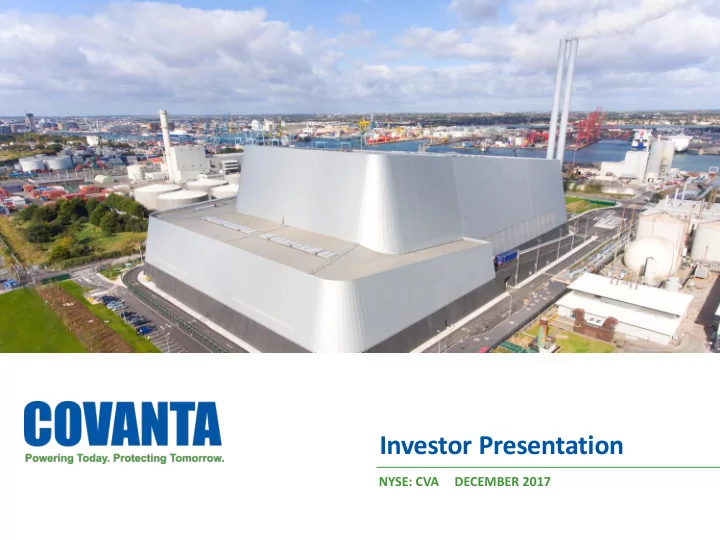
Investor Presentation NYSE: CVA DECEMBER 2017 Cautionary - - PowerPoint PPT Presentation
Investor Presentation NYSE: CVA DECEMBER 2017 Cautionary Statements All information included in this earnings presentation is based on continuing operations, unless otherwise noted. Forward-Looking Statements Certain statements in this press
NYSE: CVA DECEMBER 2017
2
All information included in this earnings presentation is based on continuing operations, unless otherwise noted. Forward-Looking Statements Certain statements in this press release may constitute “forward-looking” statements as defined in Section 27A of the Securities Act of 1933, as amended (the “Securities Act”), Section 21E of the Securities Exchange Act of 1934, as amended (the “Exchange Act”), the Private Securities Litigation Reform Act of 1995 (the “PSLRA”) or in releases made by the SEC, all as may be amended from time to time. Such forward-looking statements involve known and unknown risks, uncertainties and other important factors that could cause the actual results, performance or achievements of Covanta and its subsidiaries, or industry results, to differ materially from any future results, performance or achievements expressed or implied by such forward-looking statements. Statements that are not historical fact are forward-looking statements. Forward-looking statements can be identified by, among other things, the use of forward- looking language, such as the words “plan,” “believe,” “expect,” “anticipate,” “intend,” “estimate,” “project,” “may,” “will,” “would,” “could,” “should,” “seeks,” or “scheduled to,” or other similar words, or the negative of these terms or other variations of these terms or comparable language, or by discussion of strategy or intentions. These cautionary statements are being made pursuant to the Securities Act, the Exchange Act and the PSLRA with the intention of obtaining the benefits of the “safe harbor” provisions of such laws. Covanta cautions investors that any forward-looking statements made by Covanta are not guarantees or indicative of future performance. Important assumptions and other important factors that could cause actual results to differ materially from those forward-looking statements with respect to Covanta include, but are not limited to, the risks and uncertainties affecting Covanta’s businesses described in periodic securities filings by Covanta with the SEC. Important factors, risks and uncertainties that could cause actual results of Covanta and the JV to differ materially from those forward-looking statements include, but are not limited to: seasonal or long-term fluctuations in the prices of energy, waste disposal, scrap metal and commodities; Covanta’s ability to renew or replace expiring contracts at comparable prices and with other acceptable terms; adoption of new laws and regulations in the United States and abroad, including energy laws, environmental laws, tax laws, labor laws and healthcare laws; failure to maintain historical performance levels at Covanta’s facilities and its ability to retain the rights to operate facilities it does not own; Covanta’s and the JV’s ability to avoid adverse publicity or reputational damage relating to its business; advances in technology; difficulties in the operation of its facilities, including fuel supply and energy delivery interruptions, failure to obtain regulatory approvals, equipment failures, labor disputes and work stoppages, and weather interference and catastrophic events; difficulties in the financing, development and construction of new projects and expansions, including increased construction costs and delays; limits of insurance coverage; Covanta’s ability to avoid defaults under its long-term contracts; performance of third parties under its contracts and such third parties’ observance
Covanta’s existing indebtedness and its ability to perform its financial obligations and guarantees and to refinance its existing indebtedness; exposure to counterparty credit risk and instability of financial institutions in connection with financing transactions; the scalability of its business; restrictions in its certificate of incorporation and debt documents regarding strategic alternatives; failures of disclosure controls and procedures and internal controls over financial reporting; Covanta’s and the JV’s ability to attract and retain talented people; Covanta’s ability to utilize net operating loss carryforwards; general economic conditions in the United States and abroad, including the availability of credit and debt financing; and other risks and uncertainties affecting Covanta’s businesses described in periodic securities filings by Covanta with the SEC. Although Covanta believes that its plans, cost estimates, returns on investments, intentions and expectations reflected in or suggested by such forward-looking statements are reasonable, actual results could differ materially from a projection or assumption in any forward-looking statements. Covanta’s and the JV’s future financial condition and results of operations, as well as any forward-looking statements, are subject to change and to inherent risks and uncertainties. The forward-looking statements contained in this press release are made only as of the date hereof and Covanta does not have or undertake any obligation to update or revise any forward-looking statements whether as a result of new information, subsequent events or otherwise, unless otherwise required by law. Note: All estimates with respect to 2017 and future periods are as of October 27, 2017. Covanta does not have or undertake any obligation to update or revise any forward-looking statements whether as a result of new information, subsequent events or otherwise, unless otherwise required by law. Non-GAAP Financial Measures We use a number of different financial measures, both United States generally accepted accounting principles (“GAAP”) and non-GAAP, in assessing the overall performance of our business. To supplement our assessment of results prepared in accordance with GAAP, we use the measures of Adjusted EBITDA, and Free Cash Flow, which are non-GAAP measures as defined by the Securities and Exchange Commission. The non-GAAP financial measures of Adjusted EBITDA and Free Cash Flow as described below, and used in this release, are not intended as a substitute or as an alternative to net income, cash flow provided by operating activities or diluted earnings per share as indicators of our performance or liquidity
comparison purposes. The presentations of Adjusted EBITDA and Free Cash Flow are intended to enhance the usefulness of our financial information by providing measures which management internally use to assess and evaluate the
Note: Guidance affirmed as of October 26, 2017.
~10 million MWh generated annually 1,400+ MW base load capacity
~550,000 gross tons of ferrous and non- ferrous recovered annually
Operate 42 Energy-from-Waste (EfW) facilities ~20 million tons processed annually → 1:1 tons of CO2 equivalent offset 15 material processing facilities
$400 - $440 million
$100 - $150 million
% of 2016 Revenue
Waste 70% Metals 3% Energy 22% Other 5% 3
500-700 kWh power ~50lbs recycled metal Ash: ~10% of
1 ton of waste yields:
4
Leader in Energy-from-Waste
Critical Infrastructure Assets
Attractive Business Model
Strong Growth Outlook
5
Waste-to- Energy
Landfill
Recycling / Composting
6
7
Waste & Service Energy Metal
extending long-term contracts
utilities
generation to manage volatility
sold at prevailing commodity prices
100%
Uncontracted
16% 84%
Uncontracted Contracted
35% 8% 57%
Hedged Uncontracted Contracted
8
Note: Figures presented for EfW operations only. Percentages of revenue calculated on 2016 for waste and service and 2017 guidance midpoint for energy. Contracted energy revenue % includes capacity auction revenue.
EfW portfolio
– Construction and acquisitions
headwinds
– Mark-to-market of original long-term contracts – Commodity prices
long-term growth
– Organic growth opportunities – International development
9
market recovery
growth target
dynamics
management
Underpins long-term cash flow growth and capital allocation plans Opportunities to invest capital at attractive equity returns
robust UK project pipeline
platform for new opportunities in UK and other markets
Core Business Commodities
10
zero landfill disposal for non- hazardous waste
revenue per ton
~$100 million Revenue ~50% Adjusted EBITDA margin
material processing facilities
waste processing, recycling and field services capabilities
~$100 million Revenue ~20% Adjusted EBITDA margin
11
Comprehensive solutions for government, commercial, industrial and medical / pharmaceutical sectors
Recovery Systems
recovery: +30% ferrous and +140% non-ferrous since 2012
Processing for Enhanced Product
driving improved pricing — Upgrading ~30% of ferrous today, with plans to expand — Centralized non- ferrous processing for
Recovery and Ash Reuse
first “Total Ash Processing System” to handle ~10% of ash
recovery and sale of aggregates which reduces disposal by ~65%
12
13 AssetCo
100%
Dublin
50%
Newhurst Protos Rookery O&M Acquisitions New JV Projects Powerful Growth Platform
50%
3 GIG Projects
14
Combined development pipeline of advanced and early stage projects targeting major metro areas and totaling 2 million tonnes of annual processing capacity
1) Name and location of GIG projects withheld due to confidentiality and commercial limitations.
Newhurst
Protos
Rookery
Dublin
London Birmingham Edinburgh Belfast Liverpool Manchester Glasgow
GIG brings a portfolio of 3 EfW development projects in the UK with combined capacity of over 800,000 tonnes per year (1)
Committed to invest £3 in green infrastructure over the next three years
Dublin
15
refinancing of original capital structure to extend debt term and significantly reduce cost
– €396m 3.1% senior debt due 2032 – €50m 5.2% junior debt due 2032
50% stake in Dublin (via partnership)
– Represents market value for a premier world class asset
equity and maintains 50% ownership – Premium highlights value accretion from development activities
Refinancing Overview Attractive Valuation
GIG investing in Ireland highlights the value of this critical infrastructure asset
16
1) Please see page 31 for related notes on non-GAAP financial measures. 2) “Advanced” pipeline includes projects with planning permission and contractual structure in place (Rookery, Protos, Newhurst and 1 GIG project).
Balance Sheet Impact
– Adjusted EBITDA: $30 to $35 million (1) – Free Cash Flow: $10 to $15 million (1)
Near-term Financial Impact (Dublin)
– 4x to 5x investment multiple
Advanced UK Pipeline (2) (4 New Projects)
Long-term Growth Targets
17
3 to 5 additional UK EfW projects to follow by 2020 Plan to leverage the partnership’s sourcing capabilities and relationships to expand pipeline further in the UK and globally
Partnership to execute combined project pipeline in the UK, while establishing a platform for capitalizing on future investment opportunities
Rookery expected to commence construction in the first half of 2018
Note: Development timeline reflects current pipeline of advanced projects only.
Dublin commences
Rookery Highly visible return on investment UK Projects Online (2021+) Announce and construct 3 to 5 additional projects (Protos, Newhurst and 3 GIG projects) UK Investment Period (2018-2022) 2017
18
Dividend Stability
priority
Growth Investments
Deleveraging Dividend Growth Share Repurchases
to reduce international subsidiary debt and add €136 million in cash
years, with no material corporate maturities until 2020
availability under revolver at 9/30/17
As of 9/30/17
(Face Value; $ in millions)
Covanta Energy, LLC
Revolving Credit Facility due 2019-2020: (1) $473 Term Loan due 2020: 193 Equipment Leases due 2024-2027: 66 Tax-Exempt Corporate Bonds due 2024-2045: (2) 464
Domestic Subsidiaries
Project Debt: $173
International Subsidiaries
Project Debt: $324
1) Total facility size of $1.0 billion ($50 million due 2019 and $950 million due 2020), with $191 million letters of credit outstanding and $336 million availability at September 30, 2017. 2) The tax-exempt corporate bonds are obligations of Covanta Holding Corporation and are guaranteed by Covanta Energy, and as such are effectively senior in right of payment to the other indebtedness of Covanta Holding Corporation.
Covanta Holding Corporation
6.375% Senior Notes due 2022: $400 5.875% Senior Notes due 2024: 400 5.875% Senior Notes due 2025: 400
19
21
5) Excludes liquid waste. 6) Includes contracts at transfer stations from which waste is internalized. 7) Calculated for EfW waste processing revenue presented above. Note: certain amounts may not total due to rounding.
▪ EfW waste processing revenue down $3 million
million), plant downtime and hurricane impacts
▪ Covanta Environmental Solutions
▪ Strong waste price environment ▪ Full year 2017 profiled waste expected to grow at mid- single digits, with re-acceleration expected in 2018 ▪ Reducing full year volume outlook on Fairfax start-up timing (insurance to compensate for downtime) ▪ Continued growth in Environmental Services
1) Includes the operation of material processing facilities and related services. 2) Consists of transfer stations and transportation component of NYC MTS contract. 3) Includes waste brokerage, debt service and other revenue unrelated to EfW waste processing. 4) Elimination of intercompany transactions primarily relating to transfer stations.
(in millions, except price) Q3 2016A Q3 2017A 2017E Waste & Service Revenue: EfW Waste Processing $241 $238 $970 - $985 Environmental Services (1) 26 32 110 - 120 Municipal Services (2) 48 50 ~190 Other (3) 10 12 ~40 Intercompany (4) (26) (26) ~ (90) Total $299 $306 $1,220 - $1,245 EfW Tons: (5) Contracted (6) 4.6 4.2 Uncontracted 0.5 0.5 Total 5.1 4.7 18.9 - 19.0 EfW Revenue per Ton: (7) Contracted $44.21 $47.63 Uncontracted $76.76 $77.62 Average $47.45 $50.82 $51.25 - $51.75
(Unaudited)
22
(in millions, except price; MWh sold in millions) Q3 2016A Q3 2017A 2017E Energy Revenue: Energy Sales $81 $68 $270 - $290 Capacity 11 12 ~40 Total $92 $80 $310 - $330 MWh Sold: Contracted 0.8 0.6 2.3 - 2.5 Hedged 0.5 0.7 2.7 Market 0.2 0.2 0.8 Total 1.5 1.5 5.8 - 6.0 Revenue per MWh: (1) Contracted $65.82 $66.58 $66 - $67 Hedged $37.98 $32.25 ~ $36 Market $37.32 $25.79 $23 - $29 Average $52.63 $45.83 $46 - $48
▪ Energy revenue decreased $4 million (4.3%) on a same store basis
downtime at Fairfax ($7 million)
▪ Contract transitions reduced revenue by $8 million
contractual revenue share
▪ Power prices remain soft ▪ Reducing full year volume outlook on Fairfax timing (insurance to compensate for loss of volume) ▪ Hedge activity:
with only 0.2 million MWh left in Q4
1) Excludes capacity revenue. Note: certain amounts may not total due to rounding.
(Unaudited)
23
($ in millions, except price; tons in thousands) Q3 2016A Q3 2017A 2017E Metals Revenue: Ferrous $8 $13 $40 - $45 Non-Ferrous 6 10 30 - 35 Total $14 $23 $70 - $80 Tons Recovered: Ferrous 101 98 390 - 395 Non-Ferrous 9 10 35 - 40 Tons Sold: Ferrous 72 81 295 - 305 Non-Ferrous 10 8 28 - 33 Revenue per Ton Sold: Ferrous $117 $158 $140 - $150 Non-Ferrous $581 $1,201 $1,000 - $1,100 Average HMS index price (1) $212 $275 $250 - $260 Average Old Cast Aluminum (2) $0.58 $0.60 $0.57 - $0.63
▪ Ferrous:
enhanced product quality
▪ Non-ferrous:
improved quality from processing
processing, which is more than offset by price
▪ HMS Index averaged $275 per ton in Q3 and set at $258 in October
strong pricing year-to-date ▪ Realized non-ferrous pricing to improve further in Q4 on increased sales mix of high value metals
1) Q3 2017 and Q3 2016 average #1 Heavy Melt Steel composite index ($ / gross ton) as published by American Metal Market. 2) Q3 2017 and Q3 2016 average Old Cast Aluminum Scrap ($ / pound) calculated using the high price as published by American Metal Market. Note: certain amounts may not be totaled due to rounding.
(Unaudited)
24
Note: certain amounts may not total due to rounding.
▪ Total EfW maintenance (expense + capex) higher year-
scope at certain facilities ▪ Other plant operating expense increased year-over-year, but in line with Q2 2017
▪ Contra expense in Other Operating Expense: $8 million benefit from a contract dispute and $2 million from insurance recoveries
▪ Full year EfW maintenance expected to be near the top end of the 2017 range (well within 3-year outlook of $365 - $415 million) ▪ Other EfW plant operating expense expected to trend up in Q4 vs. Q3 with Dublin operations ▪ Remaining Fairfax business interruption insurance recoveries expected in Q4 and 2018
(in millions) Q3 2016A Q3 2017A 2017E Plant Maintenance Expense: EfW $47 $54 $275 - $285 Other 2 3 Total $48 $57 Maintenance Capex: EfW $11 $15 $90 - $100 Other 2 5 ~20 Total $14 $20 $110 - $120 Total EfW Maintenance Spend $58 $69 $365 - $385 Other Plant Operating Expense: EfW $160 $163 Other 64 80 Total $224 $243 Other Operating Expense $14 $7
(Unaudited)
25 (Unaudited, in millions) FY 2016 Actual YTD 9-30-17 FY 2017 Outlook Organic growth investments (1) $46 $27 ~ $30 New York City MTS contract 3 — — Essex County EfW emissions control system (2) 33 3 ~5 Acquisitions 9 17 17 Subtotal: Corporate funded $91 $47 ~ $50 Dublin facility construction 162 91 ~115 Total growth investments $253 $138 ~ $165
1) Organic growth programs are focused primarily on growing waste, energy and metal revenue and/or reducing operating costs. 2) Classified as growth investment because cost is reflected in overall economic benefit of contract restructuring completed in 2013. Note: certain amounts may not total due to rounding.
26 (Face value; unaudited, in millions) 12/31/2015 12/31/2016 9/30/2017 Cash and Cash Equivalents $94 $84 $37 Corporate Debt: Secured $621 $608 $732 Unsecured 1,664 1,664 1,664 Total Corporate Debt $2,285 $2,272 $2,396 Project Debt 197 406 497 Total Debt $2,482 $2,678 $2,893 Net Debt (1) $2,326 $2,547 $2,812 Stockholders’ Equity $640 $469 $335 Credit Ratios: Net Debt / Adjusted EBITDA 5.4x 6.2x 7.2x Excluding Non-Recourse Construction Debt (2) 5.3x 5.7x 6.4x Senior Credit Facility Leverage Ratio (3) 2.9x 3.0x 3.6x
1) Net debt is calculated as total principal amount of debt outstanding less cash and cash equivalents, debt service principal-related restricted funds ($16 million at September 30, 2017) and escrowed construction financing proceeds ($28 million at September 30, 2017). 2) Excludes $309 million of net debt (debt of $324 million less restricted funds of $15 million) outstanding at September 30, 2017 at Dublin project subsidiary. 3) Leverage ratio as calculated for senior credit facility covenant. Effectively represents leverage at Covanta Energy, LLC and subsidiaries.
27
Consolidated EfW (Unaudited, in millions, except price) 2015A 2016A 2017E 2018E 2019E 2020E 2021E MWh Sold – CVA Share: Contracted 3.0 3.1 2.4 2.1 2.1 2.1 2.1 Hedged 1.4 1.9 2.7 3.0 0.6 — — Market 1.4 1.0 0.8 1.7 4.1 4.7 4.7 Total MWh Sold 5.8 6.1 ~5.9 ~6.8 ~6.8 ~6.8 ~6.8 Market Sales (MWh) by Geography: PJM East 0.5 0.3 0.2 0.7 2.5 2.7 2.7 NEPOOL 0.3 0.2 0.2 0.3 0.8 1.2 1.2 NYISO 0.1 0.1 0.1 0.2 0.2 0.2 0.2 Other 0.4 0.4 0.3 0.6 0.6 0.6 0.6 Total Market Sales 1.4 1.0 0.8 1.7 4.1 4.7 4.7 Revenue per MWh: (1) Contracted $65.56 $65.98 ~$67 Hedged $45.64 $42.77 ~$36 Market $33.18 $31.35 ~$26 Average Revenue per MWh $53.17 $52.70 ~$47
Note: Reflects 100% of Dublin. Hedged generation as presented above reflects only existing hedges. Certain amounts may not total due to rounding. 1) Excludes capacity revenue.
structures and include full contribution from Dublin
Service Fee Tip Fee Owned Operated
Number of Facilities (1) 20 4 17 % of Tons Processed ~50% ~7% ~43% Client(s) Municipal anchor client; Merchant capacity Municipal anchor client; Limited merchant capacity Municipal client Waste or Service Revenue Per ton “tipping fee” Fixed O&M fee (Inflation escalators & incentives) Energy Revenue Covanta retains 100% Share with client (Covanta retains ~20% on average) Metals Revenue Covanta retains 100% Share with client (Covanta typically retains ~50%) Operating Costs Covanta responsible for all operating costs Pass through certain costs to municipal client (e.g., ash disposal) Project Debt Service Covanta responsible; Debt on Covanta books Client pays as part of service fee; Debt
Covanta not responsible; Debt not on Covanta books After Service Contract Expiration N/A Covanta owns the facility; Facility converts to Tip Fee or remains Service Fee with new terms Client owns the facility; Client extends with Covanta or tenders for new contract
1) Facilities in North America only.
28
29
1) Adjustment for impact of adoption of FASB ASC 853 – Service Concession Arrangements. 2) Guidance reaffirmed as of October 26, 2017.
Q3 YTD (Unaudited, in millions) 2016 2017 2016 2017 Full Year Estimated 2017 Net Income (Loss) $54 $15 $(12) $(74) Depreciation and amortization expense 52 51 155 155 Interest expense, net 35 35 103 106 Income tax benefit 12 (2) 5 (5) Impairment charges — — 19 1 Debt service billings in excess of revenue recognized 1 2 3 4 Severance and reorganization costs 1 — 3 1 Non-cash compensation expense 4 5 13 16 Capital type expenditures at service fee operated facilities (1) 6 10 29 36 (Gain) loss on asset sales (43) — (43) 6 Loss on extinguishment of debt — — — 13 Property insurance recoveries — 1 — (2) Other, including Other non-cash items 2 — 7 4 Total adjustments 70 102 294 335 Adjusted EBITDA (2) $124 $117 $282 $261 $400 - $440 Cash paid for interest, net of capitalized interest (24) (33) (91) (100) Cash paid for taxes, net (3) 1 (7) — Capital type expenditures at service fee operated facilities (1) (6) (10) (29) (36) Adjustment for working capital and other (3) 13 (5) (11) Net cash provided by operating activities $88 $88 $150 $114 $210 - $270 Maintenance capital expenditures (14) (20) (82) (84) (110) - (120) Free Cash Flow (2) $74 $68 $68 $30 $100 - $150 Diluted Weighted Average Shares Outstanding 131 131 129 129
30
Full Year (Unaudited, in millions) 2015 2016 LTM 9/30/2017 Net Income (Loss) $68 $(4) $(63) Depreciation and amortization expense 198 207 207 Interest expense, net 134 138 141 Income tax (benefit) expense (84) 22 9 Impairment charges 43 20 2 (Gain) loss on sale of assets, net — (44) 5 Property insurance recoveries — — (2) Loss on extinguishment of debt 2 — 13 Net income attributable to noncontrolling interests in subsidiaries 1 — — Debt service billings in excess of revenue recognized 1 4 5 Severance and reorganization costs 4 3 1 Non-cash compensation expense 18 16 19 Capital type expenditures at service fee operated facilities (1) 31 39 46 Other (includes other non-cash items) 12 9 6 Total adjustments 360 414 452 Adjusted EBITDA $428 $410 $389
Note: Adjusted EBITDA results provided to reconcile the denominator of the Net Debt / Adjusted EBITDA ratios on slide 23. 1) Adjustment for impact of adoption of FASB ASC 853 – Service Concession Arrangements.
31
Free Cash Flow Free Cash Flow is defined as cash flow provided by operating activities, less maintenance capital expenditures, which are capital expenditures primarily to maintain
We use Free Cash Flow as a measure of liquidity to determine amounts we can reinvest in our core businesses, such as amounts available to make acquisitions, invest in construction of new projects, make principal payments on debt, or amounts we can return to our stockholders through dividends and/or stock
ended September 30, 2017 and 2016, reconciled for each such period to cash flow provided by operating activities, which we believe to be the most directly comparable measure under GAAP. Adjusted EBITDA We use Adjusted EBITDA to provide additional ways of viewing aspects of operations that, when viewed with the GAAP results and the accompanying reconciliations to corresponding GAAP financial measures, provide a more complete understanding of our core business. As we define it, Adjusted EBITDA represents earnings before interest, taxes, depreciation and amortization, as adjusted for additional items subtracted from or added to net income including the effects of impairment losses, gains or losses on sales, dispositions or retirements of assets, adjustments to reflect the Adjusted EBITDA from our unconsolidated investments, adjustments to exclude significant unusual or non-recurring items that are not directly related to our operating performance plus adjustments to capital type expenses for our service fee facilities in line with our credit agreements. We adjust for these items in our Adjusted EBITDA as our management believes that these items would distort their ability to efficiently view and assess our core operating trends. Going forward, as larger parts of our business will be conducted through unconsolidated entities that we do not control, we will begin to adjust for our proportionate share of the entities depreciation and amortization, interest expense and taxes in order to improve comparability to the Adjusted EBITDA of our wholly owned entities. Us In order to provide a meaningful basis for comparison, we are providing information with respect to our Adjusted EBITDA for the three and nine months ended September 30, 2017 and 2016, reconciled for each such period to net income and cash flow provided by operating activities, which are believed to be the most directly comparable measures under GAAP. Our projected full year 2017 Adjusted EBITDA is not based on GAAP net income/loss and is anticipated to be adjusted to exclude the effects of events or circumstances in 2017 that are not representative or indicative of our results of operations. Projected GAAP net income/loss for the full year would require inclusion of the projected impact of future excluded items, including items that are not currently determinable, but may be significant, such as asset impairments and one-time items, charges, gains or losses from divestitures, or other items. Our projections of the proportional contribution of our interests in the JV to our Adjusted EBITDA and Free Cash Flow are not based on GAAP net income/loss or Cash flow provided by operating activities, respectively, and are anticipated to be adjusted to exclude the effects of events or circumstances in 2018 that are not representative or indicative of our results of operations and that are not currently determinable. Due to the uncertainty of the likelihood, amount and timing of any such adjusting items, we do not have information available to provide a quantitative reconciliation of projected net income/loss to an Adjusted EBITDA projection