
SLIDE 1
Höegh LNG Partners LP – The Floating LNG Infrastructure MLP
1
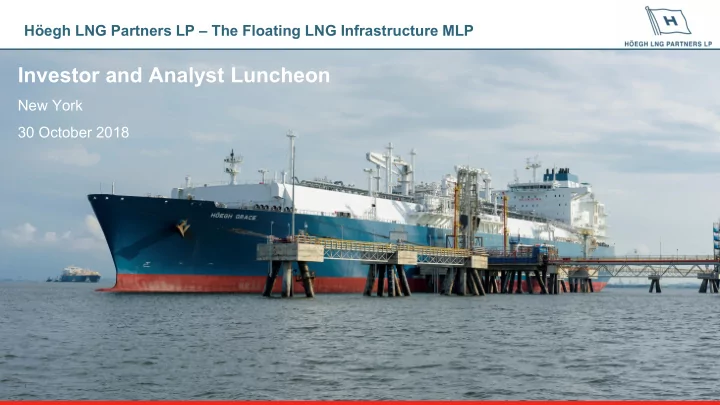
Investor and Analyst Luncheon New York 30 October 2018 1 Forward - - PowerPoint PPT Presentation
Hegh LNG Partners LP The Floating LNG Infrastructure MLP Investor and Analyst Luncheon New York 30 October 2018 1 Forward looking statements This presentation contains certain forward-looking statements concerning future events and our
1
2
This presentation contains certain forward-looking statements concerning future events and our operations, performance and financial condition. Forward-looking statements include, without limitation, any statement that may predict, forecast, indicate or imply future results, performance or achievements, and may contain the words “believe,” “anticipate,” “expect,” “estimate,” “project,” “future”, “will be,” “will continue,” “will likely result,” “plan,” “intend” or words or phrases of similar meanings. These statements involve known and unknown risks and are based upon a number of assumptions and estimates that are inherently subject to significant uncertainties and contingencies, many of which are beyond our control. Actual results may differ materially from those expressed or implied by such forward-looking statements. Important factors that could cause actual results to differ materially include, but are not limited to: market trends for FSRUs and LNG carriers, including hire rates and factors affecting supply and demand; the Partnership's distribution policy and ability to make cash distributions on the Partnership's units or any increases in the quarterly distributions on the Partnership's common units; restrictions in the Partnership's debt agreements and pursuant to local laws on the Partnership’s joint ventures' and subsidiaries' ability to make distributions; the Partnership's ability to settle or resolve the boil-off claim for the joint ventures, including the estimated amount thereof; the ability of Höegh LNG to satisfy its indemnification obligations to the Partnership, including in relation to the boil-off claim; the Partnership's ability to purchase additional vessels from Höegh LNG in the future; the Partnership's ability to integrate and realize the anticipated benefits from acquisitions; the Partnership's anticipated growth strategies; including the acquisition of vessels; the Partnership's anticipated receipt of dividends and repayment of indebtedness from subsidiaries and joint ventures; effects of volatility in global prices for crude oil and natural gas; the effect of the worldwide economic environment; turmoil in the global financial markets; fluctuations in currencies and interest rates; general market conditions, including fluctuations in hire rates and vessel values; changes in the Partnership's
condition liquidity and creditworthiness of the Partnership's existing or future customers and their ability to satisfy their obligations under the Partnership's contracts; the Partnership's ability to replace existing borrowings, including the Gallant/Grace facility, make additional borrowings and to access public equity and debt capital markets; planned capital expenditures and availability of capital resources to fund capital expenditures; the exercise of purchase options by the Partnership's customers; the Partnership's ability to perform under the Partnership's contracts and maintain long-term relationships with its customers; the Partnership's ability to leverage Höegh LNG's relationships and reputation in the shipping industry; the Partnership's continued ability to enter into long-term, fixed-rate charters and the hire rate thereof; the
vessels no longer under long-term charters; the Partnership's ability to compete successfully for future chartering and newbuilding opportunities; timely acceptance of the Partnership's vessels by their charterers; termination dates and extensions of charters; the cost of, and the Partnership's ability to comply with, governmental regulations and maritime self-regulatory organization standards, as well as standard regulations imposed by its charterers applicable to its business; demand in the FSRU sector or the LNG shipping sector in general and the demand for the Partnership's vessels in particular; availability of skilled labor, vessel crews and management; the ability of Höegh LNG to meet its financial obligations to the Partnership, including its indemnity, guarantee and option obligations; the Partnership's incremental general and administrative expenses as a publicly traded limited partnership and the Partnership's fees and expenses payable under the Partnership's ship management agreements, the technical information and services agreement and the administrative services agreements; the anticipated taxation of the Partnership, its subsidiaries and affiliates and distributions to its unitholders; estimated future maintenance and replacement capital expenditures; the Partnership's ability to retain key employees; customers' increasing emphasis on environmental and safety concerns; potential liability from any pending or future litigation; potential disruption of shipping routes due to accidents, political events, piracy or acts by terrorists; future sales of the Partnership's common units and Series A preferred units in the public market; the Partnership's business strategy and other plans and objectives for future operations; the Partnership's ability to successfully remediate any material weaknesses in its internal control over financial reporting and its disclosure controls and procedures; and other factors listed from time to time in the reports and other documents that we file with the SEC, including the Partnership's Annual Report on Form 20-F for the year ended December 31, 2017 and subsequent quarterly reports on Form 6-K. All forward-looking statements included in this presentation are made only as of the date of this presentation. New factors emerge from time to time, and it is not possible for the Partnership to predict all of these factors. Further, the Partnership cannot assess the impact of each such factor on its business or the extent to which any factor, or combination of factors, may cause actual results to be materially different from those contained in any forward-looking statement. The Partnership does not intend to release publicly any updates or revisions to any forward-looking statements contained herein to reflect any change in our expectations with respect thereto or any change in events, conditions or circumstances on which any such statement is based.
3
4
5
1) Distribution coverage ratio is for the quarter ended June 30, 2018and represents distributable cash flow divided by distributions declared 2) Segment EBITDA is a non-GAAP financial measures. See the Appendix for a reconciliation Segment EBITDA to net income, the most directly comparable GAAP financial measure. Annualized net income and Segment EBITDA is Segment EBITDA for the quarters ended March 31, 2018 and June 30, 2018 multiplied by two 3) Revenue backlog is calculated as HMLP’s share of the monthly hire rate for each vessel multiplied by the number of months remaining for each charter
6
7
8
9
10
11 1 Per million work hours
99.87% 99.70% 99.95% 99.94% 99.79% 100.00% >99.50%
2013 2014 2015 2016 2017 2018 YTD Target
1.07 0.44 0.73 0.00 0.38 0.00 <1.00
2013 2014 2015 2016 2017 2018 YTD Target
12
13
14
15
16
Source: BP Energy Outlook 2018
22 28 28
West Africa
12 13 11
N Africa
3 12 23
USA
14 14 16
S America
4 4 5
Europe
11 11 17
Russia
45 56 65
Australia
59 61 55
SE Asia 2016 2017 2018
94 91 96
MEG
Sources: GIIGNL, IHS Markit, 2018 based on annualized YTD data 17
18
− Initial capacity 14 mtpa with two trains: possibility to add another two trains − Expected to come on-line by 2025
− Developers Shell (40%), Petronas (25%) and Mitsubishi (15%) take on significant price and volume exposure − Fellow developers PetroChina and KOGAS (20% combined) to use LNG for domestic markets
− 4.5 mtpa capacity − Supported by foundation contracts
Sources: IHS Markit
19
7.7 7 9.3 10.7 5 7.5 10 12.5 2 4 6 8 10 12 14 US Gulf Canada NWE Japan USD 40 USD 60 USD 80 USD 100
USD per MMBtu
DES North East Asia Current spot Brent-indexed slope
Sources: IHS Markit, Platts
20
Source: Waterborne LNG / IHS Markit / Höegh LNG 2018 estimates based on YTD trade and historical seasonal movements in the fourth quarter
0% 5% 10% 15% 20% 25%
50 100 150 200 250 300 350 2010 2011 2012 2013 2014 2015 2016 2017 2018E million tonnes
RoW China China share, rhs
21 Sources: IHS Markit
50.7% 13.2% 6.6% 0.0% 10.0% 20.0% 30.0% 40.0% 50.0% 60.0%
0.0 0.5 1.0 1.5 2.0 2.5 3.0 3.5 4.0 4.5 5.0 Coal Oil Gas Bn tonnes oil equivalents
World total China ex HK China in % of world total, rhs
22
1 2 3 4 5 6 2016 2017 2018
million tonnes per month
Total imports Total nameplate capacity
Sources: IHS Markit
23
24
100 200 300 400 500 600 700 800 900 2000 2005 2010 2015 2020E 2025E 2030E 2035E 2040E
mtpa
JKT Europe China India Other Asia MENA S America RoW LNG Capacity
Source: IHS Markit
25
Source: IHS Markit, Höegh LNG
26
20 40 60 80 100 120 140 160 180 2011 2012 2013 2014 2015 2016 2017 2018 2019
'000 USD per day
Steam spot DFDE spot Long-term
Data source: IHS Markit
27
− BW LNGC-to-FSRU conversion − Maran Gas: 1x FSRU ordered, 1x FSRU order cancelled (LNGC) − Botas 1x FSRU for own project
8 8 5 2 1 2 1 1 2 1 2 4 6 8 10 12 Höegh LNG Excelerate Golar LNG BW Gas Other Single-purpose Units
Committed Available Committed NB Uncommitted NB
MOL Exmar Maran Dynagas Dynagas Gazprom Kol/Kal SWAN Java-1 OLT Botas
28
29
Unit Type Ownership Built Region Charterer 2018 2020 2022 2024 2026 2028 2030 2032 2034 2036 2038 Current HMLP Fleet Neptune FSRU 50% 2009 Turkey Total Cape Ann FSRU 50% 2010 India Total PGN FSRU Lampung FSRU 100% 2014 Indonesia PGN Höegh Gallant FSRU 100% 2014 WW trading EgyptCo/HLNG Höegh Grace FSRU 100% 2016 Colombia SPEC
Contracted Revenue Option
1 2 2 3 1) Economic interest; ownership interest 49% 2) Subsidiary of Total 3) Includes HMLP option to charter Höegh Gallant to HLNG at end of EgyptCo contract
PGN LNG Total Spec EgyptCo/HLNG
Asia Europe S America
30
Jaigarh, India Increase energy supply
Lampung, Indonesia Replacing expensive oil liquids in power generation
Aliaga, Turkey Meeting peak demand in energy consumption
Cartagena, Colombia Providing security of supply in periods of drought
Egypt/worldwide trading Balancing of trade, currently
31
1) Segment EBITDA and distributable cash flow are non-GAAP financial measures. Please see the Appendix for definitions of Segment EBITDA and distributable cash flow and a reconciliation of the comparable U.S. GAAP financial measure 2) Excludes principal payment on direct financing lease, amortization in revenues for above market contracts and equity in earnings of JVs: amortization for deferred revenue 3) Non-cash accrual related to boil-off-gas claim to be indemnified by HLNG 4) Distribution coverage ratio represents distributable cash flow divided by distributions declared
5 10 15 20 25 30 35 40 1Q152Q153Q154Q151Q162Q163Q164Q161Q172Q173Q174Q171Q182Q18
Indemnity 3
32
1) Proportionate share of net debt, i.e. includes 50% of JV net debt. Net debt is a non-GAAP financial measure , please see the Appendix for a definition of net debt and a reconciliation of net debt to the comparable US GAAP financial measure 2) Segment EBITDA is a non-GAAP financial measure. Please the Appendix for a definition of Segment EBITDA and a reconciliation of Segment EBITDA to net income, the comparable U.S. GAAP financial measure 3) Last Quarter Annualized
0.0x 1.0x 2.0x 3.0x 4.0x 5.0x 6.0x Dec 31, 2015 Dec 31, 2016 Dec 31, 2017 Jun 30, 2018
4) As of October 26 2018, reflecting outstanding common, subordinated and preferred units as of June 30, 2018 5) Total proportionate outstanding interesting bearing debt
33
50 100 150 200 250 IPO 2015 2016 2017 2018 USD million
Common equity Preference equity ATM Pre-funding of Höegh Gallant acquisition
Höegh Gallant acquisition
Source: InFront
1) Net proceeds to HMLP from IPO to 23 August 2018
34
Unit Type Ownership Built Region Charterer 2018 2020 2022 2024 2026 2028 2030 2032 2034 2036 2038 HLNG FSRU Fleet Independence FSRU 100% 2014 Lithuania KN Höegh Giant FSRU 100% 2017 WW trading Naturgy Höegh Esperanza FSRU 100% 2018 China CNOOC FSRU#9 FSRU 100% 2019 WW trading Naturgy FSRU#10 FSRU 100% 2019
Contracted Revenue Option
35
36
37
38
Segment EBITDA. EBITDA is defined as earnings before interest, depreciation and amortization and taxes. Segment EBITDA is defined as earnings before interest, depreciation and amortization, taxes and other financial items less non-controlling interest in Segment EBITDA. Other financial items consist of gains and losses on derivative instruments and other items, net (including foreign exchange gains and losses and withholding tax on interest expenses). Segment EBITDA is used as a supplemental financial measure by management and external users of financial statements, such as the Partnership's lenders, to assess its financial and operating performance. The Partnership believes that Segment EBITDA assists its management and investors by increasing the comparability of its performance from period to period and against the performance of other companies in the industry that provide Segment EBITDA information. This increased comparability is achieved by excluding the potentially disparate effects between periods or companies of interest, other financial items, depreciation and amortization and taxes, which items are affected by various and possibly changing financing methods, capital structure and historical cost basis and which items may significantly affect net income between periods. The Partnership believes that including Segment EBITDA as a financial and operating measure benefits investors in (a) selecting between investing in it and other investment alternatives and (b) monitoring its ongoing financial and
measures may vary among other companies. Therefore, Segment EBITDA as presented below may not be comparable to similarly titled measures of other companies. The following tables reconcile Segment EBITDA for each of the segments and the Partnership as a whole to net income (loss), the comparable U.S. GAAP financial measure, for the periods presented:
39
40
Three months ended June 30, 2018 Joint venture Majority FSRUs Total held (proportional Segment Elimin- Consolidated (in thousands of U.S. dollars) FSRUs consolidation) Other reporting ations reporting Time charter revenues $ 35,510 10,576 — 46,086 (10,576) (2) $ 35,510 Other revenue 1,100 — — 1,100 1,100 Total revenues 36,610 10,576 — 47,186 36,610 Operating expenses (6,383) (2,709) (1,180) (10,272) 2,709 (2) (7,563) Equity in earnings (losses) of joint ventures — — — — 5,111 (2) 5,111 Segment EBITDA (1) 30,227 7,867 (1,180) 36,914 Depreciation and amortization (5,268) (2,399) — (7,667) 2,399 (2) (5,268) Operating income (loss) 24,959 5,468 (1,180) 29,247 28,890 Gain (loss) on derivative instruments 544 2,967 — 3,511 (2,967) (2) 544 Other financial income (expense), net (6,839) (3,324) (785) (10,948) 3,324 (2) (7,624) Income (loss) before tax 18,664 5,111 (1,965) 21,810 — 21,810 Income tax benefit (expense) (1,845) — (21) (1,866) — (1,866) Net income (loss) $ 16,819 5,111 (1,986) 19,944 — $ 19,944 Preferred unitholders’ interest in net income — — — — 3,003 (3) 3,003 Limited partners' interest in net income (loss) $ 16,819 5,111 (1,986) 19,944 (3,003) (3) $ 16,941
(1) Segment EBITDA is a non-GAAP financial measure. For a definition of Segment EBITDA and reconciliations to net income, the most directly comparable US GAAP financial measure, please see the Appendix. (2) Eliminations reverse each of the income statement line items of the proportional amounts for joint venture FSRUs and record the Partnership's share of the joint venture FSRUs net income (loss) to Equity in earnings (loss) of joint ventures. (3) Allocates the preferred unitholders’ interest in net income to the preferred unitholders.
41
Distributable cash flow represents Segment EBITDA adjusted for cash collections on principal payments on the direct financing lease, amortization in revenues for above market contracts less non- controlling interest in amortization in revenues for above market contracts, non-cash revenue: tax paid directly by charterer less non-controlling interest: non-cash revenue, amortization of deferred revenues for the joint ventures, interest income, interest expense less amortization of debt issuance cost and fair value of debt assumed, other items (net), unrealized foreign exchange losses (gains), current income tax expense, net of uncertain tax position less non-cash income tax: tax paid directly by charterer, non-controlling interest in finance and tax items and other adjustments such as indemnification paid or to be paid by Höegh LNG for the non-cash boil-off accrual, non-budgeted expenses, losses and estimated maintenance, indemnified by, or refunded to HLNG, distributions of the Series A preferred units and replacement capital expenditures. Cash collections on the direct financing lease investment with respect to the PGN FSRU Lampung consist of the difference between the payments under time charter and the revenues recognized as a financing lease (representing the payment of the principal recorded as a receivable). Amortization in revenues for above market contracts consist of the non-cash amortization of the intangible for the above market time charter contract related to the acquisitions of the Höegh Gallant and Höegh
drydocking to the vessels. Non-cash revenue: tax paid directly by charterer and non-cash income tax: tax paid directly by charterer consists of certain taxes paid by the charterer directly to the Colombian tax authorities on behalf of the Partnership’s subsidiaries which is recorded as a component of time charter revenues and current income tax expenses. Estimated maintenance and replacement capital expenditures, including estimated expenditures for drydocking, represent capital expenditures required to maintain over the long-term the operating capacity of, or the revenue generated by, the Partnership's capital assets. Distributable cash flow is presented starting with Segment EBITDA taken from the total segment reporting using the proportional consolidation method for the Partnership's 50% interests in the joint ventures as shown in this Appendix. Therefore, the adjustments to Segment EBITDA include the Partnership's share of the joint venture's adjustments. The Partnership believes distributable cash flow is an important liquidity measure used by management and investors in publicly traded partnerships to compare cash generating performance of the Partnership’ cash generating assets from period to period by adjusting for cash and non-cash items that could potentially have a disparate effect between periods, and to compare the cash generating performance for specific periods to the cash distributions (if any) that are expected to be paid to unitholders. The Partnership also believes distributable cash flow benefits investors in comparing its cash generating performance to other companies that account for time charters as operating leases rather than financial leases, or that do not have non-cash amortization of intangibles or deferred revenue. Distributable cash flow is a non-GAAP liquidity measure and should not be considered as an alternative to net cash provided by operating activities, or any other measure of the Partnership's liquidity or cash flows calculated in accordance with GAAP. Distributable cash flow excludes some, but not all, items that affect net cash provided by operating activities and the measures may vary among companies. For example, distributable cash flow does not reflect changes in working capital balances. Distributable cash flow also includes some items that do not affect net cash provided by operating activities. Therefore, distributable cash flow may not be comparable to similarly titled measures of other companies. Distributable cash flow is not the same measure as available cash or operating surplus, both of which are defined by the Partnership's partnership agreement. The first table below reconciles distributable cash flow to Segment EBITDA, which is reconciled to net income, the most directly comparable GAAP measure for Segment EBITDA, in this Appendix. Refer to this Appendix for the definition of Segment EBITDA. The second table below reconciles distributable cash flow to net cash provided by operating activities, the most directly comparable GAAP measures for liquidity.
42
43
44
Net Debt. Net Debt is defined as long-term debt plus revolving credit and seller’s credit due to owners and affiliates net of cash and cash equivalents, restricted cash and cash designated for acquisition Net Debt is used as a supplemental financial measure used by management and external users of financial statements, such as the Partnership's lenders, to assess leverage. Net Debt is a non-GAAP financial measure and should not be considered an alternative to total debt or any other measure of liquidity presented in accordance with U.S. GAAP. The following tables reconcile Net Debt to total debt from which it is derived for the Partnership’s consolidated balance sheet and the balance sheet of its non-consolidated joint ventures, for the periods presented:
(in thousands of US dollars) Dec 31, 2015 Dec 31, 2016 Dec 31, 2017 Jun 30, 2018 Current portion of consolidated long-term debt 32,208 32,208 45,458 45,458 Consolidated long-term debt 330,635 300,440 434,845 412,479 Consolidated revolving credit and seller's credit due to owners and affiliates 47,000 43,005 51,832 45,292 Share of joint ventures' current portion of long-term debt 11,047 11,752 12,502 12,895 Share of joint ventures' long-term debt 238,551 226,979 214,654 208,193 Consolidated cash and cash equivalents - current portion (32,868) (18,915) (22,679) (20,980) Consolidated restricted cash - current portion (10,630) (8,055) (6,962) (5,958) Consolidated restricted cash - long-term portion (15,198) (14,154) (13,640) (13,404) Share of joint ventures' cash and cash equivalents (2,099) (4,753) (4,050) (2,504) Share of joint ventures' restricted cash - current portion (4,222) (4,229) (4,260) (7,685) Share of joint ventures' restricted cash - long-term portion (12,552) (12,554) (12,604) (12,662) Net interest-bearing debt 581,872 551,724 695,095 661,124 Segment EBITDA, LQA 102,796 103,384 134,808 147,656 Net debt/Segment EBITDA, LQA 5.7x 5.3x 5.2x 4.5x
45