Inverse dynamics forward Forces Motion Torques inverse - - PowerPoint PPT Presentation

inverse dynamics
SMART_READER_LITE
LIVE PREVIEW

Inverse dynamics forward Forces Motion Torques inverse - - PowerPoint PPT Presentation

Definition Inverse dynamics forward Forces Motion Torques inverse Definition Motivations Short version: A process of deriving the kinetics from the Understand and quantify the forces produced by kinematics of the motion muscles,


slide-1
SLIDE 1

Inverse dynamics

Definition

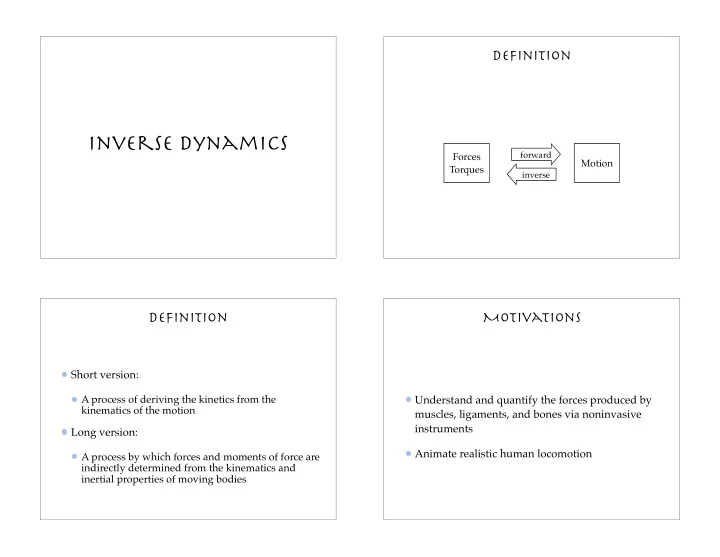
Forces Torques Motion

forward inverse

Definition

Short version:

A process of deriving the kinetics from the kinematics of the motion

Long version:

A process by which forces and moments of force are indirectly determined from the kinematics and inertial properties of moving bodies

Motivations

Understand and quantify the forces produced by muscles, ligaments, and bones via noninvasive instruments Animate realistic human locomotion

slide-2
SLIDE 2

Motion and force measurement

Need to record accurate kinematic properties of the motion

video or infrared based motion analysis systems

Need to measure the external forces precisely

force platforms that measures the ground reaction forces

Motion analysis

Interaction of muscle contractions across several joints is extremely complex Most invasive devices can only measure forces in single tissues

surgical stables buckle force transducers

Motion analysis

Inverse dynamics can only measure the net effect of the internal forces and torques across several joints Inverse dynamics can compute total load on a system, but can not determine the distribution of the load Inverse dynamics assumes there is no co- contraction of agonist and antagonist muscles

Joint kinetics

Equal in joint forces and moments, but completely different in muscle activities

slide-3
SLIDE 3

Model reduction

Reduce complex anatomical structures

F F F∗ F∗ −F∗ MF

Foot with muscle force F Forces and added at ankle center F∗ −F∗ Couple and

  • replaced by

moment −F∗ F MF

Model reduction

force from triceps surae ligament force bone-on-bone forces force from tibialis anterior gravity gravity ground contact force ground contact force

Fankle Mankle

Equation of motion

Given body kinematics and anthropometric parameters, derive the kinetics quantities using the Newton-Euler equations:

Newton (linear): Euler (angular):

Limitations

ID relies on assumption that are not always valid

joint friction and air friction non-uniform distribution of mass movement of joint center of rotation approximation of body segment parameters Measurement error and numerical error propagation