Introduction*To*Verilog*for* Combinational*Logic - - PDF document

introduction to verilog for combinational logic
SMART_READER_LITE
LIVE PREVIEW

Introduction*To*Verilog*for* Combinational*Logic - - PDF document

Introduction*To*Verilog*for* Combinational*Logic Verilog*is*a*language*used*for*simulation*and* synthesis*of*digital*logic. A*New*Extension*System*Verilog*also*Supports* new*features*including*Verification*of*Digital*Systems


slide-1
SLIDE 1

Introduction*To*Verilog*for* Combinational*Logic

  • Verilog*is*a*language*used*for*simulation*and*

synthesis*of*digital*logic.

  • A*New*Extension*“System*Verilog”*also*Supports*

new*features*including*Verification*of*Digital*Systems

  • A*Verilog*description*of*a*digital*system*can*be*

transformed*into*a*gate*level*implementation.*This* process*is*known*as*synthesis.

1

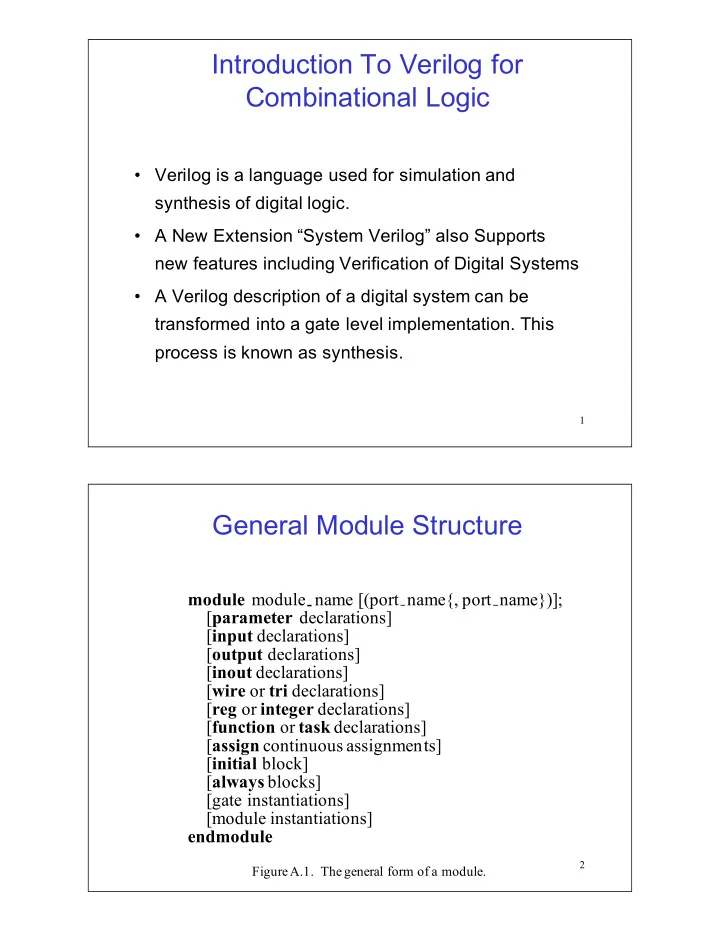
module module name [(port name{, port name})]; [parameter declarations] [input declarations] [output declarations] [inout declarations] [wire or tri declarations] [reg or integer declarations] [function or task declarations] [assign continuous assignmen ts] [initial block] [always blocks] [gate instantiations] [module instantiations] endmodule

Figure A.1. The general form of a module.

General*Module*Structure

2

slide-2
SLIDE 2

Verilog(Statements

  • We will only examine a subset of the language

– RTL – Synthesizable Portion

  • Some Verilog constructs:

– Signal Assignment: assign A = B; – Comparisons == (equal), > (greater than), < (less than), etc. – Boolean operations & (AND), | (OR), ~ (NOT), ^ (XOR) – Concurrent statements

  • Gate Instantiations:

and u1 (X, A, B);

  • Continuous Assignments

assign S = X & Y;

– Procedural (Sequential) statements

  • Evaluated in order in which written
  • Must be Contained in an always or initial block

3

Some*Verilog*Syntax

  • Approximately*100*keywords*(lowercase)

– Verilog*IS*caseNsensitive – Predefined*identifiers*Used*for*Basic*Language* Constructs

  • Comments*are:

– // to*end*of*line – /* comment here */

  • Simulator*Directives

– Technically*not*part*of*language,*but*Standard – Begin*with*a*$ – Example*$finish;

  • Simulator*Directives*not*used*for:

– Documentation – Synthesis

4

slide-3
SLIDE 3

Verilog*Keywords*(part*1)

*excerpt from IEEE 1364-2005 standard for academic use only

5

Verilog*Keywords*(part*2)

*excerpt from IEEE 1364-2005 standard for academic use only

6

slide-4
SLIDE 4

Some*Verilog*Operators

Reduction*Operators ~ negation & bitwise*AND | bitwise*OR ~& bitwise*NAND ~| bitwise*NOR ^ bitwise*XOR ~^ bitwise*XNOR ^~ bitwise*XNOR Arithmetic*Operators + unary*(sign)*plus

  • unary*(sign)*minus

+ binary*plus*(add)

  • binary*minus*(sub)

* multiply / divide % modulus Logical*Operators ! logical*negation == logical*equality != logical*inequality && logical*AND || logical*OR

7

Verilog*Values*and*Constants

Four*Basic*Values logicN0*or*false 1 logicN1*or*true x unknown*value z highNimpedance*(open) (z at*input*usually*treated*as*x) Constants integers reals strings _*can*be*embedded Specifying*Values Simple*Decimal

int,*real

Base*Format*Notation

int

Scientific

real

Double*Quotes

strings

8

slide-5
SLIDE 5

Base*Format*Notation*Examples

Format*is: [size (in bits)]’base value 5’O37 5Nbit*octal 4’D2 4Nbit*decimal 4’B1x_01 4Nbit*binary*(underscores*“_”*ignored) 7’Hx 7Nbit x (x extended) xxxxxxx 4’hZ 4Nbit z (z extended) zzzz 4’d-4 ILLEGAL:*value*cannot*be*negative 8 ’h 2A spaces*allowed*between*size*and ‘ and*between*base*and*value ’o721 9Nbit*octal ’hAF 8Nbit*hex 10’b10 10Nbit*padded*to*left 0000000010 10’bx0x1 10Nbit*padded*to*left xxxxxxx0x1 3’b1001_0011 same*as 3’b011 5’H0FFF same*as 5’H1F

9

Verilog*Data*Types

  • Net*Types*(eg.*wire)

– Represents*Physical*Connection*Between*Structural* Elements – Value*is*Determined*from*Value*of*Drivers

  • Continuous*assign Statement
  • Output*of*Gate*or*UDP*(User*Defined*Primitive)
  • If*no*Driver*is*Present,*Defaults*to*value*of*z
  • Register*Type*(eg.*reg)

– Abstract*Data*Storage*Element – Assigned*Values*Only*within*always or*initial statement – Does*not*ALWAYS*synthesize*to*storage*device – Value*is*Saved*from*one*Assignment*to*the*Next – Default*value*is*x

10

slide-6
SLIDE 6

Verilog*Data*Types

  • Net*Types

wire, tri N most*common,*default*is*z wor, trior N emulates*wiredNOR*with*mult.*drivers*(ECL*NOR) wand, triand N emulates*wiredNAND*with*mult.*drivers*(OCNTTL*NAND) trireg N stores*a*value*like*reg for*modeling*capacitive*nets tri1, tri0 N default*values*are*1(0) supply0,supply1 N used*to*model*power*connections*for*0*and*1*values

  • Register*Type

reg N most*common,*default*is*x integer N used*for*storing*integers,*typical*use*in*behavioral*model time N used*for*storing/manipulating*time*values real N used*storing*reals,*typical*use*in*behavioral*model realtime N same*as*real

11

4NValued*Net*Fanin*Tables

  • Two*Names*for*Same*Data*type

12

slide-7
SLIDE 7

Wired*Nets

  • Used*to*Model*Wired*Logic
  • Assumes*Equal*Strength*Drivers

13

Driver*Strength

  • Not*Used*in*this*Class*for*Synthesis*Purposes
  • Created*for*Accurate*Modeling*of*Devices*Such*as:

– signal*contention – bidirectional*pass*gates – resistive*MOS – dynamic*MOS – charge*sharing

  • strength0*part*of*net:

supply0 strong0 pull0 weak0 highz0

  • strength1*part*of*net:

supply1 strong1 pull1 weak1 highz1

  • In*contrast*to*9Nval.*logic*IEEE*std*1164*as*used*in*VHDL

14

slide-8
SLIDE 8

Busses*and*MultiNbit*Registers

  • Can*use*“arrayNtype”*Notation
  • Examples:

wire [2:0] Bname // A 3-bit bus called Bname reg [7:0] Accumulator // An 8-bit register named Accumulator

  • Suggestions

– Always*number*from*MSb*to*LSb – Matches*the*Radix*Power*in*Radix*Polynomial – Consistency*Helps*to*Avoid*Bugs

15

Busses*and*Instantiation

16

slide-9
SLIDE 9

Name Description Usage and f = (a · b and (f ,a,b,…) nand f = nand (f ,a,b,…)

  • r

f = (a + b + )

  • r (f ,a,b,…)

nor f = (a + b + ) nor(f ,a,b,…) xor f = (a ⊕ b ⊕ xor(f ,a,b,…) xnor f = (a ! b ! xnor(f ,a,b,…) not f = a not (f ,a) buf f = a buf (f ,a) notif0 f = (!e?a : 'bz) notif0 (f ,a,e) notif1 f = (e?a : 'bz) notif1(f ,a,e) buf0 f = (!e?a : 'bz) buf0 (f ,a,e) buf1 f = (e?a : 'bz) buf1(f ,a,e)

Table A.2. Verilog gates.

··· ) (a · b··· ) ··· ··· ··· ) ··· )

Verilog*Logic*Gate*Primitives

17

// Combinational Logic Circuit module maj_circ(Y, A, B, C); input A, B, C;

  • utput Y;

and U1 (x1,A,B); and U2 (x2,A,C); and U3 (x3,B,C);

  • r U4 (Y,x1,x2,x3);

endmodule

Example

18

slide-10
SLIDE 10

User*Defined*Primitives*(UDPs)

  • Keywords*and,*or,*not,*xor,*etc.*are*System*

Primitives

  • Can*Define*your*Own*Primitives*(UDPs)
  • Can*do*this*in*a*variety*of*ways*including*Truth*

Tables

  • Instead*of*module/endmodule use*the*keywords*

primitive/endprimitive

  • Only*one*output*and*must*be*listed*first
  • Keywords*table and*endtable used
  • Input*values*listed*in*order*with*a*:
  • Output*is*always*last*entry*followed*by*;

19

UDP*Verilog*Example

// User defined primitive (UDP) primitive crctp (x, A, B, C);

  • utput x;

input A, B, C; // Truth table for x(A,B,C)=Σ(0,2,4,6,7) table // A B C : x (note: this is a comment) 0 0 0 : 1; 0 0 1 : 0; 0 1 0 : 1; 0 1 1 : 0; 1 0 0 : 1; 1 0 1 : 0; 1 1 0 : 1; 1 1 1 : 1; endtable endprimitive // Instantiate primitive module declare_crctp; reg x,y,z; wire w; crctp (w, x, y, z); endmodule

20

slide-11
SLIDE 11

Boolean*Expressions*in*Verilog

  • Use*the*Continuous*Assignment*Statement

– Keyword*is*assign – Boolean*Operators*(normal*precedence):

& N AND | N OR ~ N NOT*(invert)

– When*in*Doubt*about*Precedence*Use* Parentheses

  • Previous*Example*as*Expression:

assign x = (A & B) | (~C);

21

Verilog*Assignment*Statements

22

slide-12
SLIDE 12

Assignment*Statement*Ordering

Sequential*Language N Program*Counter

  • r*Instruction*Pointer

N Static*Execution Event*Driven*Language N Event*Queue N Dynamic*Execution23

Verilog*Example

// Circuit specified with Boolean expressions module circuit_bln (x, y, A, B, C, D); input A,B,C,D;

  • utput x,y;

assign x = A | (B & C) | (~B & D); assign y = (~B & C) | (B & ~C & ~D); endmodule

Circuit Being Modeled A B C D x y

24

slide-13
SLIDE 13

Assignment*Statement*Problem

25