Introduction to Risk Management 1 INTRODUCTION TO RISK MANAGEMENT - - PowerPoint PPT Presentation

introduction to risk management
SMART_READER_LITE
LIVE PREVIEW

Introduction to Risk Management 1 INTRODUCTION TO RISK MANAGEMENT - - PowerPoint PPT Presentation

INTRODUCTION TO RISK MANAGEMENT Introduction to Risk Management 1 INTRODUCTION TO RISK MANAGEMENT Learning Objectives 1. What is risk? 2. Why is risk important? 3. What is risk management? 4. Who does what? 5. Keys to success 2


slide-1
SLIDE 1

INTRODUCTION TO RISK MANAGEMENT

1
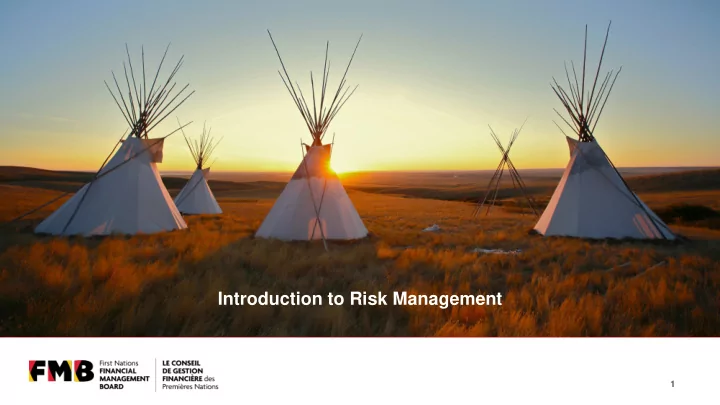
Introduction to Risk Management

slide-2
SLIDE 2

INTRODUCTION TO RISK MANAGEMENT

1. What is risk? 2. Why is risk important? 3. What is risk management? 4. Who does what? 5. Keys to success

2

Learning Objectives

slide-3
SLIDE 3

INTRODUCTION TO RISK MANAGEMENT

  • The possibility that a negative event will

happen

  • This negative event may prevent your First

Nation from achieving its objectives

3

  • 1. What is risk?
  • Bad things happen
  • We tend not to prepare

for them

  • We can anticipate them
  • We can be prepared
  • We can minimize their

impact

Reality Check

slide-4
SLIDE 4

INTRODUCTION TO RISK MANAGEMENT

4

  • 2. Why is risk important?

What keeps you up at night What should be keeping you up

slide-5
SLIDE 5

INTRODUCTION TO RISK MANAGEMENT

  • Because managing risks can help your First

Nation achieve its strategic objectives

5

  • 2. Why is risk important?
  • Risks can be opportunities
  • Managing risks =
  • Better results
  • Better decision-making
  • Better use of resources

Reality Check

slide-6
SLIDE 6

INTRODUCTION TO RISK MANAGEMENT

  • The framework to manage risks:
  • Which risks does my First Nation face?
  • What impact can they have?
  • What can be done about it?

6

  • 3. What is risk management?
  • Not all risks are equal
  • Different risks at

different levels in your First Nation Reality Check

slide-7
SLIDE 7

INTRODUCTION TO RISK MANAGEMENT

  • The process of increasing the chance

that your First Nation achieves its strategic vision, priorities and objectives.

  • 3. What is risk management?

Strategic & Departmental Planning Risk Management

Desired Future

Plans, activities and actions to achieve your desired future Management of risks and plans to reduce their impact

Priorities/Goals

How to get to your desired future

Risks

Events that could threaten your desired future

slide-8
SLIDE 8

INTRODUCTION TO RISK MANAGEMENT

8

  • 3. What is risk management?

Control Source

Good Rules Good Decisions

Level

  • Council and senior management level

concern

  • Threats to actual First Nation viability—

considered mission critical

Organizational

  • Finance & Audit Committee and

Departmental level concern

Financial

  • Departmental level concern

Operational

slide-9
SLIDE 9

INTRODUCTION TO RISK MANAGEMENT

  • The identification, evaluation, monitoring

and management

  • f risks.
  • 3. What is risk management?

Identify risks and possible impacts Monitor and report Evaluate the likelihood and impact of each risk Manage the risks

slide-10
SLIDE 10

INTRODUCTION TO RISK MANAGEMENT

  • The identification of risks

10

  • 3. What is risk management?

Identify risks and possible impacts Evaluate the likelihood and impact of each risk Monitor and report Manage the risks

slide-11
SLIDE 11

INTRODUCTION TO RISK MANAGEMENT

Phase 1 – Risk Statements

Identify which negative events can happen and what impact they can have.

11

  • 3. What is risk management?

Event Impact Not recording our stories and language Loss of our culture Lack of succession plans Loss of ‘corporate knowledge’ Delaying infrastructure/asset maintenance Infrastructure failure; Increased costs Funding shortfall due to discontinuation of grants Reduced or cut services to members Not linking cultural values to economic development activities Lack of community support for invest

slide-12
SLIDE 12

INTRODUCTION TO RISK MANAGEMENT

  • The evaluation of risks.

12

  • 3. What is risk management?

Evaluate the likelihood and impact of each risk Identify risks and possible impacts Monitor and report Manage the risks

slide-13
SLIDE 13

INTRODUCTION TO RISK MANAGEMENT

Phase 2 – Risk Register

List all of the Risk Statements and their potential impacts in a table called the Risk Register.

13

  • 3. What is risk management?

Event Impact Funding shortfall due to discontinuation of grants Reduced or cut services to members

slide-14
SLIDE 14

INTRODUCTION TO RISK MANAGEMENT

14

  • 3. What is risk management?

Phase 2 – Risk Register

Evaluate the Risk Statements according to likelihood and impact.

Define: Risk Statement Evaluate Event Impact Likelihood Score Impact Score Funding shortfall due to discontinuation of grants Reduced or cut services to members 3 4

slide-15
SLIDE 15

INTRODUCTION TO RISK MANAGEMENT

15

  • 3. What is risk management?

Phase 2 – Risk Register

Evaluate the Risk Statements according to likelihood and impact.

1 2 3 4 5

Impact

1 2 3 4 5

Likelihood

slide-16
SLIDE 16

INTRODUCTION TO RISK MANAGEMENT

  • The monitoring of risks.

16

  • 3. What is risk management?

Monitor and report Identify risks and possible impacts Evaluate the likelihood and impact of each risk Manage the risks

slide-17
SLIDE 17

INTRODUCTION TO RISK MANAGEMENT

17

  • 3. What is risk management?

Phase 3 – Risk Dashboard

Assess the Risk Dashboard (the self-populating table that consolidates the risk register from high to low impact and likelihood.)

3 2 1 2 1 1 1 3 2 2 2 1 1 1 1 1 1 1 1 Catastrophic Major Moderate Minor Insignificant LIKELIHOOD Rare Unlikely Possible Likely Almost Certain IMPACT

High impact and likelihood Moderate impact and likelihood Low impact and likelihood

slide-18
SLIDE 18

INTRODUCTION TO RISK MANAGEMENT

  • The management of risks.

18

  • 3. What is risk management?

Identify risks and possible impacts Evaluate the likelihood and impact of each risk Monitor and report Manage the risks

slide-19
SLIDE 19

INTRODUCTION TO RISK MANAGEMENT

19

  • 3. What is risk management?

Phase 4 – Risk Management Plan

Create a Risk Management Plan for only the prioritized risks (Orange and Red on the Risk Dashboard). Define: Risk Statement Evaluate Monitor and Manage Event Impact Likelihood Score Impact Score Risk Management Plan Funding shortfall due to discontinuation

  • f grants

Reduced or cut services to members 3 4 Reduce/ Mitigate: Develop other ways to fund the programs and use a portion

  • f own source revenues for core cultural

programs

slide-20
SLIDE 20

INTRODUCTION TO RISK MANAGEMENT

20

  • 3. What is risk management?

Phase 4 – Risk Management Plan Risk Management strategies involve:

No action is taken

Accept

Quit the activity

Avoidance

Transfer or share a portion of the risk

Share/Transfer

Engage in new activities to reduce the likelihood of the event happening

Reduction

slide-21
SLIDE 21

INTRODUCTION TO RISK MANAGEMENT

  • Different levels within the organization have different risk management

responsibilities:

21

  • 4. Who does what?

Chief and Council

  • Establish policies and procedures that manage risks of: fraud,

financial reporting, for-profit business activities, investments, insurance, loans, guarantees & indemnities, emergencies and technology.

  • Provide input into the risk assessment process and review and

approve Risk Management Plan annually.

slide-22
SLIDE 22

INTRODUCTION TO RISK MANAGEMENT

  • Different levels within the organization have different risk management

responsibilities:

22

  • 4. Who does what?

Finance & Audit Committee

  • Provide input into risk assessment process that includes

monitoring of financial reporting and fraud risks and effectiveness

  • f mitigating controls while considering costs.
  • Recommend Risk Management Plan to Chief and Council

annually and review Risk Management Plan on a quarterly basis to ensure risks are adequately identified and monitored.

slide-23
SLIDE 23

INTRODUCTION TO RISK MANAGEMENT

23

  • 4. Who does what?

Senior Manager

  • Manage the annual risk assessment process that includes the

identification, assessment, monitoring and reporting on risks, including financial reporting and fraud risks, and effectiveness of mitigating controls while considering costs.

  • Prepare Risk Management Plan and update on quarterly basis;

present Risk Management Plan to Finance & Audit Committee and provide progress updates on quarterly basis.

Different levels within the organization have different risk management responsibilities:

slide-24
SLIDE 24

INTRODUCTION TO RISK MANAGEMENT

24

  • 4. Who does what?

Senior Financial Officer

  • Develop and recommend procedures for identifying and

managing risks, including fraud and financial reporting risks, as part of annual Risk Management Plan.

  • Ensure approved procedures and activities are in place to

manage risks and report on these to Senior Manager on quarterly basis.

Different levels within the organization have different risk management responsibilities:

slide-25
SLIDE 25

INTRODUCTION TO RISK MANAGEMENT

25

  • 5. Keys to success

Risk strategies across the organization Risk Management Plan progress regularly Risk management approach across organization Monitoring and controls

  • f risks that matter most

Align Communicate Monitor Consistent

slide-26
SLIDE 26

INTRODUCTION TO RISK MANAGEMENT

26

  • 6. Questions
slide-27
SLIDE 27

INTRODUCTION TO RISK MANAGEMENT

27

Contact First Nations Financial Management Board

Phone: 1-877-925-6665 Website: www.fnfmb.com