Introduction to Liquid Crystals Denis Andrienko IMPRS school, Bad - - PowerPoint PPT Presentation

introduction to liquid crystals
SMART_READER_LITE
LIVE PREVIEW

Introduction to Liquid Crystals Denis Andrienko IMPRS school, Bad - - PowerPoint PPT Presentation

Liquid crystalline mesophases Short- and long-range ordering Phenomenological descriptions Literature Optical properties What are liquid crystals? Defects Simulation of liquid crystals Applications Introduction to Liquid Crystals Denis


slide-1
SLIDE 1

Liquid crystalline mesophases Short- and long-range ordering Phenomenological descriptions Optical properties Defects Simulation of liquid crystals Applications Literature What are liquid crystals?

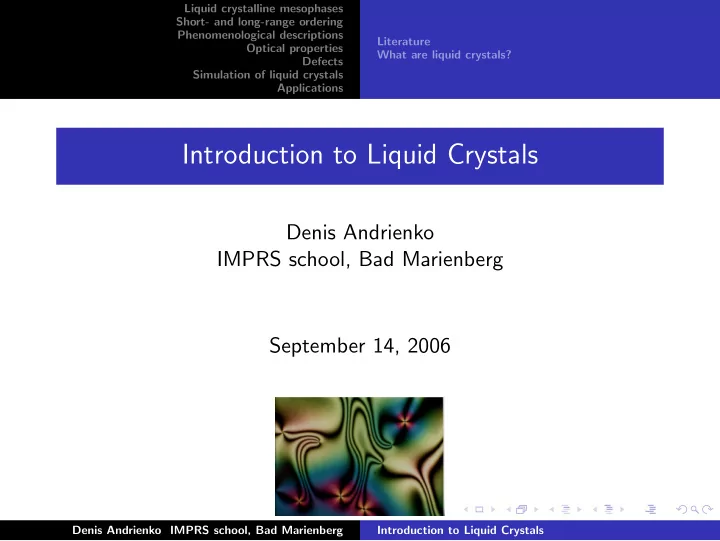
Introduction to Liquid Crystals

Denis Andrienko IMPRS school, Bad Marienberg September 14, 2006

Denis Andrienko IMPRS school, Bad Marienberg Introduction to Liquid Crystals

slide-2
SLIDE 2

Liquid crystalline mesophases Short- and long-range ordering Phenomenological descriptions Optical properties Defects Simulation of liquid crystals Applications Literature What are liquid crystals? Literature What are liquid crystals? Liquid crystalline mesophases Nematics Cholesterics Smectics Molecular arrangement Columnar phases Short- and long-range ordering Order tensor Properties of the order tensor Director Phenomenological descriptions Landau-de Gennes theory Frank-Oseen free energy One elastic constant approximation Nematic-isotropic transition Response to external fields Frederiks transition Optical properties Nematics Colors Cholesterics Defects Linear defects Interaction of defects Nematic colloids Simulation of liquid crystals Forces, torques and gorques Gay-Berne potential Phase diagrams Nematic colloids Applications Liquid Crystal Displays Liquid Crystal Thermometers Polymer dispersed liquid crystals Denis Andrienko IMPRS school, Bad Marienberg Introduction to Liquid Crystals

slide-3
SLIDE 3

Liquid crystalline mesophases Short- and long-range ordering Phenomenological descriptions Optical properties Defects Simulation of liquid crystals Applications Literature What are liquid crystals?

Recommended books

Many excellent books/reviews have been published covering various aspects of liquid crystals. Among them: 1. The bible on liquid crystals: P. G. de Gennes and J. Prost “The Physics of Liquid Crystals”. 2. Excellent review of basic properties (many topics below are taken from this review): M. J. Stephen, J. P. Straley “Physics of liquid crystals”. 3. Symmetries, hydrodynamics, theory: P. M. Chaikin and T. C. Lubensky “Principles of Condensed Matter Physics”. 4. Defects: Oleg Lavrentovich “Defects in Liquid Crystals: Computer Simulations, Theory and Experiments”. 5. Optics: Iam-Choon Khoo, Shin-Tson Wu, “Optics and Nonlinear Optics of Liquid Crystals”. 6. Textures: Ingo Dierking “Textures of Liquid Crystals”. 7. Simulations: Michael P. Allen and Dominic J. Tildesley “Computer simulation of liquids”. 8. Phenomenological theories: Epifanio G. Virga “Variational Theories for Liquid Crystals”. Finally, the pdf file of the lecture notes can be downloaded from http://www.mpip-mainz.mpg.de:/∼andrienk/lectures/IMPRS/liquid crystals.pdf. Denis Andrienko IMPRS school, Bad Marienberg Introduction to Liquid Crystals

slide-4
SLIDE 4

Liquid crystalline mesophases Short- and long-range ordering Phenomenological descriptions Optical properties Defects Simulation of liquid crystals Applications Literature What are liquid crystals?

What are Liquid Crystals?

The name suggests that it is a state of a matter in between the liquid and the crystal.

◮ Liquid

  • Fluidity
  • Inability to support shear
  • Formation and coalescence of droplets

◮ Solid

  • Anisotropy in optical, electrical, and magnetic properties
  • Periodic arrangement of molecules in one spatial direction

Denis Andrienko IMPRS school, Bad Marienberg Introduction to Liquid Crystals

slide-5
SLIDE 5

Liquid crystalline mesophases Short- and long-range ordering Phenomenological descriptions Optical properties Defects Simulation of liquid crystals Applications Literature What are liquid crystals?

What are Liquid Crystals?

The name suggests that it is a state of a matter in between the liquid and the crystal.

◮ Liquid

  • Fluidity
  • Inability to support shear
  • Formation and coalescence of droplets

◮ Solid

  • Anisotropy in optical, electrical, and magnetic properties
  • Periodic arrangement of molecules in one spatial direction

Denis Andrienko IMPRS school, Bad Marienberg Introduction to Liquid Crystals

slide-6
SLIDE 6

Liquid crystalline mesophases Short- and long-range ordering Phenomenological descriptions Optical properties Defects Simulation of liquid crystals Applications Nematics Cholesterics Smectics Molecular arrangement Columnar phases

Typical textures

Figure: (a) Schlieren texture. (b) Thin nematic film on isotropic surface. (c) Nematic thread-like texture.

“Nematic” comes from the Greek word for “thread”.

Denis Andrienko IMPRS school, Bad Marienberg Introduction to Liquid Crystals

slide-7
SLIDE 7

Liquid crystalline mesophases Short- and long-range ordering Phenomenological descriptions Optical properties Defects Simulation of liquid crystals Applications Nematics Cholesterics Smectics Molecular arrangement Columnar phases

Typical compounds

From a rough steric point of view, this is a rigid rod of length ∼ 20˚ A and width ∼ 5˚ A.

Denis Andrienko IMPRS school, Bad Marienberg Introduction to Liquid Crystals

slide-8
SLIDE 8

Liquid crystalline mesophases Short- and long-range ordering Phenomenological descriptions Optical properties Defects Simulation of liquid crystals Applications Nematics Cholesterics Smectics Molecular arrangement Columnar phases

Typical textures

Figure: (a) Fingerprint texture. (b) Grandjean or standing helix texture (c) DNA mesophases

Denis Andrienko IMPRS school, Bad Marienberg Introduction to Liquid Crystals

slide-9
SLIDE 9

Liquid crystalline mesophases Short- and long-range ordering Phenomenological descriptions Optical properties Defects Simulation of liquid crystals Applications Nematics Cholesterics Smectics Molecular arrangement Columnar phases

Typical textures

Figure: (a,b) Focal-conic fan texture of a chiral smectic A liquid crystal (c) Focal-conic fan texture of a chiral smectic C liquid crystal.

Denis Andrienko IMPRS school, Bad Marienberg Introduction to Liquid Crystals

slide-10
SLIDE 10

Liquid crystalline mesophases Short- and long-range ordering Phenomenological descriptions Optical properties Defects Simulation of liquid crystals Applications Nematics Cholesterics Smectics Molecular arrangement Columnar phases

Molecular arrangement

Figure: The arrangement of molecules in liquid crystal phases.

(a) The nematic phase. The molecules tend to have the same alignment but their positions are not correlated. (b) The cholesteric phase. The molecules tend to have the same alignment which varies regularly through the medium with a periodicity distance p/2. (c) smectic A phase. The molecules tend to lie in the planes with no configurational order within the planes and to be oriented perpendicular to the planes. Denis Andrienko IMPRS school, Bad Marienberg Introduction to Liquid Crystals

slide-11
SLIDE 11

Liquid crystalline mesophases Short- and long-range ordering Phenomenological descriptions Optical properties Defects Simulation of liquid crystals Applications Nematics Cholesterics Smectics Molecular arrangement Columnar phases

Molecular arrangement

Figure: The arrangement of molecules in liquid crystal phases.

(a) The nematic phase. The molecules tend to have the same alignment but their positions are not correlated. (b) The cholesteric phase. The molecules tend to have the same alignment which varies regularly through the medium with a periodicity distance p/2. (c) smectic A phase. The molecules tend to lie in the planes with no configurational order within the planes and to be oriented perpendicular to the planes. Denis Andrienko IMPRS school, Bad Marienberg Introduction to Liquid Crystals

slide-12
SLIDE 12

Liquid crystalline mesophases Short- and long-range ordering Phenomenological descriptions Optical properties Defects Simulation of liquid crystals Applications Nematics Cholesterics Smectics Molecular arrangement Columnar phases

Molecular arrangement

Figure: The arrangement of molecules in liquid crystal phases.

(a) The nematic phase. The molecules tend to have the same alignment but their positions are not correlated. (b) The cholesteric phase. The molecules tend to have the same alignment which varies regularly through the medium with a periodicity distance p/2. (c) smectic A phase. The molecules tend to lie in the planes with no configurational order within the planes and to be oriented perpendicular to the planes. Denis Andrienko IMPRS school, Bad Marienberg Introduction to Liquid Crystals

slide-13
SLIDE 13

Liquid crystalline mesophases Short- and long-range ordering Phenomenological descriptions Optical properties Defects Simulation of liquid crystals Applications Nematics Cholesterics Smectics Molecular arrangement Columnar phases

Typical textures

Figure: (a) hexagonal columnar phase Colh (with typical spherulitic texture); (b) Rectangular phase of a discotic liquid crystal (c) hexagonal columnar liquid-crystalline phase.

Denis Andrienko IMPRS school, Bad Marienberg Introduction to Liquid Crystals

slide-14
SLIDE 14

Liquid crystalline mesophases Short- and long-range ordering Phenomenological descriptions Optical properties Defects Simulation of liquid crystals Applications Nematics Cholesterics Smectics Molecular arrangement Columnar phases

Typical structures

Figure: Typical discotics: derivative of a hexabenzocoronene and 2,3,6,7,10,11-hexakishexyloxytriphenylene. K(70K) → Colh(100K) → I.

Denis Andrienko IMPRS school, Bad Marienberg Introduction to Liquid Crystals

slide-15
SLIDE 15

Liquid crystalline mesophases Short- and long-range ordering Phenomenological descriptions Optical properties Defects Simulation of liquid crystals Applications Nematics Cholesterics Smectics Molecular arrangement Columnar phases

Molecular arrangement

Figure: (1) Columnar phase formed by the disc-shaped molecules and the most common arrangements of columns in two-dimensional lattices: (a) hexagonal, (b) rectangular, and (c) herringbone. (2,3) MD simulation results: snapshot of the hexabenzocoronene system with the C12 side chains.

Denis Andrienko IMPRS school, Bad Marienberg Introduction to Liquid Crystals

slide-16
SLIDE 16

Liquid crystalline mesophases Short- and long-range ordering Phenomenological descriptions Optical properties Defects Simulation of liquid crystals Applications Order tensor Properties of the order tensor Director

Definition of the order tensor

Figure: A unit vector u(i) along the axis of ith molecule describes its

  • rientation. The director n shows the average alignment.

Sαβ(r) = 1 N

  • i
  • u(i)

α u(i) β − 1

3δαβ

  • Denis Andrienko IMPRS school, Bad Marienberg

Introduction to Liquid Crystals

slide-17
SLIDE 17

Liquid crystalline mesophases Short- and long-range ordering Phenomenological descriptions Optical properties Defects Simulation of liquid crystals Applications Order tensor Properties of the order tensor Director

Properties of the order tensor

  • 1. Sαβ is a symmetric tensor since u(i)

α u(i) β = u(i) β u(i) α and

δαβ = δβα: Sαβ = Sβα

  • 2. It is traceless

TrSαβ =

  • α=(x,y,z)

Sαα = 1 N

  • i
  • (u(i)

x )2 + (u(i) y )2 + (u(i) z )2 − 1

33

  • = 0,

since u is a unit vector.

  • 3. Two previous properties (symmetries) reduce the number of

independent components (3 by 3 matrix) from 9 to 5.

Denis Andrienko IMPRS school, Bad Marienberg Introduction to Liquid Crystals

slide-18
SLIDE 18

Liquid crystalline mesophases Short- and long-range ordering Phenomenological descriptions Optical properties Defects Simulation of liquid crystals Applications Order tensor Properties of the order tensor Director

Properties of the order tensor

  • 1. Sαβ is a symmetric tensor since u(i)

α u(i) β = u(i) β u(i) α and

δαβ = δβα: Sαβ = Sβα

  • 2. It is traceless

TrSαβ =

  • α=(x,y,z)

Sαα = 1 N

  • i
  • (u(i)

x )2 + (u(i) y )2 + (u(i) z )2 − 1

33

  • = 0,

since u is a unit vector.

  • 3. Two previous properties (symmetries) reduce the number of

independent components (3 by 3 matrix) from 9 to 5.

Denis Andrienko IMPRS school, Bad Marienberg Introduction to Liquid Crystals

slide-19
SLIDE 19

Liquid crystalline mesophases Short- and long-range ordering Phenomenological descriptions Optical properties Defects Simulation of liquid crystals Applications Order tensor Properties of the order tensor Director

Properties of the order tensor

  • 1. Sαβ is a symmetric tensor since u(i)

α u(i) β = u(i) β u(i) α and

δαβ = δβα: Sαβ = Sβα

  • 2. It is traceless

TrSαβ =

  • α=(x,y,z)

Sαα = 1 N

  • i
  • (u(i)

x )2 + (u(i) y )2 + (u(i) z )2 − 1

33

  • = 0,

since u is a unit vector.

  • 3. Two previous properties (symmetries) reduce the number of

independent components (3 by 3 matrix) from 9 to 5.

Denis Andrienko IMPRS school, Bad Marienberg Introduction to Liquid Crystals

slide-20
SLIDE 20

Liquid crystalline mesophases Short- and long-range ordering Phenomenological descriptions Optical properties Defects Simulation of liquid crystals Applications Order tensor Properties of the order tensor Director

Properties of the order tensor

  • 4. In the isotropic phase Siso

αβ = 0.

ux = sin θ cos φ, uy = sin θ sin φ, uz = cos θ. Sαβ = 2π dφ π sin θdθP(θ, φ)

  • uαuβ − 1

3δαβ

  • ,

Sxy = Syz = Szx = 0 because of the integration over φ. For the Szz component we obtain Szz = 2 2π dφ π/2 sin θdθP(θ, φ)

  • cos2 θ − 1

3

  • =

4πPiso 1

  • cos2 θ − 1

3

  • d(cos θ) = 2

3π (x3 − x)

  • 1

0 = 0.

Denis Andrienko IMPRS school, Bad Marienberg Introduction to Liquid Crystals

slide-21
SLIDE 21

Liquid crystalline mesophases Short- and long-range ordering Phenomenological descriptions Optical properties Defects Simulation of liquid crystals Applications Order tensor Properties of the order tensor Director

Properties of the order tensor

  • 5. In a perfectly aligned nematic (with the molecules along the z

axis), prolate geometry Sprolate =   −1/3 −1/3 2/3   . To prove this it is sufficient to calculate only the Szz component: Szz = uzuz − 1/3 = 1 − 1/3 = 2/3. Keeping in mind that S is symmetric and traceless we

  • btain (1).

Denis Andrienko IMPRS school, Bad Marienberg Introduction to Liquid Crystals

slide-22
SLIDE 22

Liquid crystalline mesophases Short- and long-range ordering Phenomenological descriptions Optical properties Defects Simulation of liquid crystals Applications Order tensor Properties of the order tensor Director

Properties of the order tensor

  • 6. In a perfectly aligned oblate geometry (uz = 0)

Soblate =   1/6 1/6 −1/3   . Try to follow previous arguments and show this!

Denis Andrienko IMPRS school, Bad Marienberg Introduction to Liquid Crystals

slide-23
SLIDE 23

Liquid crystalline mesophases Short- and long-range ordering Phenomenological descriptions Optical properties Defects Simulation of liquid crystals Applications Order tensor Properties of the order tensor Director

Definition of the director

In general, any symmetric second-order tensor has 3 real eigenvalues and three corresponding orthogonal eigenvectors. (Recall gyration tensor or mass and inertia tensor). For a uniaxial nematic phase two smaller eigenvalues are equal Sαβ = S

  • nαnβ − 1

3δαβ

  • Vector n is called a director.

In the isotropic phase S = 0, in the nematic phase 0 < S < 1. S = 1 corresponds to perfect alignment of all the molecules.

Denis Andrienko IMPRS school, Bad Marienberg Introduction to Liquid Crystals

slide-24
SLIDE 24

Liquid crystalline mesophases Short- and long-range ordering Phenomenological descriptions Optical properties Defects Simulation of liquid crystals Applications Landau-de Gennes theory Frank-Oseen free energy One elastic constant approximation Nematic-isotropic transition Response to external fields Frederiks transition

Problem

We would like to describe:

◮ isotropic to nematic transition ◮ inhomogeneous systems ◮ influence of external factors (boundaries, fields)

To do this, we need to write down a free energy of our system. There are of course several ways (levels) of doing it.

Denis Andrienko IMPRS school, Bad Marienberg Introduction to Liquid Crystals

slide-25
SLIDE 25

Liquid crystalline mesophases Short- and long-range ordering Phenomenological descriptions Optical properties Defects Simulation of liquid crystals Applications Landau-de Gennes theory Frank-Oseen free energy One elastic constant approximation Nematic-isotropic transition Response to external fields Frederiks transition

Landau-de Gennes free energy

To the extent that Sαβ is a small parameter, we may expand the free energy density g(P, T, Sαβ) in power series g = gi + 1 2ASαβSαβ − 1 3BSαβSβγSγα + 1 4CSαβSαβSγδSγδ This model equation of state predicts a phase transition near the temperature where A vanishes A = A′ (T − T ∗) .

Denis Andrienko IMPRS school, Bad Marienberg Introduction to Liquid Crystals

slide-26
SLIDE 26

Liquid crystalline mesophases Short- and long-range ordering Phenomenological descriptions Optical properties Defects Simulation of liquid crystals Applications Landau-de Gennes theory Frank-Oseen free energy One elastic constant approximation Nematic-isotropic transition Response to external fields Frederiks transition

Elastic part of the free energy

If we consider a nematic liquid crystal in which the order parameter is slowly varying in space, the free energy will also contain terms which depend on the gradient of the order parameter. These terms must be scalars and consistent with the symmetry of a nematic ge = 1 2L1 ∂Sij ∂xk ∂Sij ∂xk + 1 2L2 ∂Sij ∂xj ∂Sik ∂xk We will refer to the constants L1 and L2 as elastic constants.

Denis Andrienko IMPRS school, Bad Marienberg Introduction to Liquid Crystals

slide-27
SLIDE 27

Liquid crystalline mesophases Short- and long-range ordering Phenomenological descriptions Optical properties Defects Simulation of liquid crystals Applications Landau-de Gennes theory Frank-Oseen free energy One elastic constant approximation Nematic-isotropic transition Response to external fields Frederiks transition

Curvature strains and stresses

The question we would like to address here is: how much energy will it take to deform the director filed? We will refer to the deformation of relative orientations away from equilibrium position as curvature strains. The restoring forces which arise to oppose these deformations we will call curvature stresses or torques. The six components of curvature are defined as splay s1 = ∂nx ∂x , s2 = ∂ny ∂y twist t1 = −∂ny ∂x , t2 = ∂nx ∂y bend b1 = ∂nx ∂z , b2 = ∂ny ∂z

Denis Andrienko IMPRS school, Bad Marienberg Introduction to Liquid Crystals

slide-28
SLIDE 28

Liquid crystalline mesophases Short- and long-range ordering Phenomenological descriptions Optical properties Defects Simulation of liquid crystals Applications Landau-de Gennes theory Frank-Oseen free energy One elastic constant approximation Nematic-isotropic transition Response to external fields Frederiks transition

Curvature strains and stresses

These three curvature strains can also be defined by expanding n(r) in a Taylor series in powers of x, y, z measured from the origin nx(r) = s1x + t2y + b1z + O(r2), ny(r) = −t1x + s2y + b2z + O(r2), nz(r) = 1 + O(r2).

Denis Andrienko IMPRS school, Bad Marienberg Introduction to Liquid Crystals

slide-29
SLIDE 29

Liquid crystalline mesophases Short- and long-range ordering Phenomenological descriptions Optical properties Defects Simulation of liquid crystals Applications Landau-de Gennes theory Frank-Oseen free energy One elastic constant approximation Nematic-isotropic transition Response to external fields Frederiks transition

Frank-Oseen free energy

We now postulate that the Gibbs free energy density g of a liquid crystal, relative to its free energy density in the state of uniform

  • rientation can be expanded in terms of six curvature strains

g =

6

  • i=1

kiai + 1 2

6

  • i,j=1

kijaiaj where the ki and kij = kji are the curvature elastic constants and for convenience in notation we have put a1 = s1, a2 = t2, a3 = b1, a4 = −t1, a5 = s2, a6 = b2.

Denis Andrienko IMPRS school, Bad Marienberg Introduction to Liquid Crystals

slide-30
SLIDE 30

Liquid crystalline mesophases Short- and long-range ordering Phenomenological descriptions Optical properties Defects Simulation of liquid crystals Applications Landau-de Gennes theory Frank-Oseen free energy One elastic constant approximation Nematic-isotropic transition Response to external fields Frederiks transition

Symmetries

There are several symmetries which will reduce the number of the elastic constants in this expansion

  • 1. Uniaxial crystal (a rotation about the z axis does not change

free energy). Out of the thirty-six kij, only five are independent.

  • 2. For nonpolar molecules, the choice of the sign of n is arbitrary.

n → −n, x → x, y → −y, z → −z. k1 = k12 = 0 (nonpolar).

  • 3. In the absence of enantiomorphism (chiral molecules)

x → x, y → −y, z → z. k2 = k12 = 0 (mirror symmetry).

Denis Andrienko IMPRS school, Bad Marienberg Introduction to Liquid Crystals

slide-31
SLIDE 31

Liquid crystalline mesophases Short- and long-range ordering Phenomenological descriptions Optical properties Defects Simulation of liquid crystals Applications Landau-de Gennes theory Frank-Oseen free energy One elastic constant approximation Nematic-isotropic transition Response to external fields Frederiks transition

Symmetries

There are several symmetries which will reduce the number of the elastic constants in this expansion

  • 1. Uniaxial crystal (a rotation about the z axis does not change

free energy). Out of the thirty-six kij, only five are independent.

  • 2. For nonpolar molecules, the choice of the sign of n is arbitrary.

n → −n, x → x, y → −y, z → −z. k1 = k12 = 0 (nonpolar).

  • 3. In the absence of enantiomorphism (chiral molecules)

x → x, y → −y, z → z. k2 = k12 = 0 (mirror symmetry).

Denis Andrienko IMPRS school, Bad Marienberg Introduction to Liquid Crystals

slide-32
SLIDE 32

Liquid crystalline mesophases Short- and long-range ordering Phenomenological descriptions Optical properties Defects Simulation of liquid crystals Applications Landau-de Gennes theory Frank-Oseen free energy One elastic constant approximation Nematic-isotropic transition Response to external fields Frederiks transition

Symmetries

There are several symmetries which will reduce the number of the elastic constants in this expansion

  • 1. Uniaxial crystal (a rotation about the z axis does not change

free energy). Out of the thirty-six kij, only five are independent.

  • 2. For nonpolar molecules, the choice of the sign of n is arbitrary.

n → −n, x → x, y → −y, z → −z. k1 = k12 = 0 (nonpolar).

  • 3. In the absence of enantiomorphism (chiral molecules)

x → x, y → −y, z → z. k2 = k12 = 0 (mirror symmetry).

Denis Andrienko IMPRS school, Bad Marienberg Introduction to Liquid Crystals

slide-33
SLIDE 33

Liquid crystalline mesophases Short- and long-range ordering Phenomenological descriptions Optical properties Defects Simulation of liquid crystals Applications Landau-de Gennes theory Frank-Oseen free energy One elastic constant approximation Nematic-isotropic transition Response to external fields Frederiks transition

Frank-Oseen free energy

g = 1 2k11(∇ · n)2 + 1 2k22(n · curl n + t0)2 + 1 2k33(n × curl n)2 This is the famous Frank-Oseen elastic free energy density for nematics and cholesterics.

Figure: The three distinct curvature strains of a liquid crystal: (a) splay, (b) twist, and (c) bend.

Denis Andrienko IMPRS school, Bad Marienberg Introduction to Liquid Crystals

slide-34
SLIDE 34

Liquid crystalline mesophases Short- and long-range ordering Phenomenological descriptions Optical properties Defects Simulation of liquid crystals Applications Landau-de Gennes theory Frank-Oseen free energy One elastic constant approximation Nematic-isotropic transition Response to external fields Frederiks transition

One elastic constant approximation

For the purpose of qualitative calculations it is sometimes useful to consider a nonpolar, nonenatiomorphic liquid crystal whose bend, splay, and twist constants are equal (one-constant approximation) k11 = k22 = k33 = k. The free energy density for this theoretician’s substance is g = 1 2k

  • (∇ · n)2 + (∇ × n)2

.

Denis Andrienko IMPRS school, Bad Marienberg Introduction to Liquid Crystals

slide-35
SLIDE 35

Liquid crystalline mesophases Short- and long-range ordering Phenomenological descriptions Optical properties Defects Simulation of liquid crystals Applications Landau-de Gennes theory Frank-Oseen free energy One elastic constant approximation Nematic-isotropic transition Response to external fields Frederiks transition

Landau-de Gennes picture

Substituting Sαβ = S

  • nαnβ − 1

3δαβ

  • into Landau-de Gennes free energy we obtain

g = gi + 1 3AS2 − 2 27BS3 + 1 9CS4. The equilibrium value of S is that which gives the minimum value for the free energy.

Denis Andrienko IMPRS school, Bad Marienberg Introduction to Liquid Crystals

slide-36
SLIDE 36

Liquid crystalline mesophases Short- and long-range ordering Phenomenological descriptions Optical properties Defects Simulation of liquid crystals Applications Landau-de Gennes theory Frank-Oseen free energy One elastic constant approximation Nematic-isotropic transition Response to external fields Frederiks transition

Equilibrium order parameter

Figure: Landau theory: dependence of the Gibbs free energy density on the order parameter. The case of the three special temperatures, T ∗∗, Tc, and T ∗ are shown. For illustration we use A = B = C = 1.

Denis Andrienko IMPRS school, Bad Marienberg Introduction to Liquid Crystals

slide-37
SLIDE 37

Liquid crystalline mesophases Short- and long-range ordering Phenomenological descriptions Optical properties Defects Simulation of liquid crystals Applications Landau-de Gennes theory Frank-Oseen free energy One elastic constant approximation Nematic-isotropic transition Response to external fields Frederiks transition

Equilibrium order parameter

The minima of the free energy are S = isotropic phase (1) S = (B/4C)[1 + (1 − 24β)1/2] nematic phase, where β = AC/B2. The transition temperature Tc will be such that the free energies

  • f isotropic and nematic phases are equal

βc = 1 27; Tc = T ∗ + 1 27 B2 A′C . Above Tc the isotropic phase is stable; below Tc the nematic is stable.

Denis Andrienko IMPRS school, Bad Marienberg Introduction to Liquid Crystals

slide-38
SLIDE 38

Liquid crystalline mesophases Short- and long-range ordering Phenomenological descriptions Optical properties Defects Simulation of liquid crystals Applications Landau-de Gennes theory Frank-Oseen free energy One elastic constant approximation Nematic-isotropic transition Response to external fields Frederiks transition

Magnetic and dielectric susceptibilities

The magnetic susceptibility of a liquid crystal, owing to the anisotropic form of the molecules composing it, is also anisotropic. The susceptibility tensor takes the form χij = χ⊥δij + χaninj, where χa = χ − χ⊥ is the anisotropy and is generally positive. The presence of a magnetic field H leads to an extra term in the free energy of gm = −1 2χ⊥H2 − 1 2χa(n · H)2.

Denis Andrienko IMPRS school, Bad Marienberg Introduction to Liquid Crystals

slide-39
SLIDE 39

Liquid crystalline mesophases Short- and long-range ordering Phenomenological descriptions Optical properties Defects Simulation of liquid crystals Applications Landau-de Gennes theory Frank-Oseen free energy One elastic constant approximation Nematic-isotropic transition Response to external fields Frederiks transition

Geometry

Figure: Frederiks transition. The liquid crystal is constrained to be perpendicular to the boundary surfaces and a magnetic field is applied in the direction shown. (a) Below a certain critical field Hc, the alignment is not affected. (b) slightly above Hc, deviation of the alignment sets in. (c) field is increased further, the deviation increases.

Denis Andrienko IMPRS school, Bad Marienberg Introduction to Liquid Crystals

slide-40
SLIDE 40

Liquid crystalline mesophases Short- and long-range ordering Phenomenological descriptions Optical properties Defects Simulation of liquid crystals Applications Landau-de Gennes theory Frank-Oseen free energy One elastic constant approximation Nematic-isotropic transition Response to external fields Frederiks transition

Free energy

Let θ be the angle between the director and the z axis nx = sin θ(z), ny = 0, nz = cos θ(z) The elastic energy per unit area takes the form g = 1 2 d/2

−d/2

dz

  • k11 sin2 θ + k33 cos2 θ

∂θ ∂z 2 − χaH2 sin2 θ

  • ,

where d is the thickness of the sample.

Denis Andrienko IMPRS school, Bad Marienberg Introduction to Liquid Crystals

slide-41
SLIDE 41

Liquid crystalline mesophases Short- and long-range ordering Phenomenological descriptions Optical properties Defects Simulation of liquid crystals Applications Landau-de Gennes theory Frank-Oseen free energy One elastic constant approximation Nematic-isotropic transition Response to external fields Frederiks transition

Euler-Lagrange equation and first integral

Variation of the free energy leads to the differential equation ξ2 ∂2θ ∂2z + sin θ cos θ = 0. Here we defined the correlation length ξ =

  • k/χaH2.

The first integral is (free energy does not have explicit dependence

  • n z)

ξ2 ∂θ ∂z 2 + sin2 θ = sin2 θm.

Denis Andrienko IMPRS school, Bad Marienberg Introduction to Liquid Crystals

slide-42
SLIDE 42

Liquid crystalline mesophases Short- and long-range ordering Phenomenological descriptions Optical properties Defects Simulation of liquid crystals Applications Landau-de Gennes theory Frank-Oseen free energy One elastic constant approximation Nematic-isotropic transition Response to external fields Frederiks transition

Solutions

  • 1. Trivial solution θ = 0.
  • 2. If the maximum distortion θm is small

θ = θm cos z ξ

  • 3. The boundary conditions require that d = ξπ, or, equivalently,

Hc =

  • k33

χa π d

Denis Andrienko IMPRS school, Bad Marienberg Introduction to Liquid Crystals

slide-43
SLIDE 43

Liquid crystalline mesophases Short- and long-range ordering Phenomenological descriptions Optical properties Defects Simulation of liquid crystals Applications Landau-de Gennes theory Frank-Oseen free energy One elastic constant approximation Nematic-isotropic transition Response to external fields Frederiks transition

Solutions

  • 1. Trivial solution θ = 0.
  • 2. If the maximum distortion θm is small

θ = θm cos z ξ

  • 3. The boundary conditions require that d = ξπ, or, equivalently,

Hc =

  • k33

χa π d

Denis Andrienko IMPRS school, Bad Marienberg Introduction to Liquid Crystals

slide-44
SLIDE 44

Liquid crystalline mesophases Short- and long-range ordering Phenomenological descriptions Optical properties Defects Simulation of liquid crystals Applications Landau-de Gennes theory Frank-Oseen free energy One elastic constant approximation Nematic-isotropic transition Response to external fields Frederiks transition

Solutions

  • 1. Trivial solution θ = 0.
  • 2. If the maximum distortion θm is small

θ = θm cos z ξ

  • 3. The boundary conditions require that d = ξπ, or, equivalently,

Hc =

  • k33

χa π d

Denis Andrienko IMPRS school, Bad Marienberg Introduction to Liquid Crystals

slide-45
SLIDE 45

Liquid crystalline mesophases Short- and long-range ordering Phenomenological descriptions Optical properties Defects Simulation of liquid crystals Applications Landau-de Gennes theory Frank-Oseen free energy One elastic constant approximation Nematic-isotropic transition Response to external fields Frederiks transition

Second order transition

Figure: Dependence of θm on H.

For fields weaker than Hc only the trivial solution exists, and there is no distortion on the nematic structure.

Denis Andrienko IMPRS school, Bad Marienberg Introduction to Liquid Crystals

slide-46
SLIDE 46

Liquid crystalline mesophases Short- and long-range ordering Phenomenological descriptions Optical properties Defects Simulation of liquid crystals Applications Nematics Colors Cholesterics

Refractive indexes

Susceptibility is a tensor ǫij = ǫ⊥δij + ǫaninj. Correspondingly, we can introduce ordinary and extraordinary refractive indexes ne = ǫ, no = √ǫ⊥, ∆n = ne − no. Typically no ∼ 1.5, ∆n ∼ 0.05 − 0.5.

Denis Andrienko IMPRS school, Bad Marienberg Introduction to Liquid Crystals

slide-47
SLIDE 47

Liquid crystalline mesophases Short- and long-range ordering Phenomenological descriptions Optical properties Defects Simulation of liquid crystals Applications Nematics Colors Cholesterics

Ordinary and extraordinary light waves

Figure: Light travelling through a birefringent medium will take one of two paths depending on its polarization.

Denis Andrienko IMPRS school, Bad Marienberg Introduction to Liquid Crystals

slide-48
SLIDE 48

Liquid crystalline mesophases Short- and long-range ordering Phenomenological descriptions Optical properties Defects Simulation of liquid crystals Applications Nematics Colors Cholesterics

Nematic cell between crossed polarizers

The incoming linearly polarized light Eincident = Ex Ey

  • =

E0 cos α E0 sin α

  • becomes elliptically polarized

Ecell(z) = Ex exp(ikez) Ey exp(ikoz)

  • Using Jones calculus for optical polarizer we obtain the output

intensity Iout = |Eout|2 = E 2

0 sin2(2α) sin2

∆kL 2

  • = I0 sin2(2α) sin2 π∆nL

λ .

Denis Andrienko IMPRS school, Bad Marienberg Introduction to Liquid Crystals

slide-49
SLIDE 49

Liquid crystalline mesophases Short- and long-range ordering Phenomenological descriptions Optical properties Defects Simulation of liquid crystals Applications Nematics Colors Cholesterics

Colors arising from polarized light studies

Birefringence can lead to multicolored images in the examination

  • f liquid crystals under polarized white light.

∆n = ∆n(λ) Different wavelengths will experience different retardation and emerge in a variety of polarization states. The components of this light passed by the analyzer will then form the complementary color to λ.

Denis Andrienko IMPRS school, Bad Marienberg Introduction to Liquid Crystals

slide-50
SLIDE 50

Liquid crystalline mesophases Short- and long-range ordering Phenomenological descriptions Optical properties Defects Simulation of liquid crystals Applications Nematics Colors Cholesterics

Optical properties of cholesterics

This will be your home work.

◮ Cholesteric pitch is of the order of the wavelength of visible

light

◮ Chiral structure - circularly polarized eigenmodes of Maxwell’s

equations

◮ Pitch depends on temperature (thermometer)

Denis Andrienko IMPRS school, Bad Marienberg Introduction to Liquid Crystals

slide-51
SLIDE 51

Liquid crystalline mesophases Short- and long-range ordering Phenomenological descriptions Optical properties Defects Simulation of liquid crystals Applications Nematics Colors Cholesterics

Optical properties of cholesterics

This will be your home work.

◮ Cholesteric pitch is of the order of the wavelength of visible

light

◮ Chiral structure - circularly polarized eigenmodes of Maxwell’s

equations

◮ Pitch depends on temperature (thermometer)

Denis Andrienko IMPRS school, Bad Marienberg Introduction to Liquid Crystals

slide-52
SLIDE 52

Liquid crystalline mesophases Short- and long-range ordering Phenomenological descriptions Optical properties Defects Simulation of liquid crystals Applications Nematics Colors Cholesterics

Optical properties of cholesterics

This will be your home work.

◮ Cholesteric pitch is of the order of the wavelength of visible

light

◮ Chiral structure - circularly polarized eigenmodes of Maxwell’s

equations

◮ Pitch depends on temperature (thermometer)

Denis Andrienko IMPRS school, Bad Marienberg Introduction to Liquid Crystals

slide-53
SLIDE 53

Liquid crystalline mesophases Short- and long-range ordering Phenomenological descriptions Optical properties Defects Simulation of liquid crystals Applications Linear defects Linear defects Nematic colloids

Defects in nematics

Examples of disclinations in a nematic.

Figure: (a) m = +1, (b) the parabolic disclination, m = +1/2, (c) the hyperbolic disclination (topologically equivalent to the parabolic one), m = −1/2.

Denis Andrienko IMPRS school, Bad Marienberg Introduction to Liquid Crystals

slide-54
SLIDE 54

Liquid crystalline mesophases Short- and long-range ordering Phenomenological descriptions Optical properties Defects Simulation of liquid crystals Applications Linear defects Linear defects Nematic colloids

Energy of disclinations

The axial solutions of the Euler-Lagrange equations representing disclination lines are φ = mψ + φ0, where nx = cos φ, ψ is the azimuthal angle, x = r cos ψ, m is a positive or negative integer or half-integer. The elastic energy per unit length associated with a disclination is πKm2 ln(R/r0), where R is the size of the sample and r0 is a lower cutoff radius (the core size). Since the elastic energy increases as m2, the formation of disclinations with large m is energetically unfavorable.

Denis Andrienko IMPRS school, Bad Marienberg Introduction to Liquid Crystals

slide-55
SLIDE 55

Liquid crystalline mesophases Short- and long-range ordering Phenomenological descriptions Optical properties Defects Simulation of liquid crystals Applications Linear defects Linear defects Nematic colloids

Nematic-mediated interactions

Figure: Topological defects induced by a colloidal particle.

Interaction of colloidal particles is anisotropic: dipole-dipole, quadruple-quadruple like in the first order.

Denis Andrienko IMPRS school, Bad Marienberg Introduction to Liquid Crystals

slide-56
SLIDE 56

Liquid crystalline mesophases Short- and long-range ordering Phenomenological descriptions Optical properties Defects Simulation of liquid crystals Applications Forces, torques and gorques Gay-Berne potential Phase diagrams Nematic colloids

Forces, torques and gorques

The equations for rotational motion (Ii is the moment of inertia) ˙ ei = ui, ˙ ui = g⊥

i /Ii + λei,

and Newton’s equation of motion mi¨ ri = fi describe completely the dynamics of motion of a linear molecule. gi = −∇eiVij (2) is a “gorque”.

Denis Andrienko IMPRS school, Bad Marienberg Introduction to Liquid Crystals

slide-57
SLIDE 57

Liquid crystalline mesophases Short- and long-range ordering Phenomenological descriptions Optical properties Defects Simulation of liquid crystals Applications Forces, torques and gorques Gay-Berne potential Phase diagrams Nematic colloids

Gay-Berne potential

The complete Gay-Berne potential can be expressed as follows v (ei, ej, rij) = 4ε (ei, ej, nij)

  • ρ−12 − ρ−6

, (3) where ρ = [rij − σ (ei, ej, nij) + σs]/σs, nij = rij/rij, rij = |rij|.

σ ` ei , ej , nij ´ = σs ( 1 − χ 2 " ` ei · nij + ej · nij ´2 1 + χei · ej + ` ei · nij − ej · nij ´2 1 − χei · ej #)−1/2 , ε ` ei , ej , nij ´ = εs h ε′ ` ei , ej , nij ´iµ × h ε′′ ` ei , ej ´iν , ε′ ` ei , ej , nij ´ = 1 − χ′ 2 " ` ei · nij + ej · nij ´2 1 + χ′ei · ej + ` ei · nij − ej · nij ´2 1 − χ′ei · ej # , ε′′ ` ei , ej ´ = h 1 − χ2 ` ei · ej ´2i−1/2 . Here χ and χ′ denote the anisotropy of the molecular shape and of the potential energy, respectively, χ = κ2 − 1 κ2 + 1 , χ′ = κ′1/µ − 1 κ′1/µ + 1 . Denis Andrienko IMPRS school, Bad Marienberg Introduction to Liquid Crystals
slide-58
SLIDE 58

Liquid crystalline mesophases Short- and long-range ordering Phenomenological descriptions Optical properties Defects Simulation of liquid crystals Applications Forces, torques and gorques Gay-Berne potential Phase diagrams Nematic colloids

Phase diagrams for the Gay-Berne potential

Figure: Phase diagrams of the Gay-Berne fluid.

Denis Andrienko IMPRS school, Bad Marienberg Introduction to Liquid Crystals

slide-59
SLIDE 59

Liquid crystalline mesophases Short- and long-range ordering Phenomenological descriptions Optical properties Defects Simulation of liquid crystals Applications Forces, torques and gorques Gay-Berne potential Phase diagrams Nematic colloids

Computer simulation of nematic colloids

Figure: Computer simulation of a Saturn ring and satellite defects using Gay-Berne potential.

Denis Andrienko IMPRS school, Bad Marienberg Introduction to Liquid Crystals

slide-60
SLIDE 60

Liquid crystalline mesophases Short- and long-range ordering Phenomenological descriptions Optical properties Defects Simulation of liquid crystals Applications Liquid Crystal Displays Liquid Crystal Thermometers Polymer dispersed liquid crystals

Liquid Crystal Displays

Figure: Active-matrix liquid crystal display.

Denis Andrienko IMPRS school, Bad Marienberg Introduction to Liquid Crystals

slide-61
SLIDE 61

Liquid crystalline mesophases Short- and long-range ordering Phenomenological descriptions Optical properties Defects Simulation of liquid crystals Applications Liquid Crystal Displays Liquid Crystal Thermometers Polymer dispersed liquid crystals

Liquid Crystal Thermometers

Figure: Temperature sensitive cholesteric liquid crystalline film

http://www.prospectonellc.com/lcr.htm Reversible Temperature Indicating paints, slurries, labels, Liquid Crystal Thermometers

Denis Andrienko IMPRS school, Bad Marienberg Introduction to Liquid Crystals

slide-62
SLIDE 62

Liquid crystalline mesophases Short- and long-range ordering Phenomenological descriptions Optical properties Defects Simulation of liquid crystals Applications Liquid Crystal Displays Liquid Crystal Thermometers Polymer dispersed liquid crystals

Polymer dispersed liquid crystals

Figure: In a typical PDLC sample, there are many droplets with different configurations and orientations. When an electric field is applied, however, the molecules within the droplets align along the field and have corresponding optical properties.

Denis Andrienko IMPRS school, Bad Marienberg Introduction to Liquid Crystals

slide-63
SLIDE 63

Liquid crystalline mesophases Short- and long-range ordering Phenomenological descriptions Optical properties Defects Simulation of liquid crystals Applications Liquid Crystal Displays Liquid Crystal Thermometers Polymer dispersed liquid crystals

Thank you for your attention!

Denis Andrienko IMPRS school, Bad Marienberg Introduction to Liquid Crystals