
Introduction to I/O and Disk Management
2Secondary Storage Management
Disks — just like memory, only different
Why have disks?
Ø Memory is small. Disks are large.
❖ Short term storage for memory contents (e.g., swap space). ❖ Reduce what must be kept in memory (e.g., code pages).
Ø Memory is volatile. Disks are forever (?!)
❖ File storage.
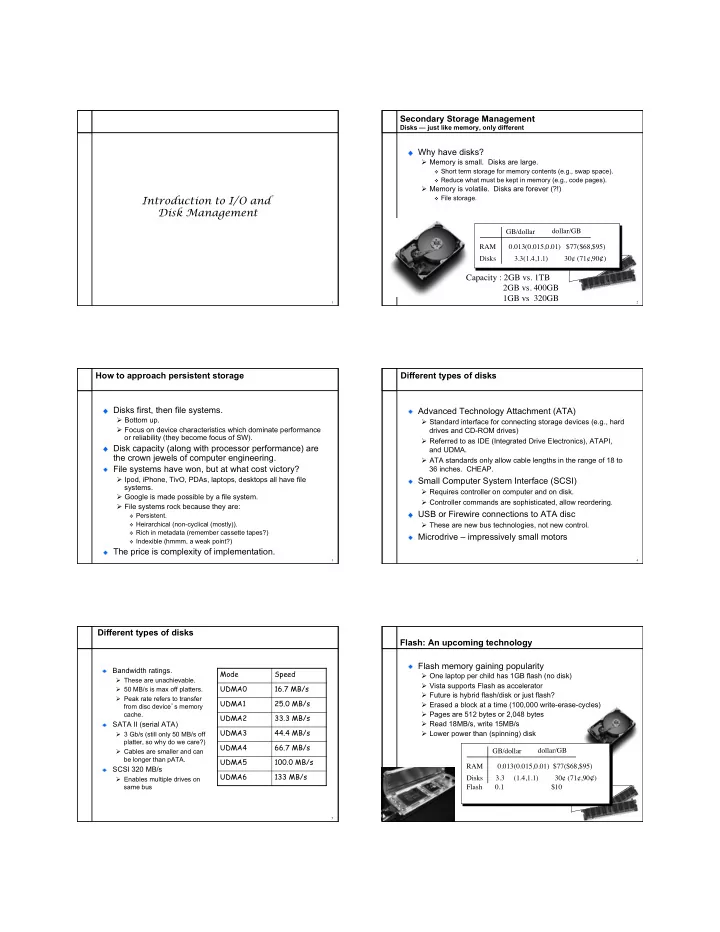
GB/dollar dollar/GB RAM 0.013(0.015,0.01) $77($68,$95) Disks 3.3(1.4,1.1) 30¢ (71¢,90¢)
Capacity : 2GB vs. 1TB 2GB vs. 400GB 1GB vs 320GB
3How to approach persistent storage Disks first, then file systems.
Ø Bottom up. Ø Focus on device characteristics which dominate performance
- r reliability (they become focus of SW).
Disk capacity (along with processor performance) are the crown jewels of computer engineering. File systems have won, but at what cost victory?
Ø Ipod, iPhone, TivO, PDAs, laptops, desktops all have file systems. Ø Google is made possible by a file system. Ø File systems rock because they are:
❖ Persistent. ❖ Heirarchical (non-cyclical (mostly)). ❖ Rich in metadata (remember cassette tapes?) ❖ Indexible (hmmm, a weak point?)
The price is complexity of implementation.
4Different types of disks Advanced Technology Attachment (ATA)
Ø Standard interface for connecting storage devices (e.g., hard drives and CD-ROM drives) Ø Referred to as IDE (Integrated Drive Electronics), ATAPI, and UDMA. Ø ATA standards only allow cable lengths in the range of 18 to 36 inches. CHEAP.
Small Computer System Interface (SCSI)
Ø Requires controller on computer and on disk. Ø Controller commands are sophisticated, allow reordering.
USB or Firewire connections to ATA disc
Ø These are new bus technologies, not new control.
Microdrive – impressively small motors
5Different types of disks
Bandwidth ratings.
Ø These are unachievable. Ø 50 MB/s is max off platters. Ø Peak rate refers to transfer from disc device’s memory cache.
SATA II (serial ATA)
Ø 3 Gb/s (still only 50 MB/s off platter, so why do we care?) Ø Cables are smaller and can be longer than pATA.
SCSI 320 MB/s
Ø Enables multiple drives on same bus
Mode Speed UDMA0 16.7 MB/s UDMA1 25.0 MB/s UDMA2 33.3 MB/s UDMA3 44.4 MB/s UDMA4 66.7 MB/s UDMA5 100.0 MB/s UDMA6 133 MB/s
6Flash: An upcoming technology Flash memory gaining popularity
Ø One laptop per child has 1GB flash (no disk) Ø Vista supports Flash as accelerator Ø Future is hybrid flash/disk or just flash? Ø Erased a block at a time (100,000 write-erase-cycles) Ø Pages are 512 bytes or 2,048 bytes Ø Read 18MB/s, write 15MB/s Ø Lower power than (spinning) disk GB/dollar dollar/GB RAM 0.013(0.015,0.01) $77($68,$95) Disks 3.3 (1.4,1.1) 30¢ (71¢,90¢) Flash 0.1 $10