Introduction to Geant4 Visualization Introduction to Geant4 - - PowerPoint PPT Presentation

introduction to geant4 visualization introduction to
SMART_READER_LITE
LIVE PREVIEW

Introduction to Geant4 Visualization Introduction to Geant4 - - PowerPoint PPT Presentation

Introduction to Geant Visualization Geant4 Workshop October 2003 Introduction to Geant4 Visualization Introduction to Geant4 Visualization HepRep/WIRED Joseph Perl SLAC Computing Services DAWN OpenGL Joseph Perl 1 Introduction to Geant


slide-1
SLIDE 1

Introduction to Geant Visualization Geant4 Workshop October 2003 Joseph Perl 1
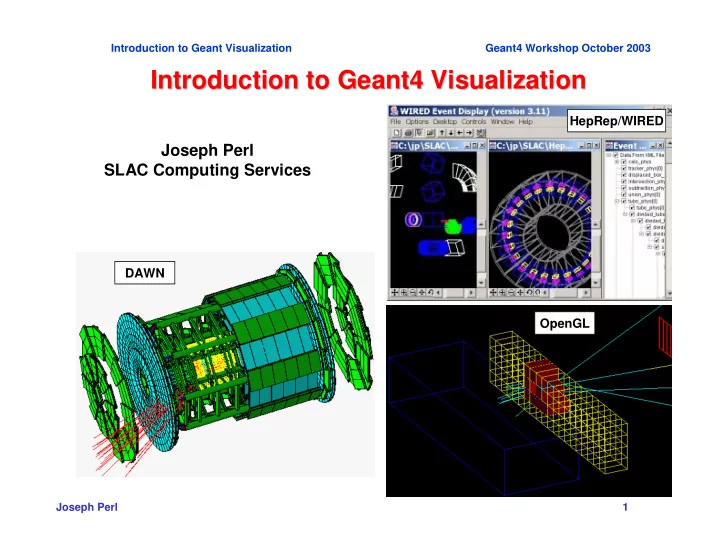
Introduction to Geant4 Visualization Introduction to Geant4 Visualization

Joseph Perl SLAC Computing Services

HepRep/WIRED DAWN OpenGL

slide-2
SLIDE 2

Introduction to Geant Visualization Geant4 Workshop October 2003 Joseph Perl 2

Contents Contents

  • The General Concepts behind Geant4 Visualization

– What you can visualize – The various visualization drivers – Visualization attributes

  • Introduction to the Visualization Commands

– Environment variables – Commands

  • This presentation can be used on its own, but gives the most comprehensive

introduction to Geant4 visualization when used as part of the following full set

  • f documents:

– Geant 4 Tutorial – Introduction to Geant4 Visualization – Geant4 Workshop Visualization Tutorial using the WIRED Event Display – Geant4 Workshop Visualization Tutorial using the DAWN Event Display – Geant4 Workshop Visualization Tutorial using the OpenGL Event Display

slide-3
SLIDE 3

Introduction to Geant Visualization Geant4 Workshop October 2003 Joseph Perl 3

How this Documents Fits in with How this Documents Fits in with Other Tutorial Materials Other Tutorial Materials

  • From here, go on to use three separate hands-on tutorials that

give you experience working with three visualization drivers: – OpenGL – HepRep/WIRED – DAWN

  • Some other Geant4 visualization drivers are not discussed

here simply because the present author is not experienced with them (such as RayTracer, VRML and ASCIITree).

slide-4
SLIDE 4

Introduction to Geant Visualization Geant4 Workshop October 2003 Joseph Perl 4

Part 1: The General Concepts behind Part 1: The General Concepts behind Geant4 Visualization Geant4 Visualization

– What you can visualize – The various visualization drivers – Visualization attributes

slide-5
SLIDE 5

Introduction to Geant Visualization Geant4 Workshop October 2003 Joseph Perl 5

Geant4 Visualization serves a Variety of Geant4 Visualization serves a Variety of Functions Functions

– Quick response to survey successive events – Impressive special effects for demonstration – High-quality output to prepare journal papers – Flexible camera control for debugging geometry – Highlighting overlapping of physical volumes – Interactive picking of visualised objects

slide-6
SLIDE 6

Introduction to Geant Visualization Geant4 Workshop October 2003 Joseph Perl 6

What You Can Visualize What You Can Visualize

  • Simulation data can be visualised such as:

– Detector components – A hierarchical structure of physical volumes – A piece of physical volume, logical volume, and solid – Particle trajectories and tracking steps – Hits of particles in detector components

  • You can also visualiseother user defined objects such as:

– A polyline, that is, a set of successive line segments (example: coordinate axes) – A marker which marks an arbitrary 3D position (example: eye guides) – Texts

  • •character strings for description
  • •comments or titles …
slide-7
SLIDE 7

Introduction to Geant Visualization Geant4 Workshop October 2003 Joseph Perl 7

The Various Visualization Drivers The Various Visualization Drivers

  • OpenGL

– View directly from Geant4 – Rendered, photorealistic image with some interactive features

  • zoom, rotate, translate

– Limited printing ability (pixel graphics, not vector graphics)

  • HepRepFile

– View in the WIRED Event Display – Wireframe or simple area fills (not photorealistic) – Many interactive features

  • zoom, rotate, translate
  • click to show attributes (momentum, etc.)
  • special projections (FishEye, etc.)
  • control visibility from hierarchical (tree) view of data

– Export to many vector graphic formats (PostScript, PDF, etc.)

  • DAWNFILE

– View in the DAWN Renderer – Rendered, photorealistic image – Runs on Linux/Unix and Windows – No interactive features – Highest quality technical rendering - output to vector PostScript

slide-8
SLIDE 8

Introduction to Geant Visualization Geant4 Workshop October 2003 Joseph Perl 8

Choose the Driver that Meets your Current Needs Choose the Driver that Meets your Current Needs

  • If you want quick photorealistic graphics with GUI control (and

have the necessary libraries installed) – OpenGL is a good solution

  • If a wireframe look will do, but you still want GUI control and

want to be able to pick on items to inquire about them (identity, momentum, etc.) – HepRep/WIRED will meet your needs

  • If you want to render highest quality photorealistic images for

use in a poster or a technical design report, and you can live without quick rotate and zoom – DAWN is the way to go

slide-9
SLIDE 9

Introduction to Geant Visualization Geant4 Workshop October 2003 Joseph Perl 9

Controlling Visualization Controlling Visualization

  • Your Geant4 code stays basically the same no matter which

driver you want to use – You can even run all three drivers at the same time.

  • Visualisation is performed either with commands or by writing

C++ source codes of user-action – For the present tutorial, we confine ourselves to command- driven visualization.

  • For some visualization drivers all commands go from Geant4

– OpenGL

  • For other visualization drivers, some work is in Geant4, a file is

produced, and that file is then rendered by another application (which may have GUI control) – HepRep – DAWN

slide-10
SLIDE 10

Introduction to Geant Visualization Geant4 Workshop October 2003 Joseph Perl 10

OpenGL Runs Directly from Geant4 OpenGL Runs Directly from Geant4

  • With OpenGL, all commands go through Geant4:

vis/open OGLIX /vis/scene/create /vis/scene/add/volume /vis/sceneHandler/attach /vis/viewer/flush /vis/viewer/set/viewpointThetaPhi 70 2 /vis/viewer/zoom 2 /vis/viewer/reset /vis/viewer/set/viewpointThetaPhi 40 4 /vis/viewer/panTo -5 -1 /vis/viewer/zoom 4. /vis/scene/add/trajectories /vis/scene/add/hits /tracking/storeTrajectory 1 /run/beamOn 1

slide-11
SLIDE 11

Introduction to Geant Visualization Geant4 Workshop October 2003 Joseph Perl 11

HepRep and DAWN work through Files HepRep and DAWN work through Files

  • With HepRep and DAWN, Geant4 creates a file:

##G4.PRIM-FORMAT-2.4 ##### List of primitives 1 ##### /BoundingBox -1.0 -1.0 -5.0 8.0 4.0 6.0 !SetCamera !OpenDevice !BeginModeling # Box /Origin 0.0 0.0 0.0 /ColorRGB 1.0 0.0 0.0 /Box 0.5 2.0 4.5 # Column /Origin 4.0 0.0 0.0 /ColorRGB 0.0 1.0 0.0 /Ndiv 50 /Column 1.5 2.0 # Trd /Origin 0.0 0.0 0.0 /ColorRGB 0.0 1.0 1.0 /Origin 7.0 0.0 0.0 /Trd 1 0.5 1 0.5 4 # Cone segment /Origin 1.0 5.0 0.0 /ColorRGB 0.0 1.0 1.0 <heprep xmlns="http://www.freehep.org/HepRep" xmlns:xsi="http://www.w3.org/2001/XMLSchema-instance" xsi:schemaLocation="HepRep.xsd"> <layerorder="Detector, Event, CalHit, Trajectory, TrajectoryPoint, Hit"/> <typetree name="G4GeometryTypes" version="1.0"> <type name="Detector"> <attvalue name="Layer" showLabel="NONE" type="String" value="Detector"/> <attdef category="Physics" desc="Logical Volume" extra="" name="LVol"/> <attdef category="Physics" desc="Material Name" extra="" name="Material"/> <type name="Detector/World"> <type name="Detector/World/Calorimeter"> <type name="Detector/World/Calorimeter/Layer"> <type name="Detector/World/Calorimeter/Layer/Lead"> </type> </type> </type> </type> </type> </typetree> <typetree name="G4EventTypes" version="1.0"> <type name="Event"> <attvalue name="Layer" showLabel="NONE" type="String" value="Event"/> <type name="Event/Trajectory">

Example .heprep File Example .prim File

slide-12
SLIDE 12

Introduction to Geant Visualization Geant4 Workshop October 2003 Joseph Perl 12

HepRep and DAWN work through Files HepRep and DAWN work through Files

  • And you then run an application to visualize that file:

HepRep/WIRED DAWN

slide-13
SLIDE 13

Introduction to Geant Visualization Geant4 Workshop October 2003 Joseph Perl 13

HepRep is Not Just for Geant4 HepRep is Not Just for Geant4 and Not Just for WIRED and Not Just for WIRED

The HepRep interface breaks the dependency between any particular experiment’s event display server and any particular event display client. The HepRep format is independent of any one particular language or protocol. It can be used from C++ or Java and can be shipped as Corba, RMI, XML, C++, Java or JNI for consumption by WIRED, FRED or any other HepRep-enabled event display client.

4/9/2002 Joseph Perl HepRep2 18

* * * * * * * 1 1 1 1 1 1 1

HepRep Instance HepRep TypeTree HepRep InstanceTree HepRep AttValue HepRep Type HepRep AttDef Linked by TypeName ID: HepRepTreeID ID: HepRepTreeID TypeTreeID:HRTreeID InstanceTreeIDs:HRTreeID[] Name: String Desc: String InfoURL: String TypeName: String X,Y,Z: Double Name: String Desc: String Category: String Extra: String AttDefName: String Value: Any ShowLabel: Int Linked by AttDef Name HepRep Point HepRep Action Name:String Expression:String HepRep Comments: String[]

HepRep: a Generic Interface Definition for HEP Event Display Representables

+getInstanceTreeTop( InstanceTreeName: String, InstanceTreeVersion: String) :HepRepInstanceTree; +getTypeTree( TypeTreeName: String, TypeTreeVersion: String) :TypeTree; +getInstances( InstanceTreeName: String, InstanceTreeVersion: String, TypeNames: String[]) :HepRepInstanceTree; +getInstancesAfterAction( InstanceTreeName: String, InstanceTreeVersion: String, TypeNames: String[], Actions:HepRepAction[], GetPoints: Boolean, GetDrawAtts: Boolean, GetNonDrawAtts: Boolean, InvertAtts: String[]) :HepRepInstanceTree; +getLayerOrder( ) :String[]; +checkForException( ) :String; Comments: String[] HepRep HepRepTreeID Name:String Version:String Linked by TypeTreeID

1

HepRep

WIRED Client (Java) Other HepRep Clients

BaBar Server LCD Interface GLAST Gaudi Service Geant4 Server

FRED Client (C++/Ruby)

slide-14
SLIDE 14

Introduction to Geant Visualization Geant4 Workshop October 2003 Joseph Perl 14

Who’s Using HepRep Who’s Using HepRep

LCD in JAS3 GLAST BaBar Offline Geant4 Geant4 Web BaBar Offline BaBar Online

slide-15
SLIDE 15

Introduction to Geant Visualization Geant4 Workshop October 2003 Joseph Perl 15

WIRED Let’s You Pick to Show Physics Attributes WIRED Let’s You Pick to Show Physics Attributes

Picked on this volume to show

  • Material
  • Density
  • Radlen
  • etc

Picked on this trajectory to show

  • Particle ID
  • Charge
  • Momentum
  • etc.
slide-16
SLIDE 16

Introduction to Geant Visualization Geant4 Workshop October 2003 Joseph Perl 16

Origins of DAWN Origins of DAWN

Fukui Renderer DAWN (Drawer for Academic WritiNgs).

  • A vectorized 3D PostScript processor with analytical hidden

line/surface removal intended for precise technical drawing of complicated objects.

  • Specifically designed for Geant4.
  • Primitives set is same as Geant4 primitives set.
  • Calculates all visible parts of the 3D data before drawing.
  • Produces device-independent vectorized graphics for high

quality technical applications.

slide-17
SLIDE 17

Introduction to Geant Visualization Geant4 Workshop October 2003 Joseph Perl 17

DAWN Examples DAWN Examples

  • From a repository of beautiful images at

– http://geant4.kek.jp/~tanaka/GEANT4/ATLAS_G4_GIFFIG/

slide-18
SLIDE 18

Introduction to Geant Visualization Geant4 Workshop October 2003 Joseph Perl 18

DAWN Examples DAWN Examples

slide-19
SLIDE 19

Introduction to Geant Visualization Geant4 Workshop October 2003 Joseph Perl 19

HepRep and DAWN are complimentary file HepRep and DAWN are complimentary file formats, each with its own strengths formats, each with its own strengths

HepRep

  • Hierarchical
  • Simple Primitives
  • General Purpose
  • Representables have Attributes
  • No Camera or Lighting

Information DAWN

  • Flat
  • All Geant4 Primitives
  • Just for Geant4
  • No Attributes
  • Camera and Lighting

Information

  • Plans to eventually use HepRep/WIRED and DAWN together

– use WIRED to select view (rotate, translate, zoom, pick to understand data), then when view selected, have WIRED call DAWN to render to photorealistic vector postscript

slide-20
SLIDE 20

Introduction to Geant Visualization Geant4 Workshop October 2003 Joseph Perl 20

Visualization Attributes Visualization Attributes

  • Necessary for visualisation, but not included in geometrical

information – Colour, visibility, forced-wireframe style, etc – A set of visualisation attributes is held by the class G4VisAttributes

  • A G4VisAttributes object is assigned to a visualisable object with its

method SetVisAttributes() :

– experimentalHall_logical -> SetVisAttributes (G4VisAttributes::Invisible)

  • Study G4 examples or references at end of this presentation to learn

more about G4VisAttributes.

slide-21
SLIDE 21

Introduction to Geant Visualization Geant4 Workshop October 2003 Joseph Perl 21

Generic Attributes Generic Attributes

  • Geant4 Trajectories and Hits can be assigned additional arbitrary attributes that will

be displayed when you click on the relevant object in the WIRED event display (and later HepRep clients will be able to turn on and off visibility of objects by cutting on these attributes)

  • Define the attributes with lines such as:

std::map<G4String,G4AttDef>* store = G4AttDefStore::GetInstance("G4Trajectory",isNew); G4String PN("PN"); (*store)[PN] = G4AttDef(PN,"Particle Name","Physics","","G4String"); G4String IMom("IMom"); (*store)[IMom] = G4AttDef(IMom, "Momentum of track at start of trajectory", "Physics","","G4ThreeVector");

  • Then fill the attributes with lines such as:

– std::vector<G4AttValue>* values = new std::vector<G4AttValue>; – values->push_back(G4AttValue("PN",ParticleName,"")); – s.seekp(std::ios::beg); – s << G4BestUnit(initialMomentum,"Energy") << std::ends; – values->push_back(G4AttValue("IMom",c,""));

  • See geant4/source/tracking/src/G4Trajectory.cc for a good example.
slide-22
SLIDE 22

Introduction to Geant Visualization Geant4 Workshop October 2003 Joseph Perl 22

Part 2: Introduction to the Visualization Part 2: Introduction to the Visualization Commands Commands

– Environment variables – Commands

slide-23
SLIDE 23

Introduction to Geant Visualization Geant4 Workshop October 2003 Joseph Perl 23

Environment Variables Environment Variables

  • Two of the visualization drivers discussed in this tutorial are always included by

default in Geant4 (snce they require no external libraries): – HepRepFile – DAWNFILE

  • Other visualization drivers may require setting environment variables:

– OpenGL

  • To include OpenGL, before you build Geant4, set the appropriate “build”

variable to 1 (to cause the necessary code to be linked into your executable), such as: – setenv G4VIS_BUILD_OPENGLX_DRIVER 1

  • Then, before you run Geant4, set the corresponding “use” variable to 1.

(Geant4 separates the BUILD and USE variables so that you can BUILD in drivers that you might not necessarily want to USE during some executions): – setenv G4VIS_USE_OPENGLX 1

  • Note, however, that you cannot run JAIDA/JAS if OpenGL is in your build.

– the OpenGL libraries pre-load the library libXt.so which makes the Java virtual machine crash when it tries to open its first Window - expect a fix when JDK 1.5 comes out.

slide-24
SLIDE 24

Introduction to Geant Visualization Geant4 Workshop October 2003 Joseph Perl 24

Command Terminology Command Terminology

  • Geant4 visualization may be easier to understand if you know Geant4’s

concepts of “scene” and “viewer” – Scene

  • A set of visualizable 3D data (detectors, events, markers)

– Viewer

  • Image generator

– Scene Handler

  • Does the modeling from the scene into the viewer
  • You will also sometimes see the term “Visualisation Driver”, which is

essentially a viewer plus an associated scene handler.

slide-25
SLIDE 25

Introduction to Geant Visualization Geant4 Workshop October 2003 Joseph Perl 25

Steps of Visualization Steps of Visualization

  • Open a driver (instantiates scene handler and viewer), such as:

– /vis/open HepRepFile

  • If using an immediate viewer, such as OpenGL, set camera parameters and

drawing style (wireframe/surface), such as: – /vis/viewer/reset – /vis/viewer/set/viewpointThetaPhi 70 20 – /vis/viewer/set/style wireframe

  • Create an empty scene:

– /vis/scene/create

  • Declare what 3D data should be added to the created scene:

– /vis/scene/add/volume – /vis/scene/add/trajectories – /vis/scene/add/hits

  • Attach scene to sceneHandler:

– /vis/sceneHandler/attach

  • Run simulation with appropriate options to store trajectory information

– /tracking/storeTrajectory 1 – /run/beamOn 1

  • Execute the visualization

– /vis/viewer/flush

  • If using an external viewer, such as for HepRepFile or DAWNFILE:

– import the .heprep or .prim file into WIRED or DAWN, set camera parameters, drawing style, etc., view the visualization

slide-26
SLIDE 26

Introduction to Geant Visualization Geant4 Workshop October 2003 Joseph Perl 26

Example 1: Visualizing a Detector Example 1: Visualizing a Detector

# Create a scene handler and a viewer for OpenGL /vis/open OGLIX # Set camera and drawing style /vis/viewer/reset /vis/viewer/set/viewpointThetaPhi 70 20 /vis/viewer/set/style wireframe # Create a new empty scene /vis/scene/create # Declare that the world volume should be added to the scene /vis/scene/add/volume # Attach scene to scenehandler /vis/sceneHandler/attach # Execute the visualisation /vis/viewer/flush

  • To visualize a detector, the commands can be as follows:
slide-27
SLIDE 27

Introduction to Geant Visualization Geant4 Workshop October 2003 Joseph Perl 27

Example 2: Visualizing Events Example 2: Visualizing Events

# Create a scene handler and viewer for HepRep /vis/open HepRepFile # Set camera and drawing style - not needed here since we make # those adjustments separately in the WIRED or DAWN applications # Create a new empty scene /vis/scene/create # Declare that the world volume, trajectories and hits should be # added to the scene /vis/scene/add/volume /vis/scene/add/trajectories /vis/scene/add/hits # Attach scene to scenehandler /vis/sceneHandler/attach # Store particle trajactories for visualisation /tracking/storeTrajectory 1 # Execute the visualization via a /vis/viewer/flush contained within # the macro “eventAction.mac” that is called at the end of each event /run/beamOn 10 eventAction.mac

  • To visualize events, the commands can be as follows:
slide-28
SLIDE 28

Introduction to Geant Visualization Geant4 Workshop October 2003 Joseph Perl 28

/vis/open Command /vis/open Command

  • To Open a Driver

– /vis/open <driver name>

  • for example

– /vis/open OGLIX – /vis/open HepRepFile – /vis/open DAWNFILE

  • The set of available drivers is listed when you first start Geant4, but

you can also get this list with the command: – help /vis/open

  • You can even open more than one driver at a time, but there are some

subtleties then about multiple scenes and sceneHandlers.

slide-29
SLIDE 29

Introduction to Geant Visualization Geant4 Workshop October 2003 Joseph Perl 29

/vis/viewer/… Commands /vis/viewer/… Commands

To Set Camera Parameters and Drawing Style. Only needed if using an immediate viewer, such as OpenGL.

  • Reset viewpoint

– /vis/viewer/reset

  • Set view angles

– /vis/viewer/set/viewpointThetaPhi <theta_angle> <phi_angle>

  • for example

– /vis/viewer/set/viewpointThetaPhi 70 20

  • Set drawing style

– /vis/viewer/set/style <style>

  • for example

– /vis/viewer/set/style wireframe – /vis/veiwer/set/style surface

  • but note that this will not affect volumes that have style explicitly force by

“setForceWireframe” or “setForceSolid” commands in the c++ code

  • Zoom

– /vis/viewer/zoom <scale factor>

  • for example

– /vis/viewer/zoom 2.

slide-30
SLIDE 30

Introduction to Geant Visualization Geant4 Workshop October 2003 Joseph Perl 30

Commands to Visualize Events Commands to Visualize Events

  • To tell tracking to make trajectories available for drawing

– /tracking/storeTrajectory 1

  • To add trajectories or hits to the scene

– /vis/scene/add/trajectories – /vis/scene/add/hits

  • To accumulate more than one event per drawing

– /vis/scene/endOfEventAction accumulate

  • Otherwise, to have just one event per drawing, take the default

– /vis/scene/endOfEventAction refresh

  • To draw at the end of each event, put the following line into a macro (such as

eventAction.mac) – /vis/viewer/flush

  • Then run with that macro

– /run/beamOn <number_of_events> <macro_name>

  • for example

– /run/beamOn 10 eventAction.mac

slide-31
SLIDE 31

Introduction to Geant Visualization Geant4 Workshop October 2003 Joseph Perl 31

Compound Commands Compound Commands

  • To allow you to work quickly, Geant4 visualization lets you issue the

equivalent of several common commands at one time by using a “compound command”.

  • Some of the commands you have already seen in this presentation are

actually compound commands: – /vis/open

  • /vis/sceneHandler/create
  • /vis/viewer/create

– /vis/viewer/flush

  • /vis/veiwer/refresh
  • /vis/viewer/update
  • Another commonly used compound commands is:

– /vis/drawVolume

  • /vis/scene/create
  • /vis/scene/add/volume
slide-32
SLIDE 32

Introduction to Geant Visualization Geant4 Workshop October 2003 Joseph Perl 32

Complete List of Commands Complete List of Commands

  • This presentation has shown only a very small subset of the full

Geant4 command set. Even for those commands shown, only a few of the options have been presented.

  • To see the complete set of commands, look in the Geant4

source code for the file: geant4/source/visualization/README.built_in_commands

  • Or see the extensive Geant4 documentation on the web:

http://cern.ch/geant4/G4UsersDocuments/UsersGuides/ ForApplicationDeveloper/html/Visualization/UIcommands/vis.txt

slide-33
SLIDE 33

Introduction to Geant Visualization Geant4 Workshop October 2003 Joseph Perl 33

Summary Summary

  • Choose a driver based on your current needs:

– If you want quick photorealistic graphics with GUI control (and have the necessary libraries installed), OpenGL is a good solution. – If a wireframe look will do, but you still want GUI control and want to be able to pick on items to inquire about them (identity, momentum, etc.), HepRep/WIRED will meet your needs. – If you want to render highest quality photorealistic images for use in a poster or a technical design report, and you can live without quick rotate and zoom, DAWN is the way to go. – Other options, not discussed in this talk simple because the present author is not experienced with them (RayTracer, VRML and ASCIITree).

  • Geant4’s visualization framework allows one to run multiple

visualization drivers side by side

  • See the accompanying hands-on tutorials to try three visualization

drivers: – G4WIREDTutorial.html – G4DAWNTutorial.html – G4OpenGLTurorial.html

slide-34
SLIDE 34

Introduction to Geant Visualization Geant4 Workshop October 2003 Joseph Perl 34

Further Resources Further Resources

Geant4 Visualization README file: geant4/source/visualisation/README On-line Documentation on Geant4 Visualisation: http://cern.ch/geant4/G4UsersDocuments/UsersGuides/ ForApplicationDeveloper/html/Visualization List of Visualization Commands: http://cern.ch/geant4/G4UsersDocuments/UsersGuides/ ForApplicationDeveloper/html/Visualization/UIcommands/vis.txt Another Presentation that Introduces Visualization, with More Focus on Controlling Visualization from C++:

http://www.ge.infn.it/geant4/training/portland/visualisation.pdf

For Questions or Comments: Geant4 Visualization Online Forum: http://geant4-hn.slac.stanford.edu:5090/HyperNews/ public/get/visualization.html

slide-35
SLIDE 35

Introduction to Geant Visualization Geant4 Workshop October 2003 Joseph Perl 35

References References

  • HepRep: a generic interface definition for HEP event display representables

http://heprep.freehep.org

  • HepRep Complete Presentation (most complete description of HepRep)

http://heprep.freehep.org/heprep2.Complete.ppt http://heprep.freehep.org/heprep2.Complete.pdf

  • Fred: oh no, another event display (a HepRep client)

http://www.fisica.uniud.it/~riccardo/research/fred

  • WIRED: world wide web interactive remote event display (a HepRep Client)

http://www.slac.stanford.edu/BFROOT/www/Computing/Graphics/Wired

  • About DAWN

http://geant4.kek.jp/~tanaka/DAWN/About_DAWN.html

  • Satoshi Tanaka’s GEANT4 Ritsumeikan University Group Home Page

(more information on DAWN, sample PRIM files, images, etc.) http://geant4.kek.jp/~tanaka/