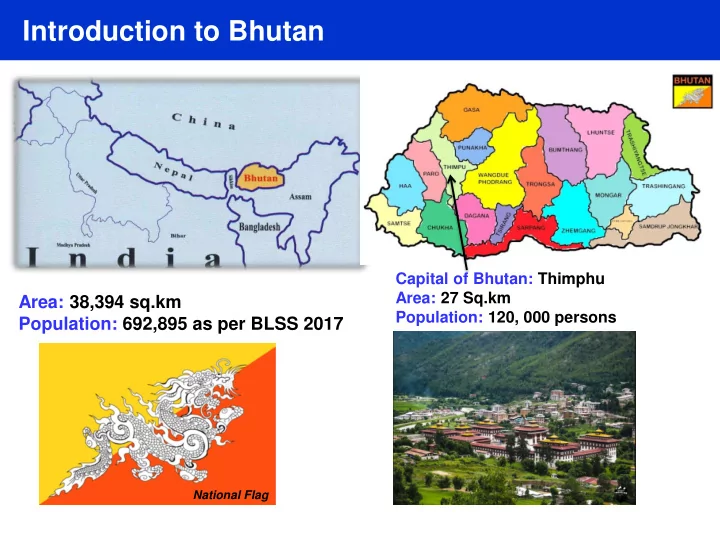
SLIDE 1 Introduction to Bhutan
Area: 38,394 sq.km Population: 692,895 as per BLSS 2017
Capital of Bhutan: Thimphu Area: 27 Sq.km Population: 120, 000 persons
National Flag
SLIDE 2
Some Images of Thimphu City
SLIDE 3 Case Study
Sustainable Urban Planning
3
Organization: Thimphu Thromde Country: Bhutan Date: 14th May 2018
SLIDE 4 4
Thimphu Structure Plan (TSP) 2002 - 2027
Principles:
1. Balance with Nature 2. Balance with Tradition 3. Conviviality 4. Efficiency 5. Human scale 6. Opportunity Matrix 7. Regional Integration 8. Balanced Movement 9. Institutional Integrity
Strategies:
1.
Decentralized Growth
2.
Regionalized Growth
3.
Densification
4.
Transport Oriented Growth
5.
Resource Utilization
6.
Urban Precincts
7.
Public Assets
8.
Defining the Urban Core
9.
Facilitating Access to Shelter
Intelligent Urbanism
SLIDE 5
Thimphu Structure Plan (TSP) 2002 - 2027
SLIDE 6
Thimphu Structure Plan (TSP) 2002 - 2027
SLIDE 7
Thimphu Structure Plan (TSP) 2002 - 2027
SLIDE 8
Thimphu Structure Plan (TSP) 2002 - 2027
SLIDE 9 Thimphu Structure Plan (TSP) 2002 - 2027
Main Theme
1. Nation Building and the Civil Society 2. The City of our dreams 3. The Tashichho Dzong 4. Community, Conviviality and Human Scale 5. Public Policy and Urban Forms 6. The Bhutanese Dream 7. The Parable of Archery, or the tragedy
8. The Domain of the Automobile Tashichho Dzong: Icon of Bhutan
Prayer Flags Protect the City Below Prayer Walls Mark out Auspicious Precincts Playing Archery – National game
SLIDE 10 Thimphu Structure Plan (TSP) 2002 - 2027
Main Theme
9. Reclaiming the Public Domain 10. The City Core 11. The Gateway to the Capital 12. Urban Corridor 13. Urban Villages 14. Open Space System and the Wang Chhu 15. Footpath System 16. Forest Boundary and City Landscape 17. Peripheral Zone Control 18. Knowledge City 19. Social Services 20. Utilities Network 21. Shelter System 22. The National Capital Region
Dancers at the Thimphu Tshechu Accent the City’s Unique Culture The Clock Tower Square: Component of the Public Domain
Norzin Lam
SLIDE 11 11
Thimphu Structure Plan (TSP) 2002 - 2027 Sustainable City-Making
1.Several Local area plans
- 2. Extensive redevelopment of Urban Core
Goal of the project
1.To facilitate and address grappling issues like population increase, land fragmentation and ad-hoc development emerging due to rapid urbanization. 2.To have creative liveable self-sustaining places
Land pooling project and land acquisition project in some cases
SLIDE 12 12
Thimphu Structure Plan (TSP) 2002 - 2027 Obstacles in the process of planning and implementation
1.Obtaining consensus from landowners: difference in pooling %/ distribution & relocation of plots/ feeling of deprived/ mine to our
- Policy level weaknesses: No legal teeth/ award to low bidders
- Implementation weaknesses: paper based, centralisation of land
administration and management
- Management weaknesses: inadequate managerial skills, supports,
bad database & record keeping
- Selfishness of staff and leaders/ politics
- Integrity of staff including leaders
- Difficult Terrain and Lack of awareness at all levels
SLIDE 13
13
Thimphu Structure Plan (TSP) 2002 - 2027 Key Strategies to overcome the obstacles
1.Open house discussions with leaders, relevant stakeholders, higher authorities and community representatives, 2.Public participation through continuous and rigorous conduct of meeting and consultation is seen as biggest strength to influence the decision of adopting the land pooling concept and its implementation. 3.Using leaders, council members and local representatives
SLIDE 14 14
Thimphu Structure Plan (TSP) 2002 - 2027
Achievement 1. 12 LAPs have been approved and implemented 2. Infrastructural development - 8 completed
3. Helped build a foundation of strong democratic principles Failure 1. Compromised some land uses, which are technically not feasible 2. Land speculation 3. Low income housing provision and recovery of fund for the projects 4. Not inclusive of poor, renters, underprivileged residents
SLIDE 15
15
Thimphu Structure Plan (TSP) 2002 - 2027
Lessons and Implications 1.Land pooling is acceptable and viable solution for urban redevelopment and addressing urban issues despite its obstacles at various stage 2.Guided the management to know what they seek in staff during selection and recruitment 3.What needed to be given in terms of trainings and capacity development 4.Establishment of proficient and committed team to manage the project 5.Design project for self-finance to offset the problem of self funding 6.Win-Win to land owners and Municipality
SLIDE 16
16
Thimphu Structure Plan (TSP) 2002 - 2027
Some national and city level projects 1.Proposed diplomatic enclave 2.Proposed Green Zone 3.Proposed relocation of two old Fuel Station from Core (Core Gateway) 4.Pedestrianisation of Norzin Lam 5.Gateway to capital city (Proposed Inter-State Bus Terminal)
SLIDE 17
17
Conclusion
Thank You