Introduction to Automatic Guided Vehicles March 16, 2004 Developed - - PDF document

introduction to automatic guided vehicles
SMART_READER_LITE
LIVE PREVIEW

Introduction to Automatic Guided Vehicles March 16, 2004 Developed - - PDF document

Introduction to Automatic Guided Vehicles March 16, 2004 Developed by Abbey Solomon and Joe Wilck, undergraduate students Updated by Rohith Kori, graduate student In the Grado Dept. of Industrial & Systems Engineering at Virginia


slide-1
SLIDE 1

1

“Introduction to Automatic Guided Vehicles”

Developed by Abbey Solomon and Joe Wilck, undergraduate students Updated by Rohith Kori, graduate student In the Grado Dept. of Industrial & Systems Engineering at Virginia Tech.

March 16, 2004

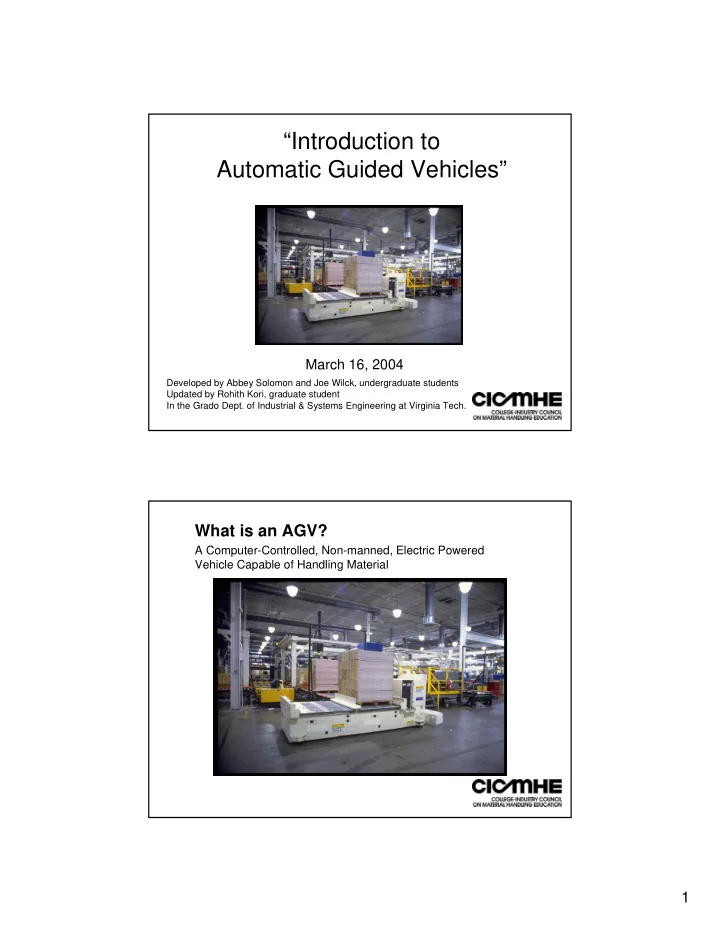
What is an AGV?

A Computer-Controlled, Non-manned, Electric Powered Vehicle Capable of Handling Material

slide-2
SLIDE 2

2

What is a good use for AGVs?

Repetitive motion Distances over 150 feet Multi-shift operation Desire to save costs and improve efficiency

Why use Guided Vehicles?

  • Not a permanent obstacle
  • Paths can be changed easily
  • System can be expanded

easily

  • Does not represent a single

point of failure - system has built-in redundancy

  • Favorable cost/benefit

compared to other automated material handling solutions

slide-3
SLIDE 3

3

What is in a system?

Host Computer Vehicle(s) RF LAN Wall Mounted RF Modem or I/O Panel Support Equipment Wireless Terminal, Sensors or Software

Different Types of AGVs

1. Fork 2. Tow/Tugger 3. Unit Load 4. Custom

slide-4
SLIDE 4

4

Vehicle Types - Fork

Outrigger (Straddle) Reach Side Reach Counterbalance Narrow Aisle Fork Over

Vehicle Types - Fork

slide-5
SLIDE 5

5

Vehicle Types – Tow/Tugger Vehicle Types – Unit Load

Conveyor Lift Standard Combination Lift & Conveyor

slide-6
SLIDE 6

6

Vehicle Types – Custom

1953 1973 1976

1st AGV 1st Assembly Vehicle 1st Unit Load

History of AGVs

1953 – First AGV created and used. It was used to pull a trailer and follow an

  • verhead wire in a grocery

warehouse.

1959

1st Tugger

1973 - Volvo in Kalmar, Sweden utilized 280 computer-controlled AGVs instead of using the typical conveyor assembly line.

slide-7
SLIDE 7

7

1985 1989 1976 1987 2003

Single Wire Guidance PC Based Controller 1st Unit Load Laser Guidance Inertial Guidance

1991 1992

Wire & Wireless AGVs in same System Changeable Path

History of AGVs

1976 – First Unit Load AGV. Now used for many different applications in multiple settings

  • f industry.

1970’s – Guidance Systems

How do they know where to go? Guidance Methods

  • Optical – Tracks contrasting color
  • Wire – Embedded in floor
  • Inertial – Gyro with magnets in floor
  • Laser – Triangulation from reflective targets
slide-8
SLIDE 8

8

Laser Guidance Layout How are they powered? Charge it!

  • Standard Charging

(battery swap)

  • In-Vehicle

(opportunity) Charging

  • Inductive Charging
slide-9
SLIDE 9

9

What about Safety? What about Safety?

Mechanical Protection Group

Side Optical Bumper Front & Rear Bumpers

Most industrial-use AGVs travel at a speed between 100 and 300 feet per minute

Front Warning Zone Front Stop Zone Rear Warning & Stop Zones Optional Tower Protection Side Protection

Electronic Protection Group

What about Safety?

slide-10
SLIDE 10

10

Safety Demonstration (click picture to play)

*Video obtained from http://www.agvsystems.com/examples/video.asp. View More Videos

New Markets/Applications

  • Assembly Deck
  • Batch Tank Transport
  • Battlefield Unmanned

Vehicles

  • Cleanroom Mobile Robot
  • Crabbing
  • Dumping
  • Extreme Precision
  • Flat Bed Truck Side Loading
  • Hospital Materials
  • Hybrid
  • Mars Rover
  • Military Shooting Range
  • Miniature
  • Monster (Humongous)
  • Non-System AGV
  • Paper Roll/Metal Coil
  • People Mover
  • Sea Cargo Container
  • Very Narrow Aisle (VNA)
slide-11
SLIDE 11

11

Gillette

Boston, Massachusetts

  • 1.5-million sq ft facility
  • 5-billion razor blades produced

per year at one manufacturing center

  • 18 AGVs are utilized with 8,000 ft
  • f guide path and over 400 pickup &

dropoff points

  • Just in Time manufacturing
  • The new AGVs combined with an AS/RS has eliminated 14

handling steps associated with storage in an off-site warehouse *Information obtained from Modern Materials Handling Online.

Sharp

Osaka, Japan

  • 485,000 sq ft building, 8 stories tall
  • 900,000 air conditioners produced per year
  • 17 AGVs are utilized on 2 separate guide paths
  • The AGVs serve to deliver raw materials to the

assembly line, carrying up to 1 ton at a time

  • Just in Time manufacturing

The new AGV system along with several miniload systems and a monorail:

  • tripled production capacity with 2/3’s less staff
  • cuts WIP by 50%

* Information obtained from MaterialHandlingInfo.com.

slide-12
SLIDE 12

12

Level 1: Simple Manual Vehicle Dispatch, Load/Unload, No Central Controller, No Host Interface. Level 2: Medium Automatic Vehicle Dispatch, Load/Unload, Central Controller, Product Tracking, Multiple Path Options. Level 3: More Automatic Vehicle Dispatch, Load/Unload, automatic coupling/uncoupling (applies to tuggers only), Central Controller, Complex Host Interface, Ethernet Link, Product Tracking, Multiple Path Options Multiple Transfer Heights, etc.

Total system cost can be estimated by multiplying the projected number of vehicles times the unit costs shown in the following tables.

Pricing Guides

(per vehicle)

Information from: http://www.mhia.org/psc/PSC_Products_GuidedVehicle_costEstimating.cfm.
Level 1: Simple Manual Vehicle Dispatch, Load/Unload, No Central Controller, No Host Interface. Level 2: Medium Automatic Vehicle Dispatch, Load/Unload, Central Controller, Product Tracking, Multiple Path Options. Level 3: More Automatic Vehicle Dispatch, Load/Unload, automatic coupling/uncoupling (applies to tuggers only), Central Controller, Complex Host Interface, Ethernet Link, Product Tracking, Multiple Path Options Multiple Transfer Heights, etc.

Total system cost can be estimated by multiplying the projected number of vehicles times the unit costs shown in the following tables.

Pricing Guides

(per vehicle)

Information from: http://www.mhia.org/psc/PSC_Products_GuidedVehicle_costEstimating.cfm.

slide-13
SLIDE 13

13

  • Member Companies

– AGV Products, Inc. – Cattron-Theimeg International Ltd. – Control Engineering Company – Egemin Automation Inc. – FMC Technologies – Frog Navigation Systems – HK Systems – Mentor AGVS, Formtek Cleveland, Inc. – Siemens Dematic Material Handling Automation Division – Transbotics Corporation

Automated Guided Vehicle Systems Product Section of MHIA

www.mhia.org/agvs/

Extra Vehicle Slides

slide-14
SLIDE 14

14

Assembly Deck AGVs Battlefield Unmanned Vehicles

slide-15
SLIDE 15

15

Hospital Materials Hybrid AGVs

slide-16
SLIDE 16

16

Mars Rover Military Shooting Range Tugger

  • Uses Differential GPS; + - 1 Ft.
  • 10 Mile Guide Path
  • Tugs Target for Firing Practice
slide-17
SLIDE 17

17

Monster AGVs Paper Roll/Metal Coil

slide-18
SLIDE 18

18

People Movers Video

Click on the image to play file

*Videos obtained from

http://w3.centor.ulaval.ca/MHMultimediaBank/general.asp?Pic=108&CategoryID=62&choice=2