Introduction 1989: a bug in the Internets core routing algorithm - - PowerPoint PPT Presentation

introduction
SMART_READER_LITE
LIVE PREVIEW

Introduction 1989: a bug in the Internets core routing algorithm - - PowerPoint PPT Presentation

Preliminaries Syllabus and lecture slides on web site Welcome to COS 461 assume youll keep up with the reading Computer Networks Send me an e-mail name, year, preferred email address jpeg image of yourself Larry


slide-1
SLIDE 1

Spring 2005 CS 461 1

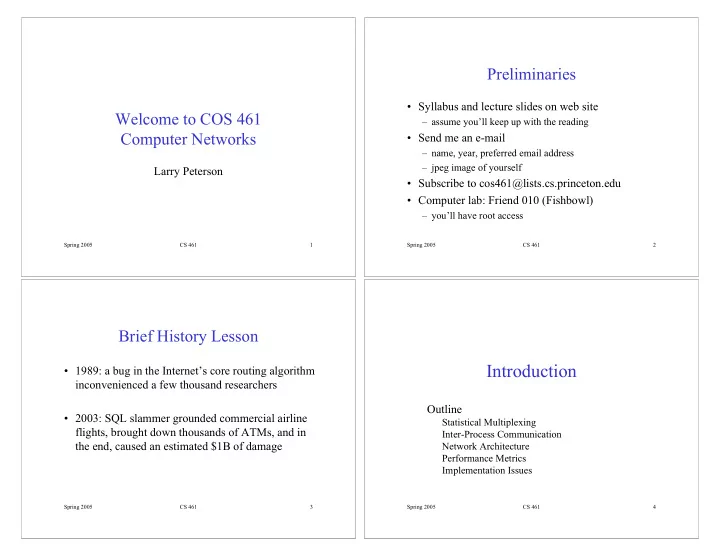
Welcome to COS 461 Computer Networks

Larry Peterson

Spring 2005 CS 461 2

Preliminaries

  • Syllabus and lecture slides on web site

– assume you’ll keep up with the reading

  • Send me an e-mail

– name, year, preferred email address – jpeg image of yourself

  • Subscribe to cos461@lists.cs.princeton.edu
  • Computer lab: Friend 010 (Fishbowl)

– you’ll have root access

Spring 2005 CS 461 3

Brief History Lesson

  • 1989: a bug in the Internet’s core routing algorithm

inconvenienced a few thousand researchers

  • 2003: SQL slammer grounded commercial airline

flights, brought down thousands of ATMs, and in the end, caused an estimated $1B of damage

Spring 2005 CS 461 4

Introduction

Outline

Statistical Multiplexing Inter-Process Communication Network Architecture Performance Metrics Implementation Issues

slide-2
SLIDE 2

Spring 2005 CS 461 5

Building Blocks

  • Nodes: PC, special-purpose hardware…

– hosts – switches

  • Links: coax cable, optical fiber…

– point-to-point – multiple access

Spring 2005 CS 461 6

Switched Networks

– two or more nodes connected by a link, or – two or more networks connected by a node

  • A network can be defined recursively as...

Spring 2005 CS 461 7

Strategies

  • Circuit switching: carry bit streams

– original telephone network

  • Packet switching: store-and-forward messages

– Internet

Spring 2005 CS 461 8

Addressing and Routing

  • Address: byte-string that identifies a node

– usually unique

  • Routing: process of forwarding messages to the

destination node based on its address

  • Types of addresses

– unicast: node-specific – broadcast: all nodes on the network – multicast: some subset of nodes on the network

slide-3
SLIDE 3

Spring 2005 CS 461 9

Multiplexing

  • Time-Division Multiplexing (TDM)
  • Frequency-Division Multiplexing (FDM)

L2 L3 R2 R3 L1 R1 Switch 1 Switch 2 Spring 2005 CS 461 10

Statistical Multiplexing

  • On-demand time-division
  • Schedule link on a per-packet basis
  • Packets from different sources interleaved on link
  • Buffer packets that are contending for the link
  • Buffer (queue) overflow is called congestion

_ _ _

Spring 2005 CS 461 11

Inter-Process Communication

  • Turn host-to-host connectivity into process-to-process

communication.

  • Fill gap between what applications expect and what the

underlying technology provides.

Host Host Host Channel Application Host Application Host

Spring 2005 CS 461 12

IPC Abstractions

  • Request/Reply

– distributed file systems – digital libraries (web)

  • Stream-Based

– video: sequence of frames

  • 1/4 NTSC = 352x240 pixels
  • (352 x 240 x 24)/8=247.5KB
  • 30 fps = 7500KBps = 60Mbps

– video applications

  • on-demand video
  • video conferencing
slide-4
SLIDE 4

Spring 2005 CS 461 13

What Goes Wrong in the Network?

  • Bit-level errors (electrical interference)
  • Packet-level errors (congestion)
  • Link and node failures
  • Packets are delayed
  • Packets are deliver out-of-order
  • Third parties eavesdrop

Spring 2005 CS 461 14

Layering

  • Use abstractions to hide complexity
  • Abstraction naturally lead to layering
  • Alternative abstractions at each layer

Hardware Host-to-host connectivity Request/reply channel Message stream channel Application programs

Spring 2005 CS 461 15

Protocols

  • Building blocks of a network architecture
  • Each protocol object has two different interfaces

– service interface: operations on this protocol – peer-to-peer interface: messages exchanged with peer

  • Term “protocol” is overloaded

– specification of peer-to-peer interface – module that implements this interface

Spring 2005 CS 461 16

Interfaces

Host 1 Host 2 Service interface Peer-to-peer interface High-level

  • bject

High-level

  • bject

Protocol Protocol

slide-5
SLIDE 5

Spring 2005 CS 461 17

Protocol Machinery

  • Protocol Graph

– most peer-to-peer communication is indirect – peer-to-peer is direct only at hardware level

Host 1 Host 2 File application Digital library application Video application File application Digital library application Video application

Spring 2005 CS 461 18

Machinery (cont)

  • Multiplexing and Demultiplexing (demux key)
  • Encapsulation (header/body)

Host Host Application program Application program RRP Data Data HHP RRP HHP Application program Application program RRP Data RRP Data HHP RRP Data

Spring 2005 CS 461 19

Internet Architecture

  • Defined by Internet Engineering Task Force (IETF)
  • Hourglass Design
  • Application vs Application Protocol (FTP, HTTP)

_ _ _

FTP TCP UDP IP NET 1 NET 2 NET n HTTP NV TFTP

Spring 2005 CS 461 20

ISO Architecture

One or more nodes within the network End host Application Presentation Session Transport Network Data link Physical Network Data link Physical Network Data link Physical End host Application Presentation Session Transport Network Data link Physical

slide-6
SLIDE 6

Spring 2005 CS 461 21

Performance Metrics

  • Bandwidth (throughput)

– data transmitted per time unit – link versus end-to-end – notation

  • KB = 210 bytes
  • Mbps = 106 bits per second
  • Latency (delay)

– time to send message from point A to point B – one-way versus round-trip time (RTT) – components Latency = Propagation + Transmit + Queue Propagation = Distance / c Transmit = Size / Bandwidth

Spring 2005 CS 461 22

Bandwidth versus Latency

  • Relative importance

– 1-byte: 1ms vs 100ms dominates 1Mbps vs 100Mbps – 25MB: 1Mbps vs 100Mbps dominates 1ms vs 100ms

  • Infinite bandwidth

– RTT dominates

  • Throughput = TransferSize / TransferTime
  • TransferTime = RTT + 1/Bandwidth x TransferSize

– 1-MB file to 1-Gbps link as 1-KB packet to 1-Mbps link

Spring 2005 CS 461 23

Delay x Bandwidth Product

  • Amount of data “in flight” or “in the pipe”
  • Usually relative to RTT
  • Example: 100ms x 45Mbps = 560KB

Bandwidth Delay

Spring 2005 CS 461 24

Socket API

  • Creating a socket

int socket(int domain, int type, int protocol)

  • domain = PF_INET, PF_UNIX
  • type = SOCK_STREAM, SOCK_DGRAM,

SOCK_RAW

  • Passive Open (on server)

int bind(int socket, struct sockaddr *addr, int addr_len) int listen(int socket, int backlog) int accept(int socket, struct sockaddr *addr, int addr_len)

slide-7
SLIDE 7

Spring 2005 CS 461 25

Sockets (cont)

  • Active Open (on client)

int connect(int socket, struct sockaddr *addr, int addr_len)

  • Sending/Receiving Messages

int send(int socket, char *msg, int mlen, int flags) int recv(int socket, char *buf, int blen, int flags)

Spring 2005 CS 461 26

Protocol-to-Protocol Interface

  • Configure multiple layers

– static versus extensible

  • Process Model

– avoid context switches

  • Buffer Model

– avoid data copies