Internet of Things System Architectures Paul Patras Image: - - PowerPoint PPT Presentation

internet of things system architectures
SMART_READER_LITE
LIVE PREVIEW

Internet of Things System Architectures Paul Patras Image: - - PowerPoint PPT Presentation

Internet of Things System Architectures Paul Patras Image: sns-it.ca Thousands of new applications spanning numerous domains. Each comes with its own requirements; combining these leads to complex (difficult to manage) and often


slide-1
SLIDE 1

Paul Patras

Image: sns-it.ca
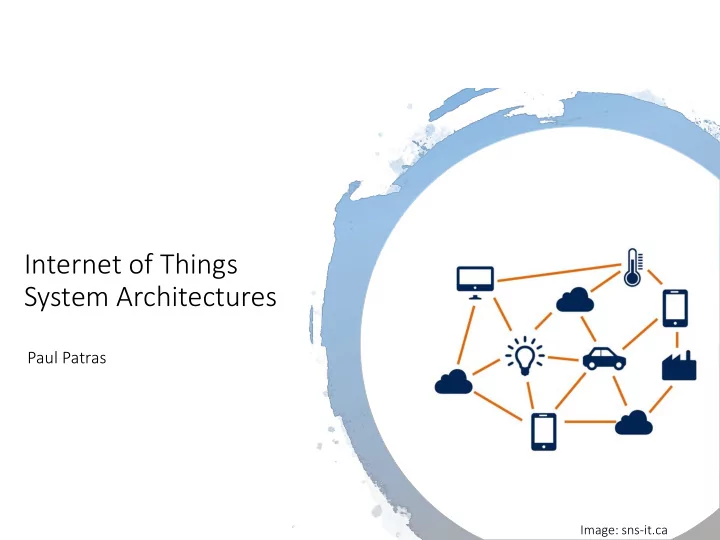
Internet of Things System Architectures

slide-2
SLIDE 2

The IoT Architectural landscape

  • Thousands of new applications spanning

numerous domains.

  • Each comes with its own requirements;

combining these leads to complex (difficult to manage) and often proprietary systems.

  • Defining a unified architecture is challenging

and interoperability problematic if too many standards to chose from.

  • Documentation scattered and often difficult

to navigate.

  • Efforts to define common frameworks
  • ITU-T, 3GPP, ETSI, IETF
  • EC (via collaborative projects),
  • Industry consortium (e.g. Open Connectivity

Foundation),

  • Big players (e.g. Cisco).
  • We will not cover everything, but focus on

the key principles these architectural patterns share and examine some examples.

slide-3
SLIDE 3

Key considerations

What application domains should be covered? Where to place the “intelligence”? What networking structure should be employed? How to modularize systems, so as to manage complexity and enable programmability? What about costs and scalability?

slide-4
SLIDE 4

Stakeholders slowly converging

At a high level, the shared view looks like this

Physical world (sensors, actuators) Infrastructure/Networking Fabric (connectivity, storage) Platform (API, protocols, data processing, device management) Applications (different scales) Security & Privacy

slide-5
SLIDE 5

Immediate advantages

  • Enabling software/app developers to build

applications without having to understand the specifics of a device – Platform as a Service (PaaS)

  • Better sharing and strict partitioning of

network and computing resources (slicing); taking away from service providers the burden of building and managing a network– Infrastructure/Network as a Service (IaaS/Naas)

  • Allowing IoT device manufacturers to focus

strictly on improving their performance, power consumption, etc. – expose only well- defined interfaces to software platforms.

slide-6
SLIDE 6

The challenging part: Security

  • Hardware isolation (eFuse, ARM TrustZone)
  • Middleware (Intel MPX- Memory Protection

Extensions)

  • Network isolation (VPN, SDN)
  • Software isolation (Sandboxing)

End-to-end security not straightforward – encryption remains the only option, but sometimes expensive (computing power, communication overheads)

slide-7
SLIDE 7

What happens in practice?

Source: Cisco

slide-8
SLIDE 8

Cloud vs Fog vs Edge

Cloud computing dominated the networked systems landscape until recently

  • End-devices merely information gatherers
  • All intelligence in the cloud (relational

DBs, analytics, web interfaces, control functions)

As the number of devices grows, applications diversify and generate more data, this will not scale

  • Routing and storage costs
  • Signalling overheads
  • Latency inappropriate for real-time apps
slide-9
SLIDE 9

Example: Smart metering

Source: iwireless-solutions.com

  • Simple sensing devices; data relayed over cellular;

processing by multiple entities in the cloud

slide-10
SLIDE 10

Fog computing

  • Pushing some of the effort closer to the device, i.e.

to access networks/gateways.

  • This includes data aggregation, compression,

(partial) processing; making localised decisions.

  • IoT device
  • Not required to be extremely smart, i.e. unique address

and ability to communication directly with the cloud

  • No substantial storage
  • Battery powered (lifetime)
slide-11
SLIDE 11

Roles of gateways

  • 1. Data filtering and processing (e.g., aggregation of

summaries, compression, etc.)

  • 2. Protocol translation and interfacing between

different connectivity technologies

  • 3. Security (e.g., data encryption, firewalling)
  • 4. Data flow multiplexing, packet routing

Sc Scala labil ilit ity proble lem: as the number of devices grows, so will the number of gateways that are required

slide-12
SLIDE 12

Example: Home automation

  • K. Mandula, R. Parupalli, C. A. S. Murty, E. Magesh and R. Lunagariya, "Mobile based

home automation using Internet of Things(IoT)," ICCICCT, Kumaracoil, 2015

slide-13
SLIDE 13

Example: Fitness tracking systems

The user’s mobile phone acting as gateway

  • H. Fereidooni, J. Classen, T. Spink, P. Patras, M. Miettinen, A.-R. Sadeghi, M. Hollick, M. Conti, "Breaking Fitness

Records without Moving: Reverse Engineering and Spoofing Fitbit", Proc. RAID, Atlanta, GA, USA, Sept. 2017.

slide-14
SLIDE 14

Edge computing (process as much as possible where data is collected)

  • Pushing processing power, communication

capabilities, intelligence down at device level

  • Emerging applications range from autonomous

vehicles, to VR glasses, to earbuds.

  • Do as much processing as required on the device,

transmit only what is relevant long term or summaries

  • Low latency and decentralised decisions
  • Less signalling and communication overhead
  • Personalised experience
slide-15
SLIDE 15

Example: Deep Learning at the Edge

Har ardware Sup upport: Low-power chips specialised in computationally intensive tasks (IBM TrueNorth, Movidius, Huawei Kirin) Sof

  • ftw

tware: lightweight inference frameworks

  • ptimised for constrained devices (mobile

TensorFlow, Apple CoreML, DeepSense) Dedi edicated NN ar architectures: Model compression (SqueezeNet, MobileNet), point-wise group convolution (ShuffleNet), model pruning (NestDNN).

slide-16
SLIDE 16

Ultimately it is about performance

Source: pubnub.com

slide-17
SLIDE 17

Standards (I)

  • IEEE, 3GPP, IETF, and several alliances

standardising the ‘language’ devices speak among each another / with gateways or cloud services.

  • IEEE (the Institute of Electrical and

Electronics Engineers) mostly dealing with definition of protocols for access networks

  • Targeting the ISM bands with 802.15.4

(used by Zigbee) and ‘WiFi’ extensions for low power wide area networking, i.e. 802.11ah (HaLow)

slide-18
SLIDE 18

Standards (II)

  • 3GPP (3rd Generation Partnership

Project) focuses on specifying cellular network architectures and protocols (GSM, 3G, 4G-LTE, etc.)

  • Developing standards for cellular

communications tailored to IoT applications

  • LTE-M - compatible with existing LTE

networks, easy to roll out, limited to max 1Mb/s speeds

  • NB-IoT - different band, lower capacity

(200kb/s), different modulation, but no need for gateways.

slide-19
SLIDE 19

Standards (III)

  • IETF (Internet Engineering Task Force)

focusing on specifying protocols for

  • Routing (6LoWPAN, Routing Over Low-

power and Lossy networks - ROLL)

  • End to end communications (TCP/IP,

HTTP, CoAP, MQTT)

  • Security (DNSSEC, Datagram Transport

Layer Security - DTLS)

  • Software updating (SUIT – specific to IoT)
  • Language independent formats (JSON)
slide-20
SLIDE 20

Standards (IV)

  • Industry alliances
  • Bluetooth (personal area networks,

application profiles)

  • ZigBee (on top of IEEE 802.15.4,

inexpensive consumer/industrial)

  • LoRaWAN (low-power long range)
  • Other (NIST – encryption, ISO – IoT

reference architecture, ITU – recommendations, reference models)

slide-21
SLIDE 21

The complete picture

slide-22
SLIDE 22

The complete picture