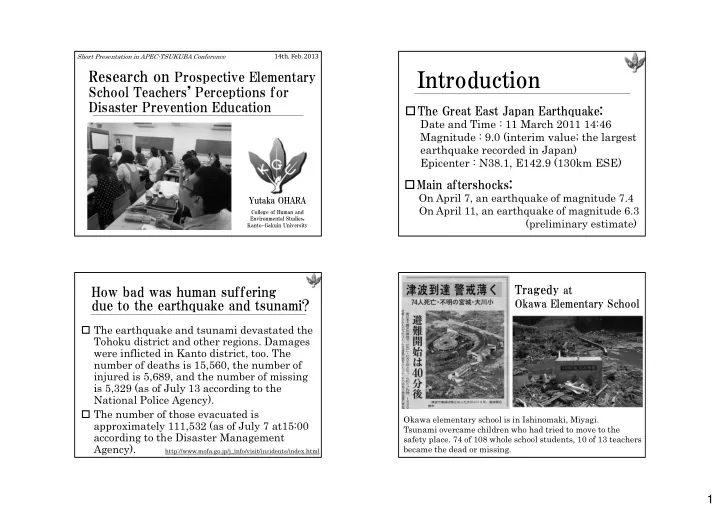
Introduction Research on Prospective Elementary School Teachers' - - PowerPoint PPT Presentation

introduction
SMART_READER_LITE
LIVE PREVIEW

Introduction Research on Prospective Elementary School Teachers' - - PowerPoint PPT Presentation

14th. Feb.2013 Short Presentation in APEC-TSUKUBA Conference Introduction Research on Prospective Elementary School Teachers' Perceptions for Disaster Prevention Education The Great East Japan Earthquake: Date and Time : 11 March 2011 14:46


slide-1
SLIDE 1

1

Research on Prospective Elementary

School Teachers' Perceptions for Disaster Prevention Education

  • 14th. Feb.2013

Short Presentation in APEC-TSUKUBA Conference

Yutaka OHARA

College of Human and Environmental Studies, Kanto-Gakuin University

The Great East Japan Earthquake:

Date and Time : 11 March 2011 14:46 Magnitude : 9.0 (interim value; the largest earthquake recorded in Japan) Epicenter : N38.1, E142.9 (130km ESE)

Introduction

Main aftershocks:

On April 7, an earthquake of magnitude 7.4 On April 11, an earthquake of magnitude 6.3 (preliminary estimate)

How bad was human suffering due to the earthquake and tsunami?

 The earthquake and tsunami devastated the Tohoku district and other regions. Damages were inflicted in Kanto district, too. The number of deaths is 15,560, the number of injured is 5,689, and the number of missing is 5,329 (as of July 13 according to the National Police Agency).  The number of those evacuated is approximately 111,532 (as of July 7 at15:00 according to the Disaster Management Agency).

http://www.mofa.go.jp/j_info/visit/incidents/index.html

Tragedy at

Okawa Elementary School

Okawa elementary school is in Ishinomaki, Miyagi. Tsunami overcame children who had tried to move to the safety place. 74 of 108 whole school students, 10 of 13 teachers became the dead or missing.

slide-2
SLIDE 2

2

Seriously consider what teacher trainer can do

In disaster, elementary schools will have most serious damage. Although there are some researches

  • n in-service teachers and pupils for

disaster prevention, little attention has been given to pre-service teacher’s perception for it.

Purpose & Method

The purpose of this study is to investigate the characteristics of prospective elementary school teachers' awareness in disaster prevention education. For this purpose, we conducted a questionnaire investigation for 96

  • subjects. Data were gathered in

November 2011.

Primary Findings

 Pre-service elementary school teachers have interest in disaster reduction education to study professional issues  Six factors extracted from their consciousness by factor analysis  Highly technical three factors had positively affected confidence in judgment, instructions under disaster, and development of pupil’s independence during usual activity.

Questionnaire investigation

Part A is to identify their levels of interests about disaster prevention education. the questionnaire has two parts. Part B is to check their levels of confidence to teach the disaster prevention for pupils

slide-3
SLIDE 3

3

  • Q1. I'm interested in disaster prevention.
  • Q2. I'm interested in disaster prevention education.
  • Q3. I would like to take a lecture on school safety.
  • Q4. I would like to hear from experts of disaster

prevention.

  • Q5. I would like to hear from afflicted people.

(Six level choices)

Part A of questionnaire

Strongly No No Maybe No Strongly Yes Yes Maybe Yes

Part B of questionnaire

 (a) Items on the earthquakes & tsunamis and terrain & facilities. (11 items)  (b) Items on the nature or cause of the earthquake & tsunami. (11 items) (c) Items on disaster prevention. (11 items)

Confidences for Pedagogical Contents Knowledge

 (d) Items on disaster prevention

  • Education. (6 items)

Confidences for Pedagogical Skills

(Six level choices)

Results of Part A

 Firstly, all items are statistically-significant by Fisher's exact probability (binominal) test.

(p<.01)

N=96 N=96

Average SD

Q1(P) **

4.73 1.06

Q2(P) **

4.82 0.91

Q3(P) **

4.81 0.95

Q4(P) **

4.64 0.94

Q5(P) **

5.03 0.98

 Therefore, prospective elementary school teachers have interest in disaster reduction education to study professional issues

Factor Scores (Weighted Average) : 0.469

Results of Part B

Profession of Disaster Presentational factor (#1) Earthquake Basement factor (#2) Earthquake Profession factor (#3) Urgency Evacuation factor (#4) Localism factor (#5) Landscape factor (#6)

Cronbach's coefficient α : 0.661

Factor Analysis

slide-4
SLIDE 4

4

Results of Part B Multiple Linear Regression Analysis

Independent Variables (factors)

Dependent Variable #1

Having a lot of confidence in ability to make right decision when Earthquake

  • ccurred

R

Multiple Correlation Coefficient Profession of Disaster Earthquake Basement Earthquake Profession

*p<.001, R2 = 0.401

Urgency Evacuation

0.608 * 0.263 *

Localism Landscape & form

  • 0.233 *

Results of Part B Multiple Linear Regression Analysis

Independent Variables (factors)

Dependent Variable #2

Having a lot of confidence in ability to provide right direction when Earthquake

  • ccurred

R

Multiple Correlation Coefficient Profession of Disaster Earthquake Basement Earthquake Profession

*p<.001, R2 = 0.414

Urgency Evacuation

0.513 * 0.231 *

Localism Landscape & form

Results of Part B Multiple Linear Regression Analysis

Independent Variables (factors)

Dependent Variable #3

Having a lot of confidence in ability to develop proactive attitude for

Disaster Prevention

R

Multiple Correlation Coefficient Profession of Disaster Earthquake Basement Earthquake Profession

β1

*p<.001, R2 = 0.276

Urgency Evacuation

0.532 *

Localism Landscape & form

Short Discussion

 Specially, three factors (Profession of Disaster

Preventional factor (#1), Urgency Evacuation factor (#4), Localism factor (#5), ) had positively

affected prospective teacher’s confidence under disaster.  So far, we have seen what it is important to develop the prospective teacher from a viewpoint of disaster prevention education in pre-service teacher training.