Introduction The IFRS revolution: some early evidence Improved - - PDF document

introduction
SMART_READER_LITE
LIVE PREVIEW

Introduction The IFRS revolution: some early evidence Improved - - PDF document

Accounting for asset impairment: A test for IFRS compliance across Europe Hami Amiraslani, George E. Iatridis, Peter F. Pope* 17 January 2013 Centre for Financial Analysis and Reporting Research (CeFARR) Faculty of Finance, Cass Business School


slide-1
SLIDE 1

Accounting for asset impairment:

A test for IFRS compliance across Europe

Hami Amiraslani, George E. Iatridis, Peter F. Pope*

17 January 2013

Centre for Financial Analysis and Reporting Research (CeFARR) Faculty of Finance, Cass Business School

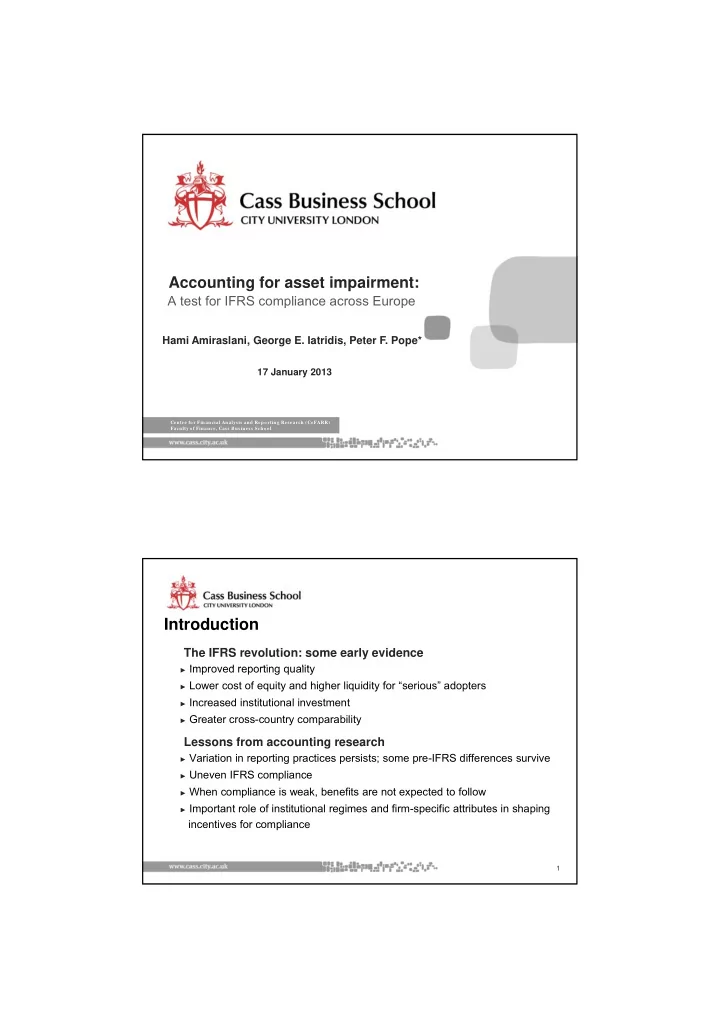
Introduction

The IFRS revolution: some early evidence

Improved reporting quality

► Improved reporting quality ► Lower cost of equity and higher liquidity for “serious” adopters ► Increased institutional investment ► Greater cross-country comparability

Lessons from accounting research

► Variation in reporting practices persists; some pre-IFRS differences survive ► Uneven IFRS compliance ► Uneven IFRS compliance ► When compliance is weak, benefits are not expected to follow ► Important role of institutional regimes and firm-specific attributes in shaping

incentives for compliance

1

slide-2
SLIDE 2

Introduction

Relevance of asset write-downs: why now?

► Financial and economic instabilities ► Financial and economic instabilities ► Events surrounding the crisis may have triggered write-downs ► Importance of assumptions and estimates underlying impairments ► IFRS preparers in Europe are likely to continue to face impaired assets

Persistent economic uncertainty: A recipe for impairment

► Assets: probable future economic benefits (e.g., future cash flows)

D d i i t f t f f t h fl d th

► Downward revisions to forecasts of future cash flows and growth ► Upward revisions to projected discount rates (risk) ► Reduced likelihood that carrying amounts will be recovered ► Revised assumptions and estimates following the crisis 2

Measuring asset impairment – IAS 36

The balance sheet value of an asset is the lower of: Carrying amount: Depreciated historical cost (or other allowed alternatives) Recoverable amount, which is the higher of: Fair value less cost to sell which is the higher of: Value in use

3

slide-3
SLIDE 3

Asset impairment testing – IAS 36

See: (Ernst & Young, 2011)

4

Overview of the research

What we do in this study

An empirical evaluation of “asymmetric timeliness” An empirical evaluation of asymmetric timeliness

► Timeliness of IFRS impairments across Europe (2006-2011) ► Speed at which economic losses are captured by impairments ► Cross-country variation in the timeliness of asset write-downs ► A sample of impairment-intensive (impairments as a % of total assets) firms

A survey of impairment reporting practices

► Compliance with IFRS impairment reporting requirements in recent published ► Compliance with IFRS impairment reporting requirements in recent published

annual accounts (2010-2011)

► Role of country-level institutional and regulatory regimes and firm-specific

factors

► Unexplored role of effort and managerial judgement in shaping compliance 5

slide-4
SLIDE 4

Institutional and regulatory diversity

► Presence of “institutional bundles” around the world

Overview of the research

► Cluster 1 countries: Outsider economies with strong outside protection

and rule enforcement regimes

► Cluster 2 countries: Insider economies with (relatively) stronger rule

enforcement regimes

► Cluster 3 countries: Insider economies with weaker regulatory scrutiny and

rule enforcement regimes

Role of institutional differences

► Variations in timely loss recognition across institutional country-clusters ► Differences in IFRS compliance for impairments of non-current non-financial

assets (PP&E, intangible assets and goodwill)

6

Institutional and regulatory regimes

Standards Institutions Outcomes Developed stock markets, dispersed ownership, strong investor protection and strong enforcement Less developed stock markets, concentrated ownership, weak investor protection and strong IFRS Financial reporting quality Compliance p g enforcement Less developed stock markets, concentrated ownership, weak investor protection and weak enforcement quality

7

slide-5
SLIDE 5

Institutional clusters in Europe

Cluster 1 Cluster 2 Cluster 3 Large, developed stock markets Di d hi Less developed stock markets C t t d hi Less developed stock markets C t t d hi Dispersed ownership Strong investor protection Strong enforcement Concentrated ownership Weak investor protection Strong enforcement Concentrated ownership Weak investor protection Weak enforcement Ireland Austria Czech Republic* United Kingdom Belgium Estonia* Denmark Greece Finland Hungary* France Italy Germany Lithuania* Luxembourg Poland* Luxembourg Poland Netherlands Portugal Norway Romania* Spain Slovakia* Sweden Slovenia* Switzerland

See: (Leuz et al., 2003; Leuz, 2010)

8

* Countries not covered in earlier classifications

Timeliness of impairments

► Asymmetric timeliness: manifestation of conditional conservatism ► Evidence from 4,474 listed companies (2006-2011) support the role of

institutions in shaping timely loss recognition across all three asset classes

AT across country-clusters (2006-2011) Firms Earnings PP&E impairment Intangible asset impairment Goodwill impairment

All countries 4,474 31.7% 5.7% 7.4% 17.8% Cluster 1 1,203 35.1% 9.4% 9.2% 20.7% Cluster 2 2,321 32.9% 4.4% 5.3% 12.9% Cluster 3 950 18.6% 1.2% 0.0% 5.9%

9

slide-6
SLIDE 6

Survey of impairment reporting practices

IFRS compliance behaviour

How we document compliance levels How we document compliance levels

► Survey based on IFRS impairment disclosures (99 items across asset groups) ► Unweighted and partial indices, overall and for each asset class ► Sample of 324 impairment-intensive companies in 2010-2011

Some highlights from our findings

► Major variations and limited cases of full compliance across the asset classes ► Median compliance ranges from 77 2% (intangible assets) to 85 6% (PP&E) ► Median compliance ranges from 77.2% (intangible assets) to 85.6% (PP&E) ► Positive association between impairment intensity and compliance 10

Survey of impairment reporting practices

Observations from selected disclosure areas

Accounting policies and judgements Accounting policies and judgements

► High levels of compliance across Europe ► Boilerplate disclosures, possibility of mere “box-ticking”

Estimation uncertainty and changes to past assumptions

► Uncertainty: root of subjectivity in impairment measurements ► Heightened relevance in times of economic uncertainty ► Limited disclosure on changes to or the continued relevance of assumptions ► Limited disclosure on changes to or the continued relevance of assumptions

Sensitivity of carrying amounts

► Limited disclosure (country-level median: 56.8%) may have implications for

the relevance of goodwill information

► Disclosures are important in shaping users’ views on reliability 11

slide-7
SLIDE 7

Observations from selected disclosure areas

T i i t

Survey of impairment reporting practices

Triggering events

► Justification for asset write-offs is critical ► Lack of adequate transparency adds to uncertainty (e.g., only 71% in PP&E)

Basis for recoverable amount (VIU or FVLCD)

► VIU is the prevalent measurement method ► Many cases where the basis is not specified (e.g., 38% in intangible assets) ► Selected bases impact balance sheet positions ► Selected bases impact balance sheet positions

Highly aggregated disclosures for segment results

► Impairments are often aggregated with segment depreciation and amortisation ► Potential for reduced relevance of segment information 12

Observations from selected disclosure areas

Di l f i i d t ithi ti t

Survey of impairment reporting practices

Disclosure of impaired assets within operating segments

► Opacity of disclosures on “impaired” assets per segment (e.g., country-level

median score for the intangibles sample is as low as 29.2%) CGU description and allocation of goodwill to CGUs

► Higher disclosure scores (e.g., description: 74%; GW per CGU: 85%) ► Uneven disclosures on justification for allocation decisions

Cash flow projections, growth and discount rates

► Variation in disclosures on assumptions about projections and selected rates

► Projection periods: single versus multiple forecast period ► Growth rates: single versus multiple growth rates ► Discount rate: WACC used evenly across CGUs with different risk profiles

13

slide-8
SLIDE 8

Institutions and firm-level attributes

C li diff t l t

Drivers of impairment reporting practices

Compliance differences across country-clusters

► Higher compliance scores in cluster 1 countries ► No major difference in compliance between cluster 2 and cluster 3 countries

Institutions and firm-specific features

► Range of firm-level attributes considered ► Results for our sample suggest that disclosure quality is higher when:

► firms have Big 4 auditors; ► are larger (size measured based on total assets) ► have higher leverage (measured based on scaled total debt) ► are more impairment-intensive ► are operating in the oil and gas industry

14

A general effort-based classification of IFRS disclosures

High effort versus low effort disclosures

Role of effort and judgement

High-effort versus low-effort disclosures

► Discretion and judgement varies across disclosures ► Some require high effort (e.g., annual sensitivity analyses) while other do not

(e.g., accounting policy on depreciation)

► Potential for variation in compliance across the two partitions

Results

► Significant differences in the two sets of disclosures across all asset classes ► Significant differences in the two sets of disclosures across all asset classes ► Cost and effort associated with disclosures adversely influence the quality of

information provided by preparers

► High compliance with low-effort requirements is masking low compliance with

high-effort requirements

15

slide-9
SLIDE 9

Asset class

Role of effort and judgement

52.64% 74.82% 86.11% 88.80% Intangible assets Goodwill

Low-effort High-effort

69.24% 89.80% 0% 10% 20% 30% 40% 50% 60% 70% 80% 90% 100% PP&E Compliance 16

Uneven application of IFRS for impairment reporting across Europe

► Variations in timeliness and compliance levels across countries and industries

Summary and conclusion

p

Role of regulatory and oversight regimes in IFRS application

► Harmonised standards may not translate into harmonised reporting practices

IFRS entail major judgements, estimates and assumptions

► Managerial discretion in making judgements ► Validity of assumptions underlying measurements

C li ff t i i t d th b fit f di l

► Compliance effort is uneven across requirements; do the benefits of disclosure

justify preparers’ costs (efforts)?

High-quality disclosure can reduce uncertainty about measurements

► Relevant for valuation purposes and to users’ economic decisions 17

slide-10
SLIDE 10

► Barth, M. E., Landsman, W. R. and Lang, M. H. and Williams, C. D. (2012) Are IFRS-based and US GAAP-

based accounting amounts comparable? Journal of Accounting and Economics 54(1), pp. 68–93.

Selected references

► Barth, M. E., Landsman, W. R. and Lang, M. H. (2008) International Accounting Standards and accounting

quality, Journal of Accounting Research 46(3), pp. 467–498.

► Basu, S. (1997) The conservatism principle and the asymmetric timeliness of earnings, Journal of

Accounting and Economics 24(1), pp. 3–37.

► Brochet, F., Jagolinzer, A. D. and Riedl, E. D. (2013) Mandatory IFRS adoption and financial statement

comparability, Contemporary Accounting Research (Forthcoming).

► Daske, H., Hail, L., Leuz, C. and Verdi, R. S. (2013) Adopting a label: Heterogeneity in the economic

consequences around IAS/IFRS adoptions, Journal of Accounting Research (Forthcoming). consequences around IAS/IFRS adoptions, Journal of Accounting Research (Forthcoming).

► European Securities and Markets Authority (2011) Report - Activity report on IFRS enforcement in 2010,

Brussels: ESMA.

► Florou, A. and Pope, P. F. (2012) Mandatory IFRS adoption and institutional investment decisions, The

Accounting Review 87(6), pp. 1993–2025.

18

► Kvaal, E. and Nobes, C. W. (2012) IFRS policy changes and the continuation of national patterns of IFRS

practice, European Accounting Review 21(2), pp. 343–371.

Selected references, continued

p , p g ( ), pp

► Leuz, C. (2010) Different approaches to corporate reporting regulation: How jurisdictions differ and why,

Accounting and Business Research 40(3), pp. 229–256.

► Leuz, C., Nanda, D. J. and Wysocki, P. D. (2003) Earnings management and investor protection: An

international comparison, Journal of Financial Economics 69(3), pp. 505–527.

► Nobes, C. W. (2006) The survival of international accounting differences under IFRS: Towards a research

agenda, Accounting and Business Research 36(3), pp. 233–245.

► Pope, P. F. and McLeay, S. J. (2011) The European IFRS experiment: Objectives, research challenges

and some early evidence Accounting and Business Research 41(3) pp 233 266 and some early evidence, Accounting and Business Research 41(3), pp. 233–266.

► Pope, P. F. and Walker, M. (1999) International differences in the timeliness, conservatism and

classification of earnings, Journal of Accounting Research 37(Supplement), pp. 53–87.

► Wysocki, P. D. (2011) New institutional accounting and IFRS, Accounting and Business Research 41(3),

  • pp. 309–328.

19