Introduction Context is a new graduate level course Approaches to - - PDF document

introduction
SMART_READER_LITE
LIVE PREVIEW

Introduction Context is a new graduate level course Approaches to - - PDF document

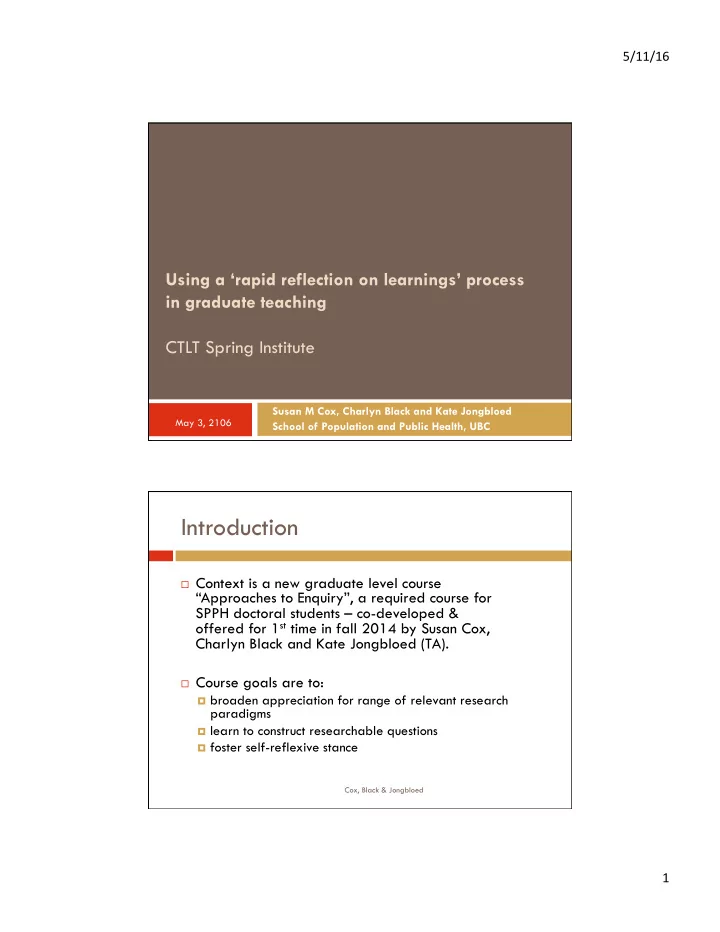
5/11/16 Using a rapid reflection on learnings process in graduate teaching CTLT Spring Institute Susan M Cox, Charlyn Black and Kate Jongbloed May 3, 2106 School of Population and Public Health, UBC Introduction Context is a new


slide-1
SLIDE 1

5/11/16 1

Using a ‘rapid reflection on learnings’ process in graduate teaching CTLT Spring Institute

Susan M Cox, Charlyn Black and Kate Jongbloed School of Population and Public Health, UBC

May 3, 2106

Introduction

Context is a new graduate level course

“Approaches to Enquiry”, a required course for SPPH doctoral students – co-developed &

  • ffered for 1st time in fall 2014 by Susan Cox,

Charlyn Black and Kate Jongbloed (TA).

Course goals are to: broaden appreciation for range of relevant research

paradigms

learn to construct researchable questions foster self-reflexive stance

Cox, Black & Jongbloed

slide-2
SLIDE 2

5/11/16 2

Focus of SoTL research

Which pedagogic strategies are most effective in team-teaching students how to appreciate a wide range of possible approaches to enquiry in population and public health (P&PH) research?

Cox, Black & Jongbloed

Our current research

Prospective case studies of co-teaching ‘Approaches

to Enquiry’ (with new cohort each year)

Use of autoethnographic (Reed-Danahay 1997) &

participatory action research (McIntyre 2008) to capture multiple perspectives, involve students in process & apply learning in iterative cycle

Methods of data collection include:

in-class observations & formative review of teaching and class interaction

(done by instructors and students or peers)

instructor de-briefing and reflective journaling after each class rapid reflection on learnings process

Cox, Black & Jongbloed

slide-3
SLIDE 3

5/11/16 3

Rapid reflection on learnings process

Evolved from ‘critical incident reporting’ (see Fook

& Gardener, 2007), renamed and oriented to avoid perception that something went wrong

Consists of one page form, completed and shared

(one copy each for instructors & student)

Asks students to identify:

points in the class where they felt most and least engaged actions taken by anyone that were affirming or confusing specific 'aha' moments salient take-away messages

Cox, Black & Jongbloed

Applying the rapid reflection process

Provide students with forms at beginning of class and

they hand in completed forms before they leave.

Allow about 5 minutes for completion at end of class. Hand written is okay though variability in neatness

means forms are sometimes hard to decipher.

Students provide their names on forms so comments

are NOT anonymous.

Response rate was nearly 100% over 10 classes (not

used at 1st and last class of term).

Cox, Black & Jongbloed

slide-4
SLIDE 4

5/11/16 4

Usefulness of RR process

The systematic feedback we obtain is invaluable to

  • ur team teaching in several key ways:

it provides weekly input that allows us to monitor

students’ learning

it helps us to identify & respond to trouble spots it prompts to students to engage in reflective

learning about their own learning

it gives us insight into effective and ineffective

pedagogic strategies

Cox, Black & Jongbloed

Monitoring students’ learning

Confirming what students understood and found relevant or irrelevant through key learnings question

“Yes! The framing of a research paradigm driving a

question that is answered by a method seems blindingly

  • bvious now.” (Week 2)

“That I need to think more deeply over the next few

months about what my positions as a researcher are. That your positions as a researcher evolve over time.” (Week 2)

“Interdisciplinary thinking can be beneficial on

collaborative teams.” (Week 3)

Cox, Black & Jongbloed

slide-5
SLIDE 5

5/11/16 5

Identifying trouble spots

Identifying substantive issues or topics that were confusing and may require additional clarification

“Discussion about methodology versus methods was a bit

confusing.” (Week 2)

“I liked the cartoon [of the sheep talking about a

conspiracy] but I felt people may have been confused about the kind of answers being looked for.” (Week 4)

“I’m still unclear about the difference between theory and

  • paradigm. How can critical theory be fitted into the

description of a paradigm?” (Week 4)

Cox, Black & Jongbloed

Prompting students to reflect on their learning

Locating a sense of how students understand their own learning process and what facilitates this

“Some experiences shared by students that made me

realize that I am not the only one!!” (Week 3)

“I had new insights about ethics in my research. Particularly

about ‘ethical moments’ that I encountered in the past. This was surprising and sometimes disturbing as I think I may not have acted properly.” (Week 6)

“Last class the personal aspect of the journal synthesis was

emphasized and this week it was de-emphasized. After last class I tried to personalize my synthesis #2 more but now I wonder if I went too far. I guess time will tell! : )” (Week 7)

Cox, Black & Jongbloed

slide-6
SLIDE 6

5/11/16 6

Insight into effective/ineffective pedagogic strategies

Gaining insight into what engages students and usefulness

  • f specific exercises or approaches

“I enjoyed our lab activity. It was neat to operationalize the

concepts in different ways.” (Week 7)

“Loved the jeopardy [game] too – great interactive activity.”

“It applies what we learn from the seminar.” (Week 5)

“Theory-based activity and solid examples can be used

more frequently (i.e., drawing from instructor’s research experience really helpful).” (Week 5)

Cox, Black & Jongbloed

Other insights from the process

Question about when students felt least engaged

shed light on physical and other constraints on ability to concentrate or stay engaged (e.g., hungry, tired, too much ambient sound at back of room)

Engagement interpreted in different ways

(e.g., “I got to talk a lot” vs the ideas were thought provoking)

Very little critical material perhaps because of

identifiability of respondents

Cox, Black & Jongbloed

slide-7
SLIDE 7

5/11/16 7

Other insights from the process cont’d

Strong endorsement of value of student/peer

expertise in learning and appreciation of students being asked to contribute to a discussion, especially as it affirmed respect for student learning and voice

Widespread collective concern for other students’

learning process and what might impede it

Thoughtfulness about actions taken by instructors

was inspiring/affirming to us along with tips for improving our teaching

Cox, Black & Jongbloed

Ethical considerations

Considerations around identifiability vs

anonymity

Ability to provide candid perspective without

concern for impact on course grade

How to identify and respond to moments

where there is a conflict and someone feels hurt or left out

Accountability to students and regular sharing

  • f what we learn from process each week

Cox, Black & Jongbloed

slide-8
SLIDE 8

5/11/16 8

Conclusions

Rapid reflection process is a core piece of our

evolving pedagogy, used as one piece of a constellation of components

Need to evaluate whether students actually do

find the process helpful to their own learning

Reconsider allowing for some portion of the

process to be anonymous and doing it electronically

Cox, Black & Jongbloed

References

Fook J. & Gardener F. (2007). Practicing Critical Reflection: A

Resource Handbook, Maidenhead. McGraw Hill/Open University Press.

McIntyre A. (2008) Participatory Action Research. Sage

Publications

Palmer, Parker J. (2007). The Courage to Teach: Exploring the

Inner Landscape of a Teacher’s Life. John Wiley & Sons.

Reed-Danahay, D. (ed.) (1997) Auto/ Ethnography: Rewriting

the Self and the Social. Oxford: Berg.

Cox, Black & Jongbloed