Introduction Lettuces Kingdom : Plantae Order : Asterales Family: - - PDF document

introduction
SMART_READER_LITE
LIVE PREVIEW

Introduction Lettuces Kingdom : Plantae Order : Asterales Family: - - PDF document

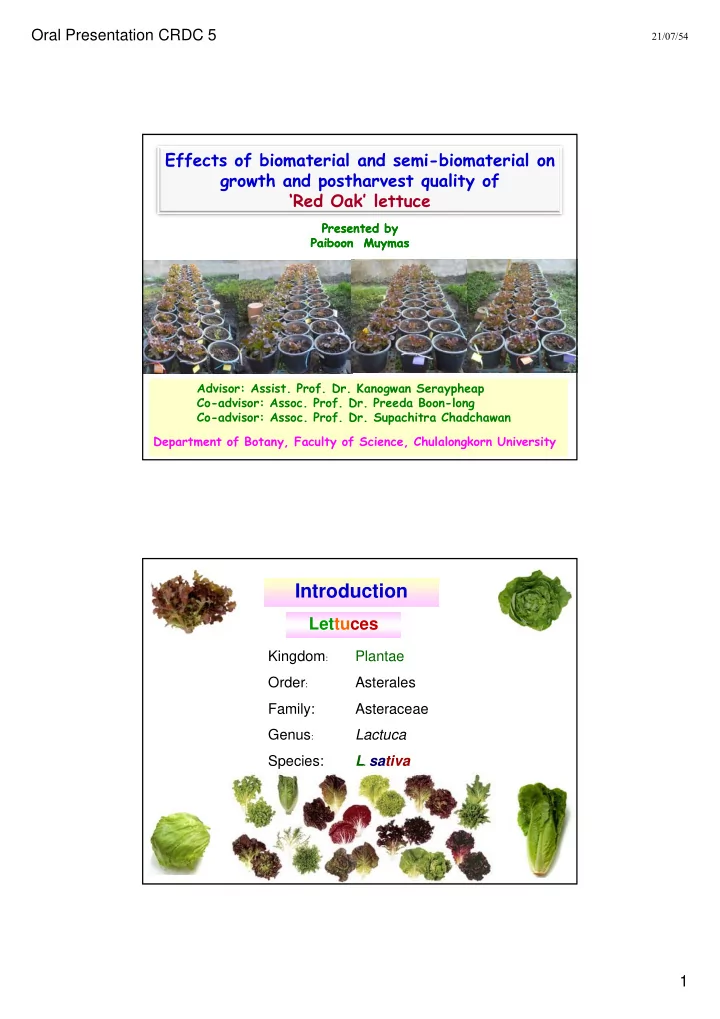
21/07/54 Oral Presentation CRDC 5 Effects of biomaterial and semi-biomaterial on growth and postharvest quality of Red Oak lettuce Presented by Presented by Paiboon Paiboon Paiboon Paiboon Muymas Muymas Muymas Muymas Advisor:


slide-1
SLIDE 1

Oral Presentation CRDC 5 21/07/54 1

Presented by Paiboon Muymas Presented by Paiboon Muymas

Effects of biomaterial and semi-biomaterial on growth and postharvest quality of ‘Red Oak’ lettuce

Paiboon Muymas Paiboon Muymas Advisor: Assist. Prof. Dr. Kanogwan Seraypheap Co-advisor: Assoc. Prof. Dr. Preeda Boon-long Co-advisor: Assoc. Prof. Dr. Supachitra Chadchawan Department of Botany, Faculty of Science, Chulalongkorn University

Kingdom: Plantae

Lettuces

Introduction

Order: Asterales Family: Asteraceae Genus: Lactuca Species:

  • L. sativa
slide-2
SLIDE 2

Oral Presentation CRDC 5 21/07/54 2

Diseases of Lettuce

Hydroponics

ผักกางมุ้ง

slide-3
SLIDE 3

Oral Presentation CRDC 5 21/07/54 3

Organic foods Chitosan

slide-4
SLIDE 4

Oral Presentation CRDC 5 21/07/54 4

Chitosan

Deacetylation

  • Sprayed chitosan (O-80) every 1 week: 10 and 50 ppm

Chitosan Appilcation

Dendrobium ‘EISKUL’

(Limpanavech et al., 2008)

induced early flowering enhanced the floral production

slide-5
SLIDE 5

Oral Presentation CRDC 5 21/07/54 5

Chitosan Appilcation

An increase of tomato yield at harvest was highly correlated Effect of chitosan on yield at harvest An increase of tomato yield at harvest was highly correlated with the concentration of chitosan applied to soil inoculated with F. oxysporum and F. radicislycopersici before seedling transplanting (Lafontaine and Benhamou, 1996) Shrimp shell

Potential of biomatertial / semi – biomatrial

Chitosan waste

slide-6
SLIDE 6

Oral Presentation CRDC 5 21/07/54 6

Objectives

  • 1. To investigate the effects of biomaterial and/or semi-biomaterial on growth

and production yield of lettuces during three successive crop seasons. 1 1 L f b 1.1 Leaf numbers 1.2 Leaf width 1.3 Leaf length 1.4 Fresh weight 1.5 Dry weight

  • 2. To investigate the effects of biomaterial and/or semi-biomaterial on

postharvest quality of lettuces during three successive crop seasons. 2.1 Percentage of fresh weight loss 2.2 Overall appearance

Material and Methods

Plant materials

Lettuce ‘Red Oak’

(Lactuca sativa L. cv.‘Red Oak’)

slide-7
SLIDE 7

Oral Presentation CRDC 5 21/07/54 7

Summer:

Crop seasons

Summer:

March- April 2010

Rainy:

August-September 2010

Winter:

December 2010-January 2011 Growhouse at Chulalongkorn University A randomized complete block design (RCBD) 6 treatments X 4 replications X 8 plants

Experiment design

Treatment Shrimp shell (g) Chitosan waste (g) Bacillus lichenifuels SK-1 (ml)

T1

  • T2

5

  • Total 192 plants

T3 5

  • 10

T4 2.5 2.5

  • T5
  • 20
  • T6
  • 10
slide-8
SLIDE 8

Oral Presentation CRDC 5 21/07/54 8

G

a i

il/ / G

b i k

il

Growing period

Growna in 1:1:3 soil/cow manure/

Grownb in 1 kg soil + 100 g cow manure

paddy coconut husk

+ (semi‐)biomaterial supplement

Addition of 5 g cow manure

Additionc of X g suppl. Addition of 50 g cow manure + (100–X) g cow manure

  • +------+------+------+------+------+------+------+------+--->

Week 1 Week 2 Week 3 Week 4 Week 5 Week 6 Week 7 Week 8

a in a plastic tray, 1 seedling/well b

GERMINATION

Total growing periodd (8 weeks) Treatment periodd (5 weeks) Acclimatizationd (3 weeks)

HARVEST

b in a plastic pot (14.5 cm height, 17.5 cm top diameter) with ground coconut husk packed at the bottom c The addition of the SK‐1 strain is assumed to have no contribution to the supplement weight. d From germination to harvest, lettuces were watered twice a day early in the morning and late in the afternoon

with 1 L of tap water/lettuce/time.

G

Transplanting in plastic tray 3 days y

slide-9
SLIDE 9

Oral Presentation CRDC 5 21/07/54 9

3 weeks Transplanting in plastic pot 4 weeks

slide-10
SLIDE 10

Oral Presentation CRDC 5 21/07/54 10

After 8 weeks of cultivation

  • 1. To investigate the effects of biomaterial and/or semi-biomaterial on growth

and production yield of lettuces during three successive crop seasons. 1.1 Leaf numbers

Measurements

1.1 Leaf numbers 1.2 Leaf width 1.3 Leaf length 1.4 Fresh weight 1.5 Dry weight

8 weeks after planting

slide-11
SLIDE 11

Oral Presentation CRDC 5 21/07/54 11

  • 2. To investigate the effects of biomaterial and/or semi-biomaterial on postharvest

quality of lettuces during three successive crop seasons. 2 1 P t f f h i ht l

Measurements

2.1 Percentage of fresh weight loss 2.2 Overall appearance

after storage at 8°C for 2 weeks

Measurements

  • 2. To investigate the effects of biomaterial and/or semi-biomaterial on

postharvest quality of lettuces during three successive crop seasons. 2.1 Percentage of fresh weight loss 2.1 Percentage of fresh weight loss 2.2 Overall appearance

Visual quality evaluation scales (Modified form Kader et al.,1973). Score Visual quality Description 5 Excellent essentially free from defects 4 G d i d f t t bj ti bl ( 20) 4 Good minor defects; not objectionable (<20) 3 Fair slightly to moderately objectionable defects; lower limit of sales appeal (<50) 2 Poor Excessive defects; limit of salability (<80) 1 Extremely poor Not useable

slide-12
SLIDE 12

Oral Presentation CRDC 5 21/07/54 12

Results and discussion

T1 T2 T3 T4 T5 T6 Effect of biomaterial and semi-biomaterial on growth and production yield of lettuce ‘Red Oak’ after 8 weeks of cultivation.

Tr. Leaf number Leaf width Leaf length Fresh weight Dry weight Fresh weight loss Overall appearance (cm) (cm) (g) (g) (%) (score)

Table 1 Lettuce yield*.

Summer season T1 T2 T3 T4 T5 T6

Summer T1 5.88 ± 0.16 xc 2.08 ± 0.14 xd 3.29 ± 0.16 xd 0.42 ± 0.06x d 0.04 ± 0.08 xc 33.06 ± 2.33x b 1.33 ± 0.18 xb T2 9.41 ± 0.40 xb 4.47 ± 0.22 bc 5.78 ± 0.34 bc 2.74 ± 0.40x c 0.24 ± 0.03 xb 27.40 ± 4.46 ab

2.50 ± 0.18 xa

T3 8.52 ± 0.27 xb 3.88 ± 0.17 xc 5.51 ± 0.21 xc 2.17 ± 0.24x c 0.14 ± 0.02 xb 23.51 ± 1.18 ab

2.36 ± 0.16 xa

T4 10.68 ± 0.41 xa 5.12 ± 0.29 xb 6.55 ± 0.25 xb 4.73 ± 0.57x b 0.30 ± 0.03 xb 31.76 ± 5.64x b

2.65 ± 0.14 xa

T5

11.63 ± 0.74 xa 6.09 ± 0.52 xa 7.59 ± 0.54 xa 6.58 ± 1.16 xa 0.40 ± 0.07 xa 17.86± 1.54x a 2.67 ± 0.18 xa

T6 6.25 ± 0.22 xc 2.58 ± 0.24 xd 3.65 ± 0.22 xd 0.54 ± 0.11x d 0.04 ± 0.01 xc 31.51 ± 3.71x b 1.46 ± 0.17 xb * Values are means ± S.E. followed by different letters denote group according to Duncan’s multiple range test (p = 0.05).
slide-13
SLIDE 13

Oral Presentation CRDC 5 21/07/54 13

Effect of biomaterial and semi-biomaterial on growth and production yield of lettuce ‘Red Oak’ after 8 weeks of cultivation.

Tr. Leaf number Leaf width Leaf length Fresh weight Dry weight Fresh weight loss Overall appearance (cm) (cm) (g) (g) (%) (score)

Rainy season T1 T2 T3 T4 T5 T6

Table 2 Lettuce yield*.

Rainy T1 5.47 ± 0.19 xc 2.37 ± 0.16 xb 3.59 ± 0.24 xb 0.54 ± 0.07x c 0.02 ± 0.00 xc 41.55 ± 3.48x d 2.38 ± 0.27x b T2 9.66 ± 0.67 xc

7.69 ± 0.45 xa 8.33 ± 0.40 xa

6.37 ± 0.80x a

0.21 ± 0.05 xa

20.63 ± 1.74 ab

3.47 ± 0.19x a

T3 9.74 ± 0.62 xc 6.47 ± 0.58 xa 6.93 ± 0.42 xa 3.78 ± 0.58 ab 0.09 ± 0.01 bc 21.65 ± 2.10 bc

3.40 ± 0.24x a

T4 7.50 ± 0.28 xa 5.94 ± 1.07 xa

9.55 ± 2.21 xa

2.03 ± 0.26 bc 0.07 ± 0.01 bc 19.53 ± 5.73x a

3.12 ± 0.21x a

T5

11.00± 0.54 xa 7.23 ± 0.56 xa 8.24 ± 0.46 xa 8.87 ± 2.18 xa 0.17 ± 0.04 ab 17.93± 2.23 ab 3.67 ± 0.25x a

T6 5.28 ± 0.27 xc 2.40 ± 0.19 xb 3.51 ± 0.27 xb 0.58 ± 0.10 xc 0.02 ± 0.00 xc 30.98 ± 2.10 cd

3.06 ± 0.19x a

* Values are means ± S.E. followed by different letters denote group according to Duncan’s multiple range test (p = 0.05).

Effect of biomaterial and semi-biomaterial on growth and production yield of lettuce ‘Red Oak’ after 8 weeks of cultivation.

Tr. Leaf number Leaf width Leaf length Fresh weight Dry weight Fresh weight loss Overall appearance (cm) (cm) (g) (g) (%) (score)

Winter season T1 T2 T3 T4 T5 T6

Table 3 Lettuce yield*.

Winter T1 6.19 ± 0.18 xc 4.40 ± 0.21 xb 6.40 ± 0.25 xd 1.99 ± 0.17 xd 0.09 ± 0.01 xd 22.71 ± 1.86 xa 2.56 ± 0.13x c T2 12.81 ± 0.34 xb 10.48 ± 0.23 xa 11.91 ± 0.22 bc 16.71 ± 0.91 xc 0.82 ± 0.06 xc 8.35 ± 1.01 xa 3.07 ± 0.13x b T3 13.09 ± 0.35 xb 13.36± 3.40 xa 11.74 ± 0.23 xc 18.29 ± 1.09 bc 0.84 ± 0.07 xc 12.07 ± 1.44 bc 3.40 ± 0.13x b T4 13.72 ± 0.33 xb 11.08 ± 0.30 xa 12.54 ± 0.21 xb 20.03 ± 0.89 xb 1.03 ± 0.07 xb 3.46 ± 5.45 xa 3.31 ± 0.20x b T5

15.13± 0.44 xa 13.29± 0.42 xa 13.52± 0.42 xa 30.17± 1.91 xa 1.41 ± 0.10 xa 6.32 ± 1.03 xa 3.93 ± 0.07x a

T6 5.69 ± 0.21 xc 5.93 ± 1.50 xb 6.49 ± 0.22 xd 1.83 ± 0.18 xd 0.12 ± 0.04 xd 19.38 ± 1.26 xa 2.46 ± 0.14x c * Values are means ± S.E. followed by different letters denote group according to Duncan’s multiple range test (p = 0.05).

slide-14
SLIDE 14

Oral Presentation CRDC 5 21/07/54 14

Chibu and Shibayama (1999): When incorporating 0.1% chitosan into soil before planting, growth of lettuce were improved.

Eustoma grandiflorum soil mix of chitosan (1%)

  • enhanced growth
  • flowered 15 days earlier

(Ohta et al., 1999)

flowered 15 days earlier

  • increased flower number

and weight chitosan enhanced :

  • flower stem length

Gerbera jamesonii

  • flower-stem length
  • number of growing leaves
  • width and length of leaves

(Wanichpongpan et al., 2000)

slide-15
SLIDE 15

Oral Presentation CRDC 5 21/07/54 15

Population of microbes in growing medium after harvest in rainy crop season.

T1 T2 T3 T4 T5 T6

Population of microbes

20,000,000 25,000,000 CFU/ml) 5,000,000 10,000,000 15,000,000 Population of microbes (

Ohta et al. (2004): Chitosan may have an elicitor effect changing the microbiota in soil.

T1 T2 T3 T4 T5 T6 Treatment

slide-16
SLIDE 16

Oral Presentation CRDC 5 21/07/54 16

Conclusions

Effect of biomaterial and semi-biomaterial on growth and postharvest quality of ‘Red Oak’ lettuce

Addition of waste from chitosan fermenter (T5) exhibits the highest growth- and yield-promoting abilities when supplemented to the growing medium of ‘Red Oak’ lettuce in all seasons. Moreover, it is the best all-year-round supplement that maximizes postharvest quality.

Acknowledgements

Advisor: Assistant Professor Dr. Kanogwan Seraypheap C d i A i t P f D P d B l Co-advisor: Associate Professor Dr. Preeda Boon-long Co-advisor: Associate Professor Dr. Supachitra Chadchawal Assistant Professor Dr. Rath Pichayangkura

Faculty

  • f

Science, Chulalongkorn University and The Thai

Department of Botany, Faculty of Science, Chulalongkorn University

Government Stimulus Package2 (TKK 2555), under the Project for Establishment of Comprehensive Center for Innovative Food, Health Products and Agriculture.

slide-17
SLIDE 17

Oral Presentation CRDC 5 21/07/54 17