Introduction Final Agreement UCLA Law School Lowell Milken Institute - - PDF document

introduction
SMART_READER_LITE
LIVE PREVIEW

Introduction Final Agreement UCLA Law School Lowell Milken Institute - - PDF document

2/11/2016 How to Turn a Term Sheet Into a Introduction Final Agreement UCLA Law School Lowell Milken Institute For Business Law and Policy February 10, 2016 Presented by Donald Scotten The Deal Process Common Deal Documents Confidentiality


slide-1
SLIDE 1

2/11/2016 1

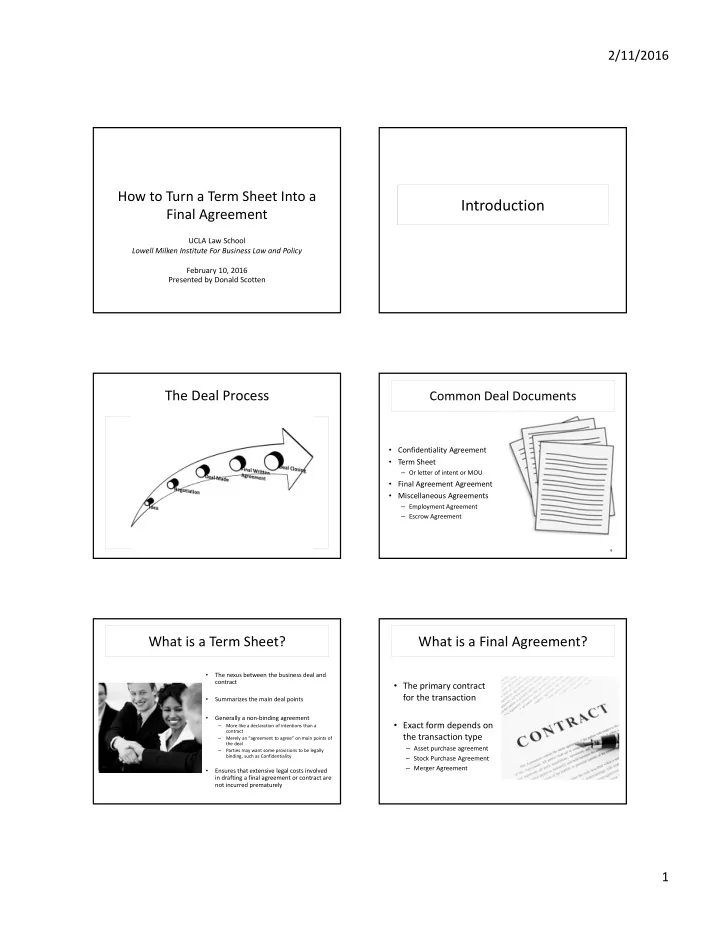
How to Turn a Term Sheet Into a Final Agreement

UCLA Law School Lowell Milken Institute For Business Law and Policy February 10, 2016 Presented by Donald Scotten

Introduction

The Deal Process

Common Deal Documents

  • Confidentiality Agreement
  • Term Sheet

– Or letter of intent or MOU

  • Final Agreement Agreement
  • Miscellaneous Agreements

– Employment Agreement – Escrow Agreement

4

What is a Term Sheet?

  • The nexus between the business deal and

contract

  • Summarizes the main deal points
  • Generally a non‐binding agreement

– More like a declaration of intentions than a contract – Merely an “agreement to agree” on main points of the deal – Parties may want some provisions to be legally binding, such as Confidentiality

  • Ensures that extensive legal costs involved

in drafting a final agreement or contract are not incurred prematurely

What is a Final Agreement?

  • The primary contract

for the transaction

  • Exact form depends on

the transaction type

– Asset purchase agreement – Stock Purchase Agreement – Merger Agreement

slide-2
SLIDE 2

2/11/2016 2

Turning Term Sheet Into Final Agreement Consider This Hypothetical

  • Beowulf, Inc., seeks to buy another company, Croft Design

Group, Ltd.

  • In addition to buying Croft, Beowolf wants Croft’s CEO and

majority shareholder, Jason Croft, to work for Beowolf.

  • After a series of business negotiations, Beowolf and Croft

have signed a term sheet.

  • You are hired by Beowolf to turn the term sheet into a final

agreement.

Step 1: Decide Which Form Agreement Is Appropriate For Deal Type

  • Characterize

the proposed transaction to determine which form agreement to use

– Merger? Stock Purchase? Asset Sale?

  • Who is your client and what

are their goals?

– Buyer or Seller?

  • Determine whether more than
  • ne form agreement may be

needed

– Which is the primary form? Employment Agreement

Form M&A Agreement Mergers, Stock Purchases & Asset Sales Introductory Provisions Deal Structure Consideration Representations & Warranties Pre‐Closing Covenants Closing Conditions Remedies/Indemnification Boilerplate Schedules

Step 2: Break Down Term Sheet into Key Contract Provisions Appropriate for Deal Type

Understanding Key Provisions

Provision Description Deal Structure Describes the mechanics of the transaction. Consideration Describes the form and timing of payment from buyer to seller. Representations Statement of fact as of moment in time intended to cause reliance. Warranties A promise that a statement will be true in the future.

Understanding Key Provisions

Provision Description Pre‐Closing Covenants A promise to do or not do something; creates a duty/obligation. Closing Conditions A state of fact that must exist before there is an obligation to perform. Indemnification A requirement that seller reimburse buyer for breaches of representations and warranties discovered after closing. Boilerplate Standardized language in the contract.

slide-3
SLIDE 3

2/11/2016 3

Step 3: Start Matching

Component Terms from Term Sheet to Include in Agreement Draft Introductory Provisions Who are the parties? How are they defined? Deal Structure What is the transaction form? What assets or liabilities are be acquired? Consideration What is the form of payment? When is the payment to be made? Representations & Warranties What information do we need to ensure is factually correct? What is the client’s desire as to risk allocation? What are our due diligence concerns? Covenants What promises do we want from the Seller? Are there any reps within the Seller’s control? Conditions Which covenants are important enough to warrant walk‐away rights? What other conditions are appropriate? Indemnification What if something is found to be untrue after closing?

Step 4: Review the Form Agreement Carefully

  • Review each and every

provision

– Eliminate Unnecessary Provisions – Check Cross‐References

  • Avoid mass copying of

documents used in prior transactions

– No two deals are ever exactly the same!

  • Remember who the client is

‐What are their goals?

Step 6: Review Each Term in Term Sheet & Identify Gaps

  • Did you forget anything?

– Specific business or legal issues

  • Are there additional provisions
  • r language that would help

protect the client?

Congratulations!

At this point, you have a first draft of the final agreement!

slide-4
SLIDE 4

ASSET PURCHASE AGREEMENT This ASSET PURCHASE AGREEMENT (this “Agreement”) is made and entered into as of _________, ____, between Croft Design Group, Ltd. (the “Seller”) and Beowulf, Inc. (the “Buyer”). ARTICLE III. REPRESENTATIONS AND WARRANTIES OF THE SELLER 1.1 The Seller represents and warrants to the Buyer that each statement contained in this Article III is true and correct, except as set forth in the disclosure schedule accompanying this Agreement, which is attached to this Agreement and is designated therein as being the “Company Disclosure Schedule” (the “Company Disclosure Schedule”). ARTICLE IV. REPRESENTATIONS AND WARRANTIES OF THE BUYER […] ARTICLE V. COVENANTS OF THE SELLER 1.1 During the period from the date of this Agreement and continuing until the earlier of the termination of this Agreement or the Closing Date, except (i) as set forth on Section 6.3 of the Company Disclosure Schedule, (ii) as otherwise contemplated by this Agreement or any Ancillary Agreement, (iii) with the prior written consent of the Buyers (which consent shall not be unreasonably withheld, conditioned or delayed) or (iv) as required by applicable Law, the Company shall not (and shall cause its Subsidiaries not to) do any of the following: (a) sell any material property or assets, except for sales of inventory in the ordinary course of business… ARTICLE VI. COVENANTS OF THE BUYERS […] ARTICLE VII. CONDITIONS TO CLOSING 1.2 Conditions to Obligations of the Buyers and the Seller. The obligations of the Buyers and the Seller to consummate the transactions contemplated by this Agreement are subject to the satisfaction on or prior to the Closing Date of the following conditions: […]. ARTICLE X. INDEMNIFICATION.

  • Survival. All representations, warranties and pre-Closing covenants contained in

this Agreement or in any schedule, exhibit or certificate delivered pursuant to this Agreement shall survive the Closing and shall be subject to claims for indemnification hereunder until ___________,____.

slide-5
SLIDE 5
slide-6
SLIDE 6