Introduction Describe a systematic process to determine proactive - - PDF document

introduction
SMART_READER_LITE
LIVE PREVIEW

Introduction Describe a systematic process to determine proactive - - PDF document

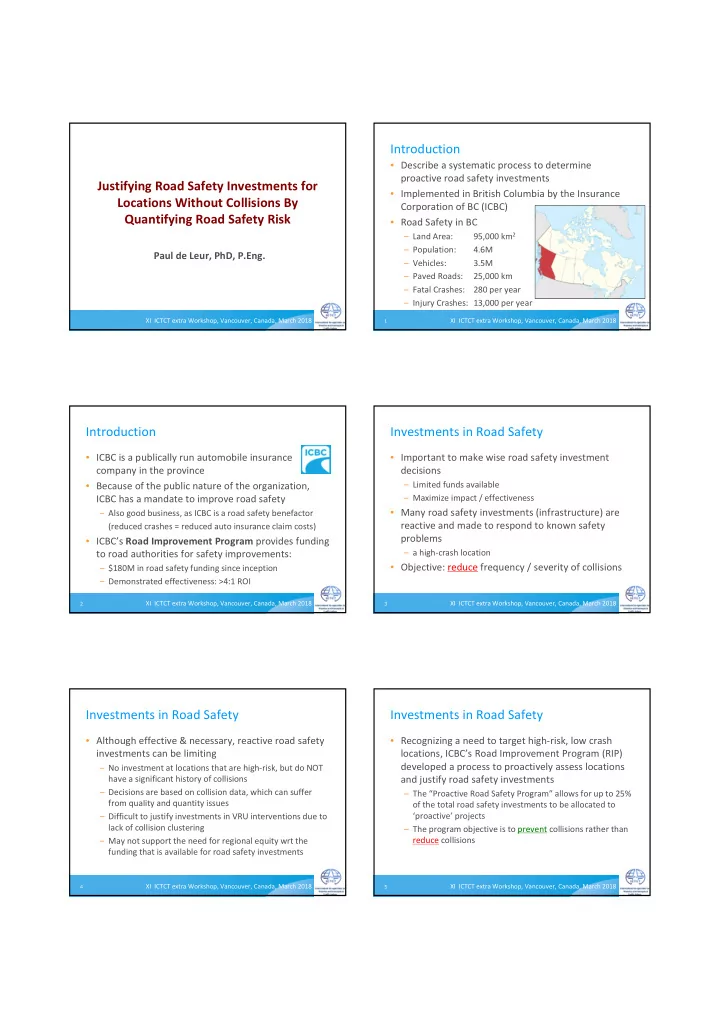
Introduction Describe a systematic process to determine proactive road safety investments Justifying Road Safety Investments for Implemented in British Columbia by the Insurance Locations Without Collisions By Corporation of BC (ICBC)


slide-1
SLIDE 1

Justifying Road Safety Investments for Locations Without Collisions By Quantifying Road Safety Risk

Paul de Leur, PhD, P.Eng.

XI ICTCT extra Workshop, Vancouver, Canada, March 2018

1

Introduction

  • Describe a systematic process to determine

proactive road safety investments

  • Implemented in British Columbia by the Insurance

Corporation of BC (ICBC)

  • Road Safety in BC

– Land Area: 95,000 km2 – Population: 4.6M – Vehicles: 3.5M – Paved Roads: 25,000 km – Fatal Crashes: 280 per year – Injury Crashes: 13,000 per year

XI ICTCT extra Workshop, Vancouver, Canada, March 2018

2

Introduction

  • ICBC is a publically run automobile insurance

company in the province

  • Because of the public nature of the organization,

ICBC has a mandate to improve road safety

– Also good business, as ICBC is a road safety benefactor (reduced crashes = reduced auto insurance claim costs)

  • ICBC’s Road Improvement Program provides funding

to road authorities for safety improvements:

– $180M in road safety funding since inception – Demonstrated effectiveness: >4:1 ROI

XI ICTCT extra Workshop, Vancouver, Canada, March 2018

3

Investments in Road Safety

  • Important to make wise road safety investment

decisions

– Limited funds available – Maximize impact / effectiveness

  • Many road safety investments (infrastructure) are

reactive and made to respond to known safety problems

– a high-crash location

  • Objective: reduce frequency / severity of collisions

XI ICTCT extra Workshop, Vancouver, Canada, March 2018

4

Investments in Road Safety

  • Although effective & necessary, reactive road safety

investments can be limiting

– No investment at locations that are high-risk, but do NOT have a significant history of collisions – Decisions are based on collision data, which can suffer from quality and quantity issues – Difficult to justify investments in VRU interventions due to lack of collision clustering – May not support the need for regional equity wrt the funding that is available for road safety investments

XI ICTCT extra Workshop, Vancouver, Canada, March 2018

5

Investments in Road Safety

  • Recognizing a need to target high-risk, low crash

locations, ICBC’s Road Improvement Program (RIP) developed a process to proactively assess locations and justify road safety investments

– The “Proactive Road Safety Program” allows for up to 25%

  • f the total road safety investments to be allocated to

‘proactive’ projects – The program objective is to prevent collisions rather than reduce collisions

XI ICTCT extra Workshop, Vancouver, Canada, March 2018

slide-2
SLIDE 2

6

Road Safety Risk

  • Approach based on the identification, understanding

and quantification of road safety risk

XI ICTCT extra Workshop, Vancouver, Canada, March 2018

– Road safety risks are not always evident to the driver – The magnitude of road safety risk is not always clear

7

Road Safety Risk

  • There are some existing techniques that are available

to evaluate road safety risk

  • Traffic Conflict Technique: A technique that is based
  • n the concept of near-misses and evasive

manoeuvres

– Time to Collision / Risk of Collisions

  • Road Assessment Programs (RAP): Uses a star-rating

system based on roadway characteristics that impact safety performance

XI ICTCT extra Workshop, Vancouver, Canada, March 2018

8

Road Safety Risk

  • For our approach, we describe road safety risk as a

function of three fundamental elements:

– 1) Exposure: the exposure to roadway hazards

  • Traffic or road user volumes, V/C ratio, etc.

XI ICTCT extra Workshop, Vancouver, Canada, March 2018

9

Road Safety Risk

  • Road safety risk is expressed as a function of three

fundamental elements:

– 2) Probability: probability of encountering roadway hazards

  • H/V alignment, cross-section, access density, conflict potential, etc.

XI ICTCT extra Workshop, Vancouver, Canada, March 2018

10

Road Safety Risk

  • Road safety risk is expressed as a function of three

fundamental elements:

– 3) Consequence: severity of outcome if hazard encountered

  • Vehicle speed, roadside environment, etc.

XI ICTCT extra Workshop, Vancouver, Canada, March 2018

11

Road Safety Risk

  • Developed procedures to quantify each element of

road safety risk

  • Three risk elements are combined to produce an
  • verall level of risk

– Road Safety Risk Index (RSRI) – Represents a measure of risk and is independent from historical collision records

XI ICTCT extra Workshop, Vancouver, Canada, March 2018

RSRICombined= Ei+P

i+Ci i =1 n

9(n)

slide-3
SLIDE 3

12

Effectiveness of Interventions

  • With RSRI determined, the next step is to evaluate

the effectiveness of the proposed interventions

– Interventions have varying levels of effectiveness – More effective interventions should be eligible for a higher level of road safety investment

XI ICTCT extra Workshop, Vancouver, Canada, March 2018

13

Effectiveness of Interventions

  • Collision modification factors (CMFs) used to evaluate

intervention effectiveness

– CMFs for BC – CMF Clearinghouse – AASHTO Highway Safety Manual – Elvik & Vaa

XI ICTCT extra Workshop, Vancouver, Canada, March 2018

14

Evaluate Road Safety Investment

  • RSRI is combined with the CMF to produce a

‘Proactive Funding Index’ (PFI)

  • Level of ICBC

funding based on an exponential function benefiting projects with a higher PFI

XI ICTCT extra Workshop, Vancouver, Canada, March 2018

15

Summary

  • It is important to address known safety problems

– Reactive interventions are effective to reduce collisions at collision ‘hot-spots’

  • Also possible to make proactive road safety

investments

– Proactive interventions to prevent collisions at high-risk locations

  • Proactive interventions have greater ability to focus
  • n the needs of VRUs

XI ICTCT extra Workshop, Vancouver, Canada, March 2018