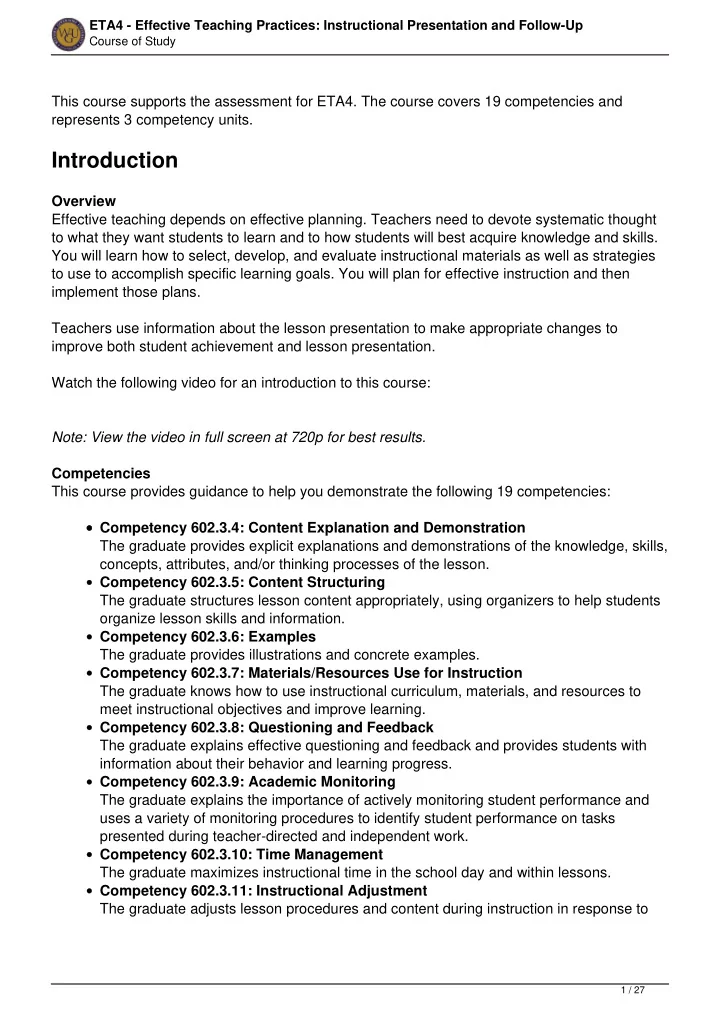
Introduction Overview Effective teaching depends on effective - - PDF document

introduction
SMART_READER_LITE
LIVE PREVIEW

Introduction Overview Effective teaching depends on effective - - PDF document

ETA4 - Effective Teaching Practices: Instructional Presentation and Follow-Up Course of Study This course supports the assessment for ETA4. The course covers 19 competencies and represents 3 competency units. Introduction Overview Effective


slide-1
SLIDE 1

ETA4 - Effective Teaching Practices: Instructional Presentation and Follow-Up

Course of Study

This course supports the assessment for ETA4. The course covers 19 competencies and represents 3 competency units.

Introduction

Overview Effective teaching depends on effective planning. Teachers need to devote systematic thought to what they want students to learn and to how students will best acquire knowledge and skills. You will learn how to select, develop, and evaluate instructional materials as well as strategies to use to accomplish specific learning goals. You will plan for effective instruction and then implement those plans. Teachers use information about the lesson presentation to make appropriate changes to improve both student achievement and lesson presentation. Watch the following video for an introduction to this course: Note: View the video in full screen at 720p for best results. Competencies This course provides guidance to help you demonstrate the following 19 competencies: Competency 602.3.4: Content Explanation and Demonstration The graduate provides explicit explanations and demonstrations of the knowledge, skills, concepts, attributes, and/or thinking processes of the lesson. Competency 602.3.5: Content Structuring The graduate structures lesson content appropriately, using organizers to help students

  • rganize lesson skills and information.

Competency 602.3.6: Examples The graduate provides illustrations and concrete examples. Competency 602.3.7: Materials/Resources Use for Instruction The graduate knows how to use instructional curriculum, materials, and resources to meet instructional objectives and improve learning. Competency 602.3.8: Questioning and Feedback The graduate explains effective questioning and feedback and provides students with information about their behavior and learning progress. Competency 602.3.9: Academic Monitoring The graduate explains the importance of actively monitoring student performance and uses a variety of monitoring procedures to identify student performance on tasks presented during teacher-directed and independent work. Competency 602.3.10: Time Management The graduate maximizes instructional time in the school day and within lessons. Competency 602.3.11: Instructional Adjustment The graduate adjusts lesson procedures and content during instruction in response to

1 / 27

slide-2
SLIDE 2

ETA4 - Effective Teaching Practices: Instructional Presentation and Follow-Up

Course of Study

student performance. Competency 602.3.12: Reteaching The graduate understands and uses reteaching purposes and methods. Competency 602.3.13: Discussion Procedures The graduate is able to lead discussions that engage all students in exploring important questions and connections among content and ideas. Competency 602.3.14: Connections The graduate connects: concepts within and across subjects; to student characteristics; and to student experiences. Competency 602.3.15: Guided Practice The graduate explains the features and functions of guided practice and uses guided practice procedures within lessons. Competency 602.3.16: Independent Practice The graduate provides opportunities for students to practice skills independently after determining that they have mastered the new skills during guided practice. Competency 602.3.17: Lesson Closure The graduate provides periodic reviews of lesson knowledge, skills, and concepts. Competency 602.3.18: Record Keeping The graduate maintains records of student performance on academic and behavioral measures. Competency 602.3.19: Analysis of Student Work The graduate analyzes student work to determine mastery. Competency 602.3.20: Assessment Administration The graduate administers a variety of assessments to measure student achievement and to evaluate instructional effectiveness. Competency 602.3.21: Assessment Interpretation and Dissemination The graduate interprets the information from assessments to understand student performance and disseminates the results to students' parents and school staff. Competency 602.3.22: Teaching Across the Content Areas The graduate uses strategies for oral language development and the teaching of reading, comprehension, writing, and numeracy within all content areas. Teaching Dispositions Statement Please review the Statement of Teaching Dispositions. Course Instructor Assistance As you prepare to successfully demonstrate competency in this subject, remember that course instructors stand ready to help you reach your educational goals. As subject matter experts, mentors enjoy and take pride in helping students become reflective learners, problem solvers, and critical thinkers. Course instructors are excited to hear from you and eager to work with you. Successful students report that working with a course instructor is the key to their success. Course instructors are able to share tips on approaches, tools, and skills that can help you apply the content you're studying. They also provide guidance in assessment preparation strategies and troubleshoot areas of deficiency. Even if things don’t work out on your first try, course instructors act as a support system to guide you through the revision process. You

2 / 27

slide-3
SLIDE 3

ETA4 - Effective Teaching Practices: Instructional Presentation and Follow-Up

Course of Study

should expect to work with course instructors for the duration of your coursework, and you are encouraged to contact them as soon as you begin. Course instructors are fully committed to your success!

Preparing for Success

The information in this section is provided to detail the resources available for you to use as you complete this course.

Learning Resources

The learning resources listed in this section are required to complete the activities in this course. For many resources, WGU has provided automatic access through the course. However, you may need to manually enroll in or independently acquire other resources. Read the full instructions provided to ensure that you have access to all of your resources in a timely manner. Automatically Enrolled Learning Resources You will be automatically enrolled at the activity level for the following learning resources. Simply click on the links provided in the activities to access the learning materials. VitalSource E-Text The following textbook is available to you as ab e-text within this course. You will be directly linked to the specific readings required within the activities that follow. Gunning, T. G (2010). Creating literacy instruction for all students. (7th ed.) Boston, MA: Allyn & Bacon. ISBN: 9780138140823 Linn, R., Miller, M., & Gronlund, N. (2009). Measurement and assessment in teaching (10th ed.). Upper Saddle River, NJ: Pearson. ISBN: 9780132408936 Borich, G. (2007). Effective teaching methods: Research-based practice. Upper Saddle River, NJ: Pearson. ISBN: 9780131714960 Note: This e-text is available to you as part of your program tuition and fees, but you may purchase a hard copy at your own expense through a retailer of your choice. If you choose to do so, please use the ISBN listed to ensure that you receive the correct edition. ASCD You will access ASCD materials at the activity level within this course. These courses are an

  • nline independent study learning resource provided by the Association for Supervision and

Curriculum Development (ASCD). Teachscape You will access video modules from Teachscape at the activity level within this course. The Teachscape modules include video lectures, exercises, and interactive elements. Other Learning Resources You will use the following learning resources for this course. Lesson Planning Best Practices

3 / 27

slide-4
SLIDE 4

ETA4 - Effective Teaching Practices: Instructional Presentation and Follow-Up

Course of Study

For this course, you will submit lesson plans to TaskStream. The Lesson Planning Best Practices resource is available to assist you in developing this important skill. Please use this resource for this course and throughout the remainder of the program.

Pacing Guide

The pacing guide suggests a weekly structure to pace your completion of learning activities. It is provided as a suggestion and does not represent a mandatory schedule. Follow the pacing guide carefully to complete the course in the suggested timeframe. Pacing Guide: Effective Teaching Practices: Instructional Presentation and Follow-Up Note: This pacing guide does not replace the course. Please continue to refer to the course for a comprehensive list of the resources and activities.

Content Structuring

You will learn strategies to present information and concepts that meet the lesson plan

  • bjectives.

As you work through this section, consider the following questions: What are the key elements of effective lesson presentation? How is questioning used in the classroom as an important instructional strategy? How can graphic organizers be used effectively to structure content and enhance students' learning? How do teachers identify and review appropriate instructional resources?

Content Structuring

You will learn fundamentals about content presentation. Once students have been introduced to lessons, teachers implement instructional strategies (e.g., questioning, short interactive lectures, compare and contrast) to present information and concepts that meet the learning outcomes. In addition to the instructional strategies that teachers select to present content, instructional materials and resources enhance the instructional and learning processes. Instructional materials developed and selected during the planning process are incorporated during various phases of instruction such as presenting content and guided practice. This topic addresses the following competencies: Competency 602.3.4: Content Explanation and Demonstration The graduate provides explicit explanations and demonstrations of the knowledge, skills, concepts, attributes, and/or thinking processes of the lesson. Competency 602.3.5: Content Structuring The graduate structures lesson content appropriately, using organizers to help students

  • rganize lesson skills and information.

4 / 27

slide-5
SLIDE 5

ETA4 - Effective Teaching Practices: Instructional Presentation and Follow-Up

Course of Study

Competency 602.3.6: Examples The graduate provides illustrations and concrete examples. Competency 602.3.7: Materials/Resources Use for Instruction The graduate knows how to use instructional curriculum, materials, and resources to meet instructional objectives and improve learning. Competency 602.3.8: Questioning and Feedback The graduate explains effective questioning and feedback and provides students with information about their behavior and learning progress. Teaching Strategies Read the following chapter in Effective Teaching Methods: Research-based Practice: chapter 7 ("Teaching Strategies for Direct Instruction") Explain the two types of learning outcomes. Think of examples of lessons that are appropriate for each outcome. Record your thoughts in your notebook. Study Tip: Presenting and Structuring Summarize the organization structures for presenting information. How will you decide which kind of structuring format is appropriate for specific lesson

  • bjectives?

Interact with your fellow teacher candidates by posting your thoughts to the "Structuring Lesson Objectives" discussion thread in the learning community. Presenting New Concepts Complete the following steps:

  • 1. Select a new concept to introduce to a group of students.
  • 2. Identify the subject, concept, and grade level for your description.
  • 3. Write an objective that includes a new concept that you will have students learn.
  • 4. In your notebook, write a brief essay explaining how to present new or unmastered

concepts in small steps that are logically organized. Now, think about the most logical and effective method for teaching the concept you have chosen. In your notebook, explain how you would present the new concept in small, logically organized steps using one of the following methods of structuring content: part whole relationships sequential relationships combinations of relationships comparative relationships

5 / 27

slide-6
SLIDE 6

ETA4 - Effective Teaching Practices: Instructional Presentation and Follow-Up

Course of Study

Share your explanation in the "Presenting New Concepts" discussion thread in the learning community. Comment on the posting of one other peer. Teaching Concepts and Presenting New Material Read the following pages in Effective Teaching Methods: Research-Based Practice: pages 281–283 Read or review the following pages in Educational Psychology: Theory and Practice: pages 216–220 pages 205–208 Read or review the following article. "The Concept Attainment Strategy" Take notes in your notebook. Concept Attainment Strategy Read the following article: "Teaching Method: Concept Attainment" Study Tip: Concept Instruction Complete the following steps:

  • 1. Identify a concept you might want to teach students.
  • 2. Explain the instructional sequence you would use to teach the concept.
  • 3. Provide a justification for the instructional sequence.

Now, interact with your fellow teacher candidates by posting your sequence and justification to the "Concept Instruction and Sequencing" discussion thread in the Instructional Presentation and Follow-Up Learning Community. Read and respond to other teacher candidate responses. Reflect on how questions relate to levels of learning. Study Tip: Questions as an Instructional Strategy Reflect on the following questions: What do you already know about the use of questions as an instructional strategy? How many different ways do you think you can use questioning as a teaching strategy?

6 / 27

slide-7
SLIDE 7

ETA4 - Effective Teaching Practices: Instructional Presentation and Follow-Up

Course of Study

Record your answers in your notebook.

7 / 27

slide-8
SLIDE 8

ETA4 - Effective Teaching Practices: Instructional Presentation and Follow-Up

Course of Study

Questioning as an Instructional Technique Review the following sections in Effective Teaching Methods: Research-Based Practice: chapter 9 ("Questioning Strategies") pages 21–28 Read the following pages in Educational Psychology: Theory and Practice: pages 209–211 in chapter 7 ("The Effective Lesson") Record your responses to the following prompts in a notebook, and keep them for future reference: Distinguish between different types of questions. Identify purposes for asking questions. Make a list of five methods for using questions as an instructional strategy. Consider how probes can be used to help students' correct responses. Explain the importance of "wait time" during questioning. Think of a learning objective. Write several questions that you might ask during

  • instruction. (Be sure to include both closed questions—those that require a specific

answer, and open questions—those that allow for varied responses.) Study Tip: Questioning and Levels of Learning Reflect on the following question: How do the questions teachers ask influence the depth of student thinking? Interact with your fellow teacher candidates by posting your thoughts about this question to the "Concept Instruction and Sequencing" discussion thread in the learning community. . Cultural Considerations Review the following pages in Effective Teaching Methods: Research-Based Practice: pages 322–324 Question Bias Read the following chapter in Measurement and Assessment in Teaching: chapter 1 ("Educational Testing and Assessment: Context, Issues, and Trends") Reflect on the following questions: How will you avoid asking biased questions? Common Question Problems

8 / 27

slide-9
SLIDE 9

ETA4 - Effective Teaching Practices: Instructional Presentation and Follow-Up

Course of Study

Read the following pages in Effective Teaching Methods: Research-based Practice: pages 324–329 In your notebook, make a list of do's and don'ts that you will follow when asking questions. Complete: Task 602.3.5-01Performance Task Complete the following task in TaskStream: ETP: Inst. Presentation: Task 602.3.5-01 For details about this performance assessment, see the "Assessment" tab in this course.

Materials and Resources for Instruction

Choosing appropriate instructional materials and resources is very important to effective

  • teaching. Teachers must know how to identify and select materials and resources that are

appropriate for all students in their classroom, regardless of performance level. As you study this section, reflect on the following questions: How do teachers access instructional materials and resources that are appropriate for a wide range of students and learning needs? How do teachers determine if a particular resource is appropriate for the needs of different groups of students? You will review resources that may be used to support instruction. This topic addresses the following competencies: Competency 602.3.4: Content Explanation and Demonstration The graduate provides explicit explanations and demonstrations of the knowledge, skills, concepts, attributes, and/or thinking processes of the lesson. Competency 602.3.5: Content Structuring The graduate structures lesson content appropriately, using organizers to help students

  • rganize lesson skills and information.

Competency 602.3.6: Examples The graduate provides illustrations and concrete examples. Competency 602.3.7: Materials/Resources Use for Instruction The graduate knows how to use instructional curriculum, materials, and resources to meet instructional objectives and improve learning. Competency 602.3.8: Questioning and Feedback The graduate explains effective questioning and feedback and provides students with information about their behavior and learning progress. Visual Representations Access the following Teachscape module:

9 / 27

slide-10
SLIDE 10

ETA4 - Effective Teaching Practices: Instructional Presentation and Follow-Up

Course of Study

Nonlinguistic Representations In this module, view at least two video clips from grades K–2 and 3–5 under the following heading: "Seeing the Strategies in Action" Varying Materials Read the following pages in Effective Teaching Methods: Research-Based Practice: pages 141–143 In your notebook, make a list of the different kinds of materials that can be incorporated to vary instruction. Reflect on the following question: How does varying instruction enhance learning? Differentiating Instruction through Materials and Resources Read or review the following article: "Differentiating Instruction" "Differentiating the Core Curriculum and Instruction To Provide Advanced Learning Opportunities" Complete: Task 602.3.7-04 Performance Task Complete the following task in TaskStream: ETP: Inst. Presentation: Task 602.3.7-04 For details about this performance assessment, see the "Assessment" tab in this course.

Guided Practice and Monitoring

Guided practice includes a variety of strategies such as questioning, providing feedback, and students demonstrating understanding. During guided practice, teachers monitor student understanding and progress, and remediate if necessary.

Guided Practice, Feedback, and Monitoring

You will learn how to employ guided practice, feedback, and academic monitoring during lesson presentation. This topic addresses the following competencies: Competency 602.3.8: Questioning and Feedback The graduate explains effective questioning and feedback and provides students with

10 / 27

slide-11
SLIDE 11

ETA4 - Effective Teaching Practices: Instructional Presentation and Follow-Up

Course of Study

information about their behavior and learning progress. Competency 602.3.9: Academic Monitoring The graduate explains the importance of actively monitoring student performance and uses a variety of monitoring procedures to identify student performance on tasks presented during teacher-directed and independent work. Competency 602.3.15: Guided Practice The graduate explains the features and functions of guided practice and uses guided practice procedures within lessons. Review: Guided Practice Read the following pages in Effective Teaching Methods: Research-Based Practice: chapter 7 ("Teaching Strategies for Direct Instruction"), with a special focus on pages 237–243 Examine the following pages in Educational Psychology: Theory and Practice: pages 209–211 Study Tip: Guided Practice Make a list of the benefits of guided practice for both teachers and students. Think of a specific guided practice activity you might use for a lesson. Save this list in your notebook for future study reference. Reflect on the following questions: What is the relationship between "guided practice" and "checks for understanding"? At which points in a lesson does a teacher check for understanding? Read and Review: Feedback and Praise Review the following pages in Effective Teaching Methods: Research-Based Practice chapter 7 ("Teaching Strategies for Direct Instruction") Read the following pages in Educational Psychology: Theory and Practice: chapter 10 ("Motivating Students to Learn") Learning Activities: Monitoring Students' Understanding Read the following article from Utah Students at Risk: "Academic Feedback" Note: To access articles from the Utah Students at Risk website, you will need to download them as PDF documents; this is done by clicking the article title.

11 / 27

slide-12
SLIDE 12

ETA4 - Effective Teaching Practices: Instructional Presentation and Follow-Up

Course of Study

Focus on Feedback Complete the following Teachscape module: Setting Objectives and Providing Feedback Focus on the part of the module that relates to providing feedback. Corrective Feedback Read or review the following articles from Utah Students at Risk: "Academic Feedback" "Academic Monitoring" Reflection: Feedback As you engage with the academic monitoring readings and resources, focus on the difference between monitoring strategies and monitoring systems. In your notebook, explain the importance of implementing good pedagogical procedures when making corrections to a group (whole-class instruction), including addressing corrections quickly and in a matter-of-fact fashion. Discuss five different and effective instructional procedures that you can use as a teacher to make corrections when addressing the whole group. This activity requires synthesis of information, so do not look for five specific procedures to be listed in your reading. Develop a list of five procedures from all of the information you read. For example, one procedure would be to consider why the class has responded incorrectly and ask additional clarification questions so the class can arrive at a correct response. Explain the importance of preserving students' dignity by not embarrassing, demeaning, or humiliating them when providing behavioral or academic feedback. Discuss at least three feedback procedures that you can use that preserve student dignity. Share your feedback strategies in the learning community discussion thread "Feedback Strategies," and comment on the posting of another peer. Study Tip: Positive and Negative Effects of Academic Monitoring Use the resources on the USU website found in the previous activity to make a chart to compare positive and negative learning effects of academic monitoring. Put the monitoring behavior in the middle of the chart with the positive use and effect on the left and negative use and effect on the right. Save this chart in your notebook for future study reference. Study Tip: Academic Monitoring

12 / 27

slide-13
SLIDE 13

ETA4 - Effective Teaching Practices: Instructional Presentation and Follow-Up

Course of Study

Academic monitoring is a process teachers use through all phases of the instructional process. For example, teachers monitor during lesson presentation, guided practice, and independent learning. Explain how teachers use academic monitoring during guided practice. Interact with your fellow teacher candidates by posting your thoughts regarding how academic monitoring is used during all phases of instruction to a pertinent discussion thread in the Instructional Presentation and Follow-Up Learning Community. Review: Self-directed Learning Read the following chapter in Effective Teaching Methods: Research-based Practice: chapter 10 ("Self-Directed Learning") Complete: Task 602.3.9-07,09 Performance Task Complete the following task in TaskStream: ETP: Inst. Presentation: Task 602.3.9-07,09 For details about this performance assessment, see the "Assessment" tab in this course.

Instructional Adjustment and Independent Practice

Reflect on the following questions as you study this section: How do teachers know when it is appropriate to adjust instruction? What are strategies for adjusting instruction for students who are struggling? What are strategies for adjusting instruction for students whose learning is accelerated? As a teacher candidate, you should learn the fundamentals of adjusting lessons based on student performance. You should also learn how to give students opportunities to practice newly acquired skills. As teachers monitor academic progress, there are times they need to adjust instruction and re-teach concepts. Once students have acquired knowledge or skills, it is important that they practice, apply, and think of ways to remember them. Independent practice structures

  • pportunities for students to enhance their learning.

Instructional Adjustment and Reteaching

As a teacher candidate, you should be able to make adjustments to your instruction based on student performance. Furthermore, you should be able to re-teach a lesson when assessment data suggest that additional learning support is needed. This topic addresses the following competencies: Competency 602.3.12: Reteaching

13 / 27

slide-14
SLIDE 14

ETA4 - Effective Teaching Practices: Instructional Presentation and Follow-Up

Course of Study

The graduate understands and uses reteaching purposes and methods. Competency 602.3.14: Connections The graduate connects: concepts within and across subjects; to student characteristics; and to student experiences. Competency 602.3.16: Independent Practice The graduate provides opportunities for students to practice skills independently after determining that they have mastered the new skills during guided practice. Competency 602.3.17: Lesson Closure The graduate provides periodic reviews of lesson knowledge, skills, and concepts. Study Tip: Alternative Explanations Develop a list of types of tasks that might require alternate explanations in order for students to learn and understand. Save it in your notebook for future study reference. Review: Alternative Explanations Read the following chapter in Effective Teaching Methods: Research-based Practice: chapter 1 ("The Effective Teacher") Adjusting Instruction for Gifted Students Access and read the following article: "Differentiating Curriculum for Gifted Students" Reteaching Review the following article from Utah Students at Risk: "Academic Feedback" (especially the portions that address the concept of reteaching) In your notebook, reflect on how academic monitoring and questioning during guided practice inform the need to reteach information. Study Tip: Reteaching Reflect on the following question: What is reteaching? In your notebook, construct a web to show your understanding of reteaching. Read: Reteaching Read the following pages in Effective Teaching Methods: Research-Based Practice: pages 242–244 pages 400–402

14 / 27

slide-15
SLIDE 15

ETA4 - Effective Teaching Practices: Instructional Presentation and Follow-Up

Course of Study

Think of strategies teachers use to determine if they need to reteach information. When should teachers reteach? How do academic monitoring and questioning during guided practice inform the need to reteach? What kind of evidence will you seek regarding student performance to help determine if reteaching is necessary? Interact with your fellow teacher candidates by posting your new understanding of reteaching to the "Reteaching" discussion thread in the learning community. Complete: Task 602.3.11-01, 02 Performance Task Complete the following task in TaskStream: ETP: Inst. Presentation: Task 602.3.11-01, 02 For details about this performance assessment, see the "Assessment" tab in this course.

Independent Practice Strategies

You will learn how to provide students with the opportunity to practice new skills derived from new knowledge. This topic addresses the following competencies: Competency 602.3.12: Reteaching The graduate understands and uses reteaching purposes and methods. Competency 602.3.14: Connections The graduate connects: concepts within and across subjects; to student characteristics; and to student experiences. Competency 602.3.16: Independent Practice The graduate provides opportunities for students to practice skills independently after determining that they have mastered the new skills during guided practice. Competency 602.3.17: Lesson Closure The graduate provides periodic reviews of lesson knowledge, skills, and concepts. Review Questions Answer the following questions in your notebook: What are several hints for providing effective practice time? What is the difference between guided practice and independent practice? Why are distributed practice and review important? How are they related to automatic processing? What is the teacher's role during independent practice? What are the benefits of multiple practice opportunities? Review: Methods for Applying and Practicing

15 / 27

slide-16
SLIDE 16

ETA4 - Effective Teaching Practices: Instructional Presentation and Follow-Up

Course of Study

Read the following chapters in Educational Psychology: Theory and Practice: chapter 6 ("Practicing") chapter 7 ("The Effective Lesson") Review: Independent and Distributed Practice Read the following pages in Effective Teaching Methods: Research-based Practice: pages 243–247 Read the following pages in Educational Psychology: Theory and Practice: pages 211–214 Homework Access and read the following web page: The Goldilocks Dilemma: Homework Policy Creating a Culture Where Simply Good Is Just Not Good Enough Focus on Technology: Flip Your Classroom to Increase Academic Achievement. Prior to completing this activity, you may want to review the sections on "homework" in the following article from Utah Students at Risk. "Practical Suggestions for Academic Monitoring" Note: For a quick review, you may want to search for the keyword "homework" within each section. Study Tip: Homework Write a script of the directions that you will provide students for a specific homework assignment. Then, write a homework policies and procedures statement for your classroom. Save this in your notebook for future reference. In your notebook, explain how student homework can be appropriately managed. Include strategies for making sure student homework consolidates skills already taught, results in low student error rates, presents a management strategy for correcting homework, and is highly aligned with daily lessons Select at least two homework strategies from the bullet points above; share your thoughts on the "Managing Homework" discussion thread in the Instructional Presentation and Follow-Up

16 / 27

slide-17
SLIDE 17

ETA4 - Effective Teaching Practices: Instructional Presentation and Follow-Up

Course of Study

Learning Community. Comment on the posting of one other peer.

Content Explanation and Making Connections

In this section, as a teacher candidate, you will learn how to employ indirect instructional

  • approaches. You will also examine concept connections as they apply to student experience

and characteristics. Up to this point in the course, you have dealt with elements of the direct instruction model. Now, a number of indirect instructional approaches will be addressed. You will also examine the making of concept connections within and across subjects to student experience, as well as learn about indirect instructional approaches and explore strategies for effective discussion. Reflect on the following questions: What are indirect instructional approaches? What are the benefits of teachers using indirect instructional strategies? How does current brain research impact curriculum development and presentation? What are the advantages of group discussions?

Indirect Instruction and Discussion Strategies

You will learn about indirect instructional approaches. You will also explore strategies for effective discussion. This topic addresses the following competencies: Competency 602.3.4: Content Explanation and Demonstration The graduate provides explicit explanations and demonstrations of the knowledge, skills, concepts, attributes, and/or thinking processes of the lesson. Competency 602.3.5: Content Structuring The graduate structures lesson content appropriately, using organizers to help students

  • rganize lesson skills and information.

Competency 602.3.10: Time Management The graduate maximizes instructional time in the school day and within lessons. Competency 602.3.13: Discussion Procedures The graduate is able to lead discussions that engage all students in exploring important questions and connections among content and ideas. Competency 602.3.14: Connections The graduate connects: concepts within and across subjects; to student characteristics; and to student experiences. Review: Indirect Instruction Read the following chapters in Effective Teaching Methods: Research-Based Practice:

17 / 27

slide-18
SLIDE 18

ETA4 - Effective Teaching Practices: Instructional Presentation and Follow-Up

Course of Study

chapter 8 ("Teaching Strategies for Indirect Instruction") Focus especially on pages 287–290, which address group discussion. Study Tip: Comparing Instructional Approaches In your notebook, develop a matrix to compare and contrast direct and indirect instructional approaches. Reflect on the following question: What are your thoughts about the similarities and differences between direct and indirect instruction? Interact with your fellow teacher candidates by posting to the "Comparing Instructional Approaches" discussion thread in the learning community. Explain two indirect instructional strategies. Save this in your notebook for future study reference. Review: Discussion Strategies Review the following pages in Educational Psychology: Theory and Practice: pages 221–223 Review the following pages in the Effective Teaching Methods: Research-based Practice text: pages 287–290 Reflect on the following question: What are the advantages of group discussions? Record your thoughts in your notebook. Discussion Strategies and Problem Solving Access and read the following section on the Discussion as a Teaching Strategy website: "Research Paper 2" Then, browse through and review the various documents and articles on the following web page: "Discussion/Problem Solving Teaching Strategies" Study Tip: Discussion Strategies Complete the following items for this activity:

18 / 27

slide-19
SLIDE 19

ETA4 - Effective Teaching Practices: Instructional Presentation and Follow-Up

Course of Study

Think of three or four objectives for lessons you might teach. Explain a specific discussion strategy you would use as your instructional strategy to teach to each objective. Explain why you have chosen the specific discussion strategy for each objective. Reflect on the following questions: How are questioning strategies related to group discussion strategies? Why is it important for teachers to ask questions during group discussions? What criteria will you use to determine whether to use small or whole group discussions? What are the advantages and disadvantages of group discussions? Save these responses in your notebook for future study reference. Complete: Task 602.3.13-05,06Performance Task Complete the following task in TaskStream: ETP: Inst. Presentation: Task 602.3.13-05,06 For details about this performance assessment, see the "Assessment" tab in this course.

Connections and Time Management

You should learn to make concept connections within and across material as it relates to student characteristics and experience. You should also learn to manage time within the school day and as it relates to lesson presentation. As you complete the activities in this section, reflect on the following questions: Why is the consideration of time in the classroom key to effective student learning? How can teachers maximize instructional time and minimize time wasters in the day? How do effective classroom management strategies maximize instructional time? This topic addresses the following competency: Competency 602.3.10: Time Management The graduate maximizes instructional time in the school day and within lessons. Review: Integrating Lessons and Units - Connections Read the following sections in Effective Teaching Methods: Research-based Practice: chapter 4 ("Unit and Lesson Planning") pages 284–287

19 / 27

slide-20
SLIDE 20

ETA4 - Effective Teaching Practices: Instructional Presentation and Follow-Up

Course of Study

Review the following chapter in Educational Psychology: Theory and Practice: chapter 6 ("Information Processing and Cognitive Theories of Learning") Think of examples of how teachers can use school, family, and community contexts when connecting student experience to real-world circumstances. Record your thoughts in your notebook. Study Tip: Challenges of Integrated Instruction Think of the benefits for students when teachers develop integrated lessons. What are the challenges for teachers when developing and teaching integrated units? Interact with your fellow teacher candidates by posting your thoughts on this question to the "Challenges of Integrated Instruction" discussion thread in the learning community. Reading: Effective Learning Environments Read the following chapter in Educational Psychology: Theory and Practice: chapter 11 ("Effective Learning Environments") Making Instructional Time Access and read the following web page: "Lesson 2: Finding Additional Instructional Time" Develop a list of the most important strategies you will use to make the most of instructional

  • time. Consider the following question:

As a teacher, what will you do to maximize the amount of instructional time you have? Save this in your notebook for future study reference. Complete: Task 602.3.10-05, Task 602.3.14-02, Task 602.3.14-06Performance Tasks Complete the following task in TaskStream: ETP: Inst. Presentation: Task 602.3.10-05 ETP: Inst. Presentation: Task 602.3.14-02 ETP: Inst. Presentation: Task 602.3.14-06 For details about this performance assessment, see the "Assessment" tab in this course.

Assessment Administration, Interpretation, and Dissemination

20 / 27

slide-21
SLIDE 21

ETA4 - Effective Teaching Practices: Instructional Presentation and Follow-Up

Course of Study

As a teacher candidate, you will learn the fundamentals of assessment administration and

  • interpretation. You will also learn how to communicate with parents about assessment results.

Assessment is an integral part of the lesson presentation process and is included in lesson planning models. Assessment provides valuable information about how and what students have learned and gives students insights about the effectiveness of lessons.

Assessment Administration

You will learn about the fundamentals of assessment administration: evaluating students developing rubrics grading systems identifying student strengths and needs communicating with parents This topic addresses the following competencies: Competency 602.3.18: Record Keeping The graduate maintains records of student performance on academic and behavioral measures. Competency 602.3.19: Analysis of Student Work The graduate analyzes student work to determine mastery. Competency 602.3.20: Assessment Administration The graduate administers a variety of assessments to measure student achievement and to evaluate instructional effectiveness. Competency 602.3.21: Assessment Interpretation and Dissemination The graduate interprets the information from assessments to understand student performance and disseminates the results to students' parents and school staff. Competency 602.3.22: Teaching Across the Content Areas The graduate uses strategies for oral language development and the teaching of reading, comprehension, writing, and numeracy within all content areas. Reading: Assessment Administration Read the following chapters in Educational Psychology: Theory and Practice: chapter 13 ("Assessing Student Learning") chapter 14 ("Standardized Tests and Accountability") Think of a learning objective for a lesson you might teach. Design an informal assessment to measure progress toward the objective. Design a formal assessment to assess the accomplishment of the objective. Save these in your notebook for future reference. Evaluating Student Work

21 / 27

slide-22
SLIDE 22

ETA4 - Effective Teaching Practices: Instructional Presentation and Follow-Up

Course of Study

Access and read the following web page: "Evaluating Student Work" Read and Review: Grading Systems; Evaluating Student Writing Read the following chapter in Effective Teaching Methods: Research-based Practice: chapter 12 ("Assessing Learners") Review the following chapter in Educational Psychology: Theory and Practice: chapter 13 ("Assessing Student Learning") Read the following chapter in Measurement and Assessment in Teaching: chapter 15 ("Grading and Reporting") Class Grading System In your notebook, describe a class grading system that includes the following systems: a timely system for managing and grading student work that provides access to information on student performance a system for dealing with late student work a system for dealing with work from students who were absent a system for calculating or determining the students' overall grade Share your description in the "Class Grading System" discussion thread in the learning community. Comment on the posting of one other peer. Review: Identify Student Strengths and Needs Review the following chapters in Educational Psychology: Theory and Practice: chapter 13 ("Assessing Student Learning") chapter 14 ("Standardized Tests and Accountability") Find an example of a student assessment. As you grade the assessment, consider what the assessment results tell you about the student's learning. What kind of errors is the student making? Record your findings in your notebook. Review: Communicating With Parents About Assessment Review the following chapter in Measurement and Assessment in Teaching:

22 / 27

slide-23
SLIDE 23

ETA4 - Effective Teaching Practices: Instructional Presentation and Follow-Up

Course of Study

chapter 15 ("Grading and Reporting") In your notebook identify why it is important to communicate assessment criteria to students and parents. Review: Record Keeping Review the following chapter in Educational Psychology: Theory and Practice: chapter 11 ("Effective Learning Environments") In your notebook, brainstorm all of the different kinds of records teachers need to keep. Do not forget to include records that serve as documentation of student behavior, grades, and accomplishments. Read: Record Keeping Read the following chapter in Creating Literacy Instruction for All Students: chapter 3 ("Assessing for Learning") Think of ways teachers could use some of the record keeping strategies identified in this chapter. Interact with your fellow teacher candidates by posting about record-keeping in the "Record Keeping" discussion thread in the learning community. Complete: Task 602.3.19-03, Task 602.3.21-01,02Performance Taskss Complete the following task in TaskStream: ETP: Inst. Presentation: Task 602.3.19-03 ETP: Inst. Presentation: Task 602.3.21-01,02 For details about this performance assessment, see the "Assessment" tab in this course.

Teaching Across the Content Areas

You will learn strategies for teaching skills across the content areas. You will also explore how oral language development, teaching reading, comprehension, writing, and numeracy are integrated into different content areas of the curriculum.

Teaching Across the Content Areas

As a teacher candidate, you will learn strategies for teaching oral language, reading, comprehension, writing, and numeracy skills across the content areas. This topic addresses the following competency: Competency 602.3.22: Teaching Across the Content Areas

23 / 27

slide-24
SLIDE 24

ETA4 - Effective Teaching Practices: Instructional Presentation and Follow-Up

Course of Study

The graduate uses strategies for oral language development and the teaching of reading, comprehension, writing, and numeracy within all content areas. Study Tip: Literacy Statement Write a teaching literacy philosophy statement that includes reasons for teaching reading in all subject areas. Interact with your fellow teacher candidates by posting your thoughts on this topic to the "Literacy Philosophy Statement" discussion thread in the learning community. Review: Reading and Study Skills Read the following chapter in Creating Literacy Instruction for All Students: chapter 9 ("Reading and Writing in the Content Areas and Study Skills") Read: Phonemic Awareness; Phonics; Vocabulary Read the following chapters in Creating Literacy Instruction for All Students: chapter 4 ("Fostering Emergent/Early Literacy") chapter 5 ("Teaching Phonics, High-Frequency Words, and Syllabic Analysis") chapter 6 ("Building Vocabulary") Think of two or three strategies for teaching vocabulary. Record them in your notebook. Read and Review: Comprehension Strategies Review the following pages in Educational Psychology: Theory and Practice: pages 185–191 Review the following chapter in Effective Teaching Methods: Research-based Practice: chapter 8 ("Teaching Strategies for Indirect Instruction") Read the following chapters in Creating Literacy Instruction for All Students: chapter 7 ("Comprehension: Theories and Strategies") chapter 8 ("Comprehension: Text Structures and Teaching Procedures") Make a list of strategies that influence learning. Describe each strategy and state its purpose. Save these in your notebook for future reference. Summarizing and Note-taking Complete the following Teachscape module: Summarizing and Note-Taking Read: Expository Text versus Literature

24 / 27

slide-25
SLIDE 25

ETA4 - Effective Teaching Practices: Instructional Presentation and Follow-Up

Course of Study

Read the following chapter in Creating Literacy Instruction for All Students: chapter 10 ("Reading Literature") Study Tip: Teaching Comprehension Reflect on the following question: How does teaching comprehension in your content area help students learn? Interact with your fellow teacher candidates by posting your response to this question to the "Teaching Comprehension and Fluency" discussion thread in the learning community. Review: Fluency Review the following pages in Creating Literacy Instruction for All Students: pages 239–249 from chapter 5 (“Teaching Phonics, High-Frequency Words, and Syllabic Analysis”) Review the following chapter in Educational Psychology: Theory and Practice: chapter 6 ("Methods for Applying") Study Tip: Fluency Reflect on the following questions: What are the components of fluency? Using the information processing model as your guide, how are fluency and automaticity in reading related to working memory space? Why is it important to teach the skill of reading across all content areas important to learning? Interact with your fellow teacher candidates by posting your thoughts on these questions to the "Teaching Comprehension and Fluency" discussion thread in the learning community. Read and Review: Language Development Read or review the following chapters in Creating Literacy Instruction for All Students: chapter 1 ("The Nature of Literacy") chapter 2 ("Literacy for All: NCLB, RTI, and Diversity in the Literacy Program") chapter 4 ("Fostering Emergent/Early Literacy") Language Development Access and read the information on the following web page: From the Reading Rug to the Play Center: Enhancing Vocabulary and

25 / 27

slide-26
SLIDE 26

ETA4 - Effective Teaching Practices: Instructional Presentation and Follow-Up

Course of Study

Comprehensive LanguageSkills by Connecting Storybook Reading and Guided Play. Early Childhood Education Journal. Mar2013, Vol. 41 Issue 2, p125-131. 7p. 3 Charts. Study Tip: Language Development Develop a chronology that includes the names of critical stages in language development, typical behaviors, suggested language development activities, and possible assessments for each stage. Save this in your notebook for future study reference. Read and Review: Impact of Linguistic Development on Instructional Decisions Read or review the following chapters in Creating Literacy Instruction for All Students: chapter 11 ("Approaches to Teaching Reading") chapter 2 ("Literacy for All: NCLB, RTI, and Diversity in the Literacy Program") Explain strategies teachers can use to build second language acquisition skills for ELL students. How does the presence of ELL students in the classroom influence the use of instructional and learning activities? Save this in your notebook for future study reference. Review: Assessment Strategies for Language Review the following chapters in Creating Literacy Instruction for All Students: chapter 3 ("Assessing for Learning") chapter 4 ("Fostering Emergent/Early Literacy") chapter 8 ("Comprehension: Text Structures and Teaching Procedures") chapter 9 ("Reading and Writing in the Content Areas and Study Skills") Then, reflect on the following question: What strategies you can use to informally assess competence in language usage and comprehension? Record your answer in your notebook Review: Correcting Misunderstandings in Language Use Review the following chapter in Creating Literacy Instruction for All Students: chapter 6 ("Building Vocabulary")

26 / 27

slide-27
SLIDE 27

ETA4 - Effective Teaching Practices: Instructional Presentation and Follow-Up

Course of Study

Review the following chapter in Effective Teaching Methods: Research-based Practice: chapter 7 ("Teaching Strategies for Direct Instruction") In your notebook explain how students can use context cues to correct language use. Identify instructional strategies that increase oral language development and understanding.

Final Steps

Congratulations on completing the activities in this course! This course has prepared you to complete the assessment associated with this course. If you have not already been directed to complete the assessment, schedule and complete your assessment now.

Powered by TCPDF (www.tcpdf.org)

27 / 27