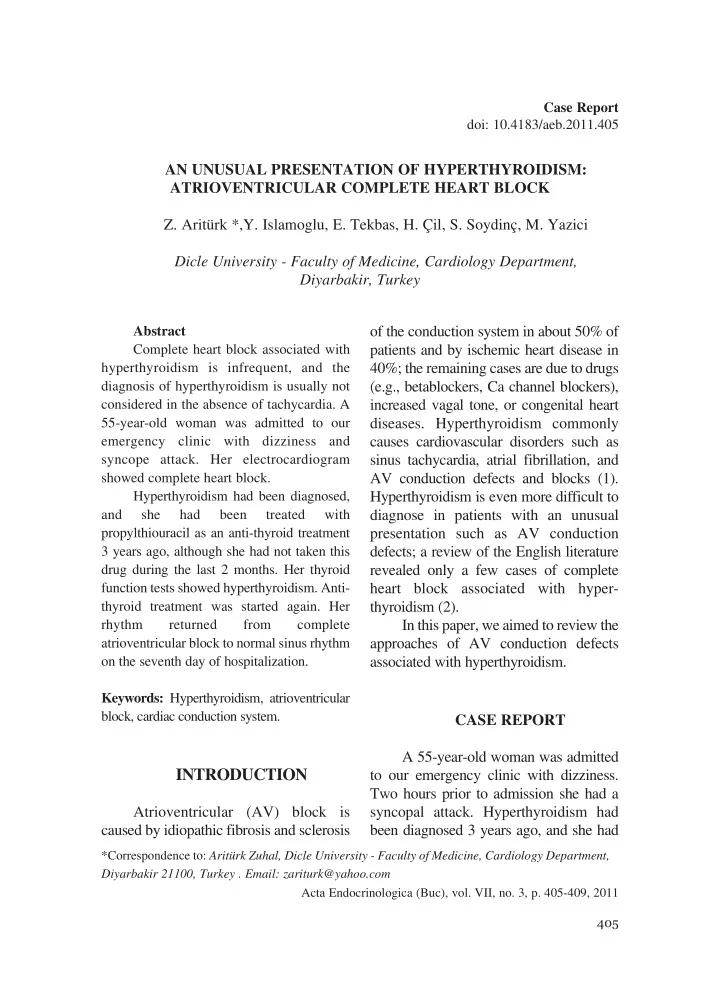
INTRODUCTION to our emergency clinic with dizziness. Two hours - - PDF document

introduction
SMART_READER_LITE
LIVE PREVIEW

INTRODUCTION to our emergency clinic with dizziness. Two hours - - PDF document

Case Report doi: 10.4183/aeb.2011.405 AN UNUSUAL PRESENTATION OF HYPERTHYROIDISM: ATRIOVENTRICULAR COMPLETE HEART BLOCK Z. Aritrk *,Y. Islamoglu, E. Tekbas, H. il, S. Soydin, M. Yazici Dicle University - Faculty of Medicine, Cardiology


slide-1
SLIDE 1

Abstract Complete heart block associated with hyperthyroidism is infrequent, and the diagnosis of hyperthyroidism is usually not considered in the absence of tachycardia. A 55-year-old woman was admitted to our emergency clinic with dizziness and syncope attack. Her electrocardiogram showed complete heart block. Hyperthyroidism had been diagnosed, and she had been treated with propylthiouracil as an anti-thyroid treatment 3 years ago, although she had not taken this drug during the last 2 months. Her thyroid function tests showed hyperthyroidism. Anti- thyroid treatment was started again. Her rhythm returned from complete atrioventricular block to normal sinus rhythm

  • n the seventh day of hospitalization.

Keywords: Hyperthyroidism, atrioventricular block, cardiac conduction system.

INTRODUCTION

Atrioventricular (AV) block is caused by idiopathic fibrosis and sclerosis

  • f the conduction system in about 50% of

patients and by ischemic heart disease in 40%; the remaining cases are due to drugs (e.g., betablockers, Ca channel blockers), increased vagal tone, or congenital heart

  • diseases. Hyperthyroidism commonly

causes cardiovascular disorders such as sinus tachycardia, atrial fibrillation, and AV conduction defects and blocks (1). Hyperthyroidism is even more difficult to diagnose in patients with an unusual presentation such as AV conduction defects; a review of the English literature revealed only a few cases of complete heart block associated with hyper- thyroidism (2). In this paper, we aimed to review the approaches of AV conduction defects associated with hyperthyroidism. CASE REPORT A 55-year-old woman was admitted to our emergency clinic with dizziness. Two hours prior to admission she had a syncopal attack. Hyperthyroidism had been diagnosed 3 years ago, and she had

405 *Correspondence to: Aritürk Zuhal, Dicle University - Faculty of Medicine, Cardiology Department, Diyarbakir 21100, Turkey . Email: zariturk@yahoo.com Acta Endocrinologica (Buc), vol. VII, no. 3, p. 405-409, 2011

AN UNUSUAL PRESENTATION OF HYPERTHYROIDISM: ATRIOVENTRICULAR COMPLETE HEART BLOCK

  • Z. Aritürk *,Y. Islamoglu, E. Tekbas, H. Çil, S. Soydinç, M. Yazici

Dicle University - Faculty of Medicine, Cardiology Department, Diyarbakir, Turkey

Case Report doi: 10.4183/aeb.2011.405

slide-2
SLIDE 2

been treated with propylthiouracil (PTU). She had stopped therapy 2 months earlier

  • n her own. In her anamnesis, she did not

report hyperthyroidism-related symptoms such as sweating or heat intolerance. Examination revealed a diffuse goiter. Her blood pressure was 120/80 mm Hg, but, surprisingly, her pulse rate was regular, at only 45 beats/min. She had been taking olmesartan 20 mg and hydrochlorothiazide 25 mg for the past 5 years. Examination

  • f

her cardiovascular system revealed heaving and displaced apex beat, and there was a systolic murmur at the left sternal edge radiating to the axilla. Her lungs were

  • clear. According to laboratory parameters,

her levels of myoglobin, troponin I, creatin kinase, and CK-MB were detected above normal ranges (70 ng/mL, 0.01 ng/mL, 148 U/L, and 3.4 ng/ml, respectively). She had a cholesterol level

  • f 241 mg/dL, triglyceride level of 321

mg/dL, low-density lipoprotein (LDL) level of 125 mg/dL, and high density lipoprotein (HDL) level of 52 mg/dL. Thyroid function tests confirmed hyper- thyroidism with a serum free triiodo- thyronine (FT3) level of 0.594 ng/dL (normal range 0.182–0.462), free thyroxin (FT4) level of 2.02 ng/dL (0.932–1.710), and thyrotropine (TSH) level of 0.005 IU/mL (0.270–4.200). Of note, the autoimmune thyroid antibodies were negative for both thyrotropin receptors and microsomes. Although there were no previous electrocardiograms for comparison, electrocardiography showed complete heart block (Fig. 1). A transthoracic echocardiogram revealed degenerative mitral valve and only moderate mitral valve insufficiency, good left ventricular systolic function, and left ventricular

  • hypertrophy. Enlarged thyroid glands

with multiple nodules were detected by thyroid ultrasonography. We did not consider a temporary transvenous pacemaker because

  • f

stable hemodynamical parameters. The patient was treated with PTU. Her rhythm returned from complete AV block to

  • A. Zuhal et al.

406

Figure 1. Electrocardiography showing complete heart block.

V1 V2 V3 V4 V6 V5 I II III aVR aVF aVL

slide-3
SLIDE 3

normal rhythm on the seventh day of hospitalization (Fig. 2). Coronary angiography was not considered because

  • f hyperthyroidism. Cardiac monitoring

showed sinus rhythm without any evidence of bradycardia or heart block in the following 5 days; subsequently, the patient underwent an uncomplicated subtotal thyroidectomy. DISCUSSION Over the last four decades, a review

  • f the literature has revealed only a few

cases of complete heart block associated with hyperthyroidism (3), with a female- to-male ratio of up to 2:1 and age range between 16 and 68 years (average of 43 years) (2,4). The diagnosis

  • f

hyperthyroidism is usually not considered in the absence of tachycardia and atypical

  • presentations. Ho et al. (4) presented a 16-

year-old girl with fever, Graves disease, and complete AV block. Although the heart block in this patient could have been a result of a focal myocarditis affecting the region around the AV node, the very rapid response to therapy suggested a metabolic etiology rather than myocardial necrosis (5). In the present case, the patient was 55 years old and receiving anti-hypertension treatment with normal lipid parameters. Considering the risk factors for cause AV block, acute ischemia, electrolyte imbalance and medication was not available. The clinical, electrophysiological, and biochemical abnormalities associated with thyrotoxicosis may be completely reversible, restoring the euthyroid state (5). Especially, rapid improvement of AV block with anti- thyroid medication give rise to thought

Atrioventricular block and hyperthyroidism 407

Figure 2. Electrocardiography showing return from complete AV block to normal rhythm on the seventh day of hospitalization.

I II III aVR aVF aVL V1 V2 V3 V4 V6 V5

slide-4
SLIDE 4

block may be due to hyperthyroidism. Topaloglu et al. (2) reported an electrophysiology study (EPS) performed in two cases. In the first case, they found that only AH interval (between the atrial electrogram and the His deflection) was prolonged, and

  • ther findings were normal.

In the second case, all findings were normal. According to this study (2), EPS is unnecessary for patients with heart block associated with hyperthyroidism. We thought that repolarization abnormalities in the electrocardiogram were due to left ventricular hypertrophy seen in echocardiography. In the light of this information, hyperthyroid patients must be followed up after anti-thyroid treatment. Interstitial inflammation of the AV node in a hyperthyroid patient with PR prolongation on electrocardiography has been reported (7). There was no previous syncope or near syncopal attacks in our paper, suggesting that a new AV block had developed due to sudden syncopal

  • attack. Osman F et al. (8) reported a 30-

year-old woman presenting subacute thyroiditis with 2:1 heart block. The exact cause of AV conduction abnormalities is unknown, but complete heart block associated with hyperthyroidism has generally been seen in patients with additional risk factors such as infectious diseases and mitral regurgitation (9-12). On top, T3 may also have an effect

  • n the myocardium and on a patient’s

electrophysiological function, specifically, the region of the AV node (13). Miller et

  • al. (3) had demonstrated that a failure to

recognize heart block due to thyrotoxicosis may result in morbidity and

  • mortality. As a possible cause of

mortality, thyrotoxicosis can lead to sudden death by cardiac arrhythmia and myocardial infarction (6). In conclusion, the AV nodal block may be reversible with the curing of the primary endocrine disease. Beta adrenergic blocking agents could aggravate an AV conduction disturbance; therefore, thyrotoxic patients should be carefully screened for electrocardio- graphic evidence

  • f

conduction disturbances before and during the administration of such drugs. The clinical, electrophysiological, and biochemical abnormalities associated with thyro- toxicosis may be completely reversible, restoring the euthyroid state. If the hemodynamic status is unstable, a temporary transvenous pacemaker may be considered.

References

  • 1. Stern MP, Jacobs RL, Duncan GW.

Complete heart block complicating

  • hyperthyroidism. JAMA 1970; 212: 2117-9.
  • 2. Topaloglu S, Topaloglu OY, Ozdemir O,

Soylu M, Demir AD, Korkmaz S. Hyperthyroidism and complete atrioventricular block-a report of 2 cases with electrophysiologic assessment. Angiology 2005, 56(2):217-220.

  • 3. Miller RH, Corcoran FH, Baker WP.

Second and third degree atrioventricular block with Graves’ disease: a case report and review of the literature. Pacing Clin Electrophysiol 1980, 3(6):702-711.

  • 4. HO, S.C., P.H. Eng, Z.P. Ding, A.C. Fok

and D.H. Thyroid storm presenting as jaundice and complete heart block. Ann Acad Med Singapore 27:748-751, 1998.

  • 5. Suresh Krishnamoorthy, Rajay Narain,

John Creamer. Unusual presentation of thyrotoxicosis as complete heart block and

  • A. Zuhal et al.

408

slide-5
SLIDE 5

renal failure: a case report. J. Med. Case

  • Rep. 2009, 3:9303.
  • 6. Ortmann C, Pfeiffer H, Du Chesne A,

Brinkmann B. Inflammation of the cardiac conduction system in a case

  • f
  • hyperthyroidism. Int J Legal Med 1999, 112

(4): 271-274.

  • 7. Surawitz B, Mangiardi ML. Electrocardio-

gram in endocrine and metabolic disorders. In: Rios JC, ed. Clinical electrocardio- graphic correlations. Philadelphia: FA Davis, 1977: 243.

  • 8. Osman F, Ayuk J, Dale J, Franklyn JA and

Gammage MD. Thyrotoxicosis with heart

  • block. J R Soc Med 2001, 94(7):346-348.
  • 9. Davis AC, Smith HL. Complete heart

block in hyperthyroidism following acute infections: a report of six cases with necropsy findings in one case. Am Heart J 1933; 9: 81-89.

  • 10. Sataline L, Donaghue G. Hypercalcemia,

heart-block and hyperthyroidism [Letter]. JAMA 1970; 213: 1342.

  • 11. Muggia A L, Stjernholm M, Houle T.

Complete heart block with thyrotoxic

  • myocarditis. N Engl Med J 1970; 283:1099-

1100.

  • 12. Eraker S A, Wickamasekaran R,

Goldman S. Complete heart block with

  • hyperthyroidism. JAMA 1978; 239:1644-6.
  • 13. Shirani J, Barron MM, Pierre-Louis ML,

Roberts WC. Congestive heart failure, dilated cardiac ventricles, and sudden death in hyperthyroidism. Am J Cardiol 1993, 72:365-368.

Atrioventricular block and hyperthyroidism 409